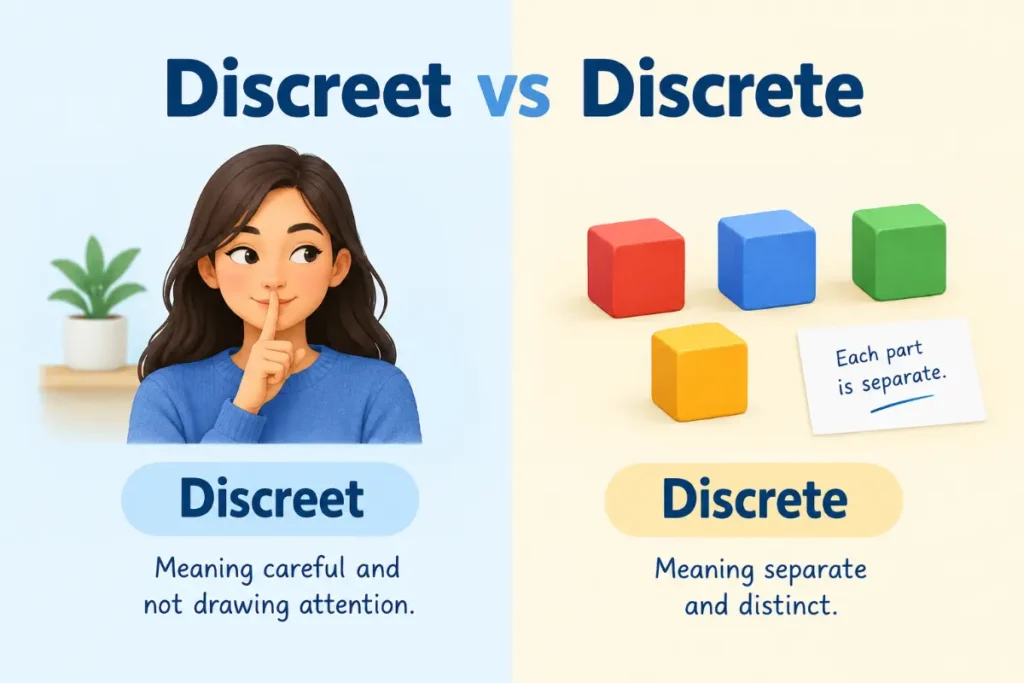
If you have ever hesitated over discreet vs discrete, you are not alone. The two words look almost identical, sound exactly the same in standard American English, and share the same historical roots. Yet they have different meanings and cannot normally be substituted for each other. Discreet describes someone or something that avoids attracting attention, protects private information, or shows good judgment. Discrete means separate, distinct, or individually identifiable.
That small spelling difference creates a surprisingly important difference in meaning. You might ask for a discreet conversation when you want privacy, but you might divide a dataset into discrete categories when you mean separate groups. Using the wrong form can change the meaning of a sentence completely.
This guide explains the distinction in plain American English, shows how each word works in real sentences, covers pronunciation and etymology, and explains common mistakes. By the end, you should be able to choose the right word quickly in emails, school assignments, workplace writing, technical documents, and everyday communication.
Quick Answer
Discreet means careful, private, tactful, or unlikely to attract attention. Discrete means separate, distinct, or individually different. Both words are pronounced /dɪˈskriːt/ in American English, so spelling and context are the key clues. Think discreet = privacy and discrete = separate.
Discreet vs Discrete at a Glance
The easiest way to understand the difference is to focus on what each word describes. Discreet is usually connected with behavior, communication, privacy, or avoiding attention. Discrete is connected with separation, individual units, categories, or things that can be distinguished from one another.
| Feature | Discreet | Discrete |
|---|---|---|
| Part of speech | Adjective | Adjective |
| Core meaning | Careful, tactful, private, unobtrusive | Separate, distinct, independent |
| Main idea | Avoiding attention or protecting information | Existing separately from something else |
| Common contexts | Conversations, questions, behavior, privacy | Categories, units, systems, data, groups |
| Tone | Usually neutral or professional | Often neutral, formal, academic, or technical |
| Pronunciation | /dɪˈskriːt/ | /dɪˈskriːt/ |
| Related word | Discretion | Discretely, discreteness |
| Opposite or contrast | Indiscreet | Continuous or connected, depending on context |
| Example | She was discreet about the matter. | The study divided participants into discrete groups. |
The spelling gives you a useful visual distinction: discreet has two e’s together after the r, while discrete has the familiar -crete ending. The meanings, however, are what matter most.
Understanding subtle spelling differences can help you avoid common stationery mistakes, especially when words sound alike but have completely different meanings.
What Does Discreet Mean?
Discreet is an adjective describing someone who is careful about what they say or do, especially when privacy, embarrassment, or sensitive information is involved. It can also describe something designed to avoid attracting attention.
For example, if a friend tells you something personal and you do not share it with anyone else, you are being discreet. If a hotel employee handles a sensitive situation quietly and professionally, the employee is being discreet.
Oxford defines discreet as being careful in what you say or do to keep something secret or avoid causing embarrassment or difficulty. Cambridge similarly connects the word with avoiding embarrassment or attracting too much attention.
The word can describe a person’s behavior:
- She was discreet about the details of the investigation.
- Please be discreet when discussing the patient’s information.
- He is discreet and trustworthy with confidential matters.
It can also describe an action or object that is deliberately unobtrusive:
- The camera was placed in a discreet location.
- She gave him a discreet signal to leave.
- The designer created a discreet logo for the product.
In these examples, the underlying idea is restraint. Something discreet does not call unnecessary attention to itself, and a discreet person knows when information should remain private.
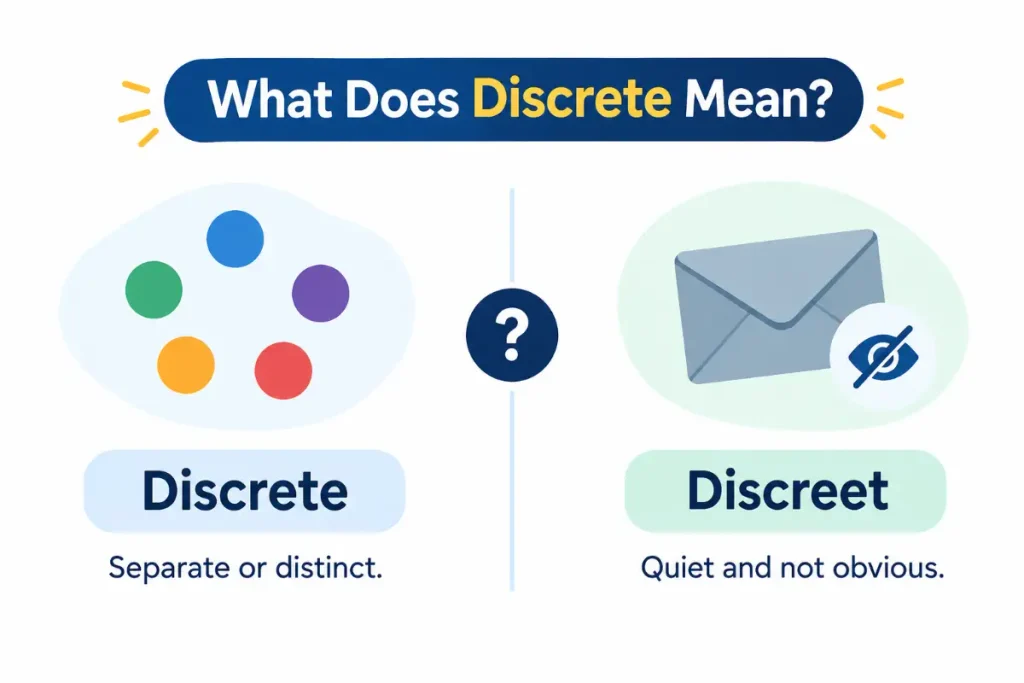
What Does Discrete Mean?
Discrete means separate, distinct, or individually identifiable. It is used when things exist as separate units rather than as one continuous whole.
For example, a company might divide its customers into discrete groups based on age or purchasing behavior. A researcher might study discrete categories of responses. A computer system might process discrete values rather than a continuous range.
Oxford describes discrete as separate and different from other things of the same type. The Oxford Advanced American Dictionary also marks the word as formal or related to technology in some uses.
Consider these examples:
- The survey divided respondents into four discrete categories.
- The machine has several discrete operating modes.
- The report identifies three discrete causes of the problem.
- Each department operates as a discrete unit.
Here, nothing is being kept secret. The point is separation.
A useful synonym is separate. If you can replace the word with separate and preserve the meaning, discrete is often the right choice.
The Key Difference Between the Two Words
The difference becomes much easier when you connect each word with a simple concept.
Discreet = careful about attention or information.
Discrete = separate from other things.
Imagine two situations.
You are having a private conversation with a coworker about a sensitive workplace issue. You want your coworker to be discreet.
Now imagine that a spreadsheet contains three separate categories of expenses: travel, equipment, and meals. Those are discrete categories.
The first situation concerns behavior and privacy. The second concerns separation and classification.
This distinction works in most everyday cases. If you are talking about a person, a conversation, a question, a gesture, or a way of handling sensitive information, discreet is often the appropriate choice. If you are talking about categories, units, groups, systems, values, or objects that are distinct from one another, discrete is usually the better choice.
Examples of Discreet in Sentences
The word discreet appears frequently in professional, personal, and formal communication. It often suggests tact, privacy, or a lack of unnecessary attention.
Here are varied examples:
- Please be discreet about the employee’s personal situation.
- She asked a few discreet questions before accepting the offer.
- The manager gave him a discreet warning during the meeting.
- We need a discreet way to discuss the complaint.
- He was discreet about his reasons for leaving the company.
- The receptionist made a discreet phone call to the supervisor.
- They chose a discreet location for the private meeting.
- She discreetly checked her phone during the long meeting.
- The photographer remained discreet throughout the ceremony.
- The hotel provided a discreet entrance for guests who wanted privacy.
Notice that these examples involve people, actions, communication, or settings where avoiding attention matters. The word does not necessarily mean completely secret. Something can be discreet simply because it is subtle or unobtrusive.
For example, a discreet design may still be visible. It is simply not loud, flashy, or attention-grabbing.
Examples of Discrete in Sentences
Discrete is especially common in academic, scientific, mathematical, business, and technical writing, although it also appears in everyday contexts.
Here are useful examples:
- The program divides the information into discrete categories.
- The building contains several discrete offices.
- Researchers analyzed the data as discrete variables.
- The system has five discrete settings.
- The neighborhood is divided into several discrete communities.
- Each department has a discrete budget.
- The experiment produced three discrete outcomes.
- The report identifies four discrete stages in the process.
- The company treats each product line as a discrete business unit.
- The survey uses discrete response options rather than a continuous scale.
The common thread is separation. Each category, group, unit, stage, or option can be identified as something distinct.
Common Mistakes With Discreet and Discrete
The most common mistake is using one spelling when the other meaning is intended. This happens because the words are pronounced the same and look nearly identical.
Mistake 1: Using Discrete for Privacy
Incorrect:
Please be discrete about this information.
Correct:
Please be discreet about this information.
The sentence concerns keeping information private, so discreet is the correct word.
Mistake 2: Using Discreet for Separate Categories
Incorrect:
The survey divides participants into discreet groups.
Correct:
The survey divides participants into discrete groups.
The groups are separate categories, so discrete is needed.
Mistake 3: Confusing a Discreet Location With a Discrete Location
Both phrases are possible, but they mean different things.
A discreet location is a place that does not attract attention or provides privacy.
A discrete location would mean a location considered as a separate or distinct unit. That wording is possible in technical or specialized contexts, but it is much less likely in ordinary conversation.
For example:
- We found a discreet location for the private meeting.
- The system records data from each discrete location separately.
The first emphasizes privacy. The second emphasizes separation.
Mistake 4: Confusing Discreet With Discretion
The noun discretion is closely related to discreet, not discrete.
You might say:
- I trust her discretion.
- He handled the matter with discretion.
- Use your discretion when deciding what to share.
In these sentences, discretion refers to careful judgment, especially when handling sensitive information. Oxford lists both the power to make decisions and the quality of being discreet among the meanings of discretion.
By contrast, discrete has related forms such as discretely and discreteness, which are associated with separation or distinctness.
Just as discreet and discrete have distinct meanings, learning to tell passed from past can make your writing more precise.
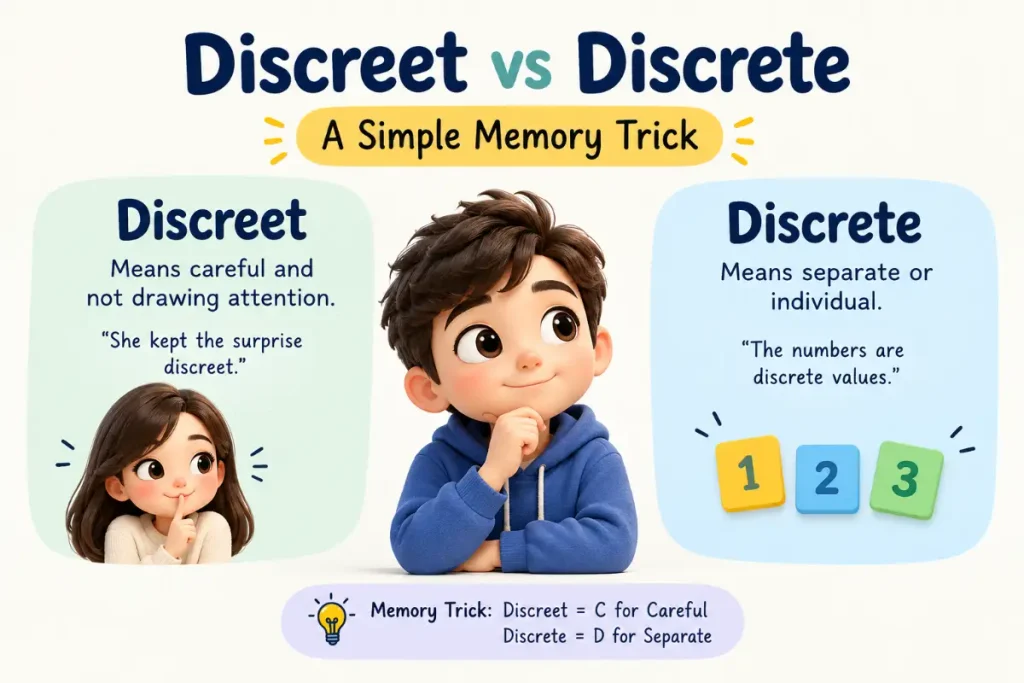
A Simple Memory Trick
If you frequently mix up these words, use this memory aid:
- Discreet has two e’s together, like a person who keeps information quietly between their ears.
- Discrete ends with te, and you can think of it as separate pieces or units.
Another simple approach is to remember:
Discreet = secret.
The two words do not mean the same thing, but the association can help you remember that discreet often involves privacy or avoiding attention.
For discrete, think distinct or separate.
- Discreet → private, tactful, unobtrusive
- Discrete → separate, distinct, individual
When you are unsure, replace the word mentally.
If private, tactful, or unobtrusive fits, choose discreet.
If separate, distinct, or individual fits, choose discrete.
Discreet and Discrete in Professional Writing
Both words are useful in professional writing, but they appear in very different situations.
Discreet is appropriate when writing about confidentiality, workplace behavior, customer privacy, sensitive conversations, or subtle actions.
For example:
- Please be discreet when discussing the customer’s complaint.
- The HR representative handled the matter discreetly.
- We need a discreet way to contact the client.
In these cases, the word communicates professionalism and restraint.
Discrete is more common when professional writing discusses categories, departments, systems, processes, data, or separate units.
For example:
- The report separates the expenses into discrete categories.
- Each team is responsible for a discrete portion of the project.
- The software stores the values as discrete data points.
In technical or academic writing, discrete can be especially important because it expresses a specific relationship between separate units.
Discreet and Discrete in Everyday Conversation
In casual conversation, discreet is more likely to appear when someone is talking about privacy or avoiding attention.
You might say:
- Can you be discreet about this?
- I need you to be discreet.
- She was very discreet about the situation.
- Let’s find a discreet place to talk.
These expressions are natural and familiar.
Discrete is less common in ordinary conversation because it often belongs to more formal or specialized vocabulary. Still, people use it when discussing clearly separate things.
For example:
- The two issues are discrete problems.
- The app has discrete settings for each user.
- Those are two discrete groups.
In everyday speech, separate might sound more natural than discrete in many of these situations. The word is not wrong; it simply has a more formal or technical feel in many contexts.
Pronunciation of Discreet and Discrete
One reason this pair causes so much confusion is that discreet and discrete are pronounced the same in standard American English.
Both are pronounced:
/dɪˈskriːt/
A simple pronunciation guide is:
dih SKREET
The stress falls on the second syllable. Cambridge lists the same US pronunciation for both words.
Because the pronunciation does not help you distinguish them, you must rely on spelling and context when writing.
This also explains why people sometimes choose the wrong spelling in emails, reports, or other written communication. Someone may know exactly which meaning they want but still write the wrong form because both words sound identical.
The related adverbs also remain easy to confuse:
- discreetly means in a careful or unobtrusive way.
- discretely means separately or as distinct units.
For example:
She discreetly left the room.
This means she left without attracting attention.
The components were analyzed discretely.
This means they were analyzed separately.
Word Origin and Etymology
The similarity between these words is not accidental. Discreet and discrete have closely connected historical roots and ultimately trace back to Latin.
Oxford gives discreet as coming through Middle English and Old French from Latin discretus, meaning separate, with a connection to discernere, meaning to distinguish or separate. The modern sense developed through the idea of discernment and good judgment.
Discrete also comes from Latin discretus, meaning separate. Its modern English sense preserves that idea more directly: something that is separate, distinct, or individually identifiable.
This shared history helps explain why the words are so similar in spelling and pronunciation while having related but distinct meanings.
The modern meanings have gradually moved in different directions. Discrete retained the idea of separation, while discreet became associated with careful judgment, tact, privacy, and restraint.
Discreet vs Discrete in American English
There is no major American versus British spelling difference between these two words. Discreet and discrete are standard forms in both varieties of English.
The important issue is not regional spelling but meaning.
American English uses discreet for careful, tactful, or unobtrusive behavior:
The employee was discreet when handling the complaint.
American English uses discrete for things that are separate or distinct:
The report contains data from five discrete categories.
Oxford’s American English dictionary gives the same core distinction. It defines discreet in terms of careful behavior and privacy, while discrete refers to things that have an independent existence or form apart from similar things.
So if you are writing for a US audience, you do not need to choose between an American and British spelling. You need to choose between two different words.
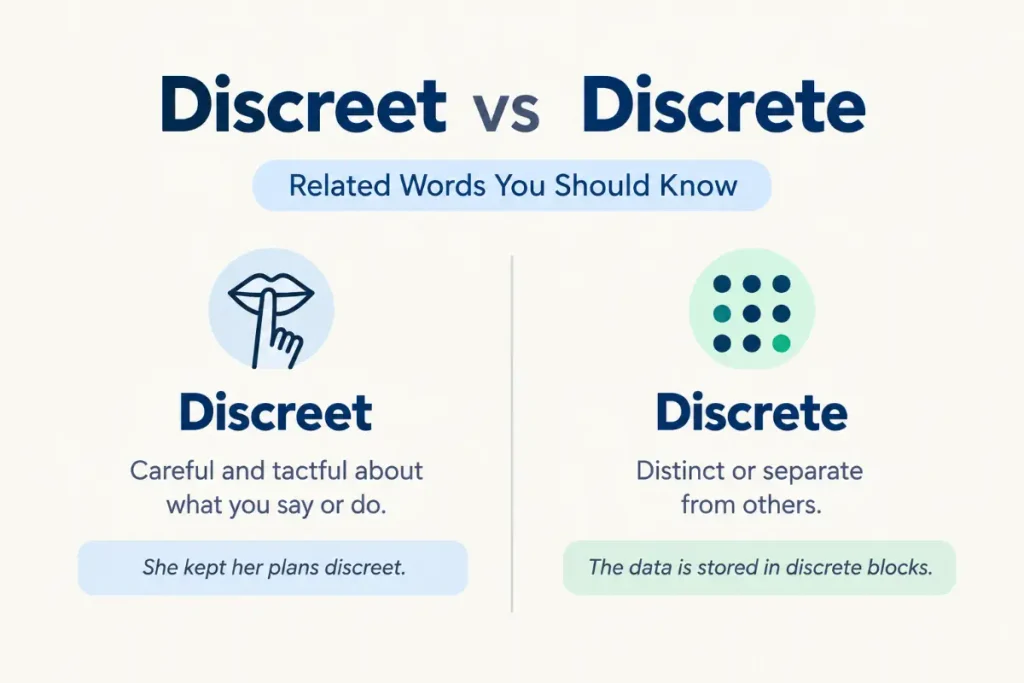
Related Words You Should Know
Understanding the related forms can make the distinction easier to remember.
Discretion
Discretion is the noun associated with discreet. It can refer to careful judgment or the ability to decide what is appropriate, and it can also refer to care in handling sensitive information.
She handled the confidential matter with discretion.
Indiscreet
Indiscreet means not careful about what you say or do, particularly when you reveal something private or embarrassing.
His indiscreet comment revealed information that was supposed to remain private.
This provides a useful opposite pair:
discreet ↔ indiscreet
Discretely
Discretely means separately or as distinct units.
The researchers examined each variable discretely.
Discreteness
Discreteness is the noun form connected with the quality of being separate or distinct.
It is most likely to appear in technical, mathematical, scientific, or academic writing.
How to Choose the Right Word
When editing your sentence, ask what you are trying to communicate.
Use discreet when the sentence involves:
- Privacy
- Confidential information
- Tact
- Sensitive subjects
- Avoiding embarrassment
- Avoiding attention
- Quiet or unobtrusive behavior
- Careful communication
Use discrete when the sentence involves:
- Separate groups
- Distinct categories
- Individual units
- Independent components
- Separate stages
- Distinct values
- Data categories
- Technical systems
For example, compare these two sentences:
The assistant made a discreet inquiry about the complaint.
The inquiry was tactful and careful.
The system recorded the complaint as a discrete data point.
The complaint was treated as an individual, separate unit of data. The spelling changes only slightly, but the meaning changes substantially.
Similar confusion can arise with other commonly mixed-up words, so knowing how council and counsel are used can help you choose the right term in context.
Frequently Asked Questions
Which is correct, discreet or discrete?
Both discreet and discrete are correct English words, but they have different meanings. Discreet means careful, tactful, private, or unobtrusive. Discrete means separate, distinct, or individually identifiable. Choose the spelling based on the meaning you need, not on pronunciation.
What does discreet mean?
Discreet means careful about what you say or do, especially when protecting private information or avoiding attention. It can describe a person, action, question, conversation, or object. For example, Please be discreet about the situation means you should handle the information carefully and avoid sharing it unnecessarily.
What does discrete mean?
Discrete means separate, distinct, or independent from other similar things. It is common in academic, scientific, mathematical, business, and technical contexts. For example, The data were divided into discrete categories means the data were organized into separate groups.
Are discreet and discrete pronounced the same?
Yes. In standard American English, both discreet and discrete are pronounced /dɪˈskriːt/. Because they sound the same, spelling is especially important when writing. Context also helps determine which word is appropriate.
Is discreet related to discretion?
Yes. Discreet and discretion are closely related words. Discretion is a noun that can describe careful judgment or care in handling private or sensitive matters. For example, I trust her discretion means you trust her to make sensible decisions about what to say or do.
Is discrete the opposite of discreet?
No. They are not opposites. Discreet concerns tact, privacy, and avoiding attention, while discrete concerns separation and distinctness. The opposite of discreet can be indiscreet. The contrasting concept for discrete depends on context and may be something continuous, connected, or not separately identifiable.
How can I remember the difference?
A useful memory trick is discreet = secret because both are associated with privacy. For discrete, think distinct or separate. If you mean someone is careful with private information, use discreet. If you mean things are separate from one another, use discrete.
Which word should I use in a professional email?
Use discreet when you are asking someone to handle sensitive information privately or tactfully, such as Please be discreet about this matter. Use discrete when discussing separate categories, units, stages, or components, such as The report contains three discrete sections. The context determines the correct choice.
Conclusion
The difference between discreet vs discrete comes down to two simple ideas. Discreet describes careful, tactful, private, or unobtrusive behavior. Discrete describes things that are separate, distinct, or individually identifiable.
The words are easy to confuse because they look almost identical and are pronounced exactly the same in American English. Still, their meanings are clearly different. When privacy or avoiding attention is the point, choose discreet. When separation or distinct units is the point, choose discrete.
A quick memory aid can help: discreet is connected with being careful and private, while discrete is connected with being separate and distinct. Once you connect each spelling with its core meaning, choosing the right form becomes much easier.