If you are trying to understand bear vs bare, the key is simple: bear usually refers to an animal or means to carry, endure, or tolerate something, while bare means uncovered, exposed, empty, or basic. The two words sound the same in American English, which makes them easy to confuse in writing, but their meanings and grammatical roles are very different. For example, you can bear the pain, but you can have bare feet. You can also bear with me when asking someone to be patient, while bare with me changes the meaning completely. This guide explains the difference between these homophones, shows how each word works in real sentences, and clears up common phrases such as bear with me, bear the pain, and I cannot bear it. You will also see their pronunciation, grammar, origins, common mistakes, and practical examples for everyday and professional writing.
Quick Answer
Bear and bare sound alike in American English but have different meanings. Bear can mean an animal, to carry, support, endure, or tolerate something. Bare means uncovered, exposed, empty, or basic. Use bear with me when asking someone to be patient, and bare when describing something without covering.
Bear vs Bare At a Glance
| Feature | Bear | Bare |
|---|---|---|
| Main meanings | An animal; to carry, endure, support, or tolerate | Uncovered, exposed, empty, or basic |
| Part of speech | Noun and verb | Mainly adjective and verb |
| Pronunciation in US English | /ber/ | /ber/ |
| Sound | Same as bare | Same as bear |
| Common phrase | Bear with me | Bare feet |
| Another common phrase | Bear the pain | Bare minimum |
| Past form as a verb | Bore | Bared |
| Past participle | Borne or born in specific uses | Bared |
| US usage | Standard | Standard |
| Main confusion | Often confused with bare in phrases | Often confused with bear in phrases |
The important point is that pronunciation cannot help you distinguish these words in American speech. Context and meaning do the work instead. Oxford identifies bear and bare as homophones, and its American dictionary gives the US pronunciation of bear as /bɛr/. Cambridge likewise lists both words with the same US pronunciation, /ber/.
Understanding the difference between discreet and discrete can also help avoid another common pair of easily confused words, much like bear and bare.
What Does Bear Mean?
Bear has several meanings, and its grammatical role changes depending on the sentence. As a noun, it can refer to the large furry animal. As a verb, it can mean to carry, support, endure, tolerate, produce, or have a particular quality or relationship.
The verb is especially important in everyday English. When someone says I cannot bear the noise, they mean they cannot tolerate it. When someone says She bore the responsibility alone, the meaning is that she carried or endured that responsibility.
Oxford lists bear as a verb meaning to accept or deal with something unpleasant, especially in expressions such as bear the pain and cannot bear it. Its verb forms include bear, bore, and borne.
Common meanings include:
- An animal: We saw a black bear near the trail.
- To tolerate: I cannot bear that noise.
- To endure: He had to bear the pain.
- To carry or support: The bridge can bear the weight of several trucks.
- To produce: The tree will bear fruit in the summer.
- To have or show: The document bears her signature.
- To be connected with: The two ideas bear some relation to each other.
These meanings may look unrelated at first, but they come from a long history of the word being associated with carrying, supporting, producing, and enduring.
What Does Bare Mean?
Bare describes something that is not covered, protected, decorated, or filled. It can describe a person’s body, a surface, a room, a landscape, or even an amount that is only just enough.
For example, bare feet are feet without shoes or socks, while bare walls have little or nothing covering them. A bare room may have very little furniture, and the bare minimum means the smallest amount necessary.
Cambridge defines the adjective bare as meaning without clothes or without a covering. It also gives meanings related to something being empty or containing only the smallest amount needed.
Common uses include:
- Not covered: She walked across the sand with bare feet.
- Exposed: The tree had bare branches.
- Empty: The shelves were almost bare.
- Basic: We had only the bare essentials.
- Minimum: He did the bare minimum required.
- Without decoration: The room had bare walls.
Bare can also function as a verb. To bare something means to uncover or expose it. For example, The dog bared its teeth means the dog exposed its teeth, usually as a sign of aggression.
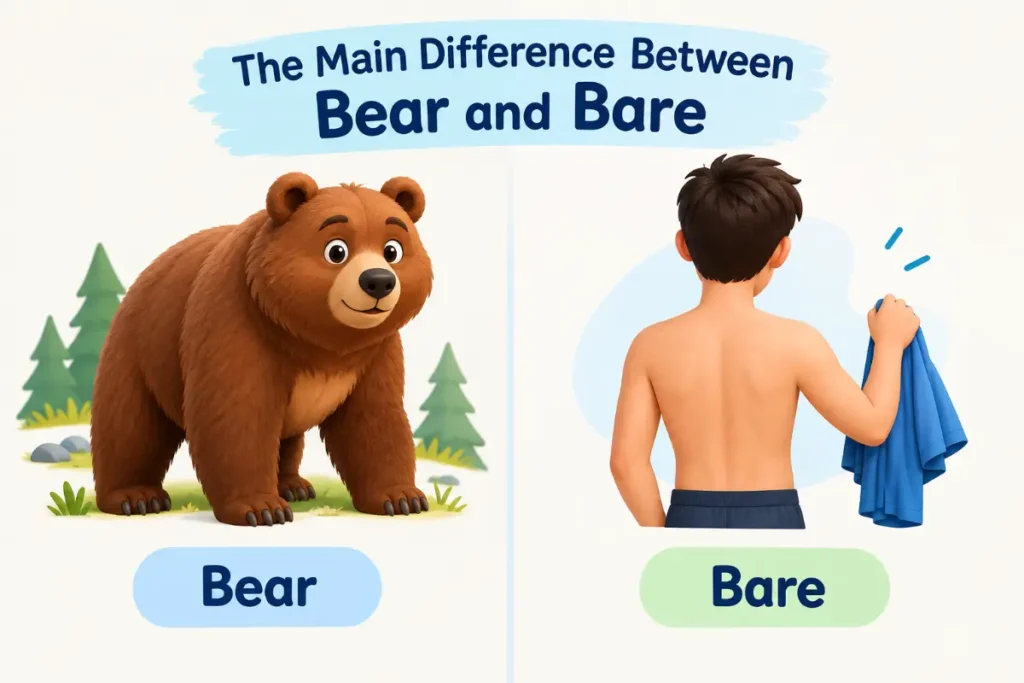
The Main Difference Between Bear and Bare
The easiest way to remember the distinction is to connect each word with its core idea.
Bear is about carrying, enduring, supporting, or the animal.
Bare is about removing or lacking a covering.
Consider these examples:
- I cannot bear the pain.
- The wound left his arm bare.
- Please bear with me for a moment.
- She walked outside with bare feet.
- The bridge can bear a heavy load.
- The room was almost bare.
The pronunciation is not a useful clue because the words are homophones in standard American English. That means they have different spellings and meanings but the same pronunciation. Oxford specifically lists bare and bear as homophones.
A useful memory trick is:
Bear = carry or endure.
Bare = uncovered or empty.
This will help with most everyday situations.
Bear With Me or Bare With Me
The correct phrase is bear with me when you are asking someone to be patient.
Bear with me means something like please be patient with me or please give me a little time while I finish or explain something.
Examples include:
- Please bear with me while I check your account.
- Bear with me for a moment while I find the right document.
- Thanks for bearing with me while I fixed the problem.
- Please bear with me as I explain what happened.
The phrase uses bear because the underlying idea is tolerating or enduring something. You are essentially asking another person to tolerate a delay, explanation, inconvenience, or temporary difficulty.
Bare with me is generally not the phrase you want in this situation. Since bare means uncovered or exposed, changing bear to bare changes the meaning and can produce an unintended sentence.
This is one of the most common bear and bare mistakes because the words sound identical when spoken.
Bear the Pain or Bare the Pain
The correct expression is bear the pain.
Here, bear is a verb meaning to endure or tolerate something difficult. You can therefore say:
- I do not know how she managed to bear the pain.
- He tried to bear the pain without complaining.
- The medication helped him bear the pain.
- She could barely bear the pain after the injury.
Bare the pain does not normally express this meaning. Bare is connected with exposing or uncovering something, not enduring it.
The same rule applies to other forms of emotional or physical difficulty:
- I cannot bear the pressure.
- She could not bear the thought of leaving.
- He had to bear the responsibility.
- They were forced to bear the consequences.
Oxford gives examples of bear meaning to accept or deal with something unpleasant, including pain and difficult thoughts.
I Cannot Bear It or I Cannot Bare It
The correct expression is I cannot bear it.
This means I cannot tolerate it, I cannot endure it, or I find it too difficult to accept.
Examples:
- I cannot bear it when people argue over small things.
- She could not bear it any longer.
- I cannot bear it when the alarm keeps ringing.
- He could not bear the thought of losing his job.
The verb bear commonly appears with can, could, cannot, and could not when describing someone’s ability to tolerate something. Oxford specifically notes this use with negative sentences and questions.
By contrast, bare it would involve the verb bare, meaning to uncover or expose something. It does not normally make sense in the phrase I cannot bare it.
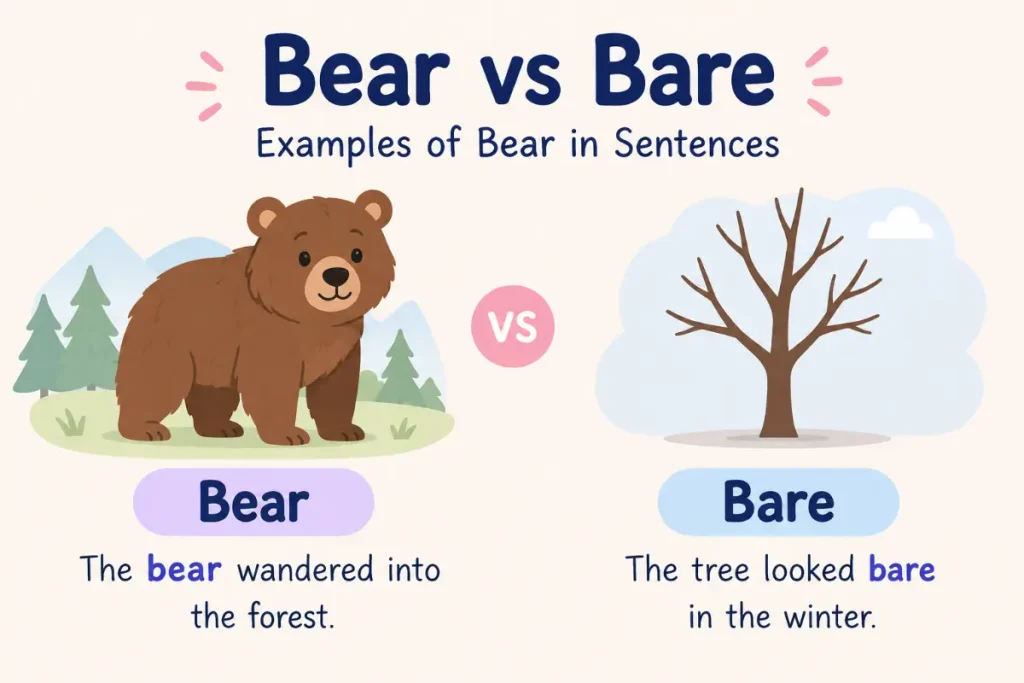
Examples of Bear in Sentences
Because bear has several meanings, it is useful to see the word in different contexts. The following examples show how the verb and noun work naturally in American English.
Bear as an Animal
- We saw a bear while hiking in the mountains.
- The zoo has several black bears.
- The mother bear stayed close to her cub.
- A bear wandered into the campground at night.
In these sentences, bear is a noun referring to the animal.
Bear Meaning Tolerate
- I cannot bear the smell of burnt coffee.
- She could not bear the suspense.
- He cannot bear being late.
- I could hardly bear to watch the final scene.
This meaning is especially common after can, could, cannot, and could not.
Bear Meaning Carry or Support
- This shelf can bear a surprising amount of weight.
- The bridge was designed to bear heavy loads.
- The responsibility was difficult to bear.
- She had to bear the cost herself.
Here, the idea is carrying or supporting a physical or figurative burden.
Bear in Other Expressions
- The company bears the cost of shipping.
- His work bears his name.
- The evidence bears no relation to the claim.
- The tree will bear fruit next year.
These uses show why bear cannot be reduced to the meaning of the animal.
Examples of Bare in Sentences
Bare also works in several different contexts. Its central idea is the absence of a covering, decoration, or excess.
Bare Meaning Uncovered
- She walked across the room in bare feet.
- His bare arms were covered in dust.
- The child had bare legs despite the cold weather.
- The hikers rested their bare feet beside the fire.
Bare Meaning Without a Covering
- The workers exposed the bare floorboards.
- The walls were completely bare.
- The winter trees had bare branches.
- The wires were bare and needed protection.
Bare Meaning Empty or Basic
- The refrigerator was almost bare.
- The apartment had bare walls and little furniture.
- We had only the bare essentials.
- The report contained the bare facts.
- They had enough money to cover the bare minimum.
Oxford describes these uses of bare as including uncovered body parts, surfaces without protection, empty rooms or cupboards, and the most basic or simple amount of something.
Common Bear and Bare Mistakes
Because the words sound the same, spelling mistakes often happen when people rely on memory of pronunciation instead of meaning. The best correction method is to look at the role the word plays in the sentence.
Mistake 1: Bare With Me
Incorrect: Bare with me while I check the information.
Correct: Bear with me while I check the information.
The correct phrase asks someone to be patient.
Mistake 2: Bare the Pain
Incorrect: She tried to bare the pain.
Correct: She tried to bear the pain.
Here, the intended meaning is to endure pain.
Mistake 3: I Cannot Bare It
Incorrect: I cannot bare it anymore.
Correct: I cannot bear it anymore.
The sentence means that the speaker cannot tolerate the situation.
Mistake 4: Bear Feet
Incorrect: He walked across the beach with bear feet.
Correct: He walked across the beach with bare feet.
The feet are uncovered, so bare is correct.
Mistake 5: Bare the Cost
Incorrect: The company will bare the cost.
Correct: The company will bear the cost.
The company will carry or accept the financial responsibility.
A quick meaning check usually catches these errors. Ask yourself: Am I talking about carrying or enduring something, or am I talking about something being uncovered or empty?
Bear and Bare Pronunciation
In American English, bear and bare are pronounced the same way. Cambridge gives the US pronunciation of both words as /ber/.
This makes them true homophones for most American speakers. You cannot normally tell from hearing the word alone which spelling the speaker intends.
The difference becomes visible when the word is written:
- bear /ber/
- bare /ber/
For learners, this is an important distinction. English contains many homophones that sound identical but have different spellings and meanings. Bear or bare belong to that group.
The British pronunciation is also the same between the two words, although dictionaries represent it differently from the American pronunciation. Cambridge lists /beər/ for the UK pronunciation.
Just as bear and bare have different meanings despite sounding alike, another commonly confused word pair is elicit and illicit.
Bear Grammar and Verb Forms
When bear is used as a verb, its forms can be confusing because the past tense is not beared.
The main forms are:
| Form | Example |
|---|---|
| Base form | I cannot bear the noise. |
| Third person | She bears the responsibility. |
| Past tense | He bore the burden alone. |
| Past participle | The cost was borne by the company. |
| Present participle | She is bearing a heavy responsibility. |
Oxford lists bore as the past tense and borne as the past participle for the verb.
There is an important distinction between borne and born. Born is used in the context of birth, as in She was born in Texas. Borne is used for other meanings of the verb, such as carrying or enduring something.
For example:
- The company bore the expense.
- The company has borne the expense.
- She was born in Chicago.
The spelling changes because these are different grammatical uses.
Bare Grammar and Verb Forms
Bare is mainly an adjective, but it can also be a verb.
As an adjective, it describes something uncovered, exposed, empty, or basic:
- bare feet
- bare walls
- bare branches
- bare necessities
- bare minimum
As a verb, bare means to uncover or expose something. Its forms are straightforward:
| Form | Example |
|---|---|
| Base form | The dog may bare its teeth. |
| Third person | The dog bares its teeth. |
| Past tense | The dog bared its teeth. |
| Past participle | The teeth were bared. |
| Present participle | The dog was baring its teeth. |
Do not confuse bare with bear when forming the past tense. Bared is correct for the verb meaning exposed, while bore is the past tense of the verb bear.
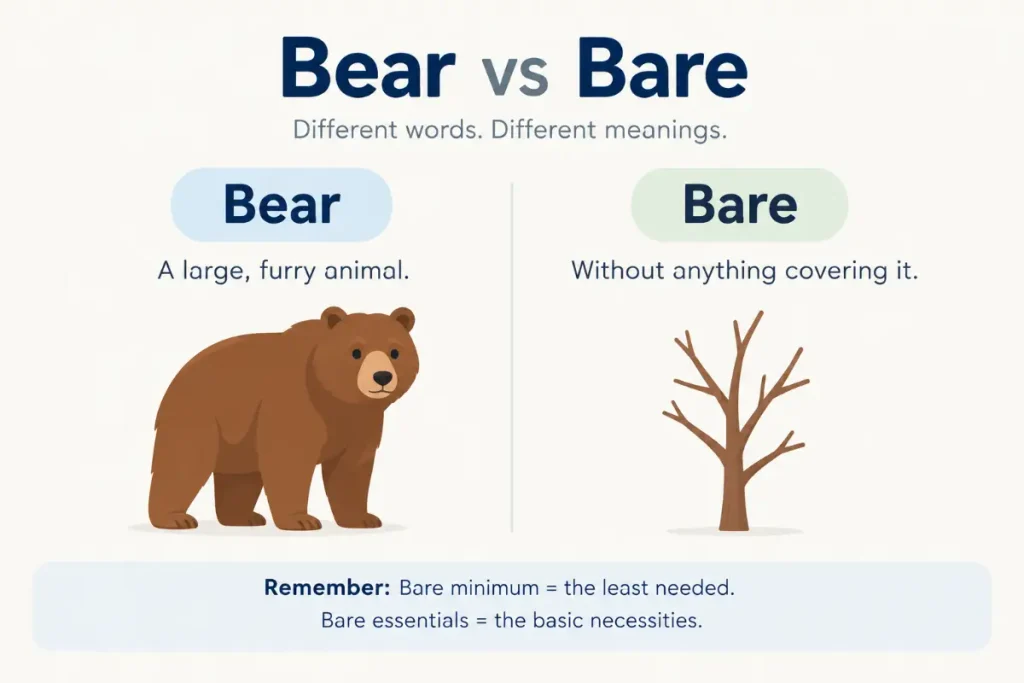
Bare Minimum and Bare Essentials
Several common expressions use bare because they refer to the smallest amount needed.
The bare minimum means the least amount required.
- He did the bare minimum to complete the assignment.
- We need the bare minimum of equipment.
- The application requires only the bare minimum of information.
The bare essentials means only the most necessary things.
- We packed the bare essentials for the trip.
- The emergency kit contains the bare essentials.
- The apartment had only the bare essentials.
These expressions make sense if you remember that bare can mean basic, stripped down, or without anything extra. Oxford’s American dictionary specifically describes bare as meaning the most basic or simple, with nothing extra.
Bare Your Teeth and Bare Your Soul
Bare appears in several established expressions.
To bare your teeth means to expose your teeth, often as a threatening or aggressive gesture.
- The dog bared its teeth when the stranger approached.
- The animal bared its teeth and growled.
To bare your soul means to reveal your deepest or most private feelings.
- She finally bared her soul to her closest friend.
- He was reluctant to bare his soul in public.
Both expressions use bare because something that is normally hidden is being exposed. Oxford lists both bare your teeth and bare your soul as established expressions.
Formal and Casual Usage
Both bear and bare are standard English words and can appear in formal, professional, academic, and casual writing. The important issue is not formality but meaning.
Bear is especially common in formal expressions involving responsibility, cost, pressure, or consequences:
- The contractor will bear the cost.
- The organization must bear responsibility for the decision.
- The company cannot bear the financial burden indefinitely.
It is also common in everyday conversation:
- I cannot bear that song.
- Please bear with me.
- I can barely bear to watch.
Bare is equally normal in everyday and professional writing:
- The room had bare walls.
- The report included the bare facts.
- The budget covers only the bare essentials.
The key is to choose based on meaning rather than perceived formality.
American English Usage
There is no spelling difference between American and British English for these two words. Bear and bare are standard forms in both varieties.
Some meanings and expressions can vary by region, but the central distinction remains the same:
- Bear means an animal or can mean carry, endure, support, or tolerate.
- Bare means uncovered, exposed, empty, or basic.
There is one regional detail worth knowing: bare has an additional slang use in British English where it can function as an intensifier meaning very or a lot. Cambridge labels these uses as UK slang, and Oxford also identifies this adverbial use as British slang. This meaning is not standard American English.
For US readers, the ordinary adjective and verb meanings are the ones that matter most.
Bear or Bare Which One Should You Use?
Use bear when the sentence involves carrying, enduring, tolerating, supporting, producing, or the animal.
Use bare when the sentence involves something uncovered, exposed, empty, plain, or reduced to the minimum.
A quick decision guide can make the choice easier:
- Can I tolerate it? Use bear.
- Do I need to carry or support it? Use bear.
- Am I talking about the animal? Use bear.
- Is something uncovered? Use bare.
- Is something empty or lacking decoration? Use bare.
- Does something mean only the minimum? Use bare.
- Am I asking someone to be patient? Use bear with me.
For professional writing, the safest approach is to pause when you encounter a phrase that sounds like bear or bare. Think about the meaning first, then choose the spelling.
If you’re learning to distinguish similar-sounding terms, knowing how emigrate and immigrate differ can make your writing more precise.
Frequently Asked Questions
Is bear with me or bare with me correct?
Bear with me is the correct expression when you are asking someone to be patient. It means to tolerate or wait through a temporary inconvenience, explanation, or delay. Bare with me is not the standard expression for this meaning because bare means uncovered or exposed.
Is it bear the pain or bare the pain?
Bear the pain is correct. The verb bear means to endure or tolerate something difficult, so bear the pain means to endure the pain. Bare the pain does not normally express this meaning.
What is the difference between bear and bare?
Bear can mean an animal or can function as a verb meaning to carry, support, endure, or tolerate something. Bare usually describes something uncovered, exposed, empty, or basic. The words sound the same in American English but have different meanings and spellings.
Is I cannot bear it correct?
Yes. I cannot bear it is grammatically correct and means I cannot tolerate it or I cannot endure it. The phrase is common when someone finds a situation, feeling, sound, or experience extremely difficult to tolerate.
Are bear and bare homophones?
Yes. Bear and bare are homophones because they have the same pronunciation but different spellings and meanings. Cambridge gives both words the US pronunciation /ber/.
What does bare mean in bare minimum?
In bare minimum, bare means the smallest or most basic amount needed. The expression refers to doing or providing only what is necessary, without anything extra. For example, She did the bare minimum required to finish the assignment means she did only what was necessary.
What is the past tense of bear?
The past tense of bear is bore. The past participle is usually borne, while born is used specifically in contexts involving birth. For example, He bore the responsibility alone and The cost was borne by the company use the verb meaning to carry or endure.
What is the past tense of bare?
The past tense of bare is bared. It means exposed or uncovered. For example, The dog bared its teeth means that the dog exposed its teeth. This is different from bore, which is the past tense of bear.
Conclusion
The difference between bear vs bare becomes much easier once you focus on meaning instead of sound. Bear can refer to an animal or describe carrying, supporting, enduring, tolerating, or producing something. Bare describes something uncovered, exposed, empty, plain, or reduced to the essentials. Because both words sound alike in American English, spelling mistakes are common, especially in phrases such as bear with me, bear the pain, and I cannot bear it. Remember the basic distinction: bear is connected with carrying or enduring, while bare is connected with being uncovered or lacking something. When you are unsure, look at what the sentence means rather than how the word sounds.