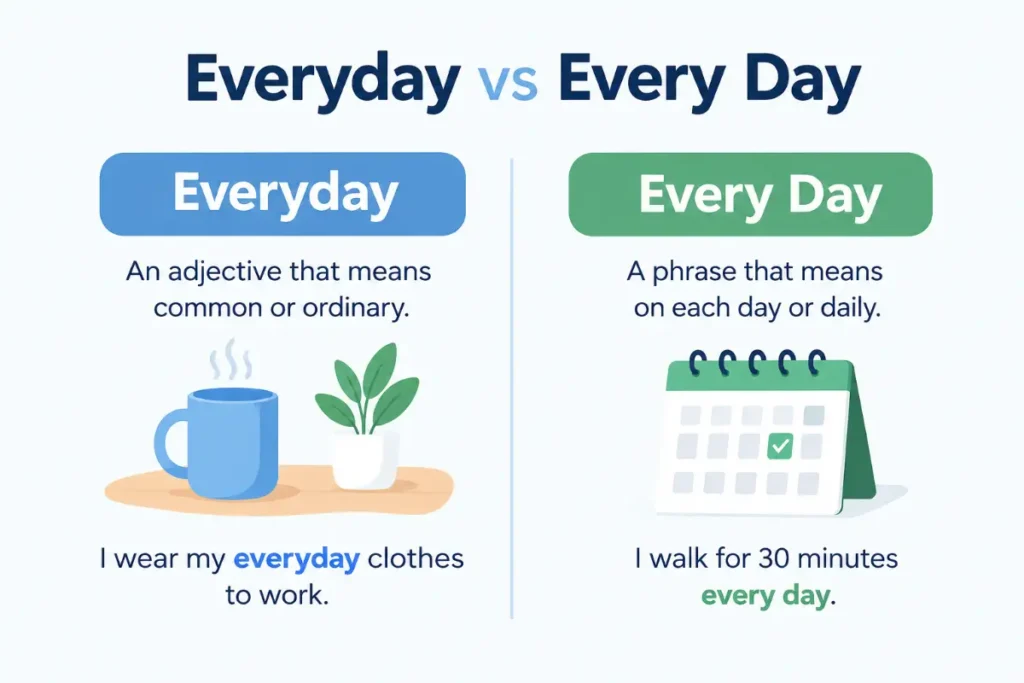
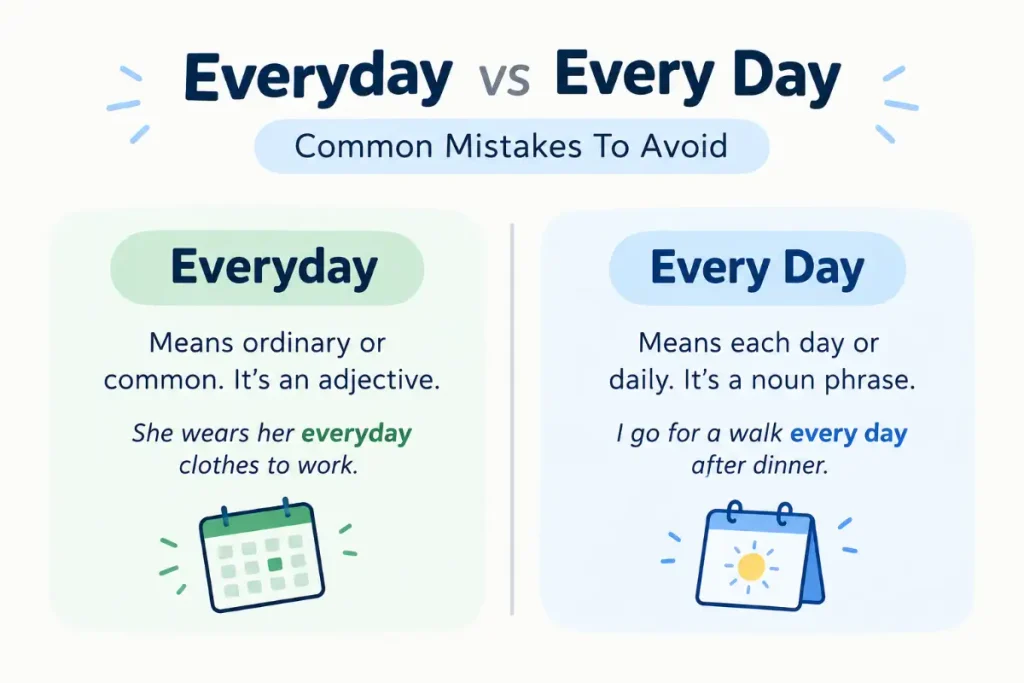
If you are unsure about everyday vs every day, the difference comes down to grammar and meaning. Everyday is one word and works as an adjective meaning ordinary, usual, or routine. Every day is two words and means each day or daily. The forms look almost identical, and they sound very similar in ordinary speech, so it is easy to mix them up in writing.
The easiest way to choose the right form is to look at what the expression is doing in the sentence. If you are describing a noun, you usually need everyday. If you are describing how often something happens, you usually need every day. Compare these two sentences:
- These are my everyday shoes.
- I wear these shoes every day.
The first describes the shoes. The second tells us how often they are worn.
This distinction becomes much easier once you learn a simple replacement test. You can usually replace everyday with “ordinary” or “usual,” while every day can usually be replaced with “each day.” The examples, grammar rules, and practical usage below will help you make the correct choice naturally.
Quick Answer
Everyday is one word when it means ordinary, usual, or routine and describes a noun. Every day is two words when it means each day and describes how often something happens. Use “ordinary” as a test for everyday and “each day” as a test for every day.
The Main Difference Between The Two Forms
The most important difference is grammatical. Everyday is an adjective. It describes a person, place, thing, activity, situation, or concept, and it commonly appears directly before a noun. Examples include:
- everyday clothes
- everyday problems
- everyday life
- everyday activities
- everyday language
- everyday expenses
In each case, the word describes the noun that follows it. “Everyday clothes” means ordinary clothes suitable for normal use, and “everyday problems” means ordinary or routine problems.
Every day, by contrast, is a phrase made from two separate words. It means each day or on each day, and it normally functions as an adverbial phrase that tells us how often an action or event happens. Examples include:
- I exercise every day.
- She calls her mother every day.
- We check the schedule every day.
- He reads before bed every day.
- They practice every day.
In these sentences, the phrase tells us the frequency of an action. It answers the question “How often?” rather than “What kind?”
A useful comparison is:
| Feature | Everyday | Every day |
|---|---|---|
| Spelling | One word | Two words |
| Main grammatical role | Adjective | Adverbial phrase |
| Basic meaning | Ordinary, usual, routine | Each day, daily |
| Main question answered | What kind? | How often? |
| Typical position | Before a noun | Often after a verb or at the beginning or end of a sentence |
| Replacement test | Ordinary or usual | Each day |
| Example | everyday clothes | I wear them every day |
The difference is small in appearance but significant in grammar. The two forms should not normally be swapped simply because they sound similar.

Just as easy-to-confuse word pairs can look nearly identical but have completely different meanings, “everyday” and “every day” depend on how they function in a sentence.
What Does Everyday Mean?
Everyday is an adjective meaning ordinary, usual, common, or routine. It describes something that belongs to normal daily life rather than something unusual, exceptional, formal, or reserved for a special occasion. Consider these examples:
- I saved my everyday clothes for the trip.
- Smartphones are part of everyday life.
In the first sentence, “everyday” describes the clothes. It tells us they are normal clothes for routine use rather than special occasion clothing. In the second, “everyday” describes “life” and means normal or ordinary life.
The word does not necessarily mean that something literally happens on every single day. An everyday problem is an ordinary problem, and it does not have to occur seven days a week. For example:
- Traffic is an everyday problem in many cities.
This means traffic is a common or routine problem. It does not necessarily mean the speaker is talking about traffic occurring every single day. That is one reason the one-word form can be confusing. Its meaning is related historically and conceptually to daily life, but its modern grammatical function is adjectival.
Common Uses Of Everyday
You will often see everyday in expressions involving ordinary life and routine experiences. Common examples include:
- everyday life
- everyday activities
- everyday clothes
- everyday language
- everyday use
- everyday problems
- everyday expenses
- everyday routines
- everyday experiences
- everyday situations
These expressions describe the nature or category of something. Compare these two sentences:
- This backpack is designed for everyday use.
- I use this backpack every day.
The first sentence does not say that the backpack is used every day. It says the backpack is suitable for normal, routine use. In the second sentence, the phrase tells us how frequently the backpack is used.
What Does Every Day Mean?
Every day means each day or on each day. It is used when you want to express frequency. It can work in several positions and sentence types:
- At the end of a sentence: I walk every day.
- At the beginning of a sentence: Every day, I walk around the neighborhood.
- With a defined period: We have a meeting every day this week.
- In a question: Do you exercise every day?
- In a negative statement: I do not check social media every day.
In each case the meaning stays the same. The first example means I walk each day, and the negative example means checking social media does not happen on each day.
The key point is simple. Every day answers a question about time or frequency. If the sentence asks “How often?” and the answer is “each day,” the two-word form is usually correct.
A Simple Test That Works
The easiest way to remember the distinction is to use two substitution tests.
Test One: Use Each Day
If you can replace the expression with each day, use every day. Here are two examples:
- I study English every day. becomes I study English each day.
- She checks her email every day. becomes She checks her email each day.
In both cases the sentence still makes sense, so every day is correct.
Test Two: Use Ordinary
If you can replace the expression with ordinary, use everyday. Here are two examples:
- These are my everyday shoes. becomes These are my ordinary shoes.
- We talked about everyday problems. becomes We talked about ordinary problems.
The meaning remains reasonable in both, so everyday is correct. This test is particularly useful when you are writing quickly and cannot immediately remember the grammar rule.
There is an important limitation, though. “Daily” can sometimes work in places where both forms appear, so do not rely on “daily” alone as your test. The more reliable distinction is each day versus ordinary or usual.
Compare The Two Forms In Real Sentences
Seeing both forms in related sentences makes the distinction much clearer. Here are three pairs:
- I wear these shoes every day. (The phrase tells us how often I wear them.)
- These are my everyday shoes. (The adjective tells us what type of shoes they are.)
- She cooks dinner every day. (The phrase tells us the frequency of cooking.)
- Cooking is an everyday activity for her. (The adjective describes the activity as routine.)
- We use the office printer every day. (The phrase tells us how often we use it.)
- The printer is an everyday part of office life. (The adjective describes the printer’s role as ordinary and routine.)
You can even use both forms in one sentence:
- I use my everyday notebook every day.
The first form describes the notebook, and the second form describes how frequently it is used. This is a useful sentence to remember because it demonstrates the entire distinction at once.
Examples Using Everyday
Here are varied examples showing how the one-word form works in natural American English:
- These are my everyday shoes, so they do not need to be formal.
- The article focuses on everyday problems that many families face.
- Coffee has become part of my everyday routine.
- She prefers simple makeup for everyday use.
- The store sells furniture designed for everyday living.
- Small conversations can make a difference in everyday life.
- The course teaches vocabulary used in everyday English.
- He keeps his everyday clothes in the front of the closet.
- Saving money can be difficult when everyday expenses keep increasing.
- The book explains complicated ideas using everyday language.
- These headphones are comfortable enough for everyday use.
- Cooking is an everyday activity in many households.
- The documentary shows the everyday lives of workers in the city.
- She wanted a bag that looked professional but was practical for everyday use.
- Minor disagreements are an everyday part of working with other people.
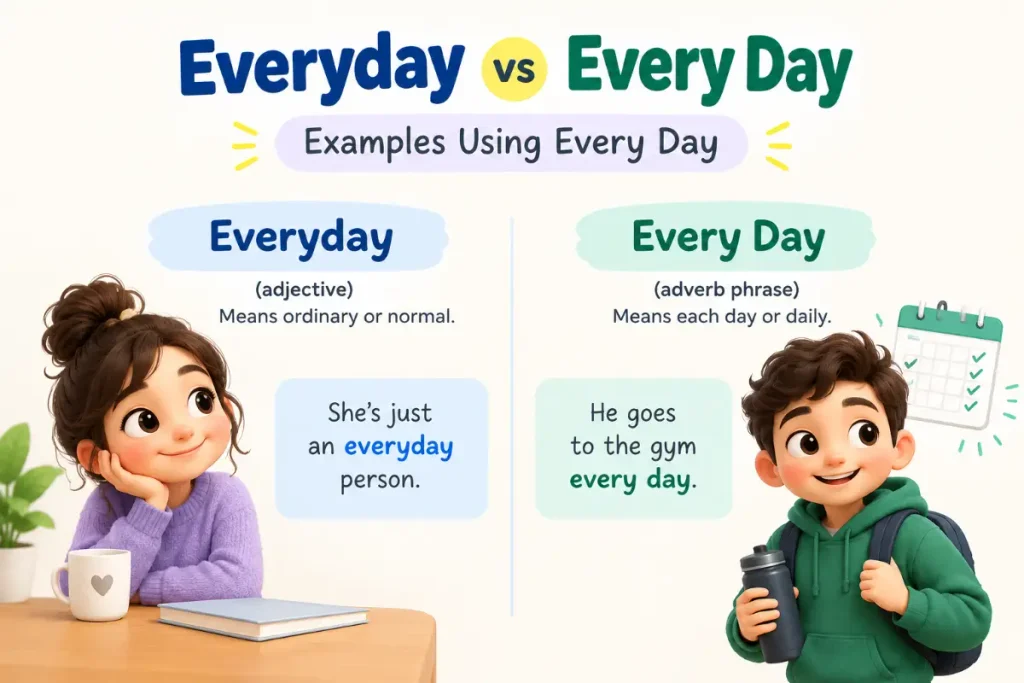
Notice that the adjective is describing a noun in each example. It tells the reader what kind of thing is being discussed.
Learning similar grammar distinctions can make everyday writing much clearer, especially when two expressions sound alike but serve different grammatical purposes.
Examples Using Every Day
Now compare examples where the meaning is each day:
- I drink coffee every day.
- She walks her dog every day before work.
- We check our messages every day.
- He studies for an hour every day.
- They practice the piano every day.
- I read the news every day.
- The store opens at nine every day.
- She calls her parents every day.
- We review the numbers every day during the project.
- He writes in his journal every day.
- I take the same route to work every day.
- They meet every day after class.
- She waters the plants every day during the summer.
- I try to learn something new every day.
- The team checks the equipment every day.
In these examples, the phrase describes an action or event and tells us how often it happens.
Everyday vs Every Day In Common Expressions
Some expressions appear frequently enough that the correct form is worth memorizing.
Everyday Life
Use everyday because the word describes “life.” The meaning is ordinary or normal life, as in this example:
- Technology affects our everyday life.
Everyday Use
Use everyday because it describes “use.” The meaning is normal or routine use, as in this example:
- This product is designed for everyday use.
Every Day At Work
Use every day when you mean each day. The phrase describes how often the action happens, as in this example:
- I check my work email every day.
Every Day After School
Use every day because it refers to each school day. Here the phrase again expresses frequency, as in this example:
- She practices soccer every day after school.
Everyday Language
Use everyday because it describes “language.” This means ordinary, accessible language rather than highly technical terminology, as in this example:
- The teacher explained the concept in everyday language.
Every Day In Summer
Use every day when referring to each day during a period. The phrase expresses frequency across that period, as in this example:
- We went swimming every day in summer.
Why People Confuse The Two Forms
The confusion is understandable because the pronunciation can be very similar, especially in quick speech. The written difference is just one space, but that space separates two different grammatical structures.
There is another reason for the confusion. The meanings are closely related. Something described as everyday is often associated with daily life, and something that happens every day is part of a regular routine. That semantic connection makes it tempting to treat the forms as interchangeable, but they are not interchangeable in standard edited English. Compare these two pairs:
- Incorrect: I go to work everyday.
- Correct: I go to work every day.
- Incorrect: I need comfortable clothes for every day use.
- Correct: I need comfortable clothes for everyday use.
In the first pair, the intended meaning is “I go to work each day.” In the second pair, the intended meaning is “normal use.” The context tells you which grammatical structure you need.
Another related usage distinction worth understanding is “into” versus “in to,” where spacing changes the grammatical role and meaning of the expression.
Common Mistakes To Avoid
Mistake One: Using Everyday After A Verb
- Incorrect: I exercise everyday.
- Correct: I exercise every day.
The phrase tells us how often the action happens. It means “each day,” so it needs two words.
Mistake Two: Separating Everyday Before A Noun
- Incorrect: These are my every day shoes.
- Correct: These are my everyday shoes.
“Everyday” is describing the noun “shoes,” so it functions as a compound adjective and should be written as one word.
Mistake Three: Assuming Everyday Means Every Single Day
A common incorrect interpretation is that everyday means something happens seven days a week. That is not the basic meaning of the adjective. For example, “an everyday occurrence” means an ordinary or common occurrence. It does not necessarily mean something that happens literally each day.
Mistake Four: Using Everyday At The End Of A Sentence
In standard usage, everyday at the end of a sentence is often a sign that the two-word form is needed. Here is an example:
- Incorrect: I read the newspaper everyday.
- Correct: I read the newspaper every day.
The phrase expresses frequency, so it should be written as two words.
Formal And Casual Usage
Both forms are completely standard in American English. The distinction is grammatical rather than a difference between formal and informal vocabulary. You can use either form in professional or casual writing:
- Professional, everyday: The software is designed for everyday business use.
- Formal, every day: Employees must complete the safety check every day.
- Casual, every day: I wear these shoes every day.
- Casual, everyday: They are just my everyday shoes.
The same distinction applies in emails, school assignments, reports, resumes, social media posts, text messages, and ordinary conversation. The important issue is not formality. It is meaning and grammatical function.
Everyday vs Every Day In Workplace Writing
This distinction matters in professional communication because a small spacing error can change the grammatical structure of a sentence. Consider these pairs:
- Employees should review the system every day. (The review is performed each day.)
- Employees should follow the everyday review procedure. (The procedure is routine or normal.)
- The manager sends an update every day. (This describes frequency.)
- The manager handles everyday customer concerns. (This describes ordinary customer concerns.)
Professional writers should pay particular attention to this difference because both forms can appear in the same document. A single report or email may need the adjective in one sentence and the frequency phrase in the next.
Everyday vs Every Day In School And Academic Writing
Students commonly encounter the distinction in essays and assignments. Consider these examples:
- Students should read every day.
- Reading is an everyday activity for many students.
- The study examines how scientific ideas are explained in everyday language.
The first sentence means students should read each day. In the second, “everyday” describes the activity as ordinary or routine. In the third, “everyday language” means language that ordinary readers can understand rather than highly specialized terminology. Academic writing often uses everyday to contrast ordinary experiences with specialized or technical ones, and using the correct form helps keep the sentence precise.
Everyday And Every Day With Other Words
The position of the expression can give you a useful clue. Everyday commonly appears before a noun:
- everyday clothes
- everyday tasks
- everyday expenses
- everyday experiences
- everyday conversation
Every day commonly appears after a verb or at the beginning of a sentence:
- I exercise every day.
- She studies every day.
- Every day, we learn something new.
This is not an absolute position rule, but it is a helpful pattern. You should still focus on meaning and grammatical function rather than relying only on position. For example, in “Every day that I work, I take the train,” the phrase “every day” comes before a clause and still means each day. Similarly, in “The everyday problems of commuting can become frustrating,” the word “everyday” comes before the noun phrase “problems of commuting.”
Everyday vs Daily
The word daily can sometimes create another layer of confusion because it can overlap with the meaning of every day. Both of these sentences can mean that the exercise happens each day:
- I exercise every day.
- I exercise daily.
Daily can also function as an adjective, as in “I have a daily exercise routine.” You cannot simply replace daily with everyday in every sentence. Compare these two examples:
- I have a daily meeting. (A meeting that happens each day.)
- I have an everyday meeting. (Usually a meeting that is ordinary or routine, not necessarily one that occurs each day.)
The distinction is useful because daily can focus on frequency or something associated with each day, while everyday primarily describes something as ordinary or routine.
Pronunciation
The two forms are pronounced very similarly, which contributes to the confusion in speech. A simple pronunciation guide is:
- everyday: EV ree day
- every day: EV ree day
In natural American speech, the difference in pronunciation may be subtle or absent for many speakers. That means you usually cannot rely on sound alone to choose the spelling. Writing requires you to identify the intended meaning: if you mean ordinary, write everyday, and if you mean each day, write every day. That meaning-based approach is much more reliable than trying to hear the difference.
Word Origin And Why The Forms Became Confusing
The two forms are closely related because everyday developed as a compound adjective from the ordinary phrase every day. English frequently creates compound adjectives from combinations of words that become established together. The modern distinction is therefore not random. The one-word form has developed a specialized adjectival function, while the two-word phrase retains the ordinary structure of “every” plus the noun “day.”
The historical connection also explains why their meanings remain closely related. Both expressions are connected with regular daily life, but modern usage gives them different grammatical jobs. For practical writing, you do not need to memorize the history, because the substitution tests are more useful.
A Fast Decision Guide
When you are unsure which form to use, follow these steps:
- Look at the meaning you want. If you mean each day, choose every day. If you mean ordinary, usual, or routine, choose everyday.
- Try replacing the expression with “each day.” If that works, use every day.
- If you are describing a noun and “ordinary” works, use everyday.
- Read the complete sentence again to make sure the intended meaning is clear.
Here are two examples of the method in action:
- I check my calendar every day. (“Each day” works, so use two words.)
- My calendar is part of my everyday routine. (“Ordinary” or “usual” works, so use one word.)
This method is faster and more reliable than trying to remember a long grammar rule.
A Quick Practice Quiz
Choose everyday or every day in each sentence.
- I take my dog for a walk ______.
- These are my ______ shoes.
- She checks her email ______ before lunch.
- Cooking is part of his ______ routine.
- We learn something new ______.
- The book discusses ______ problems.
- They practice together ______ after school.
- This bag is designed for ______ use.
- I try to exercise ______.
- Traffic is an ______ problem in the city.
Answers
- every day
- everyday
- every day
- everyday
- every day
- everyday
- every day
- everyday
- every day
- everyday
The pattern should now be clear. The time expression uses two words, and the adjective uses one.
Frequently Asked Questions
Which is correct, everyday or every day?
Both are correct, but they have different grammatical functions. Everyday is an adjective meaning ordinary, usual, or routine. Every day is a phrase meaning each day. Use “everyday clothes” but “I wear these clothes every day.” The correct choice depends on the meaning and the role the expression plays in the sentence.
Is everyday one word or two words?
Everyday is one word when it is an adjective meaning ordinary or usual. For example, “These are my everyday shoes.” When you mean each day, use the two-word phrase every day, as in “I wear these shoes every day.” The space is important because it separates two different grammatical uses.
Is it correct to say I go to school everyday?
In standard edited American English, write “I go to school every day” when you mean that you go to school each day. Here the expression describes how often the action occurs. You can replace “every day” with “each day,” which confirms that the two-word form is appropriate.
Can everyday mean every day?
The adjective everyday can be associated with things that occur regularly or belong to daily life, but it does not function as the standard two-word time expression. Use every day when you literally mean each day. Use everyday when you mean ordinary, usual, or routine.
Is everyday formal or informal?
Everyday is standard in both formal and informal English. It is an adjective used in professional writing, academic writing, journalism, and ordinary conversation. For example, “everyday expenses” is perfectly appropriate in a formal financial discussion. The issue is not formality. The important point is using the word for its correct grammatical purpose.
Can every day start a sentence?
Yes. Every day can appear at the beginning of a sentence when it means each day. For example, “Every day, she walks to work.” The comma is commonly used when the introductory phrase is set off for clarity. The same phrase can also appear later in the sentence, as in “She walks to work every day.”
What is the easiest way to remember the difference?
Use the substitution test. If you can replace the expression with each day, write every day. If you can replace it with ordinary, usual, or routine, write everyday. For example, “I exercise every day” becomes “I exercise each day,” while “everyday clothes” can become “ordinary clothes.”
Is everyday always followed by a noun?
Everyday is an adjective, so its basic job is to modify a noun. It commonly appears directly before a noun, as in “everyday life,” “everyday clothes,” and “everyday problems.” Like other adjectives, it can occur in other grammatical constructions too, but for learners, identifying the noun it describes is one of the most useful ways to recognize the one-word form.
The Key Takeaway
The difference between everyday and every day is easier than it first appears. One word describes something as ordinary, usual, or routine. Two words mean each day and express frequency. Remember the two questions:
- Do I mean ordinary or usual? Use everyday.
- Do I mean each day? Use every day.
That rule covers most situations you will encounter in American English. Write “everyday clothes,” “everyday life,” and “everyday problems” when you are describing ordinary things. Write “I work every day,” “she calls every day,” and “we practice every day” when you are talking about frequency.
The distinction may be only one space on the page, but that space changes the grammatical role and meaning. Once you start checking whether you are describing a noun or expressing frequency, choosing the right form becomes much more natural.