If you have ever paused before writing a sentence such as “Who’s car is this?” you are not alone. Who’s vs whose is a common grammar question because the two words sound the same in most American English speech, but they perform completely different jobs. One is a contraction, while the other expresses possession or introduces a possessive relationship.
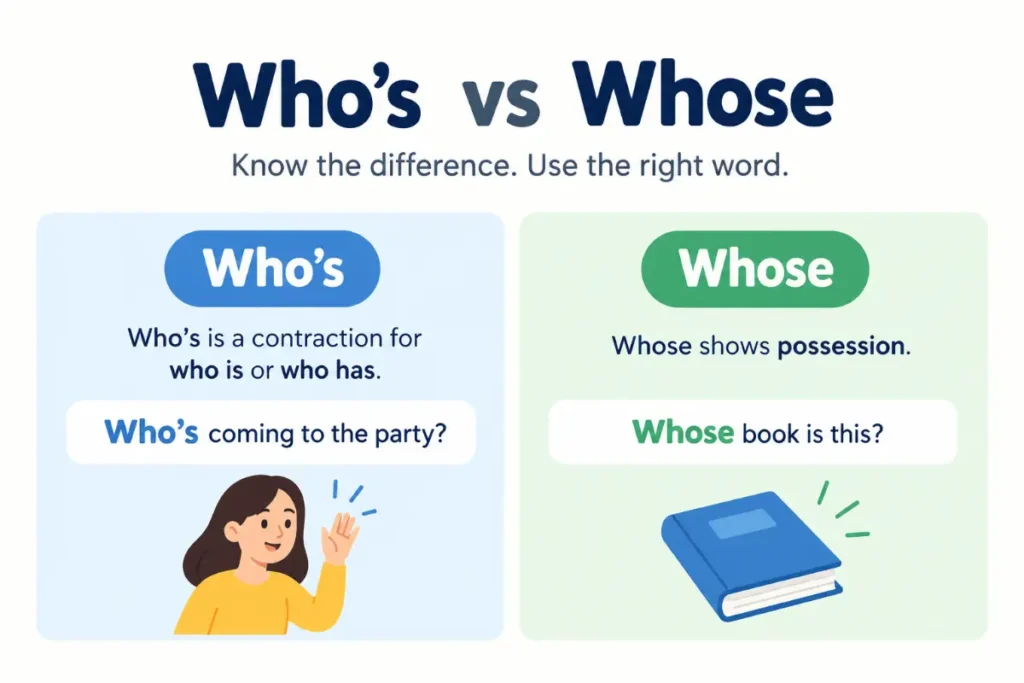
The easiest way to remember the difference is simple. Who’s means who is or who has. Whose asks who something belongs to or identifies the person, animal, or thing connected with something. The apostrophe in who’s does not indicate possession.
That last point causes much of the confusion. Apostrophes often signal possession in English, as in “Maria’s phone,” but contractions use apostrophes for missing letters. In who’s, the apostrophe replaces letters from is or has.
This guide explains the distinction with clear examples, grammar patterns, common mistakes, pronunciation, related words such as whom, and practical advice for emails, schoolwork, professional writing, and everyday conversation.
Quick Answer
Who’s is a contraction of who is or who has. Whose shows possession or asks who owns or is connected with something. Use “Who’s coming?” because it means “Who is coming?” Use “Whose phone is this?” because you are asking who the phone belongs to.
The Main Difference
The distinction becomes much easier once you stop thinking about the apostrophe and focus on the grammatical function.
Who’s is a shortened form of two words:
- Who is
- Who has
For example:
- Who’s coming to dinner? = Who is coming to dinner?
- Who’s responsible for this report? = Who is responsible for this report?
- Who’s finished the assignment? = Who has finished the assignment?
- Do you know who’s taken my seat? = Do you know who has taken my seat?
Whose is a possessive word. It can function as a pronoun or determiner and is used to ask about ownership, responsibility, or connection. It can also introduce a clause that describes possession.
Consider these two sentences:
- Who’s at the door?
- Whose coat is at the door?
The first asks for the identity of a person. The second asks who owns the coat.
A useful test is to replace who’s with who is or who has. If the sentence still makes sense, who’s is probably correct. If neither expansion works and the sentence involves ownership or connection, whose is likely the right choice.
Just like “who’s” and “whose,” other common everyday grammar mix-ups can be confusing because small differences in form can change how a word functions in a sentence.
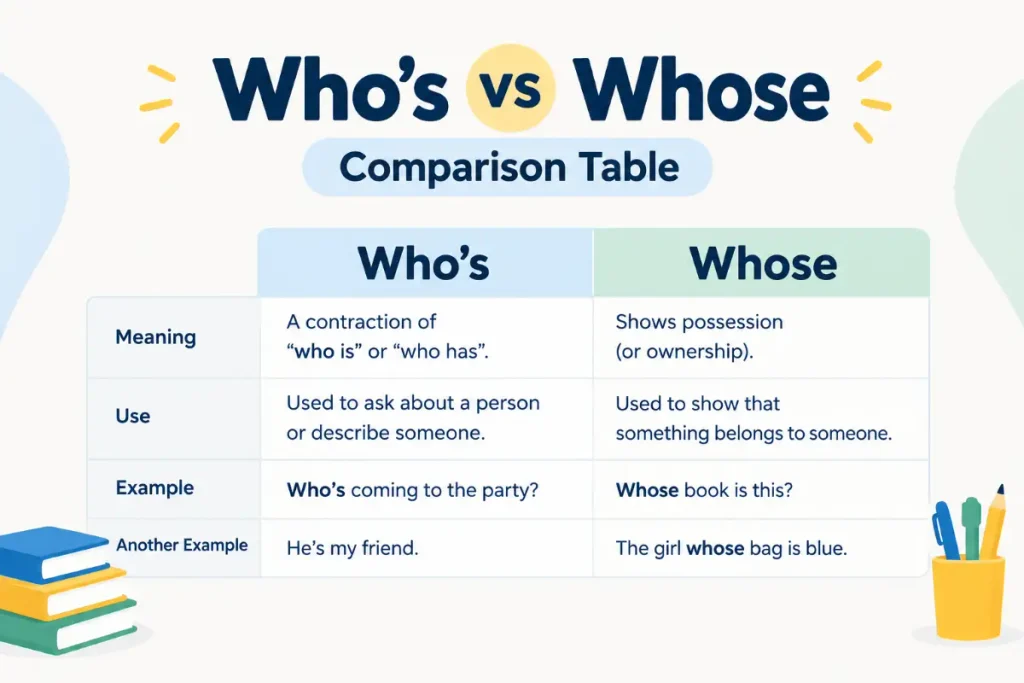
Comparison Table
| Feature | Who’s | Whose |
|---|---|---|
| Basic function | Contraction | Possessive pronoun or determiner |
| Meaning | Who is or who has | Belonging to whom or connected with whom |
| Apostrophe | Yes | No |
| Common use | Questions and statements involving is or has | Questions and clauses involving possession |
| Example | Who’s calling? | Whose phone is ringing? |
| Can come before a noun | Sometimes, as part of a larger clause | Yes |
| Shows possession | No | Yes |
| Can introduce a relative clause | Yes, as a contraction within the clause | Yes |
| Pronunciation | Usually /huːz/ | Usually /huːz/ |
| Main writing problem | Mistaken for possessive form | Mistaken for a contraction |
The most important row is the meaning. Who’s tells you that who is or who has has been shortened. Whose tells you that the sentence concerns possession, responsibility, or association.
What Does Who’s Mean?
Who’s is a contraction. It combines who with either is or has.
When it means who is, it can describe an identity, condition, location, action, or characteristic.
Examples include:
- Who’s your new manager?
- Who’s waiting outside?
- Who’s ready for lunch?
- Who’s responsible for the mistake?
- Who’s in charge of the project?
Try expanding each one:
- Who is your new manager?
- Who is waiting outside?
- Who is ready for lunch?
- Who is responsible for the mistake?
- Who is in charge of the project?
The meaning remains essentially the same.
Who’s can also mean who has. This usually appears with a past participle.
Examples:
- Who’s finished the report?
- Who’s taken my notebook?
- Who’s seen this movie?
- Do you know who’s called the office?
- Who’s already completed the application?
In each case, expanding the contraction reveals who has:
- Who has finished the report?
- Who has taken my notebook?
- Who has seen this movie?
Cambridge Dictionary identifies both who is and who has as standard meanings of the contraction.
Who’s in Questions
This is one of the most common uses in everyday American English.
- Who’s coming with us?
- Who’s your teacher?
- Who’s calling?
- Who’s using the printer?
- Who’s going to the meeting?
A quick substitution test works especially well here. If you can say who is without changing the basic meaning, use who’s.
For example:
“Who’s coming?”
becomes:
“Who is coming?”
That tells you immediately that who’s is correct.
What Does Whose Mean?
Whose is used to ask about possession or to show a possessive relationship. It can refer to people, animals, and, in some contexts, things.
It often appears directly before a noun:
- Whose phone is this?
- Whose car are we taking?
- Whose idea was it?
- Whose jacket is on the chair?
- Whose name is on the form?
Also, it can stand alone:
- Whose is this?
- Whose are these?
- Do you know whose this is?
In these sentences, whose essentially means belonging to whom.
For example:
“Whose laptop is this?”
means:
“Who does this laptop belong to?”
The word can also express responsibility or association rather than literal ownership:
- Whose fault was it?
- Whose responsibility is this?
- Whose side are you on?
- Whose decision was that?
So, do not limit whose to physical ownership. The underlying idea is a relationship between someone and something.
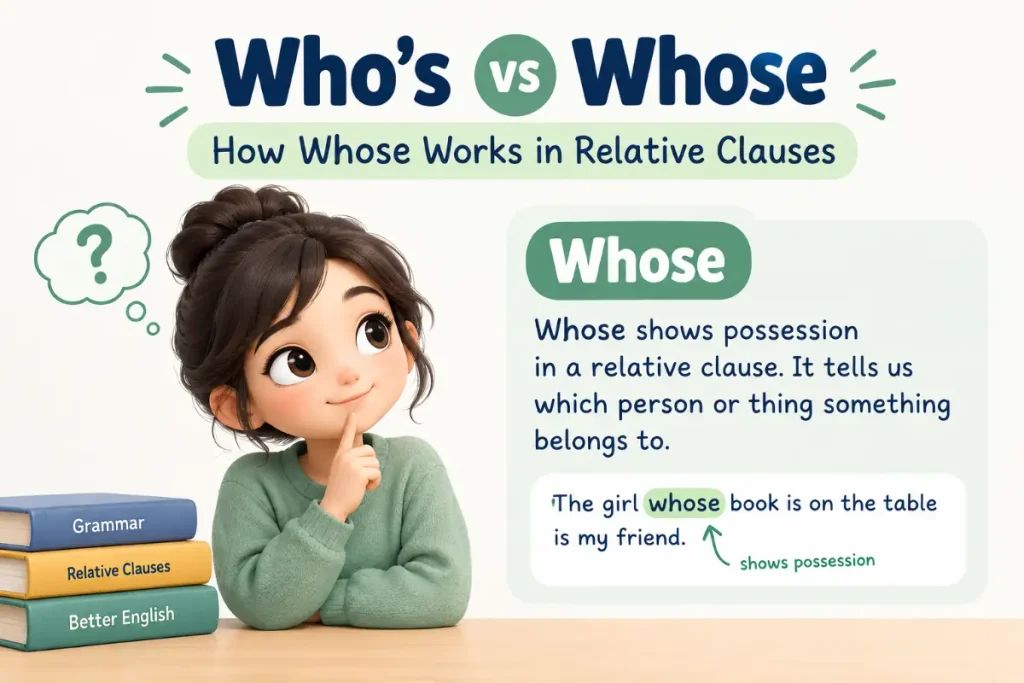
How Whose Works in Relative Clauses
There is another important use that often appears in academic, professional, and formal writing. Whose can introduce a relative clause that identifies possession or association.
Consider:
- I met a student whose brother works here.
- She hired an employee whose experience matched the position.
- We visited a company whose products are sold nationwide.
- That is the house whose roof was damaged in the storm.
In the first sentence, whose brother means the student’s brother. In the second, whose experience means the employee’s experience.
Cambridge Grammar explains that whose can introduce relative clauses indicating possession and can refer to people, animals, and sometimes things.
This makes whose particularly useful because it can connect two ideas without forcing you to repeat a noun.
Compare:
“She hired an employee. The employee’s experience matched the position.”
With:
“She hired an employee whose experience matched the position.”
The second version is more compact and natural.
Who’s vs Whose Examples
Seeing the two words side by side makes the distinction clearer.
Examples With Who’s
- Who’s coming to the party tonight?
Here, who’s means who is. - Do you know who’s in the conference room?
Here, who’s means who is. - Who’s responsible for sending the email?
Here, who’s means who is. - I wonder who’s calling me this late.
Here, who’s means who is. - Who’s ready to leave?
Here, who’s means who is. - Who’s working the front desk today?
Here, who’s means who is. - Do you know who’s finished the assignment?
Here, who’s means who has. - Who’s taken my pen?
Here, who’s means who has. - She wants to know who’s been using her computer.
Here, who’s means who has. - Who’s already submitted the form?
Here, who’s means who has.
These examples show why who’s is not a possessive form. It is simply a contraction.
Examples With Whose
- Whose backpack is this?
The question asks who owns the backpack. - Whose keys are on the table?
The question asks who the keys belong to. - Whose idea was it to change the schedule?
The question concerns responsibility or origin. - Do you know whose car is parked outside?
The question asks who the car belongs to. - Whose name should I put on the application?
The question concerns the person associated with the application. - Whose turn is it?
The question asks who is entitled to act next. - She is the manager whose office is next to mine.
Here, whose introduces a possessive relative clause. - I spoke with a teacher whose students won the competition.
Whose connects the teacher with the students. - That is the company whose software we use.
Whose expresses the relationship between the company and its software. - They adopted a dog whose previous owner could no longer care for it.
Whose connects the dog with its previous owner.
The contexts differ, but the same principle works throughout. Whose concerns possession, association, responsibility, or connection.
The Fastest Way to Choose
When you are unsure, use the expansion test.
Step One
Look at who’s and ask if it can mean who is.
- Who’s at the door?
- Who is at the door?
The sentence works, so who’s is correct.
Step Two
If that does not work, test who has.
- Who’s finished the project?
- Who has finished the project?
Again, the sentence works, so who’s is correct.
Step Three
If neither expansion makes sense, consider whose.
- Whose project is this?
- Who is project is this?
- Who has project is this?
The first version works because the sentence asks about possession.
This test is reliable because the difference is grammatical rather than merely visual.
Another tricky word-choice distinction is “born” versus “borne,” where choosing the correct form depends on its meaning and grammatical context.
Why the Apostrophe Causes Confusion
Many people learn that an apostrophe can indicate possession.
Examples include:
- Sarah’s book
- The teacher’s desk
- The company’s website
- James’s phone
That rule is useful, but it does not mean every apostrophe marks possession.
Apostrophes also appear in contractions:
- do not → don’t
- cannot → can’t
- it is → it’s
- they are → they’re
- who is → who’s
- who has → who’s
So the apostrophe in who’s represents missing letters. It does not mean something belongs to someone.
That is why whose has no apostrophe even though it expresses possession.
The same principle appears with its and it’s:
- Its color is blue.
- It’s blue.
The first expresses possession. The second means it is.
The pattern is similar with whose and who’s, but the forms sound alike, making the distinction harder to hear.
Common Mistakes
Mistake 1: Using Who’s Before a Noun to Show Possession
Incorrect:
- Who’s phone is ringing?
Correct:
- Whose phone is ringing?
The question asks who owns the phone, so whose is required.
Mistake 2: Adding an Apostrophe to Whose
Incorrect:
- Who’s book is this?
Correct:
- Whose book is this?
The apostrophe changes the grammatical function. In the correct sentence, whose expresses possession.
Mistake 3: Using Whose When You Mean Who Is
Incorrect:
- Whose coming to the meeting?
Correct:
- Who’s coming to the meeting?
The intended meaning is who is coming, so the contraction is needed.
Mistake 4: Assuming Every Apostrophe Means Ownership
Incorrect reasoning:
“Who’s has an apostrophe, so it must show possession.”
The apostrophe can signal a contraction. In who’s, it represents missing letters from is or has.
Mistake 5: Confusing Who’s With Whom
Who, whom, who’s, and whose perform different grammatical jobs.
Compare:
- Who called you?
- Whom did you call?
- Who’s calling you?
- Whose phone did you use?
The first asks about the person performing an action. The second traditionally asks about the person receiving the action. The third means who is calling. The fourth asks about possession.
Who, Whom, and Whose
The related forms who, whom, and whose can also cause confusion.
Who generally identifies a person and can function as a subject or, especially in everyday American English, an object.
- Who called?
- Who did you invite?
Whom traditionally functions as an object and is more common in formal writing than everyday conversation.
- Whom did you invite?
- To whom should I send the letter?
Cambridge Grammar notes that whom is used for objects in formal styles and is relatively uncommon in ordinary conversation.
Whose expresses possession:
- Whose idea was it?
- The student whose paper won the award was absent.
This gives you a useful four word distinction:
| Word | Main function | Example |
|---|---|---|
| Who | Identifies a person | Who called? |
| Whom | Formal object form | Whom did you call? |
| Who’s | Means who is or who has | Who’s calling? |
| Whose | Shows possession or connection | Whose phone is this? |
Do not treat these forms as interchangeable simply because they all begin with who.
Pronunciation
In most American English speech, who’s and whose are pronounced the same way. Both are commonly represented as /huːz/. Cambridge gives this pronunciation for both forms.
That explains why people often make the mistake in writing. Speaking does not provide a useful distinction.
Compare:
- Who’s there?
- Whose coat is this?
The words sound alike, but the meanings are different.
Because pronunciation cannot reliably tell you which spelling to use, the expansion test is more useful than trying to hear the difference.
Is Whose Only Used for People?
No. Whose commonly refers to people and animals, but it can also refer to things, especially in relative clauses.
For example:
- The company whose headquarters are in Chicago expanded rapidly.
- We stayed in a hotel whose lobby overlooked the river.
- She opened a book whose cover had been damaged.
Cambridge Grammar specifically notes that whose can refer to things, particularly in more formal styles.
In ordinary writing, this construction can sometimes feel formal. Writers may choose another structure if it sounds more natural:
- The company has headquarters in Chicago and expanded rapidly.
- The hotel had a lobby overlooking the river.
Still, whose referring to things is a legitimate grammatical construction. It should not automatically be treated as an error.
Formal and Casual Usage
Both words are standard in American English, but their roles differ rather than their levels of formality.
Who’s is common in conversation, texting, email, workplace communication, and formal writing when a contraction fits the style.
For example:
- Who’s available for the meeting?
- Do you know who’s responsible for this account?
In highly formal writing, some editors may prefer the expanded who is or who has, but contractions themselves are not grammatically incorrect.
Whose is equally normal across casual and formal contexts.
- Whose bag is this?
- The researcher whose work influenced the study received an award.
The choice between the two is therefore not primarily about formality. It is about meaning and grammatical function.
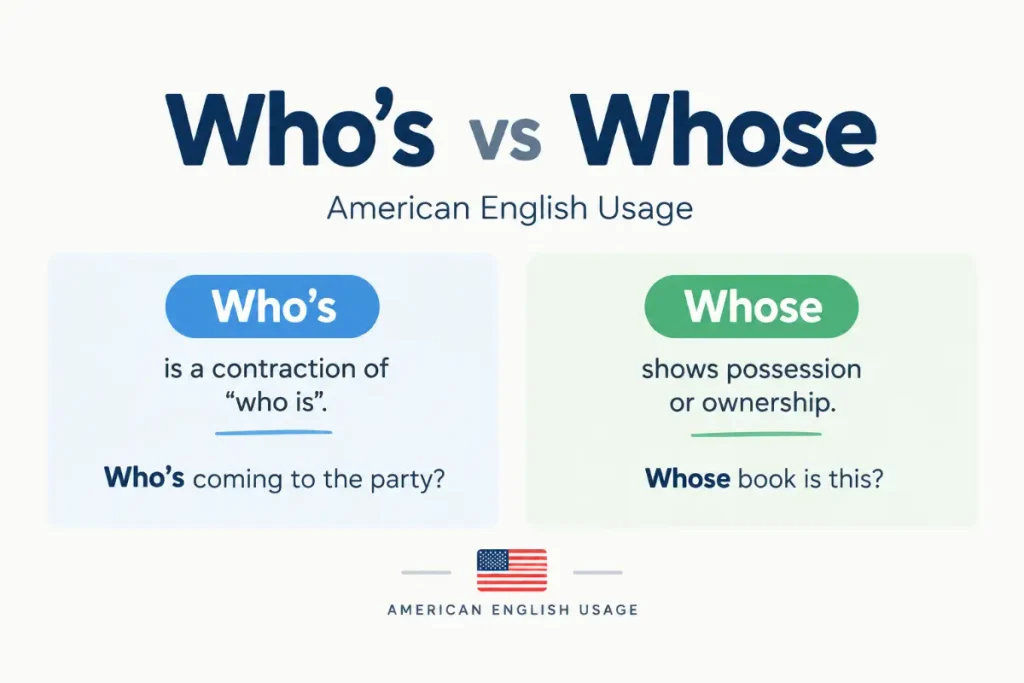
American English Usage
There is no special American spelling that replaces one form with another. American English uses both who’s and whose with the same basic distinction described above.
The main challenge for US readers is that the words are usually homophones. They sound alike but have different meanings and spellings.
This is also why proofreading software may flag the wrong choice in context or fail to catch it. A sentence such as “Who’s car is outside?” contains a grammatically meaningful word, but the software must understand the intended meaning to recognize that whose is required.
For careful writing, especially in school or professional documents, the expansion test remains one of the safest manual checks.
How Native Speakers Use These Words Naturally
The most natural usage becomes easier if you think about the question being asked.
If you are asking who is doing something, use who’s:
- Who’s driving?
- Who’s speaking?
- Who’s responsible?
- Who’s coming?
Use whose if you are asking who owns something:
- Whose car?
- Whose laptop?
- Whose office?
- Whose idea?
If you are describing someone through a possession or relationship, use whose:
- The woman whose car was stolen called the police.
- I met the student whose presentation won.
- We hired someone whose experience matched the position.
If you can expand the word to who is or who has, use who’s:
- Who’s available? → Who is available?
- Who’s finished? → Who has finished?
That simple distinction handles most everyday cases.
A Useful Memory Trick
Remember this:
- Who’s = who is or who has.
- Whose = belonging to whom.
You can think of the apostrophe as a clue that letters have been removed.
- who is → who’s
- who has → who’s
But there is no such expansion for whose.
If you see whose, ask yourself:
Whose thing or whose responsibility?
If you see who’s, ask yourself:
Who is or who has?
This works particularly well when proofreading quickly.
If you’re comparing English usage across regions, US and UK spelling differences such as “canceled” and “cancelled” are also worth understanding.
Frequently Asked Questions
Which is correct, who’s or whose?
Both are correct, but they have different meanings. Who’s is a contraction of who is or who has. Whose expresses possession or connection. Use “Who’s coming?” for “Who is coming?” and “Whose bag is this?” when asking who owns the bag.
Is who’s ever possessive?
No. Who’s does not function as the possessive form of who. It is a contraction meaning who is or who has. Whose is the possessive form used to ask about ownership or express a possessive relationship. The apostrophe in who’s represents omitted letters rather than possession.
How do you remember the difference between who’s and whose?
Use the expansion test. Replace who’s with who is or who has. If the sentence works, who’s is correct. If the sentence asks who something belongs to or describes a possessive relationship, use whose. Remembering “who’s equals who is or who has” solves most cases quickly.
Is whose grammatically correct before a noun?
Yes. Whose commonly appears before a noun when asking about possession or identifying a possessive relationship. Examples include “Whose phone is this?” and “Whose name is on the list?” It can also introduce a relative clause, as in “The student whose laptop was stolen reported it.”
Can whose refer to things?
Yes. Whose can refer to things as well as people and animals, particularly in relative clauses. For example, “We visited a building whose windows were damaged.” This usage is grammatically established, although some constructions may sound more formal than alternatives.
Are who’s and whose pronounced the same?
Usually, yes. In American English, both are commonly pronounced /huːz/. Because they are homophones, pronunciation does not normally help you choose the correct spelling. The meaning and grammatical function of the sentence determine which form you need.
Is whose the same as whom?
No. Whose expresses possession or asks about ownership or association. Whom traditionally functions as an object, especially in formal writing. Compare “Whose book is this?” with “Whom did you invite?” The first asks about possession, while the second asks about the person receiving the action.
Can I use who’s in formal writing?
Yes. Who’s is a standard English contraction of who is or who has. Formal writing sometimes favors expanded forms for stylistic reasons, but the contraction is not inherently grammatically incorrect. The important point is to use it only when it can correctly be expanded to who is or who has.
Final Takeaway
The difference between who’s vs whose comes down to one simple grammatical distinction. Who’s is a contraction meaning who is or who has. Whose expresses possession, ownership, responsibility, or another connection.
When you are unsure, expand the contraction. If “who is” or “who has” fits naturally, choose who’s. If you are asking who something belongs to or describing a possessive relationship, choose whose.
Remember the shortest version: who’s means who is or who has, while whose means belonging to whom. Once you focus on the meaning instead of the apostrophe, this commonly confused pair becomes much easier to use correctly.