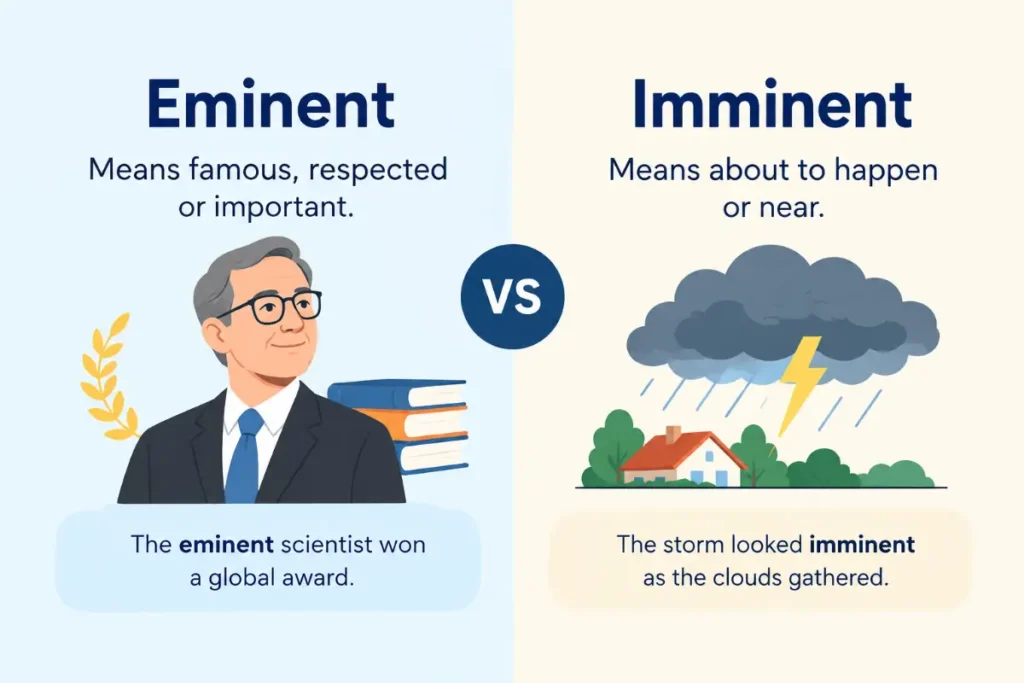
If you have ever hesitated over eminent vs imminent, you are dealing with two English words that look remarkably similar but mean very different things. Eminent describes someone who is highly respected, distinguished, or well known for important achievements. Imminent describes something that is about to happen or expected very soon. The spelling differs by only a few letters, but choosing the wrong word can completely change the meaning of a sentence.
The confusion makes sense because both words have a similar sound and share several letters. They can also appear in formal writing, especially in academic, professional, legal, and news contexts. Once you connect each word with its central idea, however, the distinction becomes much easier to remember.
Quick Answer
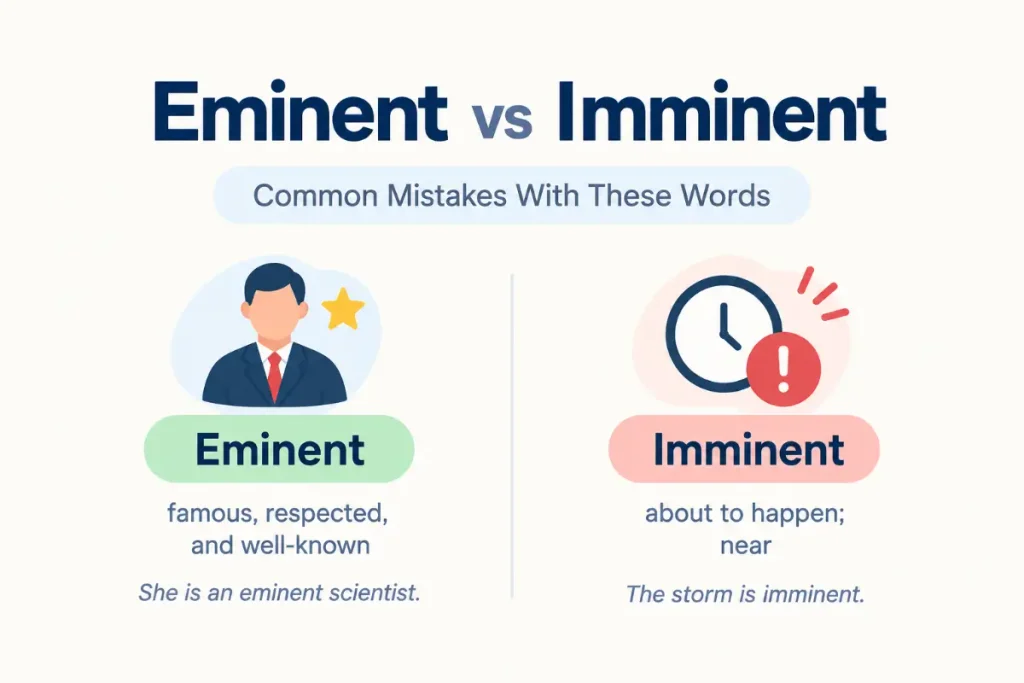
Eminent means distinguished, respected, or highly accomplished. Imminent means about to happen or expected very soon. You can describe an eminent professor because of the professor’s reputation and an imminent deadline because it is approaching. Remember that eminent relates to distinction while imminent relates to time.
What Does Eminent Mean
Eminent is an adjective used to describe someone who has earned a high level of respect because of achievement, expertise, reputation, or influence. It often suggests that the person stands out from others in the same field. You will commonly see it paired with words such as professor, scientist, physician, scholar, author, judge, researcher, and historian.
For example, you might write, “The university invited an eminent historian to speak at the conference.” The word eminent tells readers that the historian is highly respected or distinguished. It does not tell them that the historian will arrive soon or that anything is about to happen.
The word usually carries a formal tone. In casual conversation, Americans are more likely to say highly respected, famous, well known, or accomplished. In academic writing, professional biographies, formal announcements, and serious journalism, eminent can provide a more precise and elevated description.
Eminent in Simple Terms
A useful way to understand eminent is to connect it with distinction. An eminent person has a reputation that sets them apart because of their work, achievements, knowledge, or influence. The word focuses on who someone is in terms of reputation, not on what is happening next.
Consider the sentence, “She is an eminent researcher in the field of cancer biology.” The sentence praises her professional standing. It does not mean she is about to become a researcher or that something involving her is about to happen.
Here are a few natural examples:
- The university honored an eminent professor for decades of research.
- An eminent physician spoke at the medical conference.
- The journal published an interview with an eminent historian.
- An eminent author visited the school to speak with students.
- The court heard testimony from an eminent legal scholar.
In each case, eminent describes a person’s recognized standing or achievement.
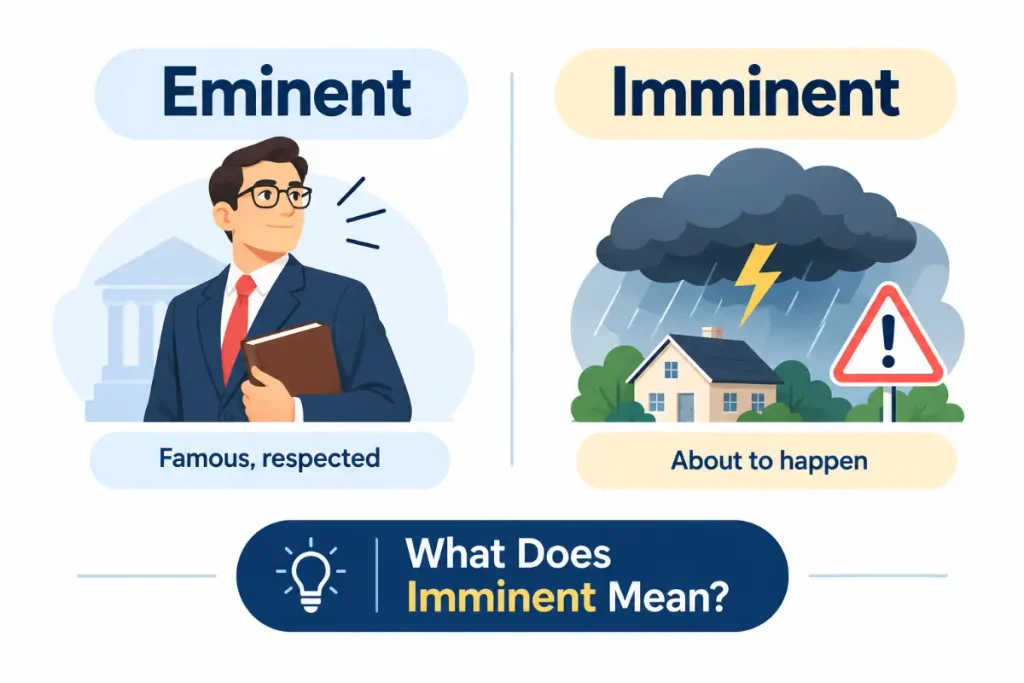
Like “eminent” and “imminent,” commonly confused words can look or sound similar while having completely different meanings.
What Does Imminent Mean
Imminent is an adjective that means something is about to happen or expected to happen very soon. Unlike eminent, it has nothing to do with fame, reputation, or professional achievement. Its central idea is time and closeness.
You might say, “A major storm is imminent.” This tells readers that the storm is expected soon. You could also say, “The company announced that a decision was imminent,” meaning the decision was expected shortly.
Imminent often appears in serious or formal contexts because writers frequently use it to describe approaching dangers, threats, changes, decisions, or major events. Common combinations include imminent danger, imminent threat, imminent arrival, imminent decision, imminent deadline, imminent change, and imminent storm.
The word does not always describe something negative. An arrival, announcement, agreement, or important event can also be imminent. The essential point is that the event is close in time.
Imminent in Simple Terms
Think of imminent as something right around the corner in time. If an event is imminent, you expect it to happen soon. The word answers a timing question rather than a question about reputation.
For example, “The deadline is imminent” means the deadline is approaching quickly. “The professor is eminent” means the professor is highly respected. These sentences look similar but communicate entirely different ideas.
Here are some examples:
- The weather service warned that severe flooding was imminent.
- The company said a major announcement was imminent.
- Residents prepared for the imminent arrival of the hurricane.
- The deadline is imminent, so the team needs to finish the report.
- Officials warned residents about the imminent danger from rising water.
The key idea stays the same in every example. Something is expected to happen soon.
Eminent vs Imminent Meaning
The simplest distinction is that eminent concerns distinction while imminent concerns timing. If you are talking about someone’s reputation or achievements, eminent may be the right choice. If you are talking about an event that is close to happening, imminent is usually the word you need.
| Feature | Eminent | Imminent |
|---|---|---|
| Meaning | Distinguished, respected, or highly accomplished | About to happen or expected soon |
| Main idea | Reputation or distinction | Time or closeness |
| Part of speech | Adjective | Adjective |
| Common subjects | People and distinguished figures | Events, situations, decisions, and dangers |
| Tone | Usually formal | Often formal or serious |
| Related noun | Eminence | Imminence |
| Example | An eminent scientist | An imminent storm |
A simple question can help you choose between them. Ask yourself, “Am I describing someone’s standing or describing something that is about to happen?” If the answer involves reputation, achievement, or distinction, choose eminent. If the answer involves the near future, choose imminent.
Eminent vs Imminent in a Sentence
Using both words in one sentence can make the distinction especially clear. Consider this example: “An eminent scientist warned that an environmental crisis was imminent.” Eminent describes the scientist because of the person’s professional reputation, while imminent describes the crisis because it is expected to happen soon.
Another example is, “The eminent attorney predicted that a major legal decision was imminent.” The attorney is distinguished, while the decision is approaching. The words work together because they describe two completely different ideas.
You can use the same structure in many contexts. “An eminent economist said an important policy change was imminent” describes an economist’s standing and a change that is close to happening. Once you see the pattern, the spelling difference becomes easier to remember.
How to Use Eminent Correctly
Eminent most commonly appears before a noun that refers to a respected or distinguished person. It is especially natural with professional and academic titles. The word can make a description sound formal and respectful.
Common combinations include:
- An eminent scientist.
- An eminent scholar.
- An eminent professor.
- An eminent judge.
- An eminent author.
- An eminent physician.
- An eminent researcher.
- An eminent historian.
- An eminent economist.
- An eminent artist.
For example, “The museum displayed the work of an eminent American artist.” The adjective tells us that the artist has earned a notable reputation. It does not suggest that the artist is appearing soon or that an event involving the artist is approaching.
Eminent can also describe someone who is highly regarded in a particular area of knowledge. A writer might refer to an eminent authority on constitutional law or an eminent expert in environmental science. In each case, the word highlights distinction and credibility.
Understanding another subtle word distinction can help you choose the right term when two words have similar pronunciations but different meanings.
How to Use Imminent Correctly
Imminent generally appears before a noun that represents an event, situation, change, decision, or outcome. It tells the reader that something is expected soon. The word often creates a sense of urgency because the event is close.
Common combinations include:
- Imminent danger.
- Imminent threat.
- Imminent arrival.
- Imminent decision.
- Imminent change.
- Imminent collapse.
- Imminent storm.
- Imminent deadline.
- Imminent announcement.
- Imminent agreement.
For example, “The manager said an announcement was imminent.” The sentence does not say that the announcement is important or famous. It says the announcement is expected shortly.
Imminent works particularly well in news reports, emergency notices, legal documents, workplace communication, and formal writing. In casual speech, people often use simpler expressions such as coming soon, about to happen, or right around the corner.
Eminent vs Imminent Pronunciation
The two words are easy to confuse in speech because their pronunciations are very close. In American English, eminent is commonly pronounced /ˈɛmɪnənt/. It begins with an “eh” sound, similar to the beginning of the word “empty.”
Imminent is commonly pronounced /ˈɪmɪnənt/. It begins with an “ih” sound, similar to the vowel sound in “imitate.” The difference is subtle, so context often helps listeners understand the intended word.
If you are learning these words for speaking as well as writing, pay attention to the first vowel. Eminent begins with the sound associated with em, while imminent begins with the sound associated with im. The distinction becomes easier with repeated exposure.
Eminent vs Imminent vs Immanent
There is a third word that often enters this confusion: immanent. It is different from both eminent and imminent and has a specialized meaning.
Immanent generally describes something that exists or operates within something else. The word appears most often in philosophical, theological, and academic contexts. It is much less common in everyday American conversation.
Consider these examples:
- The eminent professor published a new book.
- A severe storm is imminent.
- The philosopher discussed an immanent quality of nature.
The first sentence concerns distinction. The second concerns an approaching event. The third concerns something existing or operating within another thing.
A useful memory system is to associate eminent with distinction, imminent with the immediate future, and immanent with within. These connections can help you keep the three spellings separate.
Eminent vs Prominent
Eminent and prominent are related words, but they are not exact substitutes. Both can describe someone who is important or well known, yet eminent usually carries a stronger sense of distinction, achievement, and respect.
For example, a prominent business leader may be highly visible or influential in an industry. An eminent business leader is more likely to be described as exceptionally distinguished or highly respected because of accomplishments.
Compare these sentences:
- “The senator is a prominent figure in American politics.”
- “The senator is an eminent constitutional scholar.”
The first sentence emphasizes visibility or importance. The second emphasizes expertise and distinction.
This difference matters in careful writing. Use prominent when you want to highlight visibility, influence, importance, or a leading position. Use eminent when you want to emphasize exceptional achievement, expertise, or respected standing.
Eminent vs Imminent Synonyms
The best synonym for eminent depends on the exact meaning you want to express. Useful alternatives include distinguished, renowned, celebrated, respected, notable, illustrious, accomplished, and prestigious. These words overlap with eminent but do not always carry exactly the same shade of meaning.
For imminent, useful alternatives include approaching, impending, near, forthcoming, close, and about to happen. Among these, about to happen is often the clearest choice for everyday American readers. Impending can have a slightly more serious or negative tone, especially when it describes danger or trouble.
Consider the difference between “an eminent scientist” and “a renowned scientist.” Both suggest a strong reputation, but renowned focuses more directly on being widely known. Similarly, “an imminent deadline” and “an approaching deadline” communicate nearly the same idea, although imminent sounds more formal.
Imminent vs Inevitable
Imminent and inevitable can appear in similar sentences, but they answer different questions. Inevitable means something cannot be avoided or prevented. Imminent means something is expected soon.
For example, “A leadership change is imminent” means the change is expected to happen soon. “A leadership change is inevitable” means the change cannot realistically be avoided. The first statement concerns timing, while the second concerns certainty or avoidability.
An event can be inevitable without being imminent. A young child will eventually become an adult, but adulthood is not imminent. Likewise, something can appear imminent without being inevitable if circumstances could still prevent it from happening.
A simple way to remember the difference is to ask two questions. Imminent asks when something will happen. Inevitable asks if something can be avoided. That distinction is useful in professional, academic, and everyday writing.
To write with greater precision, it also helps to avoid these common mix-ups where similar-looking words can easily be confused.
Common Mistakes With These Words
The most common mistake is using eminent when you mean imminent. For example, “The eminent storm will arrive tonight” is incorrect if the intended meaning is that the storm is approaching. The correct sentence is, “The imminent storm will arrive tonight.”
The opposite mistake happens when writers use imminent to describe a respected person. “She is an imminent professor at the university” does not work because the writer is trying to describe professional distinction. The natural correction is, “She is an eminent professor at the university.”
Another common error involves imminent and immanent. A philosophical sentence may require immanent because the meaning involves something existing within another thing. Using imminent in that context changes the meaning entirely.
Autocorrect can make these errors easy to miss because all three spellings are legitimate English words. Do not rely only on how a word looks. Read the entire sentence and ask what idea the adjective needs to communicate.
Eminent and Imminent in Real Life
These words appear in different types of writing, so context can provide another useful clue. Eminent often appears when someone is being introduced, honored, quoted, or described because of professional achievement. Imminent often appears when writers need to warn readers about an approaching event or explain that an action is expected soon.
In workplace writing, you might see a sentence such as, “We are pleased to welcome an eminent researcher to our annual meeting.” Here the word establishes the researcher’s reputation. Another workplace message might say, “An important announcement is imminent,” which tells employees that the announcement is coming soon.
In academic writing, eminent frequently appears in discussions of influential scholars and researchers. Imminent can appear when an academic writer discusses an approaching event, decision, change, or consequence. Neither word is limited to one field, but their meanings remain consistent across contexts.
Formal and Casual Usage
Both eminent and imminent are standard English words, but they tend to sound more formal than their simpler alternatives. This does not make them unnatural. It simply means that everyday speakers often choose shorter and more familiar expressions.
For casual conversation, you might say, “She is a really respected doctor.” In formal writing, “She is an eminent physician” may sound more appropriate. Likewise, a friend might say, “The storm is coming soon,” while an emergency notice could say, “Severe weather is imminent.”
The best choice depends on the audience and purpose. If a simple phrase communicates the idea more clearly, there is no reason to choose a more formal word merely to sound sophisticated. Good writing uses the word that fits the context rather than the most complicated word available.
American Usage and Regional Differences
Eminent and imminent are standard words in American English. They do not have separate American and British spellings like some words that differ across English varieties. The same basic distinction applies in British, Canadian, Australian, and American English.
The main difference you may notice is not spelling but frequency and style. Both words can sound formal, so writers in different regions may choose simpler alternatives in everyday communication. In professional and academic writing, however, eminent and imminent remain useful across major English varieties.
For a US focused audience, you can safely use eminent to describe a highly distinguished person and imminent to describe something expected very soon. There is no American spelling variant that changes this distinction.
How to Remember the Difference
The fastest memory trick is to connect eminent with esteem. Both ideas involve respect, distinction, and high standing. If you are praising someone’s reputation or achievements, eminent is likely the word you need.
For imminent, think of something that is immediate in time. The words do not share the same origin, but this memory connection is useful for modern English learners. If an event is close to happening, imminent is the better choice.
You can also use the sentence test. Try replacing the word with “distinguished” or “about to happen.” If distinguished fits, choose eminent. If about to happen fits, choose imminent.
Expert Usage Tips
Good word choice often comes down to identifying the exact idea you want the reader to understand. Do not choose eminent simply because you want a stronger sounding word for famous. Eminent suggests distinction and high regard, so it works best when the person has an established reputation for achievement or expertise.
Likewise, do not use imminent simply because something is important or serious. The word specifically points to something expected soon. A major policy may be important without being imminent, while a routine deadline can be imminent because it is approaching quickly.
Professional writing benefits from this precision. When readers understand exactly what you mean without having to stop and interpret the sentence, the writing feels confident and polished.
Examples You Can Use as a Model
Here are practical examples that show the distinction across several contexts.
Examples With Eminent
- The university invited an eminent historian to deliver the keynote address.
- The hospital hired an eminent surgeon to lead its research program.
- Several eminent scholars contributed chapters to the book.
- The museum honored an eminent American artist.
- An eminent economist advised the committee on the proposed policy.
- The professor became an eminent authority on constitutional law.
- The award recognizes eminent researchers in public health.
- The newspaper published an interview with an eminent author.
- The court relied on the work of an eminent legal scholar.
- Students had the opportunity to meet an eminent scientist.
Each sentence uses eminent to communicate distinction, expertise, reputation, or achievement.
Examples With Imminent
- Officials warned that severe flooding was imminent.
- The company said an announcement was imminent.
- Residents prepared for the imminent arrival of the hurricane.
- The project deadline is imminent.
- The weather service issued a warning about imminent danger.
- Negotiators said an agreement appeared imminent.
- The manager expected an important decision to be imminent.
- Emergency crews prepared for an imminent increase in water levels.
- The team was ready for the imminent launch of the new service.
- The sudden temperature drop suggested that winter was imminent.
Every example focuses on something expected to happen soon.
Frequently Asked Questions
Which is correct eminent or imminent
Both are correct English words, but they have different meanings. Eminent describes someone or something distinguished, respected, or highly accomplished. Imminent describes something that is about to happen or expected very soon. You should choose the word based on the meaning you want the sentence to convey.
What is the difference between eminent and imminent
Eminent concerns reputation, distinction, and achievement. Imminent concerns time and an approaching event. An eminent professor has earned respect through expertise or accomplishments, while an imminent deadline is one that is coming soon. The words look similar but describe completely different ideas.
What does eminent mean
Eminent means distinguished, respected, renowned, or highly accomplished. It is most often used for people who have earned recognition because of their expertise, achievements, or influence. The word has a formal tone and works particularly well in academic, professional, and formal writing.
What does imminent mean
Imminent means about to happen or expected very soon. It can describe an approaching storm, deadline, decision, announcement, arrival, threat, or change. The word focuses on timing rather than importance or reputation. In everyday speech, people may simply say something is coming soon.
How do you pronounce eminent and imminent
In American English, eminent is commonly pronounced /ˈɛmɪnənt/, while imminent is commonly pronounced /ˈɪmɪnənt/. The first vowel differs, with eminent beginning with an “eh” sound and imminent beginning with an “ih” sound. Their similar pronunciation explains some of the confusion between them.
Is eminent the same as prominent
No. Eminent usually emphasizes distinction, expertise, achievement, and respect. Prominent usually emphasizes importance, visibility, influence, or a leading position. A person can be prominent because they are widely known without being eminent. Eminent is usually the stronger choice when you want to highlight exceptional professional or intellectual standing.
Is imminent the same as inevitable
No. Imminent means something is expected soon, while inevitable means something cannot be avoided. An event can be inevitable but far in the future, so it is not imminent. An event can also seem imminent without being inevitable if circumstances could still prevent it from happening.
What is the difference between imminent and immanent
Imminent means about to happen soon. Immanent describes something that exists or operates within another thing and appears mainly in philosophical, theological, and academic contexts. For example, an imminent storm is approaching, while an immanent quality exists within something. The two words should not be used interchangeably.
Conclusion
The easiest way to remember eminent vs imminent is to focus on the idea each word expresses. Eminent describes distinction, reputation, expertise, or achievement, while imminent describes something that is approaching in time. An eminent professor is highly respected, while an imminent deadline is coming soon.
If you are unsure which word belongs in a sentence, replace it mentally with a simpler phrase. Choose eminent if “distinguished” or “highly respected” makes sense. If “about to happen” or “coming soon” makes sense, choose imminent. That quick test will help you avoid one of the most common word choice mistakes in formal American English.