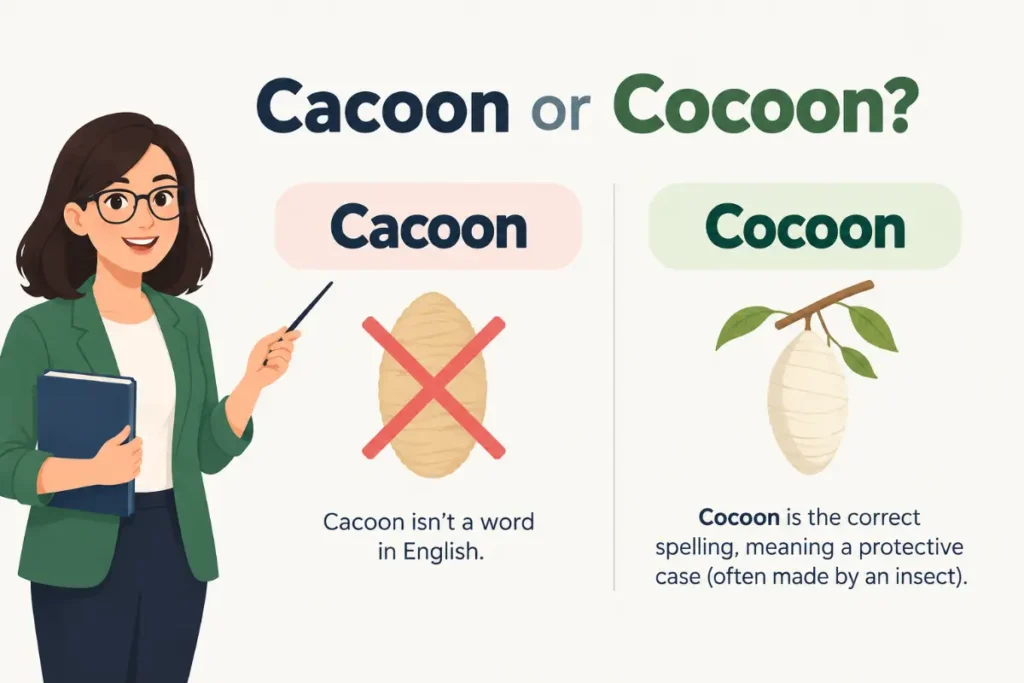
If you are searching for cacoon or cocoon, the correct spelling in standard American English is cocoon. Cacoon is a common misspelling of the word, often caused by the way people hear and pronounce it. A cocoon is a protective covering that certain insects create around themselves during a stage of development. Moths are well known for spinning cocoons, while butterflies typically form a chrysalis instead.
The word also has a figurative meaning. People use cocoon to describe a comfortable, protected space or a situation in which someone feels sheltered from outside pressures. For example, a person who spends a quiet weekend at home might say they are enjoying their cocoon of comfort.
Understanding the correct spelling is only the first step. It also helps to know how to pronounce the word, use it naturally in a sentence, understand its meaning in everyday conversation, and distinguish a cocoon from a butterfly chrysalis. These details will help you use the word confidently in school assignments, emails, professional writing, and casual conversations.
Quick Answer
Cocoon is the correct spelling, while cacoon is a misspelling in standard English. A cocoon is a protective covering spun by certain insects, especially moth caterpillars, during development. The word can also describe a safe or comfortable environment. For butterflies, the correct biological term for the pupal stage is usually chrysalis.
Cacoon or Cocoon Meaning
The difference between cacoon and cocoon is straightforward. Cocoon is the established English word, while cacoon is an incorrect spelling that commonly appears when people are unsure of the vowel in the first syllable. If you are writing about an insect’s protective covering or a person seeking comfort and privacy, use cocoon.
A cocoon can refer to a physical structure made by an insect or to a figurative feeling of protection. The exact meaning depends on the context. In biology, the word describes a covering that protects a developing insect. In everyday language, it can describe a quiet environment that helps someone feel safe, relaxed, or separated from outside distractions.
Consider these two sentences. A silkworm spins a cocoon around itself before becoming an adult moth. After a stressful week, Maya spent Saturday wrapped in a blanket and enjoying her cozy cocoon at home. The first sentence uses the literal meaning, while the second uses the figurative meaning.
Why People Spell Cocoon as Cacoon
The spelling mistake often comes from uncertainty about the first vowel. When people hear a word rather than see it written, they sometimes choose a spelling that seems to match its sound. Because the first vowel in cocoon may be less prominent in casual speech, some writers mistakenly substitute an a for the first o.
However, standard English dictionaries recognize cocoon, not cacoon, as the conventional spelling of the common noun. Spellcheck tools can help catch the error, but understanding the correct form makes it easier to notice mistakes without relying on software.
A useful memory trick is to picture the word as two connected parts: co and coon. Both parts begin with the letter o. If you are describing an insect’s protective covering, remember to write cocoon with two o’s in its first syllable.
What Is a Cocoon
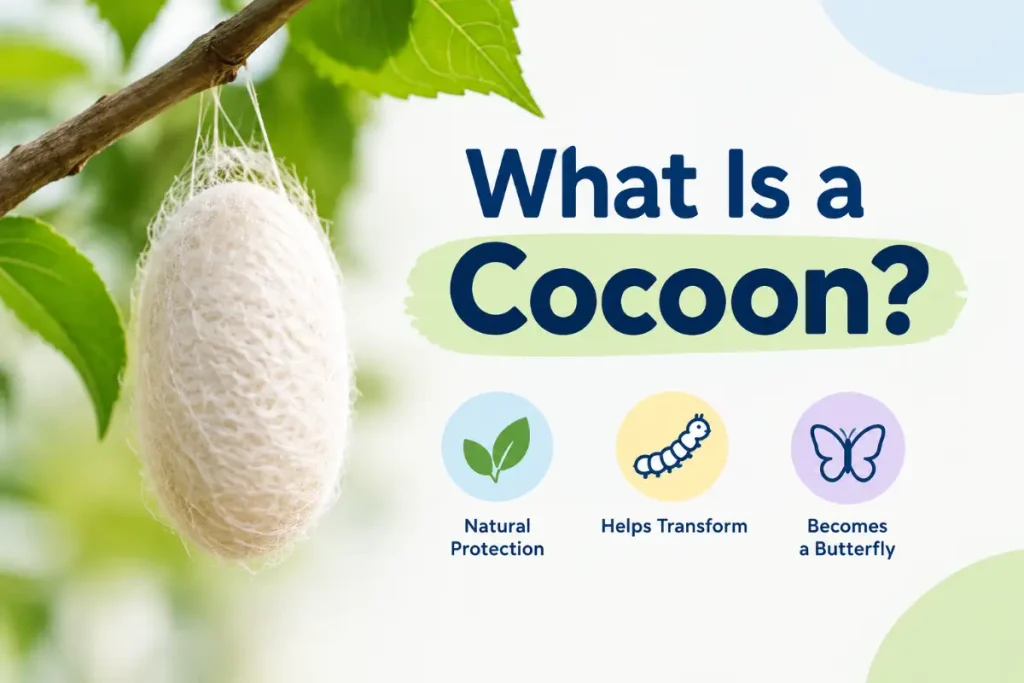
A cocoon is a protective covering made by certain insects, often from silk produced by specialized glands. The insect may use this covering while it develops into its adult form. Depending on the species, the cocoon can help protect the developing insect from environmental conditions and some external threats.
Moths are among the best known cocoon makers. A moth caterpillar may spin silk around itself or create a protective structure among leaves, soil, or other materials. Inside that covering, the insect develops during the pupal stage before emerging as an adult moth.
Not every insect creates a cocoon. Some insects develop without spinning a silk covering, and different species use different structures and strategies. This distinction matters when writing about insects because cocoon is not a universal name for every protective stage of insect development.
The Purpose of a Cocoon
A cocoon provides a protective environment during a vulnerable stage of development. Its structure and materials vary by species, so not every cocoon looks the same. Some are soft and silky, while others incorporate leaves, soil, or other surrounding materials.
Silkworms are a familiar example because they produce silk cocoons that humans can process into silk fibers. Other moth species use cocoons as part of their natural life cycle without having any connection to silk production for clothing.
The main point is that a cocoon is a structure associated with development and protection. It is not the adult insect itself, and it is not simply another name for a butterfly’s wings or a caterpillar’s body.
Cocoon vs Chrysalis
People often use cocoon and chrysalis as if they mean the same thing, especially when talking about butterflies. In biological writing, however, the distinction is useful. A cocoon is a protective covering spun by an insect, while a chrysalis is the pupal stage of a butterfly.
Most butterflies do not spin a silk cocoon around their pupae. Instead, a butterfly caterpillar develops into a pupa called a chrysalis. The chrysalis may attach to a plant or another surface, and its outer surface serves as the visible covering of the developing butterfly.
Moths vary more widely. Many moth caterpillars spin cocoons around their pupae, although some moth species pupate without a typical silk cocoon. The exact life cycle depends on the species.
| Feature | Cocoon | Chrysalis |
|---|---|---|
| Meaning | Protective covering made by certain insects | Pupal stage of a butterfly |
| Common association | Many moths and other insects | Butterflies |
| Structure | Often spun from silk or made with other materials | The pupa itself rather than a separate silk covering |
| Main role | Provides protection during development | The stage during which the butterfly develops |
| Example | A silkworm spins a cocoon | A butterfly forms a chrysalis |
For everyday conversation, people may understand what you mean if you use cocoon loosely when describing a butterfly’s development. However, if you are writing a school report, science article, or educational resource, chrysalis is the more accurate term for the butterfly pupa.
How to Pronounce Cocoon
In American English, cocoon is commonly pronounced kuh KOON. The first syllable has a short, unstressed sound, while the second syllable receives the emphasis. Its IPA pronunciation is /kəˈkuːn/.
You can divide the word into two syllables: co-coon. The first syllable sounds like the beginning of words such as collect, and the second rhymes with soon. When saying the word aloud, place the stronger stress on the second syllable rather than giving both syllables equal emphasis.
The pronunciation can contribute to the spelling confusion. When a word is familiar from conversation but less familiar in writing, people may remember its sound without remembering the exact letters. Learning the pronunciation alongside the spelling can make the word easier to recognize and use correctly.
Cocoon in a Sentence
The word cocoon works in many contexts, from biology and education to everyday conversation. It can describe an actual insect structure or a figurative environment that provides comfort and protection. The surrounding words usually make the intended meaning clear.
Here are examples that demonstrate the different uses.
Examples of Cocoon in Biology
1. The silkworm spun a delicate cocoon around its body.
2. The student observed a moth cocoon during the science lesson.
3. A protective cocoon sheltered the developing insect.
4. The caterpillar disappeared into its cocoon as part of its life cycle.
5. Researchers examined the cocoon to learn more about the insect’s development.
6. The moth emerged from its cocoon after completing its pupal stage.
7. Some caterpillars build cocoons using silk produced by specialized glands.
8. The teacher explained why certain moths form cocoons before becoming adults.
These examples use cocoon in its literal biological sense. Notice that the plural form is cocoons, with an s added to the end.
Examples of Cocoon in Everyday English
1. She wrapped herself in a blanket and settled into her cozy cocoon.
2. The quiet cabin became a cocoon away from the noise of the city.
3. He created a comfortable cocoon in his bedroom with soft lighting and warm blankets.
4. After a busy week, I wanted to stay home and enjoy my little cocoon of peace.
5. The curtains and comfortable furniture gave the reading room a cocoon like atmosphere.
6. She used noise canceling headphones to create a cocoon of concentration while working.
7. The small apartment felt like a cocoon during the winter storm.
8. He built a peaceful routine that allowed him to retreat into a cocoon of privacy.
These sentences use cocoon figuratively. The word suggests shelter, comfort, privacy, or separation from the outside world.
What Does Living in a Cocoon Mean
The expression living in a cocoon usually means living in a sheltered environment with limited exposure to outside experiences, problems, or viewpoints. The phrase compares a person’s circumstances to an insect protected inside a cocoon. Depending on the context, it can suggest comfort and safety or a lack of awareness about the wider world.
For example, someone who spends most of their time at home and avoids unfamiliar situations might be described as living in a cocoon. The speaker may mean that the person enjoys a peaceful routine, but the phrase can also suggest that the person has become isolated from different perspectives.
Consider the sentence, “Growing up in a small town, he sometimes felt as if he lived in a cocoon.” This does not mean that he lived inside an actual insect covering. It means his surroundings felt sheltered or limited compared with the outside world.
The expression is not automatically negative. A person might deliberately create a cocoon at home to rest, recover from stress, or enjoy privacy. The tone depends on the situation and the speaker’s intention.
Cocoon as a Symbol of Comfort and Protection
Writers often use cocoon as a metaphor for a place that feels safe and peaceful. A bedroom, a favorite reading chair, or a quiet home can become a personal cocoon when someone needs a break from outside demands. The image suggests a barrier between the person and the noise or pressure of everyday life.
For example, “The cabin offered a cocoon of warmth during the snowstorm” creates an image of comfort surrounded by harsh weather. Similarly, “Music became her cocoon during a difficult period” suggests that listening to music helped her feel protected or emotionally supported.
This figurative use appears in literature, personal essays, lifestyle writing, and everyday conversation. It can communicate comfort without requiring a long explanation.
When the Expression Suggests Isolation
Living in a cocoon can also describe someone who avoids reality or remains unaware of problems outside their immediate surroundings. In this sense, the metaphor suggests that protection has become a limitation. A person may feel comfortable in a familiar environment but miss important experiences or information.
For example, “He lived in a cocoon and never understood the challenges facing his neighbors” suggests that his sheltered life kept him from seeing other people’s difficulties. The phrase criticizes his limited awareness rather than praising his comfort.
When using this expression, pay attention to context. If you want to praise a peaceful environment, phrases such as cocoon of comfort or cocoon of warmth work well. If you want to describe limited awareness, living in a cocoon communicates that idea more clearly.
Cocoon as a Verb
Although cocoon is commonly used as a noun, it can also function as a verb. To cocoon someone or something means to surround, cover, shelter, or protect it in a way that resembles a cocoon. In figurative use, the verb often describes creating a comfortable or protected environment.
For example, “She cocooned herself in a thick blanket on the cold evening.” The verb describes the action of wrapping herself in something warm. Another example is, “The parents cocooned their child in love and support,” which uses the word metaphorically to describe emotional protection.
The verb can also appear in forms such as cocooned and cocooning. For instance, “He spent the weekend cocooning at home” suggests that he stayed in a comfortable private environment, away from outside demands.
This usage is understandable in modern English, although it may sound more figurative or expressive than simply saying stayed home or wrapped up. Choose it when the image of shelter or enclosure adds something meaningful to the sentence.
Cocoon Word Origin and Spelling
The English word cocoon came into use through French, from the French word cocon, which referred to a silkworm’s covering. The word is connected with the silk production associated with certain insects. Its history reflects the original physical meaning of a protective covering.
Over time, English speakers extended cocoon beyond its biological meaning. The word began to describe places, situations, and experiences that surround someone with comfort or protection. This figurative meaning is now common in everyday language.
The spelling remains cocoon in standard English. There is no standard American or British spelling distinction that makes cacoon acceptable as a variant. If you are writing for a US audience, use cocoon in both scientific and figurative contexts.
Common Spelling Mistakes With Cocoon
The most obvious mistake is writing cacoon instead of cocoon. Because cacoon is not the standard spelling, it should be corrected in schoolwork, professional writing, published articles, and everyday messages. The mistake does not create a separate word with an established meaning.
Incorrect: The butterfly stayed inside its cacoon.
Correct: The butterfly stayed inside its cocoon.
The correction fixes the spelling, although a more scientifically precise sentence might refer to a butterfly developing inside a chrysalis. The right word depends on the meaning and the insect being discussed.
Another common issue is confusing cocoon with a chrysalis. These terms are related to insect development, but they do not mean exactly the same thing. A cocoon is a covering, while a chrysalis is the butterfly’s pupal stage.
Incorrect: The butterfly caterpillar spun a chrysalis around itself.
Correct: The butterfly caterpillar formed a chrysalis.
The second sentence uses the more accurate term for the butterfly’s pupal stage. Some butterflies attach their chrysalises to surfaces rather than spinning a separate covering around them.
Cocoon in Formal and Casual Writing
Cocoon is a versatile word that works in both formal and informal settings. In scientific writing, it usually has a literal meaning related to insect development. In everyday writing, it often carries a figurative meaning connected with comfort, privacy, or protection.
For a science assignment, you might write, “The moth caterpillar spun a cocoon before entering the pupal stage.” This sentence communicates a biological process clearly. In a personal message, you might write, “I am staying home tonight and enjoying my cozy cocoon,” which sounds relaxed and conversational.
In professional writing, the figurative meaning can work when the context supports it. For example, a writer describing a quiet office might call it a cocoon of concentration. However, if the goal is to give a direct instruction or technical explanation, simpler wording may be more effective.
The main rule is to match the word to your audience. Cocoon is familiar enough for general readers, but its metaphorical use can feel expressive rather than strictly factual.
Frequently Asked Questions
Is cacoon or cocoon correct
Cocoon is the correct spelling in standard English. Cacoon is a misspelling and is not the accepted spelling of the common noun. Use cocoon when writing about an insect’s protective covering or a figurative environment that provides comfort, privacy, or protection.
What does cocoon mean
A cocoon is a protective covering that certain insects create during development, often using silk. The word can also describe a comfortable or sheltered environment. For example, a moth may develop inside a cocoon, while a person may describe a quiet home as a cocoon of peace.
Do butterflies live in cocoons
Butterflies typically develop inside a pupal stage called a chrysalis rather than a silk cocoon. Many moths spin cocoons around their pupae, although insect development varies by species. In everyday conversation, people sometimes use cocoon loosely, but chrysalis is the more precise term for a butterfly pupa.
How do you pronounce cocoon
Cocoon is commonly pronounced kuh KOON in American English, with the stress on the second syllable. Its IPA pronunciation is /kəˈkuːn/. The first syllable is unstressed, and the second rhymes with soon. Learning the pronunciation can help you remember the correct spelling.
What does living in a cocoon mean
Living in a cocoon means living in a sheltered environment with limited exposure to outside experiences or problems. The expression can suggest comfort, safety, or isolation, depending on the context. Someone who enjoys a peaceful home may describe it positively, while someone who avoids the wider world may be described as living in a cocoon negatively.
Can cocoon be used as a verb
Yes, cocoon can function as a verb meaning to surround, shelter, or protect someone or something. For example, “She cocooned herself in a blanket” describes wrapping herself in warmth. The forms cocooned and cocooning are also used, especially in figurative descriptions of comfort and privacy.
What is the plural of cocoon
The plural of cocoon is cocoons. You simply add s to the singular form. For example, “The researcher examined three cocoons” is grammatically correct. The spelling does not change when the word refers to several insect coverings or several figurative spaces.
Is cocoon an American or British spelling
Cocoon is the standard spelling in both American and British English. There is no regional spelling difference between the two varieties. Cacoon is a misspelling rather than a legitimate regional variant, so cocoon is the correct choice for writing intended for readers in the United States or elsewhere.
Conclusion
The correct spelling is cocoon, not cacoon. A cocoon is a protective covering created by certain insects during development, especially many moths. The word also has a familiar figurative meaning that describes a comfortable, sheltered, or private environment. When writing about butterflies, remember that chrysalis is the more accurate term for the butterfly’s pupal stage.
To avoid the spelling mistake, remember that cocoon begins with co and contains two o’s in its first syllable. Use the word in scientific explanations, everyday conversation, and figurative descriptions when it fits the context. Once you understand its spelling and meaning, you can use cocoon confidently in school assignments, professional writing, and casual communication.