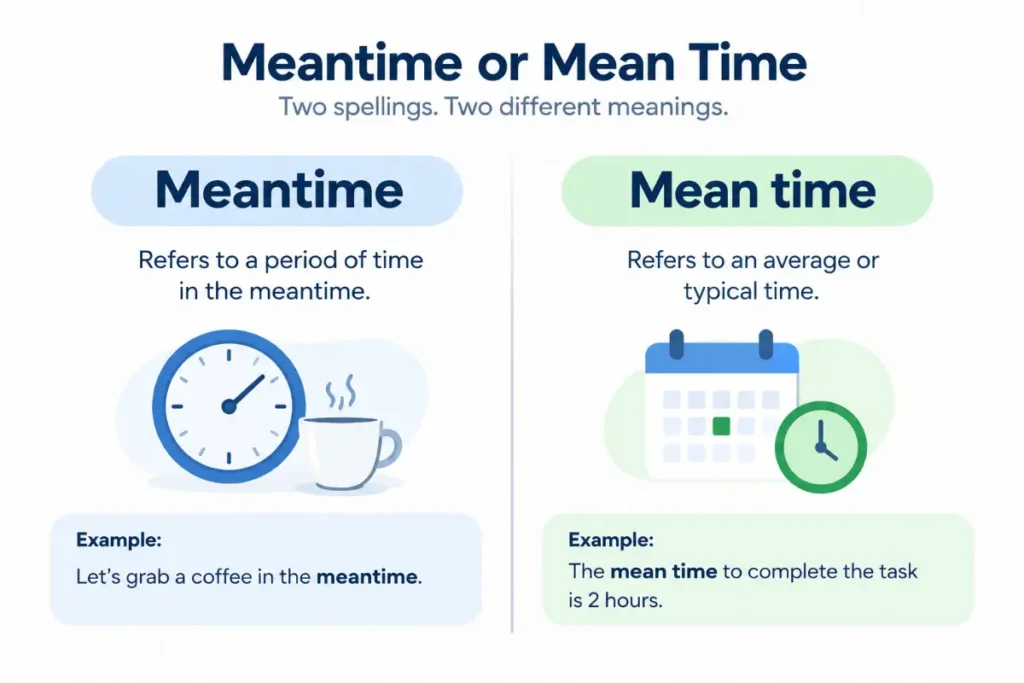
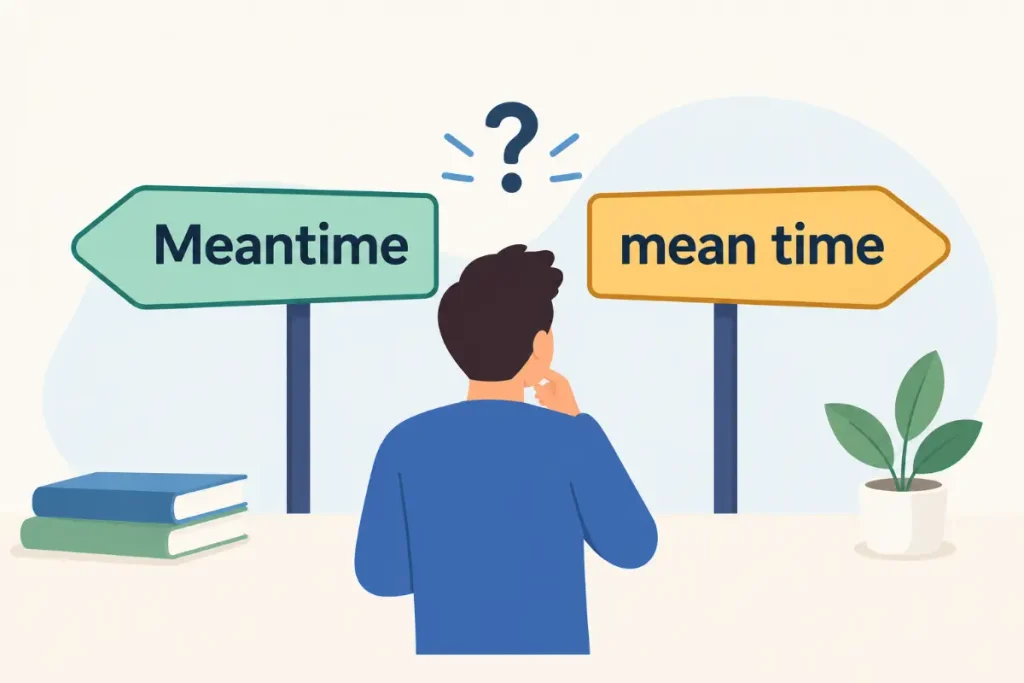
If you are unsure about meantime or mean time, the correct choice depends on what you want to say. Meantime is usually a noun that refers to the period between two events or an adverb that means during the intervening period. Mean time, written as two words, has a different meaning in mathematics, statistics, and time calculations. It can refer to an average time or a calculated time value, depending on the context.
For example, you might write, “The new employee will start next Monday. In the meantime, we will share the workload.” Here, meantime refers to the period before the employee starts. However, a scientist calculating the average time required to complete a task might use the phrase mean time. Both forms are legitimate, but they are not interchangeable in ordinary sentences.
The confusion comes from the fact that the two forms share the same words and sound nearly identical. Their meanings become much clearer when you look at their grammatical roles and the situations in which people use them. This guide explains the spelling difference, common expressions, sentence examples, synonyms, mathematical meaning, and frequent mistakes so you can choose the right form confidently in American English.
Just like this pair, commonly confused English words can have similar spellings but different meanings, so understanding their correct usage helps you write more clearly.
Quick Answer
Meantime is the standard one word form when you mean the period between two events or during the intervening period. For example, “The package will arrive tomorrow. In the meantime, you can use mine.” Mean time, written as two words, is appropriate when mean functions as a separate adjective or part of a technical expression involving average time or a calculated time value.
Meantime or Mean Time Meaning
The main difference comes down to meaning and grammatical function. Meantime refers to an intervening period, while mean time generally refers to a time value described by the word mean, often in a mathematical or technical context. In everyday American English, meantime is the form you will usually need when discussing what happens while waiting for something else.
Consider these examples. “I will finish the report tomorrow. In the meantime, please review the budget.” The word meantime identifies the period before the report is finished. Now consider a technical sentence such as “The mean time for the five trials was calculated from the recorded durations.” Here, mean describes a calculated average time rather than an intervening period.
| Feature | Meantime | Mean Time |
|---|---|---|
| Spelling | One word | Two words |
| Main meaning | The period between events | A time value described by mean |
| Common use | Everyday conversation and writing | Mathematics, statistics, and technical contexts |
| Grammatical role | Noun or adverbial expression | Mean functions as an adjective modifying time |
| Typical expression | In the meantime | Mean time for a set of trials |
| Example | In the meantime, call the office. | The mean time was 12 minutes. |
The table shows why context matters. The two forms are not competing spellings of one expression in every situation. Meantime has its own established meaning, while mean time is a combination of two separate words.
What Does Meantime Mean
Meantime refers to the period between two events or during the time before something else happens. It allows you to discuss what is happening now while waiting for a future event or while another process continues. The word is especially common in the expression in the meantime.
For example, “The mechanic needs two days to repair the car. In the meantime, I will take the bus to work.” The sentence explains what the speaker plans to do during the waiting period. The word does not describe an average or a mathematical measurement.
Meantime can also appear without the preposition in. For instance, “The manager was preparing the presentation. Meantime, the team gathered the latest sales figures.” This usage is grammatical, although in the meantime is often the more natural choice in contemporary American English.
Meantime as a Noun
Meantime can function as a noun referring to the intervening period. It often appears after the definite article the and the preposition in. The phrase identifies a stretch of time between a current situation and an expected event.
For example, “The school will announce the results on Friday. In the meantime, students should check their email regularly.” The results have not arrived, but the students still have things to do before Friday. Meantime neatly captures that temporary period.
Other examples include “We are waiting for approval, so we will continue our current process in the meantime” and “The new office opens next month. In the meantime, employees will work remotely.” In both cases, the word refers to the period before the next event.
Meantime as an Adverbial Expression
Meantime can also help explain when an action takes place. In this role, it means during the intervening period or while something else is happening. The expression often connects two related actions or situations.
For example, “The chef prepared the main course. Meantime, the servers arranged the tables.” The word links the preparation of the meal with another activity happening during the same period. In modern American writing, however, writers often prefer meanwhile in this construction.
The choice between meantime and meanwhile is usually stylistic rather than a major difference in meaning. Both can refer to actions occurring during an intervening period, but in the meantime is the more familiar expression for many everyday situations.
What Does Mean Time Mean
Mean time is a two word phrase in which mean describes time. In mathematics and statistics, it can refer to an average of recorded durations. The exact interpretation depends on the field and the surrounding sentence.
Imagine that three students take 10, 12, and 14 minutes to finish a quiz. The mean completion time is 12 minutes because the average of the three recorded times is 12. In this context, mean time refers to a calculated value, not the period between two events.
The phrase can also appear in specialized timekeeping or scientific contexts. Its meaning may depend on a particular technical definition, so readers should examine the subject being discussed instead of assuming that every use refers to an arithmetic average.
Mean Time in Mathematics
In mathematics, mean commonly refers to an average. When the values represent durations, mean time can describe the average amount of time required to complete an activity, finish a process, or reach a result. The phrase is useful when comparing several observations rather than describing one isolated event.
Suppose a delivery company records five delivery times: 20, 25, 30, 35, and 40 minutes. The mean delivery time is 30 minutes. The company can use that result to summarize its recorded deliveries, although the average alone does not reveal how much the times vary.
The term needs context because mean has several mathematical uses. A mean can refer to different measures of central tendency, including an arithmetic mean or other specialized means. In ordinary statistics, if someone simply says mean time without further qualification, an arithmetic average of recorded durations may be intended, but the full context should determine the interpretation.
Mean Time Formula
If you want to calculate the arithmetic mean of several recorded times, add the values and divide their sum by the number of observations.
\[ \text{Mean Time}=\frac{\text{Sum of Recorded Times}}{\text{Number of Observations}} \]
For example, imagine that a worker completes a task in 8 minutes, 10 minutes, and 12 minutes across three trials. Add the times to get 30 minutes, then divide by three. The mean time is 10 minutes.
This formula works when the recorded values can be meaningfully averaged and use compatible units. If some times are recorded in seconds and others in minutes, convert them to the same unit before calculating the average. Also remember that the mean can be affected by unusually high or low observations, so it does not always represent the most typical result.
Mean Time in Scientific and Technical Contexts
In scientific research, mean time may describe an average duration measured across multiple experiments or observations. Researchers might calculate the mean time needed for a chemical reaction, a computer process, or a laboratory procedure. The surrounding methodology determines which measurements count and how the average should be interpreted.
Technical fields can also use longer expressions such as mean time between failures and mean time to repair. These terms have specific meanings in reliability engineering and maintenance planning. Mean time between failures generally concerns the average operating time between failures, while mean time to repair concerns the average time required to restore a failed system.
These expressions are not interchangeable with meantime. For example, a maintenance report might state that the mean time to repair a machine is two hours. A separate sentence might say that technicians will use a backup machine in the meantime. The first refers to a measured duration, while the second refers to the period before another event or action.
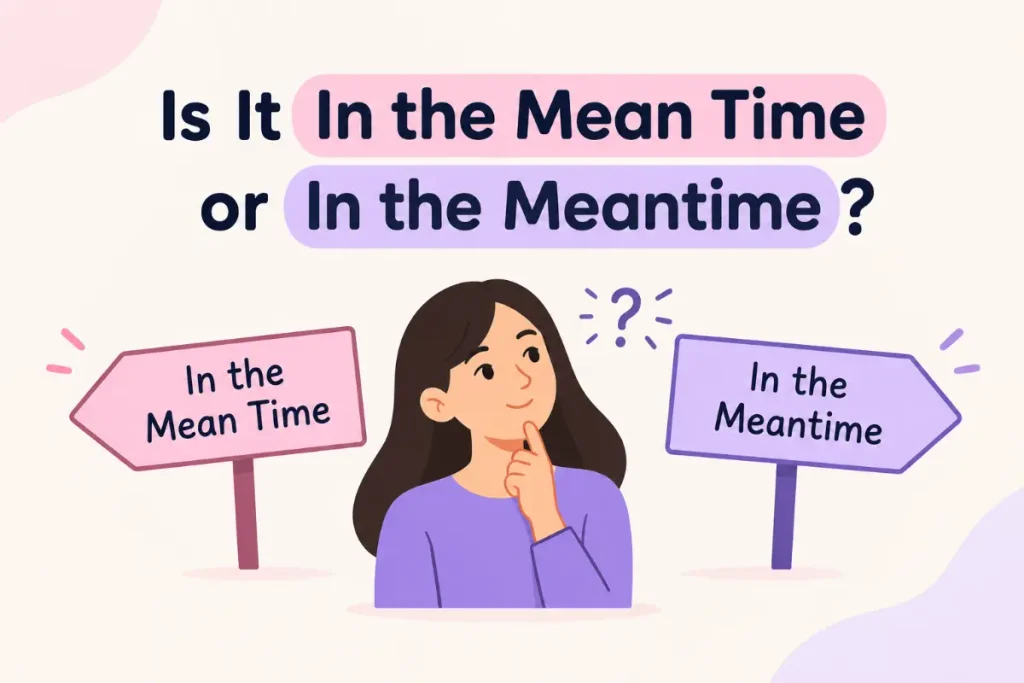
Is It In the Mean Time or In the Meantime
In ordinary American English, in the meantime is the standard expression when you mean during the intervening period. It is written as three words: in, the, and meantime. Writing in the mean time is generally not the standard choice for this everyday meaning.
For example, write “The doctor will see you shortly. In the meantime, please take a seat.” The phrase refers to the period before the appointment begins. Writing “In the mean time, please take a seat” would look incorrect or unnecessarily unusual in standard contemporary usage.
The two word phrase mean time is still valid in appropriate technical contexts. For example, a researcher might discuss the mean time recorded during an experiment. However, that use does not make in the mean time a standard substitute for the familiar expression in the meantime.
Is For the Meantime Grammatically Correct
The expression for the meantime is understandable, but it is generally less natural than in the meantime in standard American English. When you want to describe what happens during a waiting period, in the meantime is the safer and more idiomatic choice.
For example, “The permanent manager will start next month. In the meantime, an assistant manager will oversee the department.” This sentence sounds natural because the phrase connects the temporary arrangement with the period before the permanent manager starts.
Instead of writing “For the meantime, use the temporary password,” consider “In the meantime, use the temporary password.” If you want to express a temporary arrangement rather than an intervening period, you can also use for now or temporarily. These alternatives often sound more natural in casual and professional communication.
Learning about everyday spelling differences can help you recognize when words are written as one word or two, just as understanding flier and flyer helps you choose the right term for your context.
Meantime or Mean Time Examples
Examples make the difference easier to recognize because the same general subject can appear in both everyday and technical contexts. The key is to notice if the sentence refers to an intervening period or a measured duration.
Examples Using Meantime
1. The store will reopen on Monday. In the meantime, customers can shop online.
2. My laptop is being repaired. In the meantime, I am using my work computer.
3. The teacher is preparing the next lesson. In the meantime, students can finish their assignments.
4. The company expects the shipment tomorrow. In the meantime, the warehouse team is checking existing stock.
5. Your application is still under review. In the meantime, please keep your contact information updated.
6. The restaurant is renovating its dining room. In the meantime, it will offer takeout only.
7. The doctor is reviewing the test results. In the meantime, the patient should follow the current care instructions.
8. We are waiting for the final approval. In the meantime, the team can prepare the documents.
9. The new bus route starts next week. In the meantime, passengers should use the existing stops.
10. The software update is not ready yet. In the meantime, continue using the current version.
In all ten examples, meantime refers to the period before an expected change, decision, or event. The phrase helps connect a temporary situation with what is happening during the wait.
Examples Using Mean Time
1. The mean time for the three trials was 10 minutes.
2. The researchers calculated the mean time needed to complete the task.
3. The mean time across all recorded deliveries was 28 minutes.
4. The engineer compared the mean time required by two different machines.
5. The class calculated the mean time from the students’ experiment results.
6. The report lists the mean time needed to process each request.
7. The laboratory measured the mean time for the reaction to reach completion.
8. The analyst calculated the mean time using data from the full week.
9. The maintenance team tracks mean time to repair equipment after a failure.
10. The reliability report includes mean time between failures for each system.
These examples use mean time in measurement, mathematics, or technical discussion. The word mean describes a time value rather than a period of waiting between events.
Meantime Synonyms and Alternatives
The best synonym for meantime depends on the sentence. Meanwhile is often the closest alternative because it can refer to something happening during the same period or while another event is pending. For the phrase in the meantime, other natural options include during this period, until then, for now, and while we wait.
Consider the sentence, “The office will reopen next week. In the meantime, employees can work from home.” You could write, “The office will reopen next week. Until then, employees can work from home.” Both versions communicate the temporary arrangement clearly.
However, the alternatives are not identical in every context. Meanwhile often introduces a parallel action, while until then emphasizes the period before a specific future event. For now usually describes a temporary decision or arrangement rather than the period between two events.
Mean time has a different set of related terms. In a mathematical context, average time may be an appropriate alternative if the intended calculation is an arithmetic mean. In a technical context, however, use the terminology defined by the relevant field rather than replacing it with a loose synonym.
Meantime Etymology
Meantime developed from the combination of mean and time. Historically, mean could express an intermediate position or something occupying a middle place. The word time refers to a period or sequence of events, so the combined expression came to describe the interval between events.
That history helps explain the modern expression in the meantime. It refers to the period that lies between the present situation and another event or between two events more generally. The modern spelling as one word reflects the established use of meantime as a single lexical item.
Mean time remains two words when mean functions independently as a modifier of time. For example, a mathematical sentence can describe the mean time for a process because mean identifies the kind of time value being measured. The difference in spelling reflects the difference in function and meaning.
Common Mistakes With Meantime and Mean Time
One frequent mistake is separating meantime into two words when using the everyday expression. For example, “We will call you in the mean time” should normally be written as “We will call you in the meantime.” The one word form is standard for the intervening period.
Another mistake is using meantime when discussing an average duration. For example, “The meantime for the five trials was 12 minutes” is not the standard way to describe an average. If the intended meaning is the arithmetic average of the recorded durations, write “The mean time for the five trials was 12 minutes.”
Writers can also confuse in the meantime with for the meantime. Although readers will probably understand the latter, in the meantime is more idiomatic for standard American English. If you are describing a temporary arrangement, for now may be a clearer alternative.
Finally, do not assume that every use of mean time involves a mathematical average. Specialized fields may define technical time measures more precisely. Check the surrounding terminology and use the wording that accurately reflects the intended calculation or concept.
How to Choose the Right Form
When you need to decide between meantime and mean time, start by identifying the meaning of the sentence. If you are talking about what happens while you wait for something else, choose meantime. If you are describing a time value calculated from several observations or using a technical expression, mean time may be correct.
For everyday writing, in the meantime is almost always the natural choice when you want to connect a temporary action with a future event. It works well in emails, text messages, school assignments, workplace notices, and general conversation. For technical or academic writing, mean time is appropriate when the word mean modifies time as part of a measurement or defined term.
Here is a quick editing test. Replace meantime with during the intervening period. If the sentence still makes sense, the one word form is probably correct. If you can replace mean time with average duration and preserve the intended meaning, the two word phrase may be appropriate.
Frequently Asked Questions
Is meantime one word or two words
Meantime is one word when it refers to the period between events. The standard expression is in the meantime, as in “The meeting starts at three. In the meantime, you can review the agenda.” Mean time is written as two words when mean functions separately to describe a time value, often an average duration.
Is it in the mean time or meantime
For everyday American English, write in the meantime. The phrase means during the period before something else happens or while you wait for an event. In the mean time is not the standard spelling for this expression, although mean time can be correct as a separate phrase in mathematical and technical contexts.
Is for the meantime grammatically correct
For the meantime is understandable, but in the meantime is generally more natural in standard American English. Use in the meantime to describe what happens during a waiting period. Use for now when you want to describe a temporary decision or arrangement, such as “For now, we will keep the existing schedule.”
What is the meaning of mean time
Mean time can refer to an average duration calculated from several recorded times. For example, if a task takes 8, 10, and 12 minutes across three trials, its arithmetic mean time is 10 minutes. The precise meaning depends on the context, particularly in scientific and technical writing.
What is the meaning of average time
Average time generally refers to a typical or calculated duration based on multiple observations. In a basic arithmetic calculation, you add the recorded times and divide by the number of observations. The result summarizes the measurements, but it does not necessarily describe every individual trial or reveal how widely the observations vary.
What is the mean time formula
To calculate the arithmetic mean time, add all the recorded durations and divide the total by the number of observations. For example, the mean of 8, 10, and 12 minutes is 10 minutes because their sum is 30 and 30 divided by 3 equals 10. Make sure all measurements use compatible units.
What is another word for meantime
Meanwhile is often the closest alternative to meantime. Depending on the sentence, you can also use until then, during this period, or while we wait. For a temporary arrangement, for now may sound more natural. Choose the alternative that preserves the relationship between the current situation and the event you are waiting for.
What does in the meantime mean in a sentence
In the meantime means during the period before something else happens or while another situation continues. For example, “The new phone will arrive Friday. In the meantime, you can borrow mine.” The phrase connects the temporary arrangement with the period before the phone arrives.
Similar-looking words can be easy to mix up, and exploring words with different meanings such as receipt and recipe can help you avoid confusion when choosing between fliers and flyers.
Conclusion
The choice between meantime or mean time depends on what you want to communicate. Use meantime as one word when you mean the period between events, especially in the familiar expression in the meantime. Use mean time as two words when mean describes a time value, such as an average duration in mathematics or a technical measurement.
For everyday American English, in the meantime is the natural and reliable choice. In technical writing, check the intended calculation or definition before choosing the two word form. If you can replace the phrase with during the intervening period, meantime is likely correct. If you mean average duration, mean time may be the better fit.