Have you ever wondered if the correct spelling is spicey vs spicy? Both forms look reasonable, especially when you consider how English words often change when we add the letter Y. However, only one spelling is accepted in standard English. The correct word is spicy, while spicey is a common spelling mistake.
Spicy is an adjective that describes food with a strong flavor, especially when it contains spices or ingredients such as chili peppers, black pepper, ginger, or cayenne. It can also describe something exciting, bold, controversial, or slightly provocative. You might use it when talking about a hot curry, a flavorful sauce, or an interesting conversation.
The confusion happens because the noun spice ends with the letter E. Some writers assume that the E should remain when adding Y. However, English spelling rules explain why that does not happen in this case.
In this guide, you will learn the correct spelling, meaning, pronunciation, grammar rules, and different ways to use spicy in everyday English. You will also discover common mistakes, practical examples, and simple tricks to remember the correct form.
Quick Answer
Spicy is the correct spelling in standard American and British English. Spicey is an incorrect spelling when you intend to describe food with strong or hot flavors. For example, write “This chicken is spicy,” not “This chicken is spicey.” The correct spelling drops the final E from spice before adding Y.
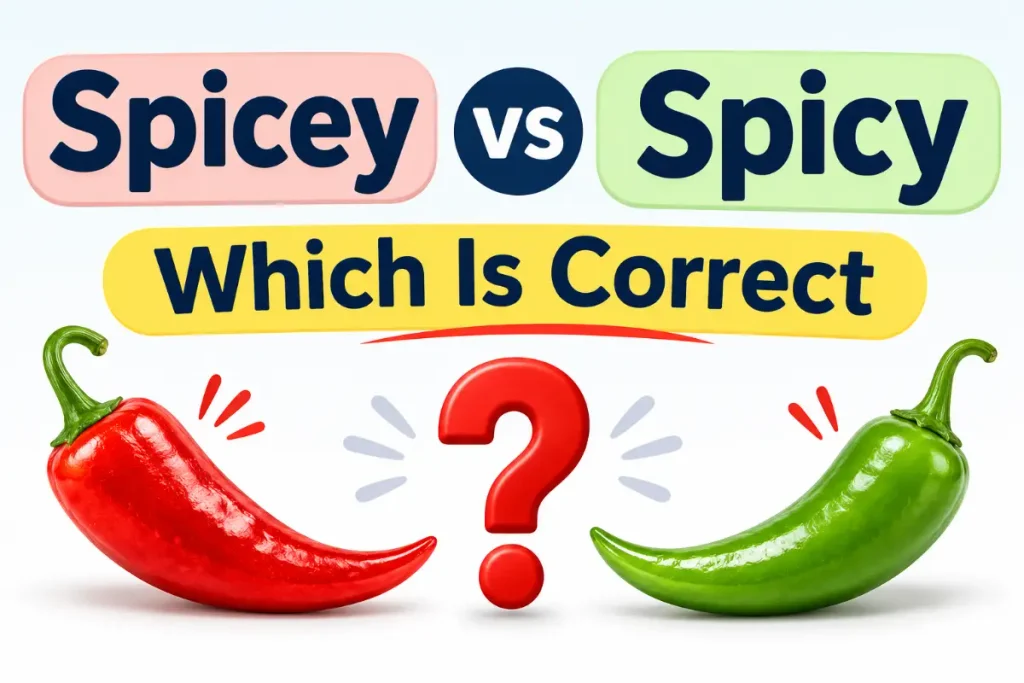
Spicey or Spicy Which Is Correct
The correct spelling is spicy, with five letters: S, P, I, C, and Y. It is an adjective that describes something containing strong spices or producing a hot, sharp, or pungent flavor.
For example:
- This curry is too spicy for me.
- I love spicy Mexican food.
- She added chili sauce to make the noodles spicy.
- That restaurant serves some of the best spicy chicken.
- Would you like your meal mild or spicy?
In each example, spicy describes the flavor or heat of food. It tells the reader that the food contains ingredients that create a strong or hot taste.
On the other hand, spicey is not the standard spelling of this adjective. Although it may look logical because the original noun is spice, English spelling rules require removing the final E before adding Y.
Here is the simple spelling pattern:
Spice + Y = Spicy
The final E disappears, leaving the correct five letter word.
This spelling rule is useful because many English adjectives follow similar patterns when they are formed from nouns or other word forms.
Why Do People Write Spicey Instead of Spicy
There are several reasons people accidentally write spicey.
First, the confusion often comes from the original word spice. Since spice ends with E, writers may assume that adding Y should produce spicey. However, the final E is dropped when forming the adjective.
Second, people sometimes spell words based on how they look rather than following established spelling patterns. The incorrect form may appear natural because English contains many words that retain their final E when another ending is added.
Third, typing quickly can lead to spelling mistakes. Someone writing a food review, social media caption, or restaurant description may type spicey without checking the spelling.
Finally, some writers may have seen the incorrect spelling online and remembered it as the correct form. Repeated exposure to a spelling mistake does not make it standard English.
The easiest way to avoid this error is to remember that the adjective has five letters. Whenever you describe food with a hot or strong flavor, write spicy.
What Does Spicy Mean
Spicy is an adjective that describes a strong, rich, or hot flavor produced by spices and other ingredients. It commonly refers to food that creates a noticeable sensation on the tongue.
However, its meaning is not limited to heat. Depending on the context, spicy can describe something flavorful, exciting, bold, controversial, or slightly provocative.
Understanding these meanings will help you use the word naturally in different situations.
Spicy as a Description of Food
The most common meaning of spicy relates to food. It describes dishes that contain ingredients such as chili peppers, cayenne pepper, black pepper, ginger, or other flavoring spices.
For example:
- My mother makes spicy chicken curry.
- This restaurant has a delicious spicy soup.
- I prefer spicy noodles over plain noodles.
- The chef prepared a spicy seafood dish.
- These tacos have a spicy tomato sauce.
In these sentences, spicy describes the flavor of the food. It helps someone understand that the dish has a strong taste or noticeable heat.
The word is especially common in restaurant menus, recipes, food reviews, and everyday conversations about meals.
Spicy as a Description of Strong Flavor
Not every spicy food needs to burn your mouth. Sometimes, spicy describes food with a rich combination of seasonings and aromatic ingredients.
For example, ginger, cinnamon, cloves, and certain spice blends can create warm or bold flavors without producing the same burning sensation as hot peppers.
Consider these examples:
- The soup has a spicy ginger flavor.
- This sauce has a warm and spicy aroma.
- I enjoy spicy seasoning in roasted vegetables.
- The recipe uses several spicy ingredients.
- The tea has a slightly spicy taste.
These examples show that spicy can describe a complex flavor rather than only extreme heat.
Spicy as Slang
In informal English, spicy can also describe something exciting, bold, controversial, or surprising.
People often use this meaning in conversations, social media posts, and entertainment discussions.
For example:
- That was a spicy comment.
- She shared some spicy gossip.
- The debate became spicy after his response.
- This television show has a few spicy scenes.
- That is a spicy opinion about the new movie.
In these examples, spicy does not describe food. Instead, it suggests that something is interesting, daring, provocative, or likely to attract attention.
The exact meaning depends on the conversation. A spicy comment might be humorous, bold, controversial, or slightly offensive.
Spicy as a Description of Romantic or Adult Content
Spicy can also describe romantic or suggestive content, especially in informal conversations and online entertainment discussions.
For example:
- The novel has a few spicy scenes.
- They recommended a spicy romance book.
- This movie has some spicy moments.
- She enjoys reading spicy romance stories.
Here, spicy suggests romantic tension, intimate scenes, or mature themes. It does not refer to the literal taste of food.
This usage is informal, so it may not be suitable for every professional or academic situation.
Spicey vs Spicy Difference
The main difference is spelling. Spicy is the correct adjective, while spicey is a misspelling when used to describe food, flavor, or something exciting.
| Feature | Spicy | Spicey |
|---|---|---|
| Standard spelling | Yes | No |
| Number of letters | Five | Six |
| Final letters | CY | CEY |
| Part of speech | Adjective | Incorrect spelling of the adjective |
| Describes hot food | Yes | No |
| Describes strong flavors | Yes | No |
| Used as informal slang | Yes | No, as the intended adjective |
| Accepted in standard English | Yes | No |
Consider these examples:
Incorrect: This pizza is very spicey.
Correct: This pizza is very spicy.
The corrected sentence uses the standard adjective to describe the flavor of the pizza.
Another example:
Incorrect: I enjoy eating spicey chicken wings.
Correct: I enjoy eating spicy chicken wings.
The second sentence follows standard English spelling.
The important thing to remember is that the noun spice and the adjective spicy have different endings. The E disappears when you form the adjective.
Why Does Spice Become Spicy
The spelling change happens because of a common English word formation pattern.
The noun spice refers to a substance used to add flavor, aroma, or color to food. When you turn it into the adjective spicy, you remove the final E and add Y.
The transformation looks like this:
- Noun: Spice
- Suffix: Y
- Adjective: Spicy
The letter Y changes the word from a noun into an adjective. Instead of naming the seasoning itself, spicy describes something that contains or has the qualities of spices.
You can see a similar pattern in other English words.
| Base Word | Correct Adjective | Incorrect Form |
|---|---|---|
| Ice | Icy | Icey |
| Noise | Noisy | Noise y |
| Grease | Greasy | Greasey |
| Taste | Tasty | Tastey |
| Spice | Spicy | Spicey |
Notice that the final E disappears before Y is added in these examples.
This is a useful spelling pattern to learn because it appears in several common English adjectives.
However, English spelling does not follow one rule in every situation. Some words retain their final E when adding certain suffixes. Therefore, it is best to learn common word forms instead of assuming that every word follows the same pattern.

How to Use Spicy in a Sentence
Spicy is a versatile adjective. You can use it in conversations about food, restaurant experiences, recipes, entertainment, and personal opinions.
The following examples demonstrate its natural usage in different situations.
Everyday Conversation Examples
- I cannot eat spicy food because it upsets my stomach.
- This chicken curry is delicious but extremely spicy.
- Do you prefer spicy food or sweet food?
- My brother always orders the spiciest dish on the menu.
- Can you make the soup less spicy?
- I added some chili flakes to make the pasta spicy.
- That restaurant is famous for its spicy burgers.
- These noodles are too spicy for the children.
- She likes spicy snacks more than salty ones.
- We ordered spicy wings for dinner.
These examples show how people commonly use spicy when discussing food preferences, cooking, and restaurant experiences.
Text Message and Social Media Examples
- That spicy food challenge looks difficult.
- Your homemade salsa looks really spicy.
- This restaurant serves the best spicy tacos.
- That was a spicy reply!
- I need something spicy for dinner tonight.
- This gossip is getting spicy.
- His opinion was a little spicy.
- That spicy recipe looks amazing.
- The comments section just got spicy.
- This is the spiciest food I have ever tried.
In online conversations, the word can have both literal and figurative meanings. The surrounding message usually makes the intended meaning clear.
School and Academic Examples
- Chili peppers are commonly used to prepare spicy dishes.
- The recipe contains several spicy ingredients.
- The chef demonstrated how to prepare spicy vegetable soup.
- Some people enjoy spicy foods more than others.
- The restaurant offers a selection of spicy meals.
- Ginger can add a warm flavor to spicy recipes.
- The students compared different spicy sauces during the cooking lesson.
- The menu identifies spicy dishes with a special label.
- The experiment examined how people responded to different levels of food heat.
- The cookbook includes several spicy vegetarian recipes.
These examples demonstrate how spicy can appear in educational writing, cooking instructions, and food related discussions.
Workplace and Professional Examples
- Our restaurant is introducing a new spicy chicken sandwich.
- The chef developed a spicy sauce for the summer menu.
- Please identify the spicy dishes on the updated menu.
- Customers can request less spicy seasoning.
- The food company plans to launch a spicy snack product.
- We received positive feedback about the new spicy noodles.
- The restaurant offers mild, medium, and spicy options.
- The marketing team prepared a campaign for our spicy food collection.
- Please mention the spicy ingredients in the product description.
- The new menu includes several spicy vegetarian options.
These sentences are appropriate for workplace communication, restaurant menus, food product descriptions, and professional writing.
Common Spelling Mistakes to Avoid
Even experienced English writers sometimes make mistakes when adding suffixes to words. Understanding the following errors can help you improve your spelling and writing.
Adding Y Without Removing the Final E
This is the most common mistake involving spicy.
Incorrect: The restaurant serves spicey chicken.
Correct: The restaurant serves spicy chicken.
Explanation: Remove the final E from spice before adding Y. The correct adjective is spicy.
Using Spicey in Restaurant Reviews
Restaurant reviews often describe food, flavors, and cooking styles. Using the incorrect spelling can make an otherwise useful review look less polished.
Incorrect: Their spicey noodles are my favorite.
Correct: Their spicy noodles are my favorite.
Explanation: Spicy is the standard adjective used to describe food with a strong or hot flavor.
Confusing Spicy With Hot
Although spicy and hot can have similar meanings when describing food, they are not always interchangeable.
Spicy usually describes a strong flavor created by spices or ingredients that produce heat. Hot can describe temperature or the burning sensation caused by certain ingredients.
For example:
- The soup is hot because it just came off the stove.
- The soup is spicy because it contains chili peppers.
- The spicy curry is still hot from cooking.
The context determines the intended meaning.
Using Spicy When You Mean Flavorful
Spicy does not always mean flavorful. A dish can have plenty of flavor without being spicy.
For example:
Incorrect: This dessert is spicy because it tastes sweet.
Better: This dessert is flavorful because it tastes sweet and rich.
Explanation: Sweet, rich, savory, and spicy describe different taste qualities. Choose the adjective that accurately communicates the flavor.
Confusing Spicy With Spiced
Spicy and spiced are related, but they have slightly different meanings.
Spicy describes a strong or hot flavor.
Example: This is a spicy chicken sandwich.
Spiced means that something has been seasoned with spices.
Example: She prepared a spiced apple cake.
A dish can be spiced without being particularly spicy. For example, a cake containing cinnamon and nutmeg may have a warm, aromatic flavor without tasting hot.
Spicy vs Spiced vs Spice
These three words are related, but they perform different grammatical functions.
Spice is primarily a noun. It refers to a substance used to add flavor or aroma to food. It can also be used as a verb when describing the act of adding spices.
Example: Cinnamon is my favorite spice.
Spicy is an adjective. It describes food or something else with a strong, hot, or bold quality.
Example: I ordered a spicy chicken sandwich.
Spiced is the past tense and past participle of the verb spice. It also works as an adjective to describe something seasoned with spices.
Example: The restaurant serves spiced rice.
Here is a quick comparison:
| Word | Part of Speech | Meaning | Example |
|---|---|---|---|
| Spice | Noun or verb | A seasoning or the act of adding seasoning | Add some spice to the soup. |
| Spicy | Adjective | Having a strong or hot flavor | This curry is spicy. |
| Spiced | Verb or adjective | Seasoned with spices | We ordered spiced rice. |
Understanding these forms will help you select the right word when writing about food or cooking.
American and British English Spelling
There is no spelling difference between American and British English when it comes to spicy. Both varieties use the same five letter spelling.
| English Variety | Correct Spelling |
|---|---|
| American English | Spicy |
| British English | Spicy |
| Canadian English | Spicy |
| Australian English | Spicy |
The incorrect form spicey is not an accepted regional alternative.
This means you can confidently use spicy in American school assignments, British publications, Australian restaurant menus, Canadian food blogs, and professional writing.
The spelling remains the same across these English varieties.
How to Remember the Correct Spelling
If you regularly confuse spicey and spicy, a few simple techniques can help you remember the correct form.
Remember the Final E Rule
Think about what happens when you change spice into spicy.
The final E disappears before Y is added.
Spice becomes spicy.
You can use the same idea with other familiar words:
- Ice becomes icy.
- Grease becomes greasy.
- Taste becomes tasty.
- Noise becomes noisy.
Remembering these examples can help you recognize the spelling pattern.
Connect Spicy With Food
Think of a hot chili pepper or a bowl of spicy noodles whenever you need to remember the word.
For example:
- Spicy chicken.
- Spicy pizza.
- Spicy curry.
- Spicy noodles.
- Spicy sauce.
The more often you see and use the correct spelling, the easier it becomes to remember.
Practice Writing Short Sentences
Writing the word in different sentences can strengthen your spelling skills.
Try these examples:
- I love spicy food.
- This sauce is too spicy.
- She ordered spicy noodles.
- The chef prepared spicy chicken.
- We enjoy spicy Mexican dishes.
Pay attention to the final CY. This is the correct ending of the adjective.
Use Spell Checkers
Most modern writing tools can identify spicey as a spelling error and suggest spicy as the correction.
Spell checkers are useful when writing emails, blog posts, school assignments, and restaurant descriptions. However, they should support your knowledge rather than replace it.
Learning the spelling rule will help you catch mistakes even when automatic correction is unavailable.

Pronunciation of Spicy
The word spicy is generally pronounced /ˈspaɪ.si/ in American English.
It has two syllables:
- Spi: Sounds like the beginning of the word spy.
- Cy: Sounds like see.
Together, the word sounds like “SPY see.”
The first syllable receives the primary stress, so you pronounce it more strongly than the second syllable.
Here are some words with similar sounds:
- Icy.
- Pricey.
- Dicey.
- Lacy.
- Policy.
The spelling and pronunciation of spicy are consistent in standard American and British English.
Is Spicy Pronounced Differently From Spicey?
Spicey is not the standard spelling of the adjective, so it does not have a separate accepted pronunciation in this context.
People who accidentally write spicey generally intend to pronounce the word as spicy.
The correct spelling remains spicy, regardless of how someone attempts to write it.
Frequently Asked Questions
Is Spicey or Spicy Correct?
Spicy is the correct spelling in standard English. Spicey is a common spelling mistake when describing food with strong or hot flavors. The final E in spice disappears before Y is added. For example, write “I love spicy chicken” instead of “I love spicey chicken.”
Why Is Spicy Not Spelled Spicey?
Spicy is formed by removing the final E from spice and adding Y. This spelling pattern appears in several English adjectives, including icy, greasy, and tasty. Therefore, the correct spelling has five letters rather than six.
Is Spicey a Real Word?
Spicey is not an accepted standard spelling of the adjective spicy. You may encounter it in usernames, brand names, or informal writing, but that does not make it the correct spelling for ordinary English. Use spicy when describing food or something with a bold flavor.
What Does Spicy Mean in Slang?
In slang, spicy can describe something exciting, bold, controversial, surprising, or provocative. For example, someone might call a bold comment spicy or describe an interesting piece of gossip as spicy. The meaning depends on the situation and the speaker’s tone.
Does Spicy Mean Hot or Flavorful?
Spicy can mean both, depending on the context. It commonly describes food with strong seasonings or a noticeable burning sensation. However, it can also refer to warm, aromatic flavors. Not every flavorful dish is spicy, and not every spicy ingredient produces the same level of heat.
What Is the Difference Between Spicy and Spiced?
Spicy is an adjective describing something with a strong or hot flavor. Spiced describes something that has been seasoned with spices. For example, spicy chicken may contain hot peppers, while spiced apple cake may contain cinnamon and nutmeg without being hot.
Is Spicy the Same in American and British English?
Yes, both American and British English use the spelling spicy. There is no regional spelling difference between these varieties. Spicey is not the standard alternative in either variety, so spicy is the correct choice for international English writing.
How Do You Remember the Spelling of Spicy?
Remember that spice loses its final E before you add Y. Think of the transformation as spice becoming spicy. You can also remember similar words such as ice and icy or taste and tasty. Practicing these word pairs makes the spelling easier to recognize.
Conclusion
The correct spelling is spicy, not spicey. Although both forms may look reasonable, standard English requires removing the final E from spice before adding Y. Spicy is an adjective used to describe food with strong flavors, noticeable heat, or bold seasonings. It can also describe exciting conversations, controversial opinions, and suggestive content in informal English.
Remember the simple spelling pattern: spice becomes spicy. This same pattern appears in words such as icy, greasy, and tasty. Use spicy in your restaurant reviews, recipes, text messages, school assignments, and professional writing. Once you remember the final E rule, you will find it much easier to choose the correct spelling every time.