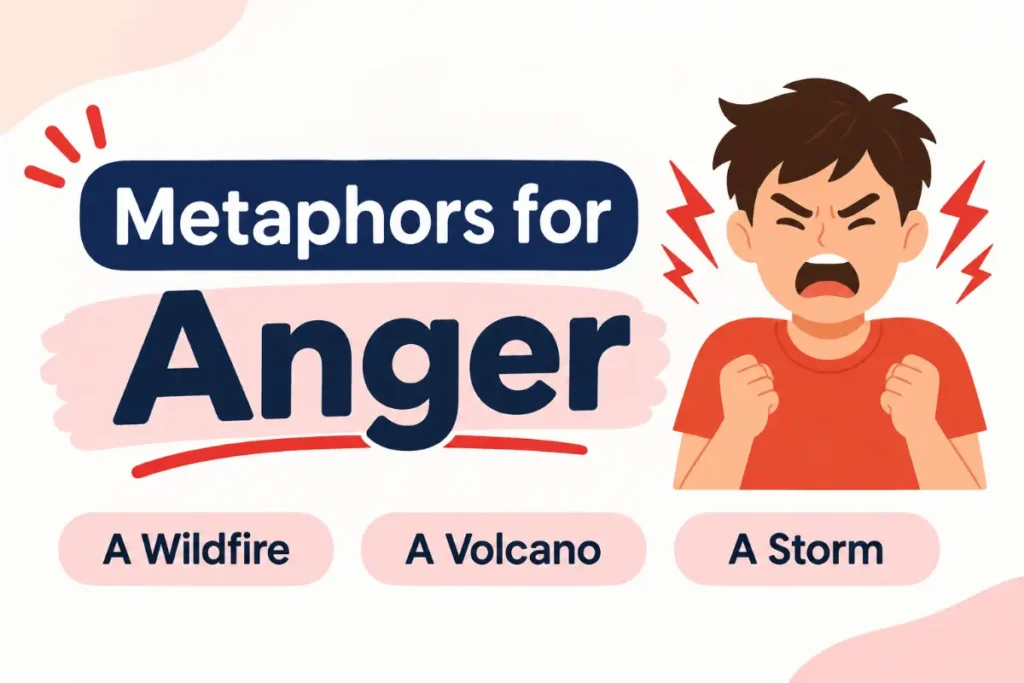
Anger is a strong emotion, and plain words like “mad” or “furious” often fall short of how it feels. Metaphors help by turning that feeling into something you can picture: a fire, a storm, a pot about to boil. They show how intense the anger is, how fast it arrived and whether it is loud or quiet.
This guide gives you 40 metaphors for anger, each with a clear meaning, plus example sentences, an intensity scale, tips for essays and fiction, and a list of clichés to avoid. It is part of our collection of metaphor examples by topic, where you can browse every theme in one place.
What Is a Metaphor for Anger?
A metaphor for anger describes the feeling as something else, without using “like” or “as.” “He was furious” states a fact. “He was a volcano” makes you see the pressure, the heat and the coming eruption. The comparison is not meant literally. Nobody thinks the person is made of lava. It simply borrows the qualities of the image: heat, force, danger and the sense that something is about to burst.
Anger metaphors are everywhere in daily speech. People say a conversation got heated, a meeting was a minefield or a boss is a ticking bomb. Most of the time we do not notice them. Once you start noticing, you can choose them on purpose, and your writing improves.
Why Do We Use Metaphors for Anger?
Anger is physical. People feel heat in the face, pressure in the chest, tension in the jaw and a clenching in the hands. Because the feeling lives so strongly in the body, most anger metaphors borrow from things with the same physical qualities: fire, explosions, weather, machines under pressure, and wild animals.
Metaphors also let writers show differences that the single word “angry” cannot. A simmering pot suggests a slow build. A flash flood suggests sudden, overwhelming rage. A block of ice suggests cold, controlled anger that is quiet but frightening. Choosing the right image tells the reader what kind of anger they are looking at.
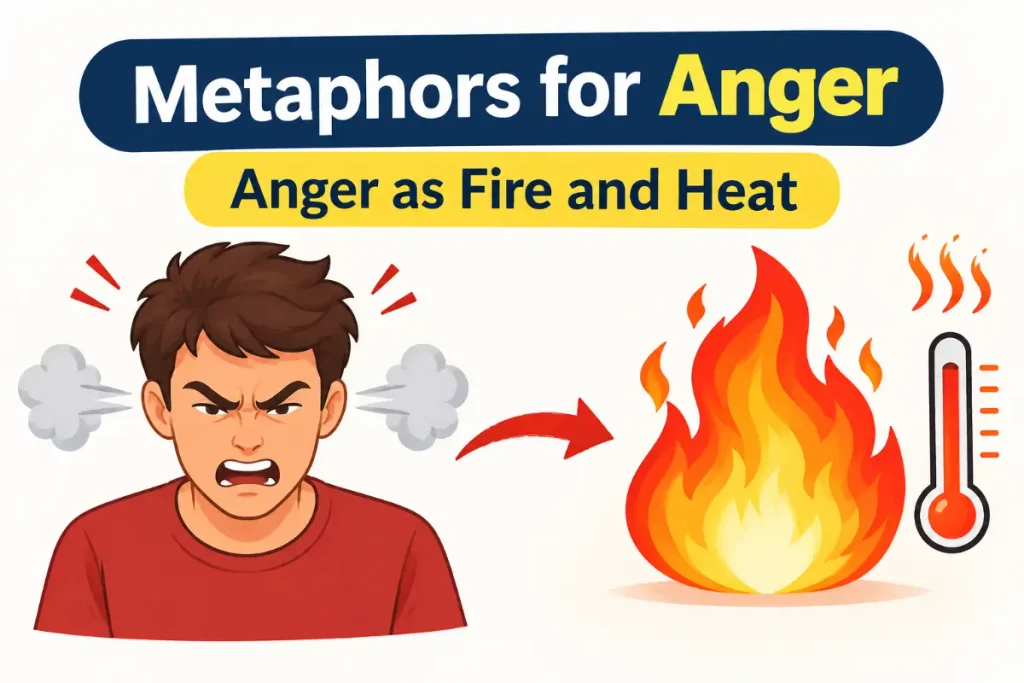
Anger as Fire and Heat
Fire is the most common image for anger because it spreads, destroys and is hard to control.
- Anger is a wildfire. It spreads fast and burns everything in its path.
- His temper was a match near gasoline. Any small spark could set him off.
- She was boiling over. Her anger grew until it spilled out.
- Rage is a furnace in the chest. A constant, painful heat inside.
- Their argument was a bonfire fed by every old grudge. Past hurts kept the anger burning.
Anger as Storms and Explosions
Storms and blasts suggest sudden force and a feeling that things are about to break.
- He was a thundercloud all morning. Dark, tense and about to break.
- Her anger broke like a storm. Sudden, loud and hard to stop.
- The meeting was a powder keg. The tension was so high that one word could explode it.
- A volcano of anger erupted. Long-buried anger finally burst out.
- His words were hail on a tin roof. Sharp, loud and impossible to ignore.
Anger as Animals and Machines
Animals show raw instinct, while machines show pressure and speed.
- She was a cornered cat, all claws. Defensive and ready to lash out.
- He growled at everyone who passed. Gruff, hostile behavior.
- Her patience was a thread, and the last comment snapped it. Limited tolerance that finally gave out.
- His anger was a steam engine at full speed. Pressure building with force.
- The argument was a car with no brakes. Out of control and heading toward harm.
Anger as Weight, Poison and Pressure
These images show anger that is held in and slowly does damage.
- Resentment is a slow poison. Anger that is held in harms the person holding it.
- He carried his anger like a stone in his pocket. He could not stop feeling its weight.
- Anger was a lid rattling on a pot. Pressure that shows before it blows.
- Her silence was a locked door with a storm behind it. Quiet anger that is still intense.
- His jaw was a clenched fist. Anger held in the body.
Anger as Ice, Blades and Cold Fury
Not all anger is hot. Cold anger is quiet, controlled and often more frightening.
- Her anger was ice, not fire. Cold, quiet and controlled, which can feel scarier than shouting.
- He sharpened his words like knives. Every comment was meant to cut.
- A frost settled over the room when she spoke. Her anger chilled everyone nearby.
- His glare was a blade. One look was enough to wound.
- Cold fury was a frozen lake with something moving underneath. Calm on the surface and dangerous beneath.
Anger in the Body
Describing anger through the body makes it concrete and believable.
- Rage was lava in her veins. Hot, heavy and ready to flow out.
- His fists were two stones at his sides. Tight and heavy with held-back anger.
- His face was a red flag. A clear sign that trouble was coming.
- Her voice was gravel. Rough, low and hard.
- Anger drew every muscle into a bow. His body was tight and ready to release.
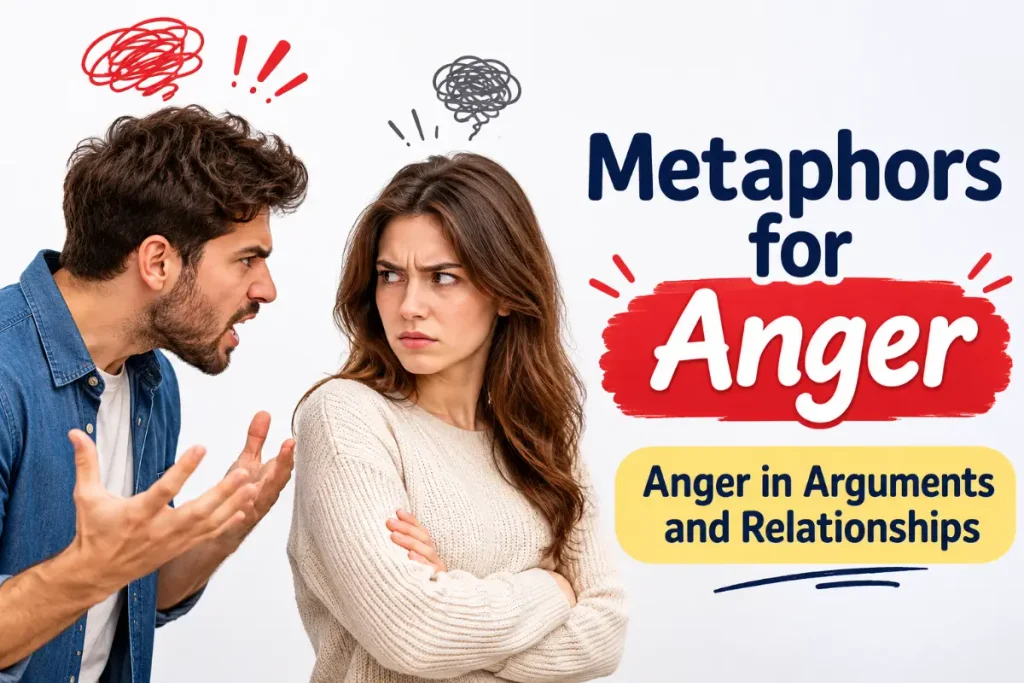
Anger in Arguments and Relationships
Many anger metaphors come from conflict between people, because that is where anger usually appears.
- Their argument was a tug of war with no winner. Both sides pulled harder and neither gave way.
- Her words were stones thrown through a window. They broke something that would be hard to repair.
- He built a wall of silence. He used quiet to shut her out.
- The kitchen was a battlefield. The home became a place of conflict.
- Every old fight was a splinter, and one more jab drove it deeper. Past hurts kept coming back and hurting more.
Anger and Self-Control
These metaphors show the struggle to keep anger under control.
- She held her temper on a short leash. She barely kept it in check.
- His patience was a dam, and the cracks were showing. He was close to breaking.
- Anger was a wild horse, and he could barely hold the reins. Hard to control and pulling in its own direction.
- She swallowed her anger like a hot coal. She held it in at a painful cost.
- His calm was a thin coat of paint over a cracked wall. He looked calm, but the surface was not stable.
Metaphors for Anger in Sentences and Paragraphs
Seeing a metaphor in a full sentence shows how it works. Here are a few short passages that use anger metaphors in different ways.
- After the third delay, the manager was a pot at full boil, and the whole office could see the lid rattle.
- Her anger was a wildfire; by the time anyone noticed the spark, the argument had already spread to every old complaint.
- He kept his rage in a locked room, and the silence at dinner was the only sign of the storm behind the door.
- The crowd was a powder keg, and the referee’s call was the match.
Here is a longer example that builds one image across a paragraph. Notice that every sentence stays inside the same picture, which is what makes it an extended metaphor:
Nina’s temper was a kettle on a slow flame. At breakfast it only hummed. By noon, when her brother ignored her message for the third time, it began to rattle. By evening the whole house could hear the whistle, and when he finally walked in, the steam had nowhere left to go.
And here is a cold-anger version, which uses a completely different image to create a different feeling:
Marcus never raised his voice. His anger was a frozen lake, smooth and still on top, and everyone in the office learned not to walk across it.
The Anger Intensity Scale
Anger comes in different strengths, and the best metaphors match the strength. Use this table to pick an image that fits the level you want.
| Level | Feeling | Metaphor | What it shows |
|---|---|---|---|
| Mild | Annoyed | The noise was a pebble in his shoe. | A small, constant irritation |
| Low | Irritated | Her patience was a fraying rope. | Tolerance wearing thin |
| Medium | Angry | His temper was a pot on a high flame. | Heat building steadily |
| High | Furious | Rage was a wildfire in a dry forest. | Fast, wide and out of control |
| Extreme | Explosive | He was a volcano erupting. | Sudden, huge release |
| Quiet | Cold anger | Her anger was a block of ice. | Controlled, silent and intense |
How Writers Use Anger Metaphors
Good writers do not just drop an anger metaphor into a sentence. They use it to say something about the character or the story. A few techniques are worth learning.
Match the metaphor to the character. A cook might describe anger as a pan too hot to touch, a sailor as a squall coming over the horizon, and a mechanic as an engine running too hot. When the image fits the person’s world, it tells the reader who they are, not just how they feel.
Use quiet and loud anger differently. Loud anger suits fire, thunder and explosions. Quiet anger suits ice, locked doors and held breath. A story that uses only loud images feels one-note. Mixing them shows the full range of the feeling.
Let the metaphor change as the scene changes. A character might begin the scene as a simmering pot, become a rattling lid, and end as a spilled kettle. Moving through related images lets the reader feel the anger rising without a single line of explanation.
Use metaphors in dialogue sparingly. Angry people really do speak in metaphors, shouting that someone is a snake or a brick wall. In fiction, one sharp line like this lands well, but a whole speech of them sounds unnatural.
Show the aftermath. Anger metaphors do not have to describe the moment itself. Smoke after a fire, a quiet street after a storm or a cracked window after a thrown stone can describe what anger leaves behind.
How to Use Anger Metaphors in School Essays
If you are asked to analyze a metaphor for anger in a poem or story, follow three steps: find it, explain it and show its effect.
- Find it. Look for a comparison that says one thing is another, such as “his anger was a volcano.”
- Explain it. Say what the two things share. A volcano is quiet for a long time and then explodes, so the comparison shows that his anger built up in silence.
- Show the effect. Say what the metaphor makes the reader feel, such as tension or fear.
Here is a short sample paragraph:
The writer describes the father’s anger as “a locked door with a storm behind it.” This metaphor suggests that his anger is hidden but powerful. The locked door shows that he keeps his feelings inside, while the storm shows how intense they are. As a result, the reader feels uneasy, waiting for the door to give way.
When you write your own metaphor in an essay, always add a sentence that explains what it shows. A metaphor with no explanation is only half finished.
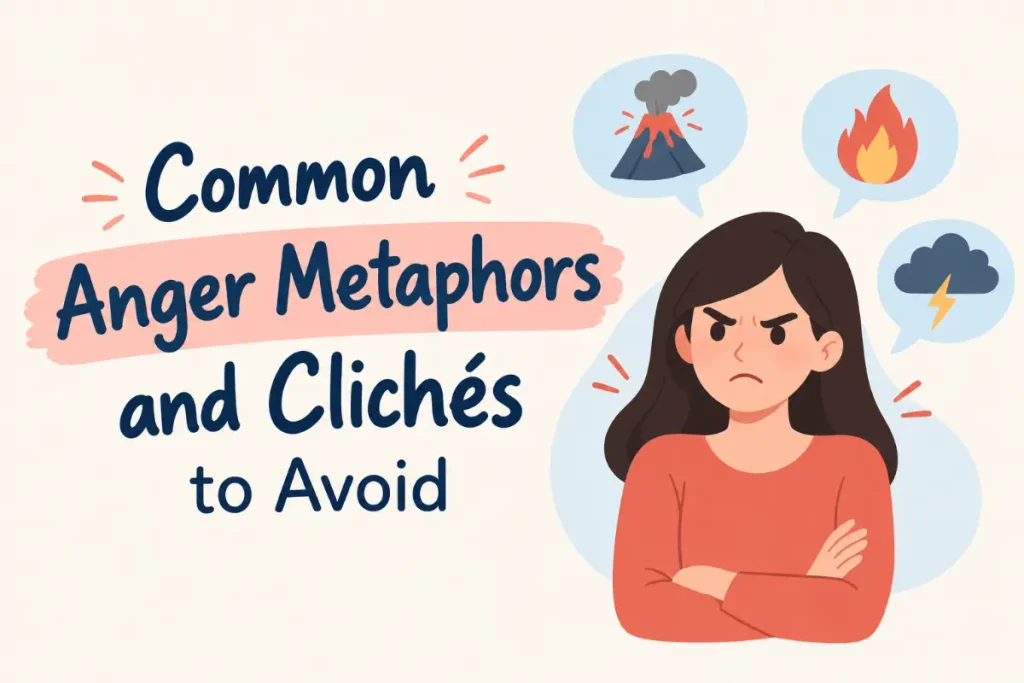
Common Anger Metaphors and Clichés to Avoid
Some anger metaphors have been used so often that readers barely notice them. They are not wrong, but they do not make writing stand out. Try replacing them with fresher images.
| Common phrase | Fresher alternative |
|---|---|
| Seeing red | The room went the color of a stop sign. |
| Blowing a fuse | His fuse had been burning since breakfast. |
| Boiling mad | A kettle screaming on the stove. |
| Hot-headed | A stove someone forgot to turn off. |
| Hit the roof | She went up like a cork from a shaken bottle. |
| Bite his head off | He snapped at her like a trap closing. |
Other mistakes to watch for:
- Mixing images. “His anger was a fire that crashed over her like a wave” confuses the reader. Choose one image.
- Overdoing it. If every sentence in a paragraph has an anger metaphor, none of them stands out.
- Too much violence. Strong images are fine, but make sure they fit the tone of your writing, especially in school work.
- Not matching the intensity. Calling a minor irritation a volcano makes the writing feel exaggerated.
Try It Yourself: Write an Anger Metaphor in Five Steps
Practicing is the fastest way to improve. Follow these steps with any situation you like.
- Choose a moment. For example: a friend cancels plans at the last minute.
- Decide the intensity. Is it a small annoyance or a deep hurt?
- Pick a source for your image. The kitchen, the weather, machines, animals or sports all work.
- Write three versions. For example: My patience was a pot lid, rattling. / The text message was a stone dropped in still water. / I was a clock wound too tight.
- Choose the best one and add a body detail. My patience was a pot lid rattling, and my thumb pressed the screen hard enough to leave a mark.
Try the same moment with cold anger and see how different the image becomes.
Frequently Asked Questions
What Is a Good Metaphor for Anger?
“Anger is a wildfire” is a common metaphor because it spreads quickly and can be difficult to control. For quieter anger, you could use images such as a pot with a tightly closed lid or a frozen lake.
Is “He Exploded” a Metaphor for Anger?
Yes. “He exploded” is a metaphor that compares someone’s anger to an explosion, even though nothing literally blew up. Many everyday expressions about anger use metaphors that people no longer notice.
What Is the Difference Between a Metaphor and an Idiom for Anger?
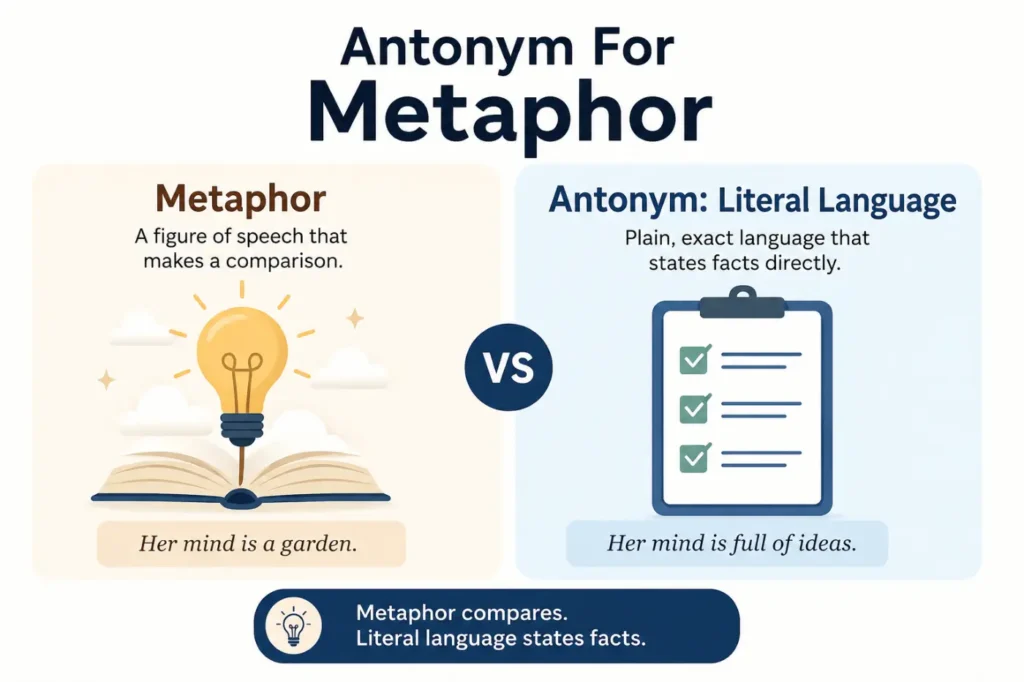
An idiom, such as “hit the roof,” is a fixed expression commonly used in everyday language. A metaphor is a direct comparison that can be created in your own words, such as “His temper was a match near gasoline.”
Can I Describe Anger With a Simile?
Yes. “He was as angry as a hornet” is a simile because it uses the word “as” to make a comparison. A metaphor makes the comparison directly without using “like” or “as,” such as “He was a hornet in a jar.”
What Is a Metaphor for Suppressed Anger?
Metaphors involving containment work well for describing suppressed anger. For example, you can compare it to a lid rattling on a boiling pot, a dam developing cracks, a locked room, or a heavy stone in someone’s pocket. These images show anger that remains hidden but is still present.
Why Is Fire So Common in Anger Metaphors?
Fire is often used in anger metaphors because it is hot, spreads quickly, causes destruction, and can be difficult to control. It also offers several powerful images for writers, including a spark, a flame, a blazing fire, and fading ashes.
Are Anger Metaphors Appropriate for School Assignments?
Yes. Anger metaphors are suitable for school assignments, including poetry, narrative writing, and character analysis. Choose language appropriate for your audience and explain how the metaphor helps communicate a character’s emotions or feelings.
Conclusion
Anger is loud, hot and hard to hold, which is why its best metaphors involve fire, storms and pressure. But anger can also be cold, quiet and controlled, and the best writers know how to show both. The right image shows not just that a character is angry, but how fast the feeling arrived, how intense it is and whether it is shouted or buried.
Pick one strong comparison, match it to the level of anger, show it in the body, and explain what it reveals about the person. Avoid worn-out phrases when you can, and let the metaphor grow with the scene. Handled well, an anger metaphor can turn a flat sentence into a scene readers can feel.
Related Metaphors
- Anger and fear often sit side by side, so read our guide to fear metaphors next.
- For the worry that builds underneath, see metaphors for anxiety.
- To explore the quieter side of strong feelings, try metaphors for sadness.