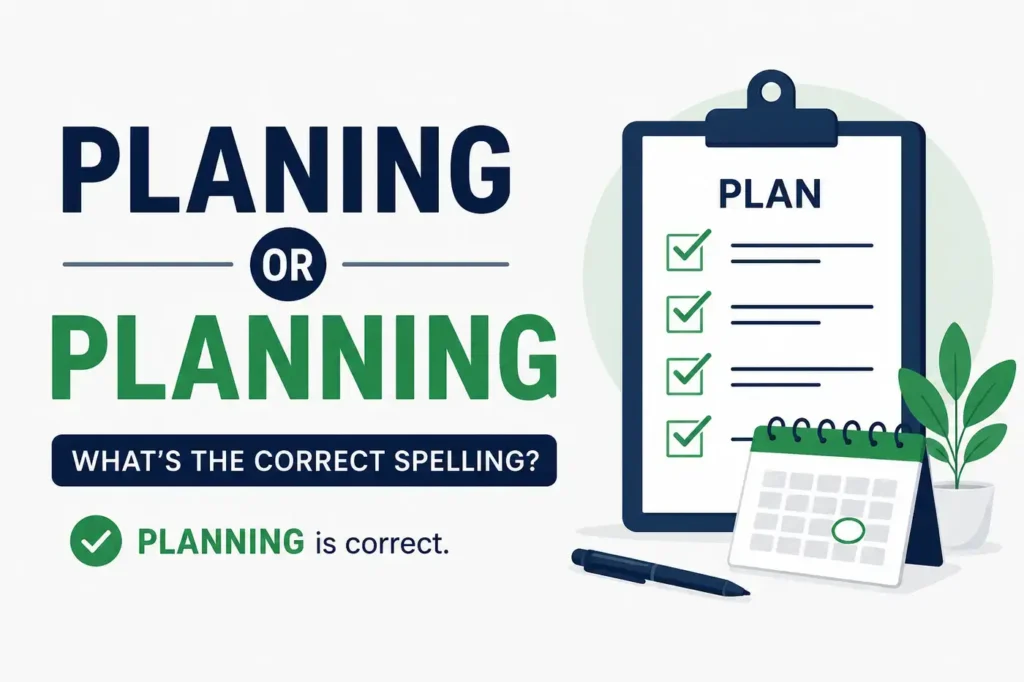
If you have ever typed planing or planning into a search engine, you are probably trying to figure out which spelling is correct. At first glance, the two words look almost identical. The only difference is one extra letter, yet that small change creates two completely different meanings. That is why many students, writers, and English learners pause before using either word.
The short answer is simple. Planning is the correct spelling when you are talking about making preparations, organizing tasks, or creating a strategy for the future. Planing, on the other hand, is a real English word, but it has a completely different meaning. It usually refers to smoothing or shaping wood with a hand plane or machine, and it can also describe the action of a boat or aircraft gliding across a surface under certain conditions.
This guide explains the difference in clear, everyday language. You will learn what each word means, how to pronounce and use it correctly, why people confuse the two spellings, and how grammar rules affect their formation. Along the way, you will find comparison tables, practical examples, expert writing tips, and real world usage that will help you choose the right word with confidence.
Quick Definition
Planning is the present participle and gerund of the verb plan, meaning to prepare or organize something before it happens. Planing is also a correct word, but it refers to smoothing wood with a plane or, in technical fields, moving smoothly across a surface. The two words are unrelated in meaning and should never be used interchangeably.
Quick Answer
If your sentence is about organizing, preparing, scheduling, or making decisions for the future, planning is almost always the correct choice.
Use planing only in these situations.
- When describing the process of smoothing or shaping wood with a plane.
- When referring to a boat or aircraft moving across a surface in technical contexts.
- When discussing woodworking, carpentry, aviation, or marine engineering.
A simple way to remember the difference is this.
- Planning helps you prepare for tomorrow.
- Planing changes the shape of wood or describes a specific type of movement.
Just like planning is often confused with planing, many writers also make spelling mistakes involving similar words when choosing between brite and bright.
Comparison Table
| Feature | Planning | Planing |
|---|---|---|
| Part of speech | Verb form and noun | Verb form and noun |
| Meaning | Preparing organizing or arranging | Smoothing wood with a plane or gliding across a surface |
| Base word | Plan | Plane |
| Correct use | Daily communication education business personal goals | Woodworking carpentry aviation marine engineering |
| Formality | Standard in all writing | Standard but technical |
| Origin | From the verb plan | From the verb plane |
| Usage frequency | Extremely common | Relatively uncommon |
| Example | We are planning a family vacation. | He is planing the edge of the wooden board. |
Meaning Of Planning
Planning comes from the verb plan, which means to think ahead, organize actions, or prepare for something before it happens. It is one of the most frequently used words in everyday English because people constantly make plans for work, school, travel, finances, and personal goals.
Depending on the sentence, planning can function as both a verb and a noun.
As a verb, it describes an action that is happening now.
Example:
- They are planning a surprise birthday party.
As a noun, it refers to the process itself.
Example:
- Careful planning helped the project finish on time.
You will commonly see this word in many situations.
- Business planning.
- Financial planning.
- Event planning.
- Travel planning.
- Lesson planning.
- Career planning.
- Project planning.
- Strategic planning.
Because the word appears in so many everyday contexts, it is the spelling most people need.
Meaning Of Planing
Unlike planning, planing is a specialized word that many people never encounter outside technical fields.
Its primary meaning comes from the verb plane, which means to smooth or shape the surface of wood using a hand plane or a power planer. Carpenters, cabinet makers, furniture builders, and woodworkers use this term regularly.
For example:
- The carpenter spent the afternoon planing rough boards before assembling the table.
The word also appears in engineering and transportation.
In aviation and marine science, planing describes movement where an aircraft or boat rides across the surface instead of pushing deeply through it.
For example:
- The speedboat began planing as it gained speed across the water.
Although both meanings are correct, they are far less common than the everyday meaning of planning.
Key Differences
The spelling difference may seem small, but the meanings have nothing in common. Understanding the distinction makes it much easier to choose the correct word.
The biggest difference is the base verb.
- Planning comes from plan, which means to prepare or organize.
- Planing comes from plane, which means to smooth a surface or move across it in a technical sense.
Another important difference is how often people use each word. Most English speakers write planning regularly because it applies to everyday life. Planing appears mainly in woodworking manuals, construction guides, technical documents, and engineering discussions.
The table below highlights the main differences.
| Planning | Planing |
|---|---|
| Related to preparation and organization | Related to smoothing wood or technical movement |
| Common in everyday English | Mostly used in technical fields |
| Comes from the verb plan | Comes from the verb plane |
| Frequently used in business education and daily life | Frequently used in carpentry aviation and marine engineering |
A quick memory trick can also help.
Think of the extra n in planning as standing for next. Planning is something you do before the next step. Planing has no extra n because it comes directly from plane, the woodworking tool.
Which One Is Correct
The correct spelling depends entirely on what you want to say.
If you are talking about preparing for an event, setting goals, creating a schedule, or organizing work, planning is the correct word.
For example:
- We are planning our summer vacation.
- She enjoys planning community events.
- Good planning reduces stress and saves time.
Use planing only when discussing woodworking or specific engineering concepts.
For example:
- The craftsman is planing the wooden surface until it is perfectly smooth.
- The boat started planing after reaching a higher speed.
Many spelling mistakes happen because people know the word plan but forget that adding ing requires doubling the final n. This follows a common English spelling rule for short verbs ending in a single vowel followed by a single consonant.
Pronunciation Guide
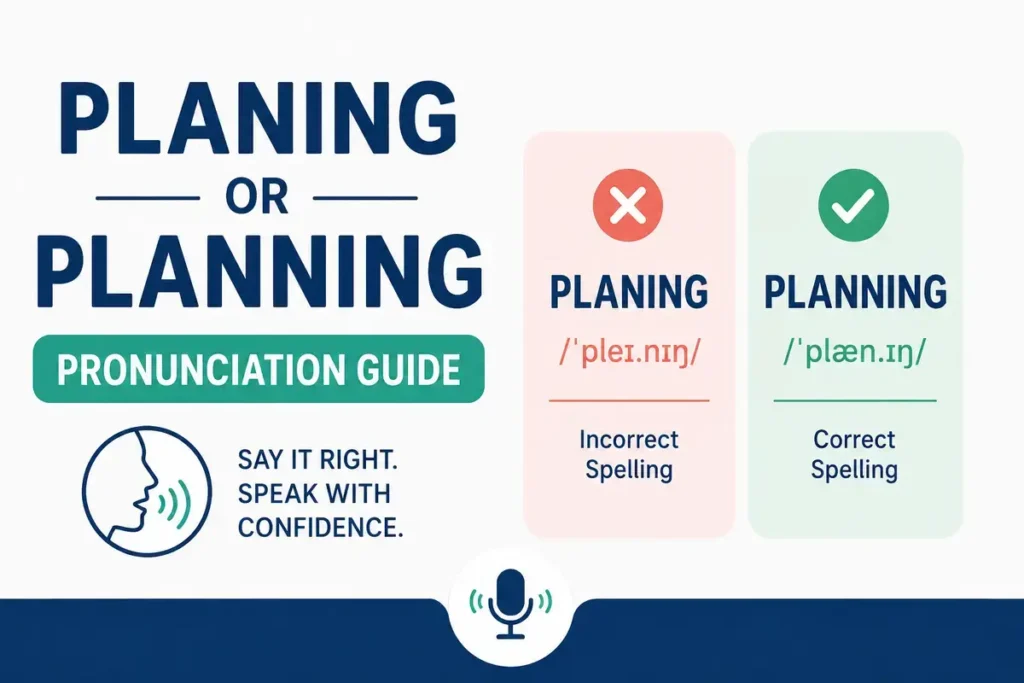
Although the spellings are similar, the pronunciation helps reinforce that these words come from different base verbs.
Planning
IPA pronunciation:
/ˈplænɪŋ/
Syllable breakdown:
Plan • ning
The first syllable rhymes with man, and the second syllable is pronounced ning.
Planing
IPA pronunciation:
/ˈpleɪnɪŋ/
Syllable breakdown:
Plane • ing
The first syllable sounds exactly like the word plane, followed by ing.
Because the vowel sounds are different, native speakers usually distinguish the words easily in conversation. Most confusion happens in writing, where the spellings look much more alike than they sound.
If you enjoy learning about commonly confused spellings, you might also want to explore whether “nosey” or “nosy” is correct, since both versions appear frequently in everyday writing.
Expert Language Insight
Professional editors rarely confuse these words because they begin by identifying the base verb instead of looking only at the ending. If the sentence involves preparation, organization, or future actions, the base verb is plan, so the correct form is planning. If the sentence describes smoothing wood or a technical type of movement, the base verb is plane, making planing the right choice.
This approach is more reliable than trying to memorize the spellings. Once you connect each word to its original verb and meaning, choosing the correct form becomes almost automatic, even in longer pieces of writing.
Examples In Sentences
Seeing each word in context is one of the easiest ways to remember the difference. As you read these examples, pay attention to what the sentence is describing. If the focus is on preparing or organizing, planning is the correct choice. If the sentence is about smoothing wood or a technical type of movement, planing is the right word.
Planning Examples
These examples show the everyday use of planning.
- We are planning a family vacation for next summer.
- She spent weeks planning her wedding.
- Good planning helped the team finish the project ahead of schedule.
- The city is planning a new public park.
- Careful planning can save both time and money.
- They are planning to open another store next year.
- Our teacher is planning tomorrow’s science lesson.
- The company is planning several improvements to its website.
- He enjoys planning weekend hiking trips with friends.
- Successful businesses depend on thoughtful planning.
Notice that every example involves preparation, organization, or making decisions before something happens.
Planing Examples
These examples demonstrate the correct use of planing in technical contexts.
- The carpenter is planing the edge of the wooden board.
- She finished planing the tabletop before applying the stain.
- The craftsman checked the surface after planing each piece of wood.
- Proper planing creates a smooth finish before painting.
- The woodworker spent an hour planing rough lumber.
- The machine simplifies planing large boards.
- Careful planing removed the uneven spots from the surface.
- The instructor demonstrated safe planing techniques in the workshop.
- The speedboat began planing across the water after accelerating.
- Engineers studied the aircraft’s planing characteristics during testing.
These examples highlight that planing belongs to specialized fields rather than everyday conversation.
Common Mistakes
Because the two words differ by only one letter, they are easy to confuse. Most mistakes happen because writers focus on spelling instead of meaning.
Here are the errors editors see most often.
Forgetting To Double The Final N
This is the most common mistake.
Incorrect:
- We are planing our vacation.
Correct:
- We are planning our vacation.
The verb plan ends with one vowel followed by one consonant. When adding ing, English spelling rules require doubling the final n, creating planning.
Using Planing Outside Technical Topics
Some people assume planing is simply another spelling of planning.
It is not.
Unless your sentence is about woodworking, boats, or aircraft, planning is almost certainly the correct choice.
Thinking Planing Is A Misspelling
Many people believe planing is always incorrect because they rarely see it.
In reality, it is a legitimate English word with a specific technical meaning. Dictionaries recognize both spellings, but they define completely different actions.
Ignoring Context
Always ask yourself one question before choosing a spelling.
What is the sentence about?
If the answer is preparation or organization, choose planning.
If the answer is smoothing wood or technical movement, choose planing.
That simple habit prevents nearly every mistake.
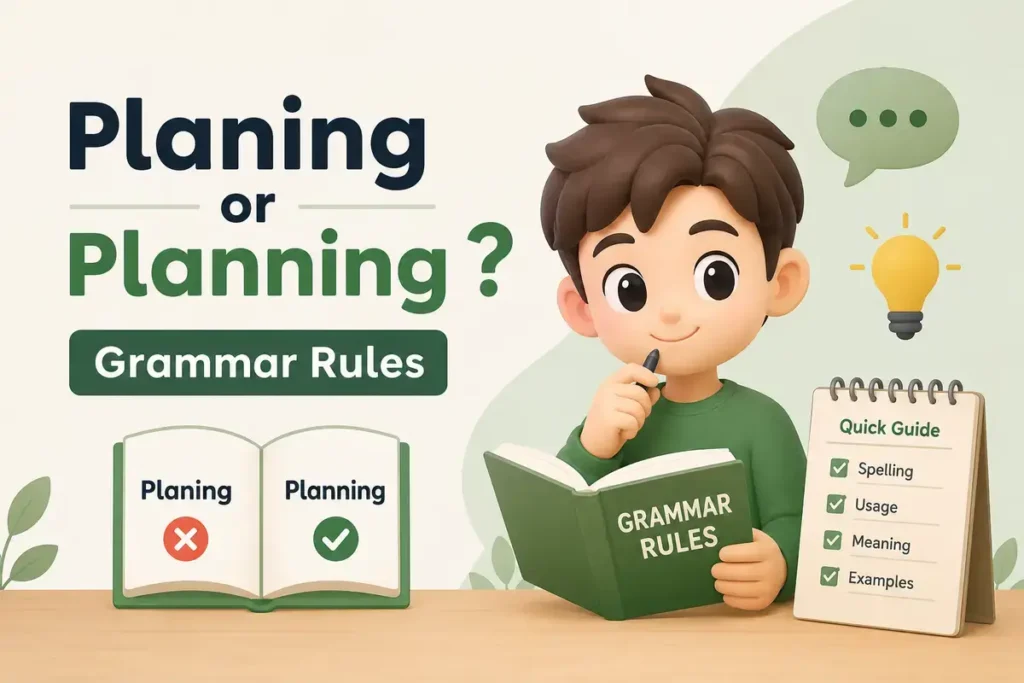
Grammar Rules
Understanding the spelling rule behind planning makes it much easier to remember.
Why Does Planning Double The Final N
The verb plan follows a common English spelling pattern.
When a short verb ends with:
- One vowel.
- One final consonant.
The last consonant is usually doubled before adding a suffix that begins with a vowel.
For example:
- Plan becomes planning.
- Stop becomes stopping.
- Run becomes running.
- Sit becomes sitting.
- Swim becomes swimming.
Doubling the final consonant keeps the pronunciation consistent.
Why Planing Does Not Double The N
The word planing comes from the verb plane, not plan.
Since plane already ends with a silent e, the spelling changes differently.
The final e is dropped before adding ing.
Examples include:
- Plane becomes planing.
- Bake becomes baking.
- Drive becomes driving.
- Write becomes writing.
- Shape becomes shaping.
The two spellings follow different grammar rules because they come from different base words.
Parts Of Speech
Both words can function as nouns and verb forms.
Planning commonly appears as:
- A gerund.
- A present participle.
- A noun describing the process of preparation.
Planing commonly appears as:
- A present participle.
- A gerund referring to the woodworking process.
- A noun describing the act of smoothing wood.
The grammar is correct in both cases. The meaning determines which word belongs in the sentence.
Etymology And Word Origin
Although these words look related, their histories developed from different roots.
The word plan entered English through French and ultimately traces back to the Latin word planum, meaning a flat surface or drawing. Over time, the meaning expanded to include drawings, designs, and eventually the idea of preparing something before it happens. That evolution gave English the modern word planning.
The word plane, meaning a woodworking tool, has a different history. It comes from the Latin word planus, meaning flat or level. Craftsmen used a plane to flatten rough wood, leading to the verb plane and the noun and verb form planing.
Even though both words share distant Latin roots connected with flat surfaces, their meanings separated long ago. Today they belong to different parts of everyday language.
Regional Usage
Unlike many English spelling differences, these words do not change between countries.
American English
American English uses planning for preparation and planing for woodworking and technical movement.
British English
British English follows exactly the same distinction. The spelling does not change between regions because the words have different meanings rather than different regional preferences.
Australian English
Australian English also uses planning and planing according to their meanings. Carpenters, builders, and woodworkers use planing, while everyone else uses planning for organization and preparation.
Canadian English
Canadian English follows the same rule. Both spellings are accepted because each one serves a different purpose.
This consistency is helpful for writers. Once you understand the difference, you can use the correct spelling confidently regardless of your audience.
Real Life Usage Examples
The two words appear in very different situations.
Daily Conversation
Most people use planning regularly.
Examples include:
- Planning a birthday party.
- Planning a family vacation.
- Planning weekly meals.
- Planning home improvements.
- Planning a school schedule.
Academic Writing
Students and teachers often write about planning.
Examples include:
- Lesson planning.
- Research planning.
- Study planning.
- Career planning.
- Educational planning.
Professional Communication
Businesses use planning every day.
Examples include:
- Strategic planning.
- Financial planning.
- Project planning.
- Workforce planning.
- Marketing planning.
Woodworking And Construction
This is where planing becomes common.
Examples include:
- Planing rough lumber.
- Planing a door so it closes properly.
- Planing hardwood before assembly.
- Machine planing in furniture production.
- Hand planing fine wood surfaces.
Aviation And Marine Engineering
Technical professionals also use planing.
Examples include:
- A boat planing across calm water.
- Aircraft planing during specific landing conditions.
- Engineers measuring planing performance.
- Marine designers improving planing efficiency.
- Testing hull designs for better planing characteristics.
Looking at these examples makes one pattern very clear. Planning belongs to everyday English, while planing belongs mainly to specialized industries and technical discussions.
Planing and planning aren’t the only words that cause confusion, another common spelling dilemma is deciding whether blankie or blanky is the preferred form.
Related Words And Confused Terms
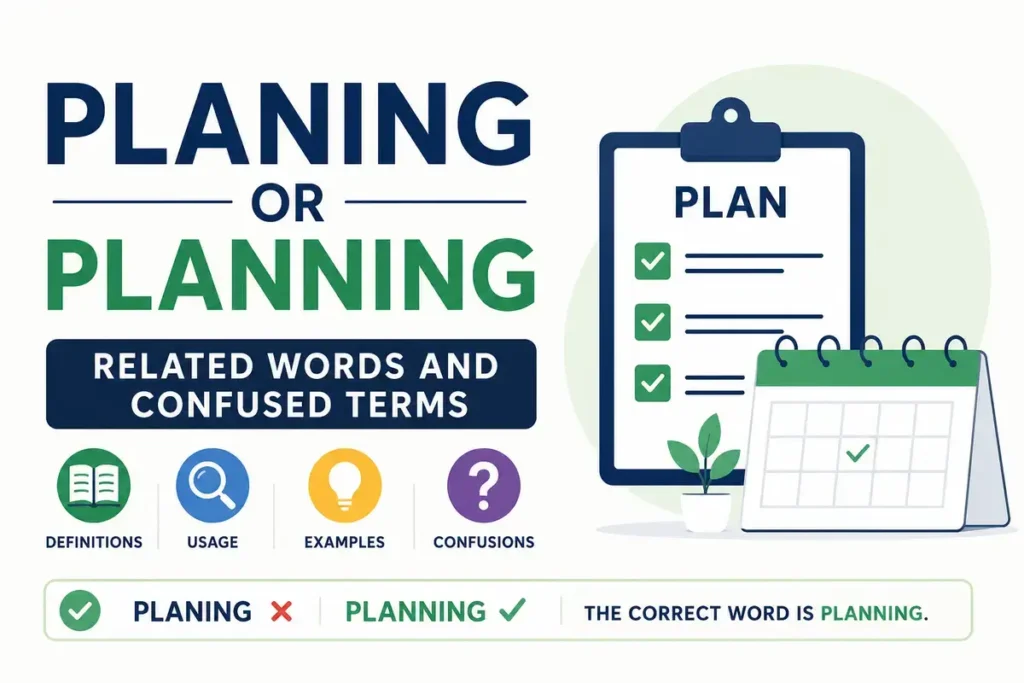
People who search for this topic are often unsure about more than just these two spellings. English has several words that look similar or share the same root, making them easy to mix up. Understanding the related terms helps you build confidence and avoid future mistakes.
Here are some commonly confused words.
| Word | Meaning |
|---|---|
| Plan | To prepare or decide something in advance. |
| Planning | The act of organizing or preparing. |
| Planned | Already arranged or prepared. |
| Planner | A person who organizes or a tool used for scheduling. |
| Plane | A woodworking tool, a flat surface, or an aircraft depending on the context. |
| Planing | Smoothing wood with a plane or gliding across a surface in technical fields. |
You may also come across these related expressions.
- Strategic planning.
- Financial planning.
- Project planning.
- Business planning.
- Lesson planning.
- Event planning.
- Travel planning.
- Wood planing.
- Surface planing.
- Hand planing.
Although some of these terms share similar spellings, their meanings depend entirely on the context. Looking at the surrounding words usually makes the intended meaning clear.
Expert Language Insight
Professional editors rarely rely on memorization when choosing between similar words. Instead, they identify the base word first.
Ask yourself what the sentence is describing.
If it involves preparing, organizing, scheduling, or thinking ahead, the base word is plan, so planning is the correct choice.
If the sentence is about shaping wood with a woodworking tool or describing a technical type of movement across a surface, the base word is plane, making planing the correct form.
Native English speakers follow this pattern naturally because they connect the spelling with the meaning instead of counting letters. Developing the same habit makes proofreading much easier and reduces spelling mistakes in every type of writing.
Another tip from experienced editors is to read the complete sentence instead of focusing on a single word. Context usually answers the question before you even think about the spelling.
Frequently Asked Questions
Is planning or planing the correct spelling?
Both spellings are correct, but they have different meanings. Planning refers to preparing or organizing something before it happens. Planing refers to smoothing wood with a plane or describes a specific type of movement in technical fields such as aviation and marine engineering.
Why does planning have two n letters?
The word comes from the verb plan. English spelling rules require doubling the final consonant when a short verb ending in one vowel followed by one consonant takes ing. That is why plan becomes planning.
Is planing a real English word?
Yes. Planing is a legitimate English word. It is commonly used in woodworking to describe smoothing or shaping wood with a plane. It also appears in technical discussions about boats and aircraft moving across a surface.
What does planing wood mean?
Planing wood means using a hand plane or power planer to remove thin layers from the surface of a board. This process creates a smoother, flatter, and more even finish before the wood is assembled, painted, or stained.
Can I use planing instead of planning?
No. These words are not interchangeable. Planning relates to preparation and organization, while planing relates to woodworking or technical movement. Replacing one with the other changes the meaning of the sentence completely.
How can I remember the difference?
Think about the purpose of the sentence. If you are making preparations for the future, choose planning. If someone is working with wood or discussing boats or aircraft, planing is probably the correct word.
Are the spellings different in British and American English?
No. American English, British English, Australian English, and Canadian English all use the same distinction. The difference is based on meaning rather than regional spelling preferences.
Why do so many people confuse these words?
The confusion comes from their similar appearance. Many writers know the word plan but forget that adding ing requires doubling the final n. Others are unfamiliar with the technical meaning of planing, so they assume it is simply a misspelling.
Conclusion
Choosing between these two spellings becomes much easier once you understand what each word represents. Planning is the word you need when talking about preparing, organizing, scheduling, or making decisions for the future. It is the spelling used in everyday conversations, business communication, education, and most types of writing.
Planing is also correct, but it belongs to a much narrower group of topics. It usually describes smoothing wood with a plane or the movement of a boat or aircraft across a surface. Unless your sentence relates to those technical fields, planning is almost certainly the right choice.
Instead of memorizing the spellings, connect each word to its base verb. That simple habit helps you choose the correct form naturally and reduces mistakes when writing emails, reports, assignments, or professional documents. With a little practice, the difference becomes easy to recognize, and you’ll be able to use both words confidently whenever the situation calls for them.