Have you ever typed bearer vs barer into a search engine because you were not sure which word belonged in your sentence? You are in good company. These two words sound exactly alike, yet they have completely different meanings. That makes them easy to confuse, especially when writing emails, school assignments, legal documents, or social media posts.
The short answer is simple. Bearer is the word most people need because it refers to someone who carries, holds, delivers, or possesses something. Barer, on the other hand, is much less common. It is the comparative form of bare, meaning more uncovered or more exposed.
The confusion comes from their identical pronunciation. Since they are homophones, your ears cannot tell the difference. Only the spelling and the context reveal which word is correct.
This guide explains each word in plain English with practical examples, grammar tips, pronunciation guidance, common mistakes, and expert writing advice. By the end, you will know exactly when to use bearer, when barer is the right choice, and how to avoid mixing them up in future writing.
Quick Definition
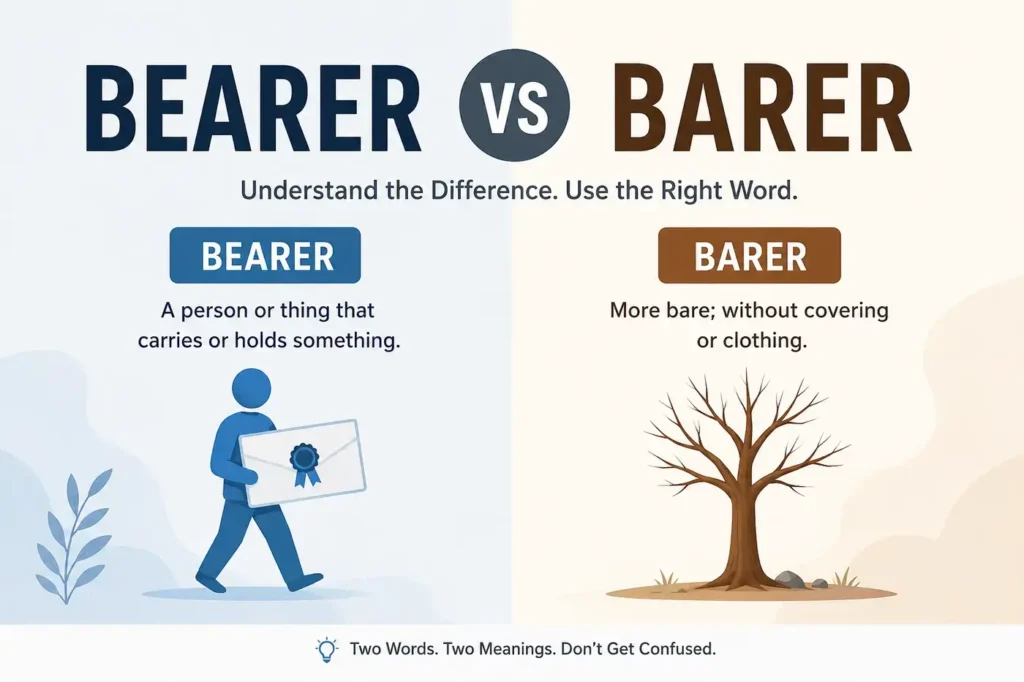
Bearer is a noun that describes a person or thing carrying, holding, delivering, or possessing something, such as a flag bearer or the bearer of bad news. Barer is the comparative form of the adjective bare, meaning more uncovered or less covered. Although they sound identical, they serve completely different grammatical purposes.
If you enjoy clearing up confusing word pairs like bearer and barer, you may also find our guide to common spelling mistakes in English helpful, especially when dealing with words such as using and useing.
Quick Answer
If you only remember one rule, make it this one.
- Use bearer when referring to someone who carries, holds, possesses, or delivers something.
- Use barer when comparing something that is more exposed or less covered than something else.
- If your sentence involves responsibility, ownership, delivery, or carrying, bearer is almost always the correct choice.
- If your sentence compares the amount of covering, clothing, or exposure, barer is the correct word.
For example:
- The ring bearer carried the wedding rings down the aisle.
- After removing his jacket, his arms looked barer than before.
Comparison Table
| Feature | Bearer | Barer |
|---|---|---|
| Part of speech | Noun | Comparative adjective |
| Meaning | A person or thing that carries, holds, delivers, or possesses something | More bare, more uncovered, or more exposed |
| Origin | Derived from the verb bear | Derived from the adjective bare |
| Formality | Standard in formal and informal writing | Standard but much less common |
| Common contexts | Legal writing, ceremonies, finance, military, business, literature | Descriptive writing, comparisons, everyday language |
| Usage frequency | Very common | Relatively uncommon |
| Example | The flag bearer led the parade. | The second tree looked barer after winter. |
Meaning Of Each Word
Although these words sound the same, they come from different root words and serve different purposes. Understanding their meanings makes choosing the correct spelling much easier.
What Does Bearer Mean
A bearer is someone or something that carries, holds, transports, delivers, or possesses something. The word comes from the verb bear, which has several meanings, including to carry, support, endure, or bring.
Because of its broad meaning, bearer appears in many different situations.
You may come across it in:
- Business documents.
- Legal agreements.
- Banking and finance.
- Military ceremonies.
- Weddings.
- News reporting.
- Literature.
- Everyday conversation.
Here are a few common examples.
- The ring bearer carefully carried the wedding rings.
- The flag bearer proudly led the national team.
- She became the bearer of bad news after receiving the phone call.
- The ticket is valid only for the bearer.
- The courier acted as the bearer of an important package.
Notice that every example involves carrying, delivering, holding, or possessing something.
What Does Barer Mean
Barer is the comparative form of the adjective bare.
It simply means more bare, less covered, or more exposed than something else. Unlike bearer, this word is not a noun. It functions as an adjective used for comparison.
Because people do not often compare how uncovered something is, barer appears much less frequently in everyday writing.
Here are several natural examples.
- The trees looked barer after the storm.
- The room seemed barer once the furniture was removed.
- His face appeared barer without a beard.
- The hills became barer during the dry season.
- The walls looked barer after the paintings were taken down.
In every example, barer compares one level of exposure with another.
Bearer vs Barer Key Differences
Since these words are homophones, pronunciation will not help you choose the correct spelling. The meaning and grammar provide the answer.
The most important differences are listed below.
| Bearer | Barer |
|---|---|
| Refers to a person or thing | Describes a comparison |
| Noun | Comparative adjective |
| Related to carrying or possessing | Related to being uncovered |
| Common in everyday English | Used much less often |
| Frequently appears in legal, financial, and ceremonial writing | Mostly appears in descriptive writing |
Another useful way to remember the difference is to look at the root word.
- Bearer comes from bear, meaning to carry or support.
- Barer comes from bare, meaning uncovered or exposed.
Once you identify the root word, the correct spelling usually becomes obvious.
Which Word Is Correct
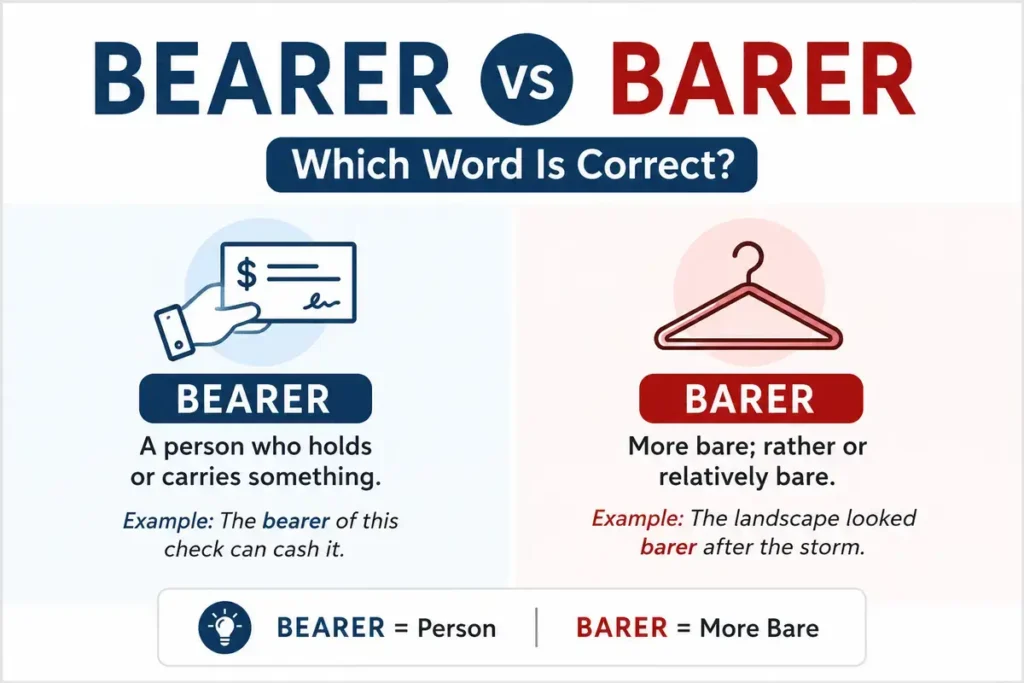
Neither word is more correct than the other. The correct choice depends entirely on your sentence.
Choose bearer if your sentence involves carrying, holding, delivering, supporting, or possessing something.
Examples include:
- The flag bearer walked at the front of the parade.
- She was the bearer of bad news for the entire team.
- The museum admitted only the ticket bearer.
- Every passport bearer had to show identification.
Choose barer when comparing how exposed or uncovered something is.
Examples include:
- The landscape looked barer after the wildfire.
- His office appeared barer once the shelves were removed.
- The mountain became barer near the summit.
- The winter garden looked much barer than it did in spring.
A simple question can help you decide.
Ask yourself:
Am I talking about someone carrying something, or am I comparing how uncovered something is?
If the answer involves carrying, choose bearer. If it involves comparison, choose barer.
Pronunciation Guide
One reason these words create so much confusion is that they are pronounced exactly the same.
Bearer
IPA pronunciation:
/ˈberər/
Syllable breakdown:
bear er
Barer
IPA pronunciation:
/ˈberər/
Syllable breakdown:
bare er
There is no pronunciation difference between the two words. Native speakers rely entirely on context and spelling to understand which word is intended.
For example:
- The bearer delivered the message.
- The room looked barer after the renovation.
Although they sound identical, the surrounding words immediately make the intended meaning clear.
Expert Writing Tip
Professional editors rarely confuse these words because they identify the role the word plays before checking the spelling.
Instead of focusing on pronunciation, ask two questions.
- Is the word naming a person or thing that carries, holds, or delivers something?
- Is the word comparing how uncovered something is?
The answer tells you which spelling belongs in the sentence. This simple habit is much more reliable than trying to remember the letters alone, and it becomes second nature with practice.
Examples In Sentences
Reading words in context is one of the fastest ways to remember them. The examples below show how each word functions naturally in everyday English. Pay attention to the role each word plays instead of looking only at the spelling.
Bearer Examples
A bearer is a person or thing that carries, delivers, holds, or possesses something.
- The ring bearer proudly carried the wedding rings down the aisle.
- The flag bearer led the team during the opening ceremony.
- She became the bearer of bad news after the company announced layoffs.
- Only the ticket bearer may enter the concert venue.
- The document was handed directly to its intended bearer.
- Every passport bearer must present valid identification at immigration.
- The award recognized him as the bearer of the organization’s highest honor.
- The courier acted as the bearer of confidential documents.
- The torch bearer inspired the crowd as the ceremony began.
- The gift bearer arrived just before the celebration started.
These examples show that bearer usually refers to someone who carries, delivers, possesses, or represents something.
Barer Examples
Barer compares one thing with another by showing that it is more exposed or less covered.
- The trees looked barer after the strong winds.
- The room felt barer once the artwork was removed.
- His face appeared barer after he shaved off his beard.
- The mountains became barer as the snow melted.
- The shelves looked barer after the books were packed away.
- Her garden seemed barer during the winter months.
- The walls looked barer after the family moved out.
- The beach appeared barer early in the morning before visitors arrived.
- The landscape became barer following the drought.
- The apartment felt barer after the furniture was sold.
Unlike bearer, this word appears far less often because people do not frequently compare levels of exposure.
Similar to the distinction between bearer and barer, understanding the difference between suit and suite can help you avoid another frequently confused pair in both writing and everyday communication.
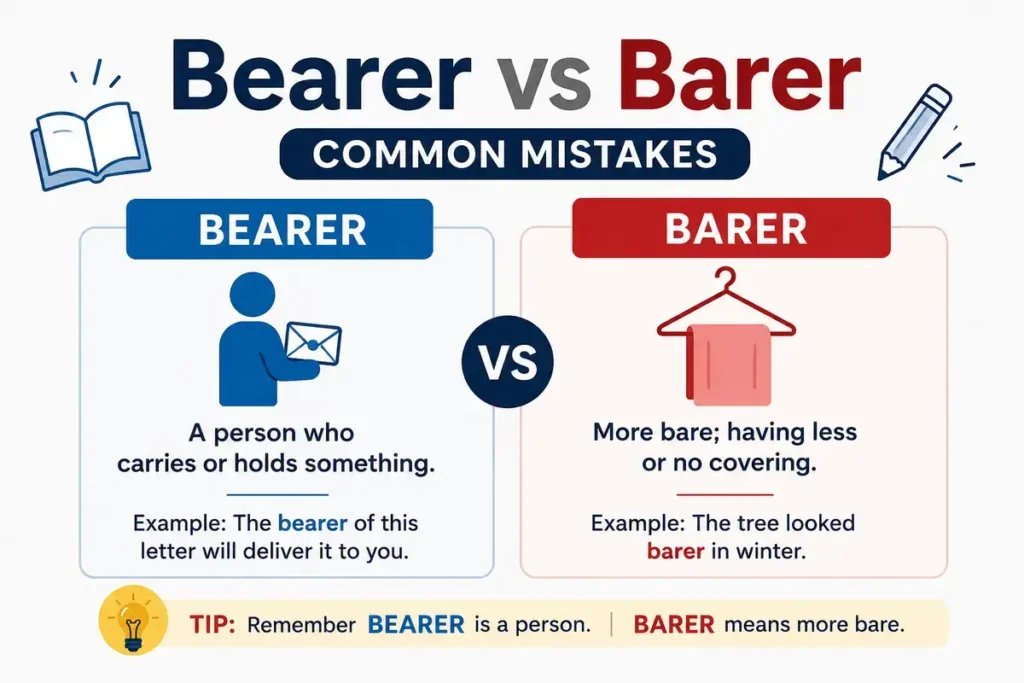
Bearer vs Barer Common Mistakes
These homophones cause confusion because they sound identical. Most mistakes happen when writers rely on pronunciation instead of meaning.
Here are the errors that appear most often.
Using Barer Instead Of Bearer
This is the most common mistake.
Incorrect:
The barer carried the company flag.
Correct:
The bearer carried the company flag.
Remember that anyone carrying, delivering, holding, or possessing something is a bearer.
Using Bearer Instead Of Barer
Writers sometimes choose bearer simply because they recognize it more easily.
Incorrect:
The garden looked bearer after winter.
Correct:
The garden looked barer after winter.
The sentence compares how exposed the garden became, so the comparative adjective barer is required.
Confusing Ring Bearer And Ring Barer
One of the most searched questions online is ring bearer or barer.
The correct term is always ring bearer because the child carries the wedding rings during the ceremony.
Ring barer is incorrect.
Confusing Bearer Of Bad News Or Barer
Another common question is bearer of bad news or barer.
The correct phrase is bearer of bad news because the person delivers unpleasant information.
The expression has nothing to do with being uncovered, so barer does not fit.
Assuming Every Similar Sounding Word Has The Same Meaning
English contains many homophones that sound alike but have different meanings.
For example:
- Their, there, and they’re.
- Principle and principal.
- Complement and compliment.
- Stationary and stationery.
- Bearer and barer.
Understanding the meaning first is much more reliable than guessing based on pronunciation.
Etymology And Word Origin
Although bearer and barer sound the same today, they developed from different words with separate histories.
Origin Of Bearer
Bearer comes from the Old English verb beran, meaning to carry, support, produce, or bring. Over time, the suffix er was added to create a noun describing a person who performs the action.
This pattern appears in many English words.
- Teach becomes teacher.
- Build becomes builder.
- Drive becomes driver.
- Read becomes reader.
- Bear becomes bearer.
As English evolved, bearer gained several specialized meanings in law, banking, religion, military traditions, and ceremonial events.
Origin Of Barer
Barer comes from the adjective bare, which traces its roots to Old English bær, meaning uncovered, exposed, or unclothed.
Adding er forms the comparative adjective.
Examples include:
- Bare becomes barer.
- Bright becomes brighter.
- Tall becomes taller.
- Small becomes smaller.
Unlike bearer, barer remained a descriptive adjective rather than becoming a noun.
Regional Usage
One interesting fact about these words is that their meanings remain consistent across the English speaking world. Unlike words such as gray and grey, there is no regional spelling difference.
American English
American English uses bearer in legal documents, financial writing, ceremonies, transportation, and everyday communication.
Examples include:
- Ticket bearer.
- Passport bearer.
- Flag bearer.
- Ring bearer.
The word barer appears much less often and is mainly found in descriptive writing.
British English
British English follows the same usage.
Readers expect bearer whenever someone carries or possesses something, while barer is reserved for comparisons involving exposure or covering.
Australian English
Australian English also uses the same spellings and meanings.
Terms such as flag bearer and torch bearer appear frequently in sports, government, and news reporting.
Canadian English
Canadian English follows the same grammatical rules.
Both words have identical meanings across Canada, although bearer is encountered far more often in everyday writing.
Because these meanings remain stable across regions, choosing the correct word depends on grammar and context rather than location.
Grammar Rules
Learning the grammar behind these words makes them much easier to use correctly.
Bearer As A Noun
Bearer functions as a countable noun.
Examples include:
- The ticket bearer entered the stadium.
- Every passport bearer received instructions.
- The flag bearer stood at the front of the parade.
Plural form:
Bearers
Examples:
- The torch bearers gathered before the ceremony.
- The standard bearers marched together.
Barer As A Comparative Adjective
Barer compares one noun with another.
Examples include:
- The second room looked barer than the first.
- The hills became barer during the dry season.
Because it is a comparative adjective, barer is often followed by than.
Examples:
- This office looks barer than last year.
- The branches seem barer than they did in autumn.
Common Sentence Patterns
You will often see these natural structures.
For bearer:
- Bearer of responsibility.
- Bearer of gifts.
- Flag bearer.
- Ring bearer.
- Torch bearer.
For barer:
- Barer than before.
- Barer than expected.
- Looking barer after winter.
- Becoming barer each season.
Recognizing these patterns helps you choose the correct word quickly without second guessing yourself.
Real Life Usage Examples
Both words appear in real life, although one is much more common than the other.
Daily Conversation
People often say:
- He was the bearer of the invitation.
- The garden looks barer this year.
Academic Writing
Teachers and textbooks usually discuss bearer in vocabulary lessons, literature, and legal terminology. Barer appears mainly in comparative writing exercises.
Professional Communication
Business documents commonly include phrases such as:
- Bearer bond.
- Bearer instrument.
- Bearer certificate.
- Authorized bearer.
These expressions are standard in legal and financial writing.
Literature And Media
Authors frequently describe characters as the bearer of hope, bearer of news, or bearer of responsibility.
Descriptive writing may use barer to compare landscapes, rooms, forests, or physical appearance when emphasizing that something has become more exposed.
Related Words And Commonly Confused Terms
Learning similar words alongside bearer and barer helps you avoid future mistakes. Many English words sound alike but have different meanings, so understanding the context is just as important as knowing the spelling.
Here are several related words and phrases that readers often search for.
Flag Bearer
A flag bearer is the person who carries a flag during a parade, sporting event, military ceremony, or official celebration.
Examples:
- The flag bearer proudly walked at the front of the procession.
- She was selected as the flag bearer for the opening ceremony.
Ring Bearer
One of the most familiar uses of bearer is ring bearer.
In a wedding, the ring bearer carries the wedding rings to the couple. Because the person carries the rings, bearer is always the correct spelling.
Bearer Of Bad News Meaning
The phrase bearer of bad news refers to the person who delivers unpleasant or disappointing information.
For example:
- I hate being the bearer of bad news, but the meeting has been canceled.
- Nobody wants to be the bearer of bad news, yet someone has to share difficult information.
The expression focuses on delivering news, not on being uncovered, so barer is never correct.
Bearer Bond
A bearer bond is a financial instrument owned by the person who physically possesses it rather than by someone whose name appears on the document.
Although bearer bonds are much less common today, the term still appears in legal and financial discussions.
Barer In English
Many learners search for barer in English because they rarely encounter the word.
The answer is simple. Barer is the comparative form of bare. It means more exposed, less covered, or more empty than something else.
Barer Weapon
Some people search for barer weapon, but in standard English this expression is uncommon.
In most situations, writers actually mean bearer of a weapon, weapon bearer, or armed person, depending on the context.
Barrer Meaning
Another frequent search is barrer meaning.
Barrer is not a standard English word in modern dictionaries. In many cases, it is simply a misspelling of bearer, barer, or barrier, depending on the intended meaning.
Barer Scrabble Word
Yes. Barer is a valid Scrabble word because it is the comparative form of bare.
Even though it is accepted in word games and dictionaries, it appears far less often than bearer in everyday writing.
Similar Homophones
English contains many homophones that cause confusion because they sound alike.
Examples include:
- Accept and except.
- Complement and compliment.
- Principal and principle.
- Desert and dessert.
- Stationary and stationery.
- Bearer and barer.
Whenever you come across words that sound identical, focus on their meaning and grammatical role instead of pronunciation.
Learning the correct usage of bearer and barer goes hand in hand with mastering correct plural forms in English, including tricky words like attornies and attorneys.
Expert Language Insight
Experienced editors rarely confuse bearer vs barer because they identify the word’s function before checking its spelling.
If the word names a person, object, or role, it is almost always bearer. Think about a flag bearer, a torch bearer, a ring bearer, or the bearer of bad news. Each example refers to someone carrying, delivering, or representing something.
If the word compares how exposed or uncovered something is, then barer is the correct choice. This usage is much less common, which explains why many people are unfamiliar with it.
One useful editing habit is to replace the word mentally before proofreading.
Ask yourself:
- Can I replace it with carrier, holder, or messenger? If yes, bearer is probably correct.
- Can I replace it with more exposed or less covered? If yes, barer is the right choice.
This simple technique works far better than relying on pronunciation because both words sound exactly the same.
Frequently Asked Questions
Is bearer or barer correct?
Both words are correct, but they have different meanings. Bearer is a noun referring to someone who carries, holds, or delivers something. Barer is the comparative form of bare and means more uncovered or more exposed. The correct choice depends on your sentence.
What is the difference between bearer and barer?
The main difference is grammatical function. Bearer is a noun, while barer is a comparative adjective. One names a person or thing that carries something. The other compares the amount of covering or exposure.
Is it ring bearer or ring barer?
The correct expression is ring bearer. During a wedding, the child carries the wedding rings, making bearer the only correct spelling. Ring barer is a spelling mistake.
Is it bearer of bad news or barer of bad news?
The correct phrase is bearer of bad news because the person delivers unpleasant information. The expression has been part of English for many years and appears in both formal and informal writing.
Is barer a real English word?
Yes. Barer is a legitimate English word. It is the comparative form of bare, meaning more exposed or less covered. Although it is correct, it is used much less frequently than bearer.
Why do people confuse these words?
People confuse them because they are homophones. They share the same pronunciation but have different spellings, meanings, and grammatical functions. Without context, it is impossible to know which word is intended when spoken.
Does bearer have legal meanings?
Yes. Bearer appears in many legal and financial terms, including bearer bond, bearer instrument, and bearer certificate. In these contexts, it refers to the person who possesses or presents the document.
How can I remember the correct spelling?
Remember the root word. Bearer comes from bear, meaning to carry or support. Barer comes from bare, meaning uncovered. Thinking about the original word makes it much easier to choose the correct spelling.
Conclusion
Although bearer and barer sound exactly alike, they have different meanings and serve different grammatical purposes. Bearer is the word most writers need because it refers to a person or thing that carries, delivers, holds, or possesses something. It appears in familiar expressions such as flag bearer, ring bearer, and bearer of bad news.
Barer is much less common. It is simply the comparative form of bare, describing something that is more exposed or less covered than something else.
The easiest way to choose the correct word is to think about the sentence rather than the pronunciation. If the idea involves carrying, delivering, or possessing something, use bearer. If you are comparing how uncovered something is, use barer.
Once you understand the role each word plays, the difference becomes easy to recognize. A quick check of the meaning before you write will help you avoid one of the most common homophone mistakes in English.