Have you ever typed mentioned vs mentionned and paused because both forms look like they could be correct? You are not alone. The confusion usually comes from the way English forms past tense verbs and from the fact that many English words double their final consonant before adding a suffix.
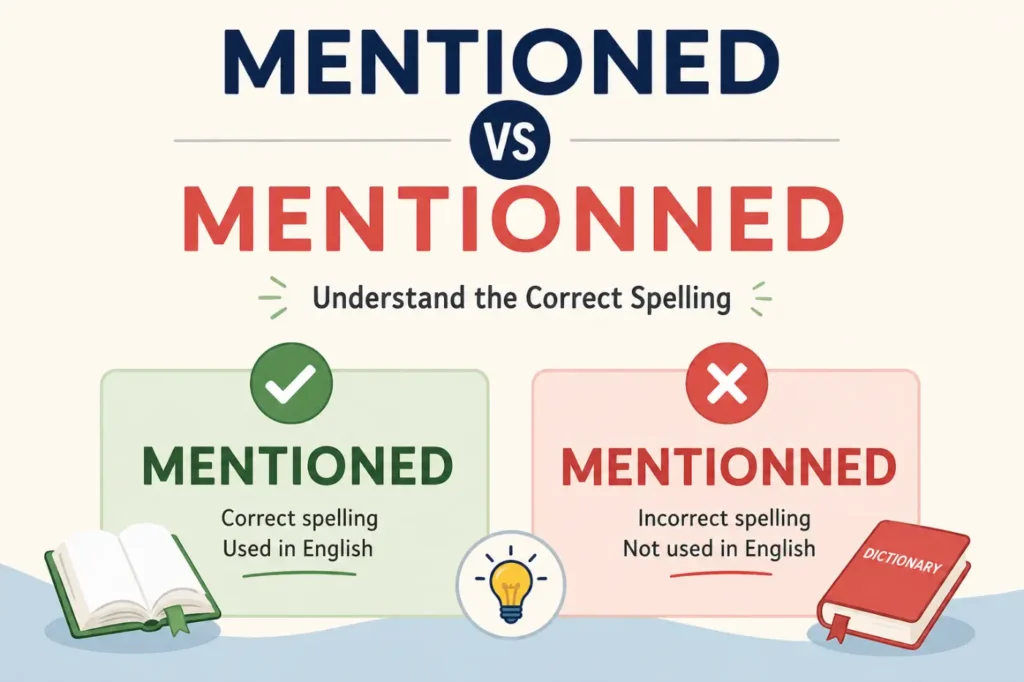
The answer is clear. Mentioned is the correct spelling in standard English. Mentionned is a spelling mistake.
The confusion is understandable because the verb mention ends in a consonant and the past tense is formed by adding ed. However, English does not double the final n in this word. The correct form is simply mention + ed = mentioned.
This guide explains the difference in detail. You will learn what each form means, why one spelling is standard and the other is incorrect, how to pronounce the word, how the past tense works, and how native speakers use it in real sentences. We will also look at common spelling mistakes, word origins, regional English, related verbs, and practical editing advice.
If you only need the answer for a message or document, use mentioned. That is the form you should choose.
Quick Definition
Mentioned is the correct past tense and past participle of the verb mention, meaning to refer to someone or something briefly in speech or writing. Mentionned is an incorrect spelling in standard English. The word does not double its final n before the ed ending.
Quick Answer
The correct spelling is mentioned.
- Mentioned is the past tense and past participle of mention.
- Mentionned is incorrect in standard English.
Examples:
- She mentioned your name during the meeting.
- I mentioned the problem in my email.
- The report mentioned several possible causes.
The extra n in mentionned is unnecessary.
Comparison Table
| Feature | Mentioned | Mentionned |
|---|---|---|
| Correct form | Yes | No |
| Part of speech | Verb form | Incorrect spelling |
| Base word | Mention | Mention |
| Meaning | Referred to briefly | Intended to mean mentioned |
| Tense | Simple past and past participle | No standard grammatical form |
| Origin | From the verb mention | Misspelling caused by extra consonant |
| Formality | Standard in all forms of English | Not standard |
| Common contexts | Conversation writing reports emails journalism | Spelling mistakes and informal typing |
| Usage frequency | Very common | Rare as a correct form because it is not standard |
| Example | He mentioned the issue. | He mentionned the issue. Incorrect |
The important point is that these forms do not represent two different English words. They are not two regional spellings like color and colour. They do not have different meanings, and one is not more formal than the other. Mentioned is the standard form, while mentionned is simply an error.
If you’re unsure whether British vs American spelling differences affect words like enrol and enroll, understanding the regional preference can help you choose the correct form for your audience.
Meaning Of Both Forms
The two spellings need to be treated differently because only one is a genuine standard English word form.
What Mentioned Means
Mentioned is the past tense and past participle of mention.
To mention something means to refer to it briefly. You can mention a person, place, idea, fact, problem, event, or subject without discussing it in great detail.
For example:
- The teacher mentioned the upcoming exam.
- She mentioned that she would arrive late.
- The article mentioned several health benefits.
- He mentioned your suggestion during the discussion.
In each sentence, someone refers to information. The reference may be short or detailed, but the central idea is the same.
The word appears constantly in everyday English because people often refer to things without making them the main subject of a conversation.
You might say:
- I mentioned your idea to my manager.
- She mentioned that the store was closed.
- The doctor mentioned a possible alternative.
- Nobody mentioned the change in schedule.
The form mentioned works naturally in both casual and formal communication.
What Mentionned Means
Mentionned is not the standard English spelling of the past tense of mention.
A reader will usually understand what the writer intended, but the extra n makes the word incorrect. In a school assignment, professional email, article, report, or application, an editor would normally correct mentionned to mentioned.
This mistake often happens because English has many verbs that double a final consonant when adding ed or ing.
For example:
- Stop becomes stopped.
- Plan becomes planned.
- Admit becomes admitted.
- Prefer becomes preferred.
Because these patterns are common, learners may assume that mention follows the same rule. It does not. The correct form is:
Mention + ed = mentioned.
Not:
Mention + ned = mentionned.
Mentioned vs Mentionned Key Differences
The most important difference is simple. Mentioned is a correct English verb form. Mentionned is not. Still, understanding why the mistake happens can help you avoid similar errors.
Spelling Difference
The correct form contains one n before the ed ending.
- Mentioned
The incorrect form contains two n letters in the middle.
- Mentionned
That extra consonant does not belong there.
Grammar Difference
Mentioned has a clear grammatical role. It can function as:
- The simple past form of mention.
- The past participle after auxiliary verbs.
- A participial adjective in certain contexts.
Examples include:
- She mentioned the problem yesterday.
- He has mentioned the issue several times.
- The previously mentioned article provides more detail.
Mentionned has no standard grammatical role in English because it is not a recognised form of the verb.
Meaning Difference
There is no genuine difference in meaning because the second spelling is not a standard alternative word.
When someone writes mentionned, readers usually understand that they mean mentioned. The intended meaning remains clear, but the spelling is still incorrect.
Tone Difference
The correct form works in every tone. You can use mentioned in:
- Casual conversation.
- Text messages.
- Academic writing.
- Business emails.
- Legal documents.
- News reports.
- Technical writing.
The incorrect form may make writing look rushed or poorly edited. In professional communication, even a small spelling mistake can distract the reader.
Regional Difference
There is no standard British and American spelling difference here.
- British English uses mentioned.
- American English uses mentioned.
- Australian English uses mentioned.
- Canadian English uses mentioned.
The spelling does not change across these major varieties of English.
Which Spelling Is Correct
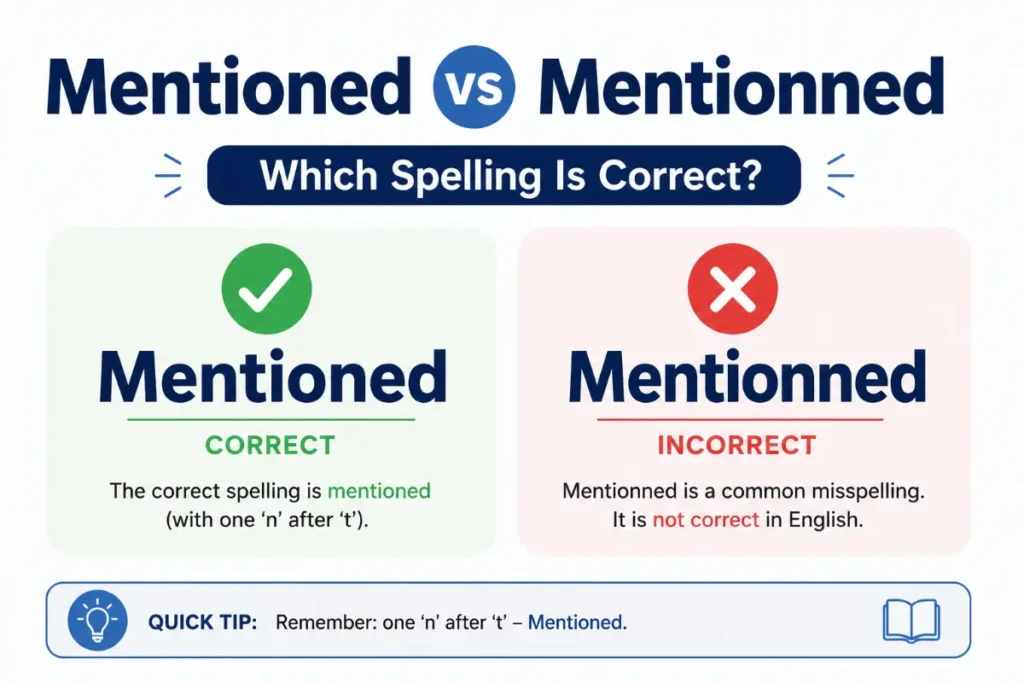
Mentioned is the correct spelling. The word comes from the base verb mention. To form its simple past tense and past participle, add ed:
Mention + ed = mentioned.
You do not double the final n.
This follows the normal spelling pattern for this verb. The word mention ends with the sound and letter sequence tion, not with a short stressed vowel followed by a single final consonant that needs doubling.
Compare these examples:
- Plan becomes planned.
- Stop becomes stopped.
- Admit becomes admitted.
- Mention becomes mentioned.
The spelling rule depends on the structure and pronunciation of the base word. You cannot simply double every final consonant before adding ed.
If you are writing a sentence and hesitate between the two forms, choose mentioned.
Pronunciation Guide
The correct form is pronounced differently from how some learners may expect based on the spelling.
IPA Pronunciation
Mentioned is commonly pronounced:
/ˈmenʃənd/
The exact vowel quality can vary slightly across accents, but the general pronunciation remains consistent.
Syllable Breakdown
The word is usually pronounced as two syllables:
MEN shənd
The first syllable receives the main stress.
The ending ed does not create a separate syllable here. This is important because English past tense endings can have three different pronunciations.
Compare:
- Walked has one syllable.
- Wanted has two syllables.
- Mentioned has two syllables because the base word already has two syllables.
Common Pronunciation Mistakes
Some learners pronounce the word as if the extra n in the incorrect spelling should create another sound. It does not. The correct pronunciation does not contain an additional n sound between the base word and the ending.
Another common mistake is trying to pronounce the ed as a full extra syllable. In natural speech, the ending blends into the final part of the word.
Listening to native speakers say mentioned can help you hear the difference between spelling and pronunciation. English often contains letters that affect spelling without creating a separate sound.
How To Remember The Correct Spelling
The easiest way to remember the correct form is to return to the base word.
Start with:
Mention
Then add:
ed
The result is:
Mentioned
There is no reason to insert another n.
A useful memory trick is to think of the word as a complete unit:
men + tioned
The ending already begins with the t sound and spelling pattern in mention. The word does not need an extra consonant before ed.
You can also compare it with similar verbs that do not double their final consonants.
- Listen becomes listened.
- Open becomes opened.
- Answer becomes answered.
- Visit becomes visited.
- Mention becomes mentioned.
The spelling pattern becomes easier when you focus on the actual base word instead of applying a general rule mechanically.
A practical editing habit helps too. If you see mentionned in your writing, remove one n. The correct form is always mentioned in standard English.
Examples In Sentences
The clearest way to understand mentioned is to see how naturally it works in different situations. The word can refer to a person, object, idea, event, problem, or fact. It can also appear in simple past sentences, perfect tenses, passive structures, and descriptive phrases.
Ten Examples With Mentioned
- She mentioned your name during the conversation.
- I mentioned the problem in my email yesterday.
- The teacher mentioned that the test would begin at nine.
- He mentioned a restaurant near the train station.
- The report mentioned several possible causes of the delay.
- My friend mentioned that she was moving to another city.
- The article mentioned the importance of regular exercise.
- Nobody mentioned the change to the meeting schedule.
- The manager mentioned your suggestion during the team discussion.
- As I mentioned earlier, the deadline is next Friday.
These examples show an important feature of the verb. A person can mention something directly or mention that something happened. The structure changes slightly, but the spelling remains the same.
For example:
- She mentioned the new policy.
- She mentioned that the policy had changed.
In the first sentence, mentioned is followed by a noun phrase. In the second, it is followed by a clause beginning with that. Both structures are natural.
Mentioned vs Mentionned Common Mistakes
The most common mistake is adding an unnecessary n. However, learners also make several other errors involving spelling, tense, sentence structure, and meaning.
Writing Mentionned
This is the central spelling error.
Incorrect:
The article mentionned the new rule.
Correct:
The article mentioned the new rule.
The verb does not double the n before the past tense ending.
Confusing Mentioned With Mention
The base form and past form are not interchangeable.
Incorrect:
Yesterday she mention the problem.
Correct:
Yesterday she mentioned the problem.
Use mention for the present form and mentioned for the simple past.
Compare:
- I mention the issue whenever it becomes relevant.
- I mentioned the issue during yesterday’s meeting.
The time reference determines the form.
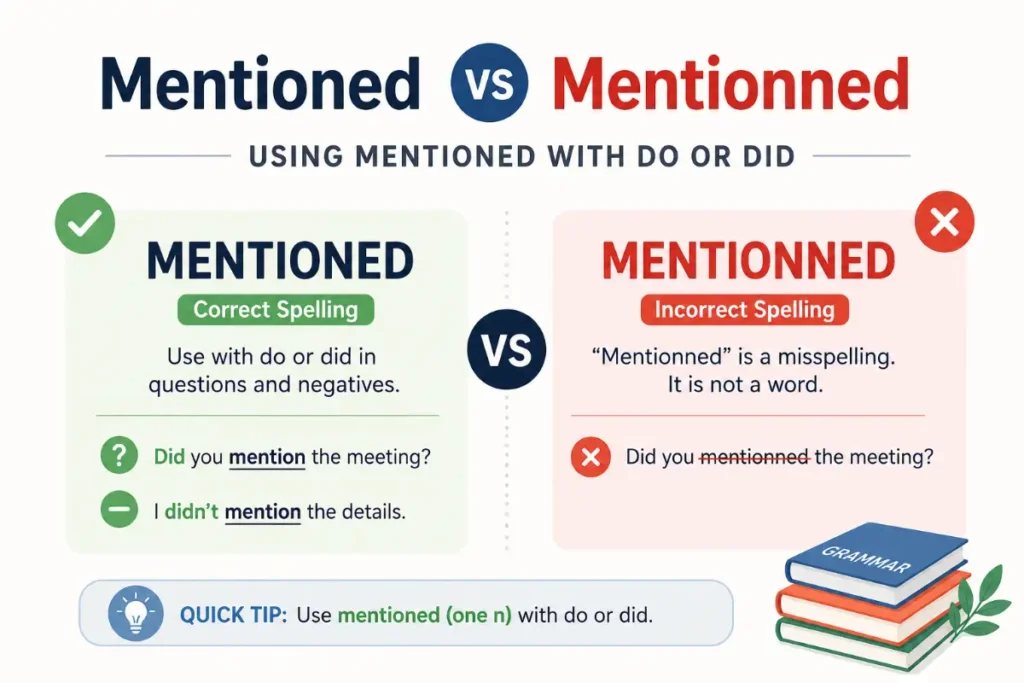
Using Mentioned With Do Or Did
A common grammar mistake occurs when writers use the past form after did.
Incorrect:
Did she mentioned the problem?
Correct:
Did she mention the problem?
After did, use the base form mention because the auxiliary verb already carries the past tense.
The same rule applies to negative sentences.
Incorrect:
She did not mentioned the issue.
Correct:
She did not mention the issue.
This is a useful rule to remember because English does not normally mark the past tense twice in the same verb phrase.
Confusing Mentioned With Discussed
To mention something usually means to refer to it briefly. To discuss something usually means to examine or talk about it in greater detail.
Compare these sentences:
- The speaker mentioned the budget problem.
- The speaker discussed the budget problem for thirty minutes.
The first sentence suggests a brief reference. The second suggests a deeper conversation.
The difference is not absolute because context matters, but this distinction is useful in everyday writing.
Adding An Unnecessary Preposition
Native speakers usually say:
She mentioned the problem.
Not:
She mentioned about the problem. The verb mention normally takes its object directly.
Correct examples include:
- He mentioned the new project.
- She mentioned your name.
- The report mentioned the risks.
You can also use mention that: He mentioned that the project was delayed.
Assuming The Spelling Changes In British English
Some English words have different spellings in British and American English. This is not one of them. Both varieties use mentioned. The same applies to Australian and Canadian English.
Mentioned and mentionned aren’t the only words that cause confusion—another common plural spelling mistake is deciding whether copys or copies is the correct form.
Etymology And Word Origin
The verb mention has a long history in English and ultimately comes from Latin.
It developed through Old French from the Latin word mentio, meaning a mentioning or reference. The word entered English through the influence of French after the Norman Conquest and gradually became part of the language used for referring to people, subjects, and ideas.
The modern English verb has kept the central meaning of its historical roots. To mention something is to bring it briefly into a conversation or written discussion.
The past form developed in the usual English way:
Mention + ed = mentioned.
The extra n in the incorrect form is not connected to the word’s history. It is a modern spelling error caused by applying a consonant doubling pattern where it does not belong.
This is a useful reminder that English spelling rules work by patterns rather than by one universal formula. Some verbs double a final consonant. Others do not.
Regional Usage
The spelling remains the same across the major varieties of English.
American English
American writers use mentioned in conversation, journalism, business writing, education, and technical communication.
For example:
The study mentioned several limitations.
British English
British English uses the same spelling and the same grammar.
For example:
She mentioned the issue during the interview.
There is no regional spelling difference between mentioned and mentionned.
Australian English
Australian English also uses mentioned as the standard past tense and past participle.
The form appears in both casual conversation and formal writing.
Canadian English
Canadian English follows the same spelling convention.
The word is written mentioned in academic, professional, and everyday contexts.
This makes the rule easy to apply. Unlike some spelling questions involving regional English, you do not need to choose between two accepted national forms.
Grammar Rules
Understanding the grammar behind the word makes the spelling easier to remember.
Mentioned As The Simple Past
Use mentioned to describe a completed reference in the past.
Examples:
- She mentioned the issue yesterday.
- He mentioned your name at lunch.
- The article mentioned the study last week.
The action happened before the time of speaking.
Mentioned As A Past Participle
The same form appears with auxiliary verbs such as has, have, and had.
Examples:
- She has mentioned the issue several times.
- They have mentioned your proposal in previous meetings.
- He had mentioned the problem before the discussion began.
In these structures, mentioned is a past participle.
Passive Voice
The word can also appear in passive constructions.
Examples:
- The problem was mentioned during the meeting.
- Your name was mentioned in the report.
- The proposal has been mentioned by several researchers.
The subject receives the action rather than performing it.
The Base Form After Did
After did, use mention, not mentioned.
Examples:
- Did she mention the deadline?
- Why did he mention that issue?
- They did not mention the change.
This rule is especially important in questions and negative statements.
The Present Form
Use mention for present habits, general facts, and actions connected to the present.
Examples:
- I often mention this example in class.
- She usually mentions the deadline at the start of each meeting.
- The article does not mention the source.
The Present Participle
The ing form is mentioning.
Examples:
- She is mentioning the problem again.
- He kept mentioning the same example.
- The report is mentioning several possible explanations.
Notice that the final n is not doubled here either.
Common Verb Forms
The main forms are:
- Base form: mention.
- Third person singular: mentions.
- Past tense: mentioned.
- Past participle: mentioned.
- Present participle: mentioning.
The verb is regular. Its past tense and past participle both use the ed ending.
Real Life Usage Examples
The word appears in almost every type of English communication. Its meaning stays stable, but the surrounding language changes depending on the situation.
Daily Conversation
In ordinary conversation, people use the verb when referring to something they said or heard.
Examples include:
- I think she mentioned your name.
- You mentioned that you were looking for a new job.
- Did he mention when he would arrive?
- I forgot to mention one important detail.
The word is especially common when someone adds information to a conversation.
Academic Writing
Academic writers use it to identify information that appears in a source or previous discussion.
Examples include:
- The study mentioned several limitations.
- Previous research has mentioned a connection between the two factors.
- The author mentioned this issue briefly in the introduction.
In academic writing, mentioned can sometimes sound less precise than a more specific verb such as reported, identified, argued, or observed.
For example:
The study reported a significant increase.
This is usually stronger than:
The study mentioned a significant increase.
That distinction matters in careful writing. Mentioned describes the act of referring to information. It does not necessarily tell the reader how important, reliable, or thoroughly examined that information was.

Professional Communication
The word is common in emails, reports, meetings, and workplace messages.
Examples include:
- As mentioned in our meeting, the project will begin next week.
- I mentioned the issue to the technical team.
- The client mentioned a concern about the delivery date.
- Please review the points mentioned in the attached report.
The phrase as mentioned earlier is especially common in professional writing. However, experienced editors often recommend using it carefully. If you can restate the important information clearly, that is often more helpful than sending the reader back through a long message.
Literature
Writers use the word when referring to earlier details, characters, events, or ideas.
For example, a narrator may refer back to something previously introduced. The word can help create continuity across a longer passage.
A phrase such as the previously mentioned house tells the reader that the house appeared earlier in the text.
Media And Journalism
News articles frequently use the verb when describing what a person, report, or source said.
Examples include:
- The minister mentioned the proposal during the press conference.
- The report mentioned concerns about rising costs.
- The actor mentioned the project during a recent interview.
Journalists often choose more precise verbs when the exact nature of the statement matters. Announced, confirmed, claimed, explained, and stated each provide more information than the general verb mentioned.
Digital Communication
The word is also common in emails, text messages, social media posts, and online discussions.
Examples include:
- As I mentioned in my last message, the file is attached.
- You mentioned this in a previous post.
- Nobody mentioned that the schedule had changed.
The spelling remains exactly the same in casual digital communication.
Related Words And Confused Terms
The verb mention belongs to a wider group of words used when people refer to information, ideas, events, or opinions. These words overlap in meaning, but they are not interchangeable in every sentence.
Understanding the differences helps you choose a more precise verb instead of relying on the same word repeatedly.
Mention
To mention something means to refer to it briefly.
Example:
She mentioned the new project during the meeting.
The sentence tells us that she referred to the project. It does not tell us how long she discussed it or how much detail she provided.
Discuss
To discuss something means to talk about it in greater detail.
Example:
The team discussed the new project for two hours.
This suggests a deeper conversation than mentioned.
Refer To
To refer to something means to direct attention to it or speak about it.
Example:
The report refers to several earlier studies.
This phrase is especially common in academic and professional writing.
State
To state something means to express it clearly and directly.
Example:
The report stated that the results were inconclusive.
This sounds more precise and formal than mentioned.
Note
To note something means to point it out or record it.
Example:
The researcher noted a significant change in the results.
This word often suggests that the information deserves attention.
Cite
To cite a source means to refer to it as evidence or authority.
Example:
The paper cited three studies to support its conclusion.
A source can be mentioned without being cited. Citation usually involves a more formal connection to evidence.
Announce
To announce something means to make information known publicly.
Example:
The company announced its new policy on Monday.
Saying that the company merely mentioned the policy would suggest a less formal or less significant reference.
Bring Up
Bring up is a conversational phrasal verb that means to introduce a subject into a discussion.
Example:
She brought up the problem during lunch.
In casual speech, this may sound more natural than mentioned in some situations.
Similar spelling mix-ups also appear outside everyday vocabulary, such as the Conex vs Connex naming confusion, where two nearly identical terms have very different origins and usage.
Expert Language Insight
Experienced editors make an important distinction between referring to information and explaining information. Mentioned is a broad and neutral verb. It tells readers that something appeared in speech or writing, but it does not explain the speaker’s purpose, level of certainty, or depth of analysis.
That is why stronger writing often replaces it with a more specific verb when the context allows.
Compare these sentences:
- The study mentioned a rise in prices.
- The study reported a rise in prices.
- The study documented a rise in prices.
- The study identified a rise in prices.
The first sentence is acceptable but general. The others provide more information about what the study actually did.
This is a useful editorial principle. Use mentioned when the simple act of referring to something is the point. Choose a more precise verb when you need to show what happened.
Another important point concerns the spelling mistake mentionned. Native speakers usually understand it immediately, but recognition does not make it correct. In polished writing, spelling accuracy matters because small errors can interrupt the reader’s attention and weaken confidence in the text.
The best practical rule is simple:
- Write mentioned for the standard past tense and past participle.
- Do not double the final n.
- Use a more precise synonym when the context demands greater detail.
- Use mention after did.
- Use mentioned after has, have, had, and in ordinary past tense statements.
Frequently Asked Questions
Is mentioned or mentionned correct?
Mentioned is correct. It is the standard past tense and past participle of the verb mention. Mentionned is a spelling mistake caused by adding an unnecessary extra n. The correct form is used in American, British, Australian, and Canadian English.
Why is mentionned spelled incorrectly?
The error usually happens because English contains many verbs that double a final consonant before adding a suffix. Words such as planned and stopped can make learners assume that mention follows the same pattern. It does not. The correct form is mention + ed, which gives mentioned.
What is the past tense of mention?
The past tense is mentioned. For example, you can say, She mentioned the problem yesterday. The same form also works as the past participle in sentences such as, He has mentioned the issue several times.
Do you say mentioned or mention after did?
Use the base form mention after did. The correct question is Did she mention the problem? The incorrect form is Did she mentioned the problem? The auxiliary did already carries the past tense, so the main verb stays in its base form.
Is mentioned a regular verb?
Yes. Mention is a regular verb. Its main forms are mention, mentions, mentioned, mentioned, and mentioning. The past tense and past participle are both formed with the regular ed ending.
Is there a difference between mentioned and discussed?
Yes. Mentioned usually means referred to something briefly, while discussed generally suggests a fuller conversation or examination. Someone can mention a problem in one sentence or discuss it for an hour. The best choice depends on how much attention the subject received.
How do you pronounce mentioned?
The standard pronunciation is approximately /ˈmenʃənd/. It is usually spoken as two syllables, with the main stress on the first syllable. The ed ending does not create a separate third syllable.
Can mentioned be used in formal writing?
Yes. Mentioned is completely acceptable in formal writing. However, professional and academic writers sometimes choose a more precise verb such as reported, identified, stated, observed, or cited when they need to explain exactly how information was presented.
Conclusion
The correct spelling is mentioned. It is the simple past tense and past participle of mention, and it works naturally in everyday conversation, academic writing, professional communication, journalism, and formal documents.
Mentionned is not an alternative spelling. It is a common mistake caused by doubling the final n when the word does not require it. The correct formation is straightforward:
Mention + ed = mentioned.
The word can describe a brief reference to a person, idea, event, fact, or subject. Its meaning is broad and neutral, which makes it useful in many situations. Still, careful writers should choose more specific verbs such as reported, stated, discussed, or identified when those words communicate the exact action more clearly.
The simplest rule to remember is this: mentioned is the correct spelling and mentionned is a mistake. If you are still wondering about mentioned vs mentionned, choose mentioned every time in standard English. One n is all you need before the ed ending.