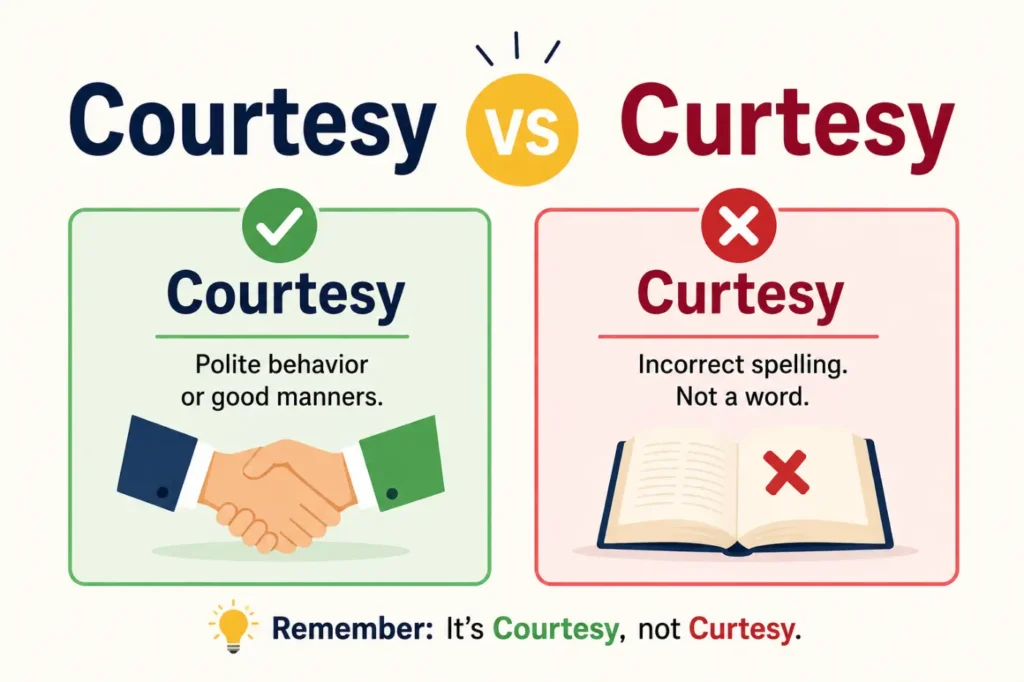
If you have searched for courtesy vs curtesy, you are probably trying to figure out which word is correct. They look almost identical, sound similar, and are often confused in writing. That makes it easy to assume one is simply a misspelling of the other. The truth is a little more interesting.
In modern English, courtesy is the word most people need. It refers to politeness, respect, good manners, or a thoughtful act. You will see it in everyday conversations, business communication, customer service, and formal writing.
Curtesy, on the other hand, is a real English word, but it belongs to an old legal context. It describes a historical property right that existed under common law. Unless you are reading legal history or discussing traditional inheritance laws, you are unlikely to use it.
Another word adds to the confusion. Curtsy refers to the respectful gesture of bending the knees, often performed in formal ceremonies. Although it sounds similar, it has a completely different meaning.
This guide explains the meaning of each word, when to use it, how to pronounce it, common mistakes to avoid, and practical examples that make the differences easy to remember.
Quick Definition
Courtesy means politeness, respect, or a considerate action and is the correct word in almost every modern situation. Curtesy is an archaic legal term describing a husband’s historical right to use his deceased wife’s property under common law. Curtsy is a respectful gesture made by bending the knees.
Quick Answer
If you only need a fast answer, remember these points.
- Courtesy is the correct choice in everyday English.
- Curtesy is a real word, but it is limited to historical legal discussions.
- Curtsy is the correct spelling for the respectful bow often associated with formal traditions.
- Unless you are writing about legal history, you almost certainly mean courtesy.
Just as many people confuse courtesy with curtesy, writers also struggle with the correct spelling of “commit”, especially when deciding whether to double the final consonant.
Comparison Table
| Feature | Courtesy | Curtesy |
|---|---|---|
| Part of speech | Noun | Noun |
| Correct in modern writing | Yes | Only in historical legal contexts |
| Primary meaning | Politeness Respect Thoughtful behavior | Common law right of a widower to his wife’s property |
| Origin | Old French and Latin | Medieval English legal terminology |
| Formality | Everyday and formal | Legal and historical |
| Common contexts | Customer service Business Emails Daily conversation Literature | Legal history Property law Historical documents |
| Usage frequency | Extremely common | Very rare |
| Example | Thank you for your courtesy. | The court examined the doctrine of curtesy. |
Meaning Of Both Terms
Although these words differ by only one letter, they belong to completely different parts of everyday language.
What Does Courtesy Mean
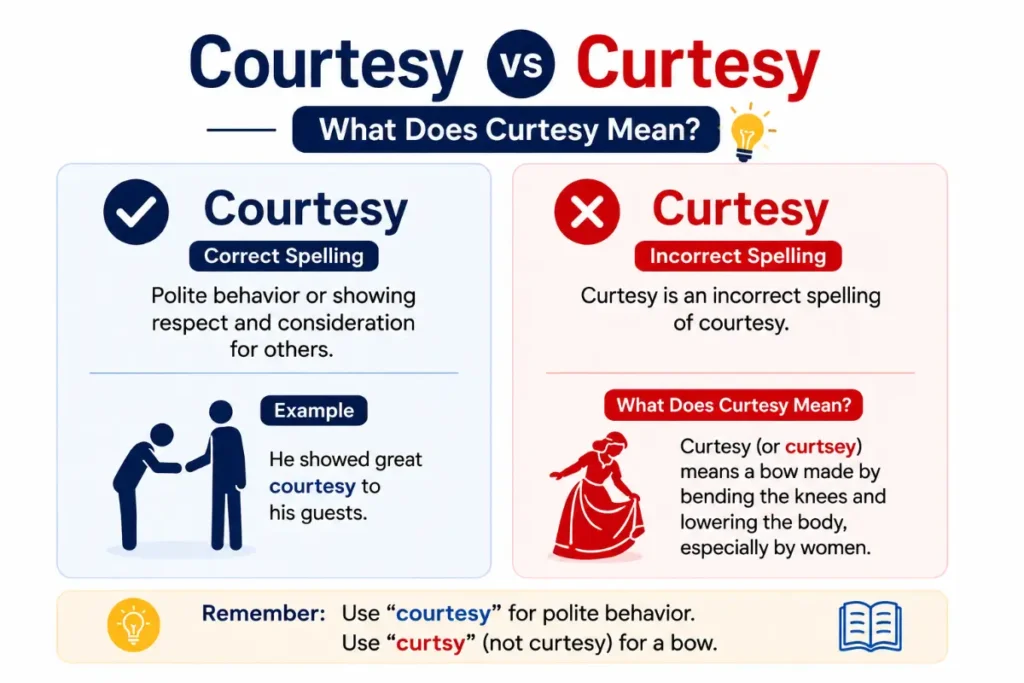
Courtesy refers to polite behavior, respect, kindness, and consideration for others. It can describe someone’s attitude, a thoughtful action, or a social expectation.
You will encounter this word in many situations, including:
- Customer service.
- Professional communication.
- Schools.
- Public notices.
- Hospitality.
- Everyday conversations.
- Formal speeches.
Common expressions include:
- Courtesy call.
- Courtesy copy.
- Courtesy reminder.
- Courtesy of someone.
- Common courtesy.
For example, if someone holds a door open or thanks another person sincerely, those actions are acts of courtesy.
The word can also appear in phrases that acknowledge a source, such as Photo courtesy of the local museum or Image courtesy of the author. In these cases, it means the material was provided through someone’s kindness or permission.
What Does Curtesy Mean
Curtesy is an old legal term that originated in English common law. It referred to a husband’s right to use certain property owned by his deceased wife during his lifetime, provided specific legal conditions were met.
Today, this legal doctrine has little practical importance because modern inheritance laws have replaced it in most legal systems.
Outside legal history, the word is rarely used. Many people have never encountered it except when searching for the difference between these spellings. If you are writing an email, article, school assignment, or business document, curtesy is almost certainly not the word you want.
Key Differences
The easiest way to understand these words is to compare how they are actually used.
The first difference is meaning. Courtesy relates to good manners, respect, and thoughtful behavior. Curtesy belongs to historical property law and has nothing to do with politeness.
The second difference is frequency. You will read and hear courtesy every day in newspapers, websites, conversations, and professional communication. By contrast, curtesy appears mainly in legal textbooks, historical records, and discussions of old common law.
Their audiences also differ. Almost everyone uses courtesy, while curtesy is primarily recognized by legal historians, scholars, and students studying historical law.
Here is a quick comparison.
- Courtesy is part of modern English.
- Curtesy is an archaic legal term.
- One relates to manners and kindness.
- The other relates to historical property rights.
- They are never interchangeable in ordinary writing.
Understanding this distinction helps you avoid one of the most common spelling mistakes involving these words.
Which Word Is Correct
The answer depends on what you want to say, but for almost every reader, courtesy is the correct choice.
If you are talking about politeness, respect, customer service, thoughtful behavior, or a kind gesture, always use courtesy.
Choose curtesy only when discussing the historical legal doctrine found in old common law. Outside that narrow context, using it instead of courtesy will be treated as a spelling mistake by readers and editors.
You may also encounter curtsy, which is another valid English word. It refers to the formal gesture of bending the knees as a sign of respect. Although its pronunciation is similar, it has an entirely different meaning.
Before using any of these words, ask yourself a simple question. Am I writing about manners, historical law, or a formal gesture? The answer will immediately point you to the correct word.
Pronunciation Guide
The similar sound of these words is one reason people confuse them.
IPA Pronunciation
Courtesy
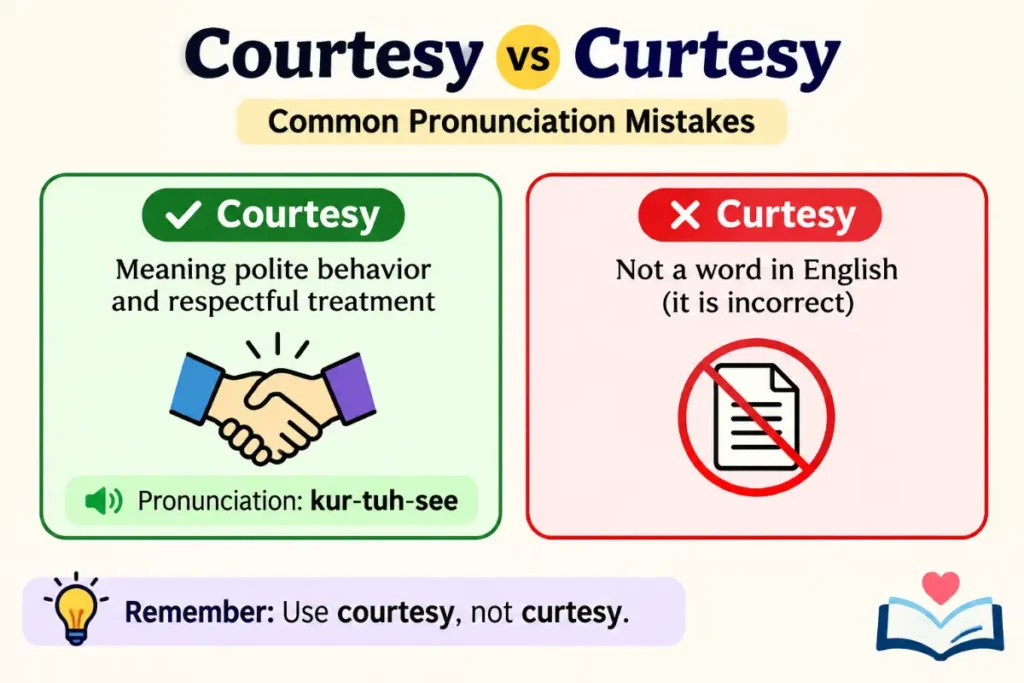
/ˈkɝː.tə.si/ in American English.
/ˈkɜː.tə.si/ in British English.
Curtesy
/ˈkɝː.tə.si/
Curtsy
/ˈkɝːt.si/
Syllable Breakdown
Courtesy
CUR te see
Curtesy
CUR te see
Curtsy
CURT see
Notice that courtesy and curtesy are pronounced almost identically, while curtsy is shorter because it has one fewer syllable.
Common Pronunciation Mistakes
These tips will help you speak the words naturally.
- Do not drop the middle syllable in courtesy.
- Do not confuse courtesy with curtsy simply because they sound alike.
- Remember that pronunciation alone cannot tell you which spelling is correct. Context determines the right word.
How To Remember The Correct Word
A simple memory trick can prevent this mistake every time.
Think about the word courteous. It describes someone who is polite and respectful. Since courteous and courtesy share the same root, they naturally belong together.
You can also remember that the word courtesy appears in familiar expressions you already know.
- Common courtesy.
- Courtesy call.
- Courtesy reminder.
- Courtesy copy.
- Courtesy of the photographer.
Because these phrases appear so often in modern English, they reinforce the correct spelling every time you read them.
For curtesy, remember one idea instead. It belongs to old legal history rather than everyday language. If your sentence has nothing to do with historical property law, you almost certainly do not need that spelling.
Courtesy vs Curtesy Examples In Sentences
Looking at real examples is one of the fastest ways to understand how these words are used. The first set shows the modern word that appears in everyday English. The second set demonstrates the historical legal term in its proper context.
Examples Using Courtesy
These sentences reflect natural, modern English.
- Thank you for your courtesy during our meeting.
- The hotel staff treated every guest with courtesy and respect.
- As a courtesy, the store extended the return deadline.
- She made a courtesy call before arriving at the office.
- The magazine published the image courtesy of the local museum.
- Common courtesy includes saying please and thank you.
- The airline offered a courtesy shuttle to nearby hotels.
- His calm tone and courtesy impressed everyone in the room.
- Please accept this gift as a courtesy from our team.
- The receptionist greeted visitors with genuine courtesy.
Notice how naturally the word fits into conversations, business communication, customer service, and everyday writing.
Examples Using Curtesy
The following examples show the historical legal meaning rather than politeness.
- The professor explained the doctrine of curtesy during the property law lecture.
- The old court record mentioned the right of curtesy.
- Several legal historians have written about curtesy in English common law.
- The textbook compared dower and curtesy.
- The lawyer discussed curtesy while explaining historical inheritance rules.
- Curtesy became less significant as inheritance laws changed.
- Students examined the doctrine of curtesy in medieval legal documents.
- The article described how curtesy affected property ownership centuries ago.
- Modern legislation has replaced many principles related to curtesy.
- The museum displayed legal manuscripts discussing dower and curtesy.
Outside legal history, these sentences are uncommon because the term rarely appears in modern communication.
If you’re interested in avoiding similar writing mistakes, another commonly misspelled verb is proving, which is often incorrectly written with an extra “o.”
Common Mistakes
Most mistakes happen because the words look alike and sound almost identical. Understanding the common errors makes it much easier to choose the correct spelling.
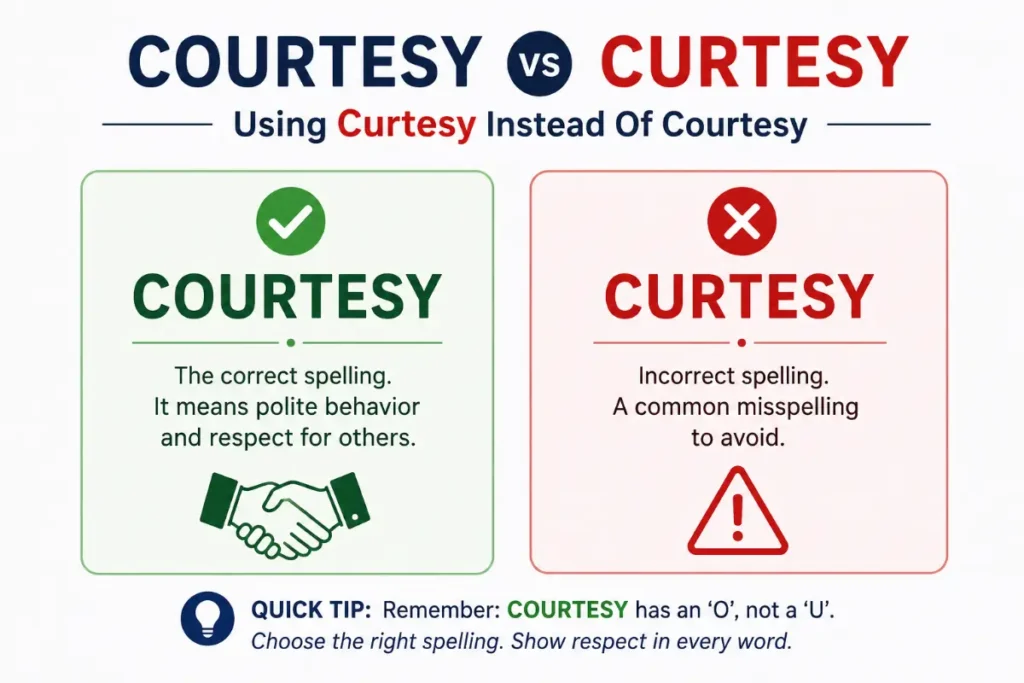
Using Curtesy Instead Of Courtesy
This is the mistake editors see most often.
Incorrect:
Thank you for your curtesy.
Correct:
Thank you for your courtesy.
If you are talking about politeness or kindness, courtesy is almost always the correct choice.
Confusing Courtesy With Curtsy
Many writers accidentally replace courtesy with curtsy because both words begin with the same letters. Remember the difference.
- Courtesy means politeness.
- Curtsy is a respectful gesture.
The meanings are completely unrelated.
Assuming Curtesy Is Just A Misspelling
This assumption is understandable but not entirely accurate. Curtesy is a genuine English word with a long legal history. The problem is that it belongs to a very specific historical context rather than modern English.
Mixing The Words In Formal Writing
Professional documents, business emails, school assignments, and articles almost always require courtesy. Unless your topic is legal history, using curtesy will usually be marked as an error.
Misunderstanding Common Expressions
Several familiar expressions always use courtesy.
These include:
- Courtesy call.
- Courtesy reminder.
- Courtesy copy.
- Courtesy of the author.
- Common courtesy.
Replacing courtesy with curtesy changes these well established expressions into incorrect English.
Etymology And Word Origin
Although the spellings are similar, the words developed along different paths.
Courtesy comes from the Old French word courtoisie, meaning politeness, refinement, or behavior suitable for a royal court. Its roots trace back to the Latin word cohors, which eventually gave rise to the concept of a court and the respectful behavior expected there.
Over time, the meaning expanded. Today, the word refers to kindness, respect, consideration, and good manners in everyday life.
Curtesy has a different history. It developed as a legal term in medieval England and became part of English common law. The doctrine described a husband’s right to enjoy certain property owned by his deceased wife during his lifetime if specific legal conditions were met.
As legal systems evolved, most countries replaced this doctrine with modern inheritance laws. As a result, the term gradually disappeared from ordinary language and now survives mainly in legal history and historical documents.
Understanding this history explains why one word remains common while the other has become rare.
Courtesy vs Curtesy Regional Usage
Unlike many spelling differences, this comparison is not divided between American and British English.
American English
American English uses courtesy in everyday speech, journalism, education, and business writing. The legal term curtesy appears only in discussions of historical property law.
British English
British English follows the same pattern. Writers use courtesy for politeness and respectful behavior, while curtesy remains limited to historical legal references.
Australian English
Australian English also treats courtesy as the standard modern word. Most speakers will never encounter curtesy outside legal history or academic research.
Canadian English
Canadian English follows the same convention. Although Canadian spelling sometimes differs from American spelling, there is no regional variation here. Modern writers consistently choose courtesy for ordinary communication. Across major English speaking countries, the distinction remains the same.
Grammar Rules
Knowing how the word functions in a sentence helps you write more naturally.
Part Of Speech
Both courtesy and curtesy are nouns.
Examples include:
- Courtesy costs nothing.
- The doctrine of curtesy influenced historical property law.
Common Sentence Patterns
The word courtesy appears in several natural sentence structures.
Examples include:
- Thank you for your courtesy.
- He acted with courtesy.
- The tickets were provided as a courtesy.
- Please accept this courtesy from our company.
- The photograph appears courtesy of the local newspaper.
Common Collocations
Native speakers regularly pair the word with these expressions.
- Common courtesy.
- Courtesy call.
- Courtesy copy.
- Courtesy reminder.
- Courtesy vehicle.
- Courtesy shuttle.
- Professional courtesy.
- Courtesy of someone.
Learning these combinations makes your writing sound more natural because they reflect how the language is actually used.
Real Life Usage Examples
The word appears in many situations beyond grammar books.
Daily Conversation
People often use courtesy when talking about polite behavior.
Examples include:
- Showing courtesy to neighbors.
- Thanking someone for their kindness.
- Holding the door open for another person.
Academic Writing
Researchers discussing communication, ethics, education, and sociology often use the word when describing respectful behavior or social expectations.
The legal term appears only in historical or legal research.
Professional Communication
Businesses use courtesy every day.
Examples include:
- Courtesy call.
- Courtesy email.
- Courtesy reminder.
- Professional courtesy.
- Courtesy vehicle.
These expressions are common in customer service, healthcare, hospitality, finance, and corporate communication.
Literature And Media
Authors often use courtesy to describe characters who demonstrate kindness, respect, or good manners.
Historical novels and legal texts may occasionally mention curtesy, but modern fiction rarely uses the term unless the story explores historical law.
Courtesy Call Meaning
A courtesy call is a brief phone call or visit made out of respect, politeness, or professional etiquette rather than necessity. Businesses often make courtesy calls to confirm appointments, check on customer satisfaction, or maintain positive relationships.
Courtesy Of Someone
The phrase courtesy of someone gives credit to the person or organization that provided something.
Examples include:
- The image appears courtesy of the city library.
- Refreshments were provided courtesy of a local business.
- The photographs are published courtesy of the artist.
This expression is widely used in journalism, publishing, advertising, museums, and online media to acknowledge permission or generosity.
Spelling errors involving doubled letters are common, and understanding why “transferred” has two Rs can help you recognize similar patterns in English word formation.
Related Words And Confused Terms
Several English words resemble courtesy in spelling or pronunciation. Some are closely related in meaning, while others belong to entirely different contexts. Knowing the difference helps you choose the right word with confidence.
| Word | Meaning | Common Use |
|---|---|---|
| Courtesy | Politeness, respect, or a considerate act | Everyday English |
| Curtesy | Historical legal right under common law | Legal history |
| Curtsy | A respectful gesture made by bending the knees | Ceremonies and formal traditions |
| Courteous | Showing good manners and respect | Everyday English |
| Discourtesy | Rude or impolite behavior | Formal and everyday writing |
| Politeness | Respectful behavior toward others | Everyday English |
| Etiquette | Rules of polite social behavior | Formal and social settings |
| Civility | Respectful and considerate conduct | Public and professional communication |
These related terms expand your vocabulary and make it easier to understand subtle differences in meaning.
One comparison deserves special attention.
- Courtesy relates to politeness.
- Curtesy refers to an old legal doctrine.
- Curtsy describes a physical gesture of respect.
Although the words sound similar, they are never interchangeable.
Expert Language Insight
Professional editors almost never hesitate when choosing between these words because the context provides the answer immediately.
If a sentence discusses kindness, respect, customer service, manners, or thoughtful behavior, courtesy is the correct choice. It appears naturally in conversations, business communication, newspapers, books, and academic writing.
The legal term survives mainly because it remains part of legal history. Modern inheritance laws have replaced the doctrine in most jurisdictions, so contemporary writers rarely need to use it outside historical discussions.
Editors also pay close attention to familiar expressions. Phrases such as common courtesy, courtesy call, courtesy reminder, and courtesy of the photographer have become fixed expressions in English. Changing the spelling would immediately look incorrect to experienced readers.
A useful editing habit is to replace the word mentally with kindness or good manners. If the sentence still makes sense, courtesy is almost certainly the right choice. If the discussion involves historical property rights, then the legal term may be appropriate instead.
Frequently Asked Questions
Is courtesy or curtesy correct?
For almost every modern situation, courtesy is correct. It refers to politeness, respect, or a thoughtful act. Curtesy is a genuine English word, but it is limited to historical legal writing and rarely appears in everyday communication.
Is curtesy a real word?
Yes. Curtesy is a real English word, but it is an archaic legal term rather than a modern synonym for politeness. It referred to a husband’s historical right to use certain property owned by his deceased wife under English common law.
What is the difference between courtesy and curtsy?
The difference is based on meaning rather than spelling. Courtesy means politeness or respectful behavior. Curtsy is the act of bending the knees as a formal sign of respect. Although the words sound similar, they describe completely different ideas.
What does courtesy call mean?
A courtesy call is a phone call or visit made as a gesture of politeness or professional respect. Businesses often use courtesy calls to confirm appointments, follow up with customers, or maintain positive relationships.
What does courtesy of someone mean?
The phrase courtesy of someone gives credit to the person or organization that supplied permission, information, images, services, or other materials. It acknowledges generosity or assistance rather than ownership.
How do you pronounce courtesy?
In American English, the pronunciation is /ˈkɝː.tə.si/. In British English, it is /ˈkɜː.tə.si/. The word has three syllables and is commonly spoken as CUR te see.
Is courtesy used in both American and British English?
Yes. Courtesy is standard in American English, British English, Australian English, and Canadian English. The spelling and meaning remain the same across these major varieties of English.
How can I remember the correct spelling?
Think of the adjective courteous. Both words share the same root and relate to politeness and respect. If your sentence is about good manners, the spelling with ou is almost always the one you need.
Conclusion
The distinction between courtesy vs curtesy is easier than it first appears. Courtesy is the standard English word for politeness, respect, kindness, and considerate behavior. It belongs in everyday conversations, professional communication, academic writing, and formal documents.
Curtesy is also a legitimate English word, but it has a very specific historical legal meaning. Unless you are discussing old common law or legal history, it is unlikely to be the word you intend.
It is also helpful to remember curtsy, which refers to the respectful gesture of bending the knees. Because all three words look or sound similar, writers sometimes confuse them. Paying attention to the context quickly removes that uncertainty.
When in doubt, ask yourself what your sentence is about. If it involves good manners or respectful behavior, choose courtesy. That simple habit will keep your writing accurate, natural, and easy for readers to understand.