Finding the right words for death is not always easy. Saying someone died is clear and direct, but sometimes direct language does not capture the grief, love, peace, or sense of finality that a writer wants to express. That is where figurative language can help.
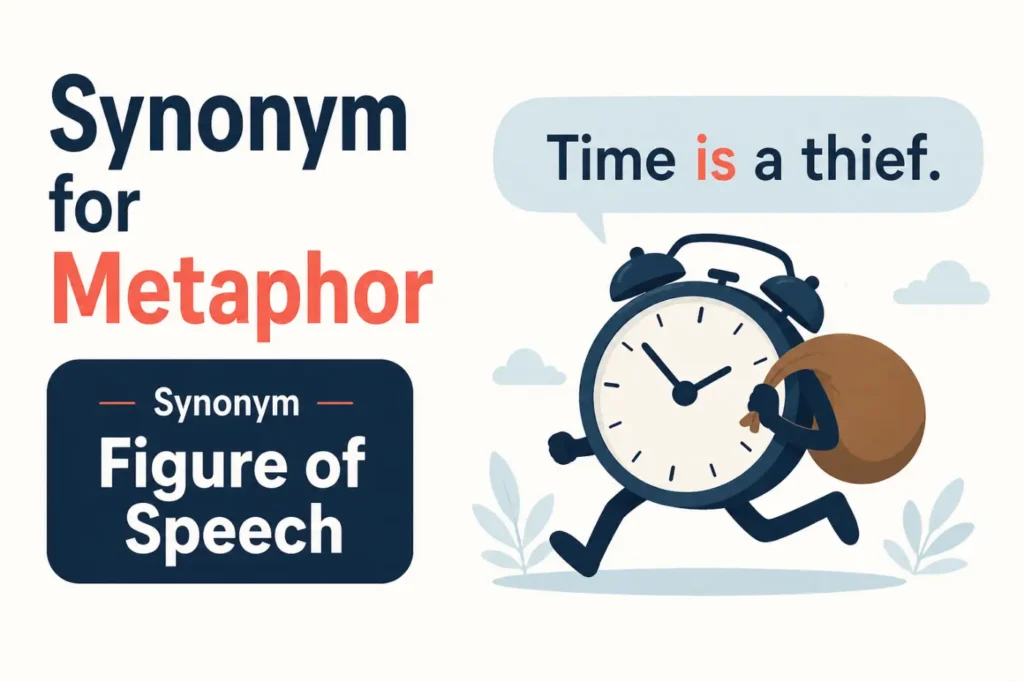
A metaphor for death describes death through an image or idea that readers already understand. A person might be described as beginning a final journey, reaching the last page of a story, becoming a fading light, or crossing to another shore. None of these statements is meant literally. Each one gives death an emotional shape.
The best expression depends on the situation. A phrase for a sympathy card should feel gentle and sincere. A poem can be more imaginative. A eulogy may need warmth and dignity. A novel can use darker or more unusual imagery, while a humorous piece may deliberately take a completely different approach.
This guide brings those choices together in one place. You will find short expressions, poetic imagery, examples for losing someone you love, biblical references, similes, idioms, gentle phrases, dark humor, and practical advice for choosing language that fits your message.
Quick Definition
A metaphor about death describes dying through another image or concept. Common images include journeys, sleep, sunsets, fading light, closed doors, final chapters, crossing water, and extinguished flames. These comparisons allow writers to express death indirectly while communicating emotions such as grief, peace, love, finality, spiritual hope, or remembrance.
Quick Answer
The best death metaphor depends on the feeling you want to communicate. A journey can suggest transition. Sleep can suggest peace. A sunset can suggest a natural ending. A fading light can express loss. A final chapter can emphasize completion. For someone grieving a loved one, gentle images usually work better than clever or dramatic ones.
Comparison Table
| Type | Main image | Emotional tone | Best use | Example |
|---|---|---|---|---|
| Journey | Travel or departure | Gentle | Eulogies and memorials | He began his final journey. |
| Sleep | Rest | Peaceful | Sympathy messages | She entered her final rest. |
| Sunset | Day ending | Reflective | Poetry and tributes | His sun had finally set. |
| Light | Light fading | Emotional | Memorial writing | Her light still shines in us. |
| Final chapter | Story ending | Literary | Speeches and essays | His final chapter had closed. |
| Crossing | Moving across water | Spiritual | Religious writing | He crossed to the other shore. |
| Homecoming | Returning home | Warm | Faith based writing | She had finally gone home. |
| Flame | Fire going out | Poetic | Poetry and tributes | His flame burned brightly. |
| Closed door | Separation | Final | Literature | The final door had closed. |
| Last song | Music ending | Poetic | Memorial writing | Her song had ended. |
| Falling leaf | Natural change | Gentle | Poetry | He was a leaf carried away by autumn. |
| Funny expression | Everyday activity | Humorous | Comedy | He finally clocked out for good. |
The emotional effect matters as much as the words themselves. The final journey feels calm and reflective. The closed door feels more final. The fading light carries sadness. The homecoming can suggest spiritual comfort.
That is why writers should choose an image based on the feeling they want readers to experience rather than simply picking the phrase that sounds most poetic.
Just as death can be described through imagery and symbolism, powerful metaphors for love can help express deep emotions that are difficult to put into ordinary words.
What A Death Metaphor Means
A metaphor is a comparison in which one idea is presented through another. Instead of explaining something directly, the writer gives the reader an image and allows the image to carry part of the meaning.
Consider this sentence:
His life was a long journey.
A person’s life is not literally a road with physical destinations. The journey represents the experiences, relationships, choices, challenges, and stages that make up a lifetime.
Now consider:
His journey had reached its final destination.
The journey has become an image for life, while the destination represents death.
This approach is powerful because readers already understand journeys. They know that journeys have beginnings, difficult stretches, turning points, destinations, and endings. The writer can borrow those familiar ideas to describe something much harder to explain directly.
Death imagery works in the same way. A sunset can represent an ending because readers understand that daylight gradually disappears. A candle can represent life because its flame can burn brightly and then go out. A final chapter can represent death because readers understand that a story eventually reaches its conclusion.
Why Writers Use This Kind Of Language
Death is a universal experience, but people talk about it in very different ways. Some prefer direct language. Others find comfort in softer expressions that focus on peace, memory, spirituality, or the natural cycle of life.
Figurative language gives writers room to make that choice.
It can serve several purposes.
- It can soften difficult language. A phrase such as she went to her final rest may feel gentler than a blunt statement.
- It can communicate emotion. Saying his light went out creates a different feeling from simply saying he died.
- It can honor a person’s life. A journey metaphor can focus attention on everything the person experienced rather than only the final moment.
- It can express spiritual beliefs. Images of crossing, returning home, or entering eternal rest can reflect religious ideas.
- It can create memorable writing. A strong image can stay with readers long after they finish a poem or speech.
- It can give grief a shape. Images such as silence, fading light, empty rooms, and closed doors can help writers express feelings that are difficult to state directly.
Good figurative language does not hide the reality of death for the sake of sounding beautiful. It gives the writer another way to approach that reality.
Main Types Of Death Metaphors
Different images carry different emotional meanings. Learning these categories makes it easier to choose language that fits your situation.
Death As A Journey
The journey is one of the oldest and most familiar ways of describing death. It presents life as a path and death as the point where that path ends or changes.
Examples include:
- He began his final journey.
- Her journey had reached its destination.
- He traveled beyond the horizon.
- She crossed to the other shore.
- His earthly journey had come to an end.
This image is especially common in eulogies, memorial speeches, religious writing, and poetry because it can acknowledge finality without making the language feel harsh.
It can also shift attention toward the person’s entire life. A journey has distance behind it. That gives the writer an opportunity to honor the experiences and relationships that came before the ending.
Death As Sleep
Sleep is another familiar image. It focuses on rest and stillness rather than disappearance.
Examples include:
- She entered her final sleep.
- He found eternal rest.
- She rests peacefully now.
- He closed his eyes for the last time.
- She went quietly into eternal rest.
This imagery often appears in religious writing and memorial language. It can feel comforting, but writers should remember that not every audience interprets death through spiritual beliefs. In a personal message, use language that fits the beliefs and feelings of the person receiving it.
Death As A Sunset
A sunset provides a natural image of an ending. The light gradually fades, the day comes to a close, and darkness arrives.
Examples include:
- His sun had finally set.
- Her beautiful day had come to an end.
- The sunset marked the closing of his remarkable life.
- His final evening had arrived.
- Her light faded gently beyond the horizon.
This imagery works particularly well in poetry, memorial writing, and reflective prose because it creates a calm visual scene.
A sunset metaphor can also avoid making death sound abrupt. It presents the ending as part of a larger natural cycle.
Death As Fading Light
Light is closely associated with life, warmth, hope, knowledge, and presence. When a writer describes that light as fading, the image naturally suggests loss.
Examples include:
- His light went out too soon.
- Her light still shines in our memories.
- The room felt darker after his light was gone.
- Her bright flame slowly faded.
- His light may be gone from our sight, but his warmth remains.
This type of imagery works especially well when the deceased person was known for kindness, energy, leadership, or warmth.
Death As The Final Chapter
The final chapter is a particularly useful literary image. A person’s life becomes a story, while death becomes the point where that story ends.
Examples include:
- His final chapter had been written.
- Her story reached its final page.
- The last chapter of his life had closed.
- His remarkable story came to an end.
- The final page turned quietly.
This metaphor is especially appropriate for books, essays, speeches, obituaries, and literary writing.
It also gives writers an important advantage. A book does not become meaningless because it ends. The earlier chapters still matter. In the same way, a person’s death does not erase the value of the life that came before it.
Death As Crossing
Crossing imagery presents death as moving from one place to another.
Examples include:
- He crossed the final river.
- She crossed to the other shore.
- He passed beyond the horizon.
- She crossed into the quiet beyond.
- He reached the far shore.
Water imagery has a long history in literature and religion. A river can represent a boundary between two states of existence. The image is especially effective when the writer wants to suggest transition rather than simply ending.
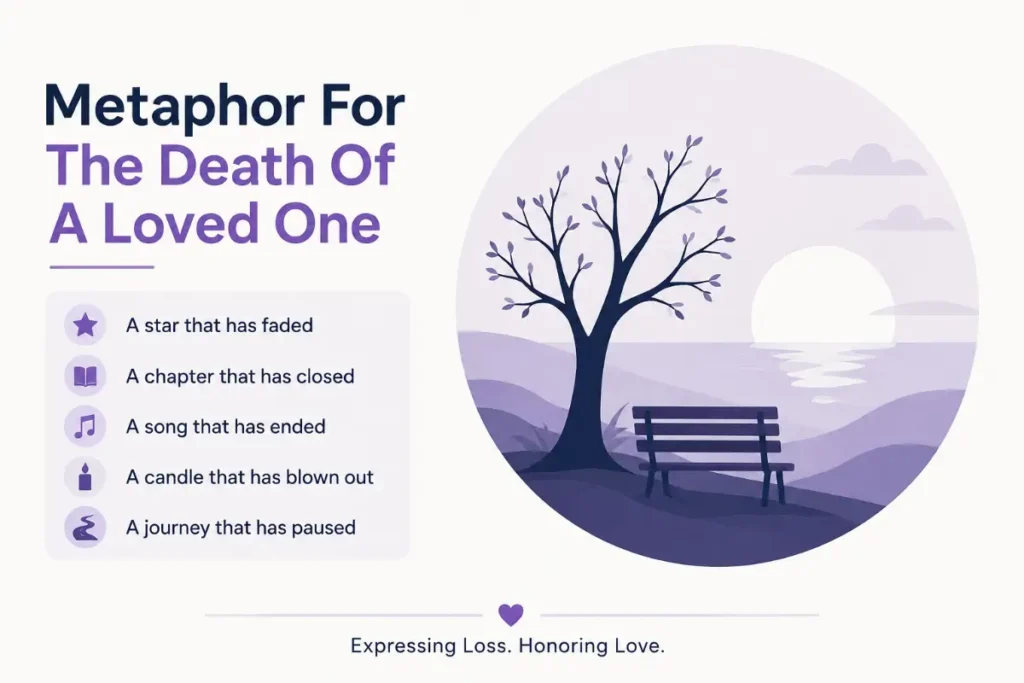
Metaphor For The Death Of A Loved One
Writing about someone you love requires more than finding a beautiful phrase. The language needs to feel personal.
A generic expression may sound polished but still feel emotionally empty. The strongest writing often connects the image to something that made the person special.
For example:
Her life was a warm light that made every room feel brighter. Even now, that light lives on in everyone she loved.
The metaphor works because it describes both the person and the loss. The light represents her warmth and presence, while its continuation represents memory.
Another example:
His life was a long road filled with people he helped along the way. His journey may have ended, but the people he touched are still walking with his memory.
This works better than simply calling death a journey because the image connects to relationships and legacy.
When writing about a loved one, think about the person’s actual character.
- A generous person might be described as a light.
- A teacher might be described as a guiding star.
- A musician might be remembered through a song.
- A traveler might naturally fit a journey image.
- A gardener might be connected to seasons or flowers.
- A parent might be described as a home or shelter.
Personal details make figurative language feel genuine.
Short Metaphors For Death
Sometimes a writer needs only a few words. Short expressions can work well in poems, memorial cards, social posts, inscriptions, and brief tributes.
Here are some options.
- The final journey.
- The last chapter.
- The fading light.
- The quiet departure.
- The final rest.
- The closing door.
- The setting sun.
- The extinguished flame.
- The final crossing.
- The last page.
- The silent shore.
- The fading star.
- The end of the road.
- The final curtain.
- The journey home.
Each phrase has a different emotional color. The final journey sounds reflective. The final rest sounds peaceful. The last chapter sounds literary. The fading star feels poetic. The closing door feels more definite and final.
Choose the phrase that matches the surrounding message instead of using the most dramatic option.
Poetic Metaphors For Death
Poetry gives writers more freedom to create unusual images. A poet can connect death with weather, seasons, music, nature, light, distance, silence, or time.
Consider these examples:
The last leaf let go of the branch.
The falling leaf represents a life ending. The image is simple, but it also suggests the natural cycle of the seasons.
Her song ended, but its melody remained in the room.
Here, the song represents the person’s life while the lingering melody represents memory.
He became a star beyond our reach.
The star represents someone who is no longer physically present but remains visible through memory and emotional influence.
The evening closed its door behind him.
This image combines nature with a doorway to create a sense of finality.
Poetic language works best when the image has a purpose. A string of beautiful comparisons can quickly become sentimental if none of them adds meaning.
Similes About Death
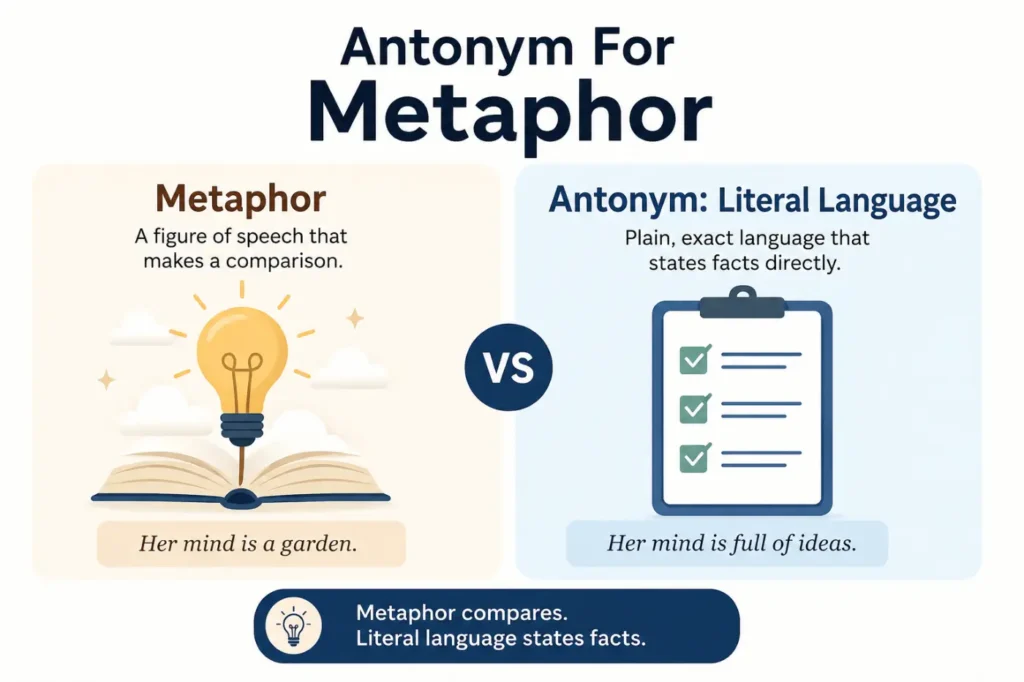
A simile makes a comparison using words such as like or as. It is closely related to metaphor but has a different grammatical structure.
Compare these two sentences.
Metaphor:
Her life was a candle.
Simile:
Her life was like a candle slowly fading in the wind.
The metaphor makes the connection directly. The simile openly tells the reader that a comparison is being made.
Here are some natural similes related to death.
- His passing was like the sudden closing of a door.
- Her absence felt like a room losing its light.
- His life ended like a song reaching its final note.
- The loss spread through the family like a long winter.
- Her departure felt like watching the last boat disappear across the water.
- His memory remained like a warm light on a cold evening.
- The house felt as quiet as an empty church after the service.
- Her death came like a sunset after a long day.
- His absence was like a missing voice in a familiar song.
- The grief felt like walking through a house with all the lights turned off.
Similes can be useful when you want to explain an emotional experience in a more conversational way.
How To Choose The Right Expression
The strongest figurative language matches the audience and purpose. A phrase that works beautifully in a poem may feel strange in a sympathy card.
Before choosing an expression, consider these factors.
- Audience. Think about the person who will read your words.
- Relationship. A close family member may call someone a guiding light, while a formal obituary may require more restrained language.
- Tone. Decide if the writing should feel peaceful, spiritual, poetic, serious, hopeful, or humorous.
- Setting. A funeral speech requires more care than a fictional story.
- Beliefs. Religious imagery should fit the beliefs of the audience.
- Purpose. Decide if you are comforting someone, remembering a person, telling a story, or creating a poem.
A useful rule is to make the metaphor serve the emotion rather than making the emotion serve the metaphor.
If the reader remembers the clever phrase but forgets the person being honored, the writing has missed its target.
Poetic Metaphors For Death
Poetry gives writers room to say something difficult without stating it in the most direct way. A poet can turn death into a sunset, a departing ship, a fading melody, a falling leaf, or an empty chair. The image creates an emotional experience instead of simply delivering information.
The strongest poetic images usually connect death with something readers already understand. Nature works particularly well because change is built into it. Flowers bloom and fade. Seasons change. Day becomes night. Leaves fall. Rivers keep moving. These familiar patterns can give abstract ideas a physical form.
Here are some original examples.
- The last light slipped quietly beyond the horizon.
- His final song faded into the evening air.
- She became a star just beyond the reach of our hands.
- The garden lost one of its brightest flowers.
- His footprints ended where the road disappeared into the mist.
- The autumn wind carried her final leaf away.
- His candle burned brightly until the final flame became still.
- She sailed beyond the horizon and left her memories on the shore.
- The last page of his story turned beneath a quiet sky.
- Her voice became an echo living inside the rooms she once filled.
Notice that these images do more than replace the word death. Each one creates a particular mood. A fading song suggests memory. A disappearing road suggests mystery. A flower suggests beauty and fragility. A final page suggests completion.
That distinction matters when writing poetry. Do not choose an image simply because it sounds pretty. Choose one that supports the emotion of the entire piece.
Metaphors For Death In The Bible
Biblical language has had an enormous influence on the way English speakers talk about mortality. Many familiar expressions about death, rest, darkness, light, dust, journeys, and resurrection have roots in biblical imagery.
One of the most recognizable images presents death as sleep. This image emphasizes rest and has a particular place in Christian thought because death is connected with the hope of resurrection. The language can therefore carry both sorrow and hope.
Another recurring image is dust. Biblical passages use dust to emphasize human mortality and the physical nature of life. The image reminds readers that human beings are temporary and connected to the earth.
The Bible also uses the image of a valley when describing the experience of facing death. Psalm 23 contains the well known phrase the valley of the shadow of death. The image is powerful because a valley can be dark and dangerous while still being a place through which a person travels.
Other biblical themes include:
- Sleep and rest.
- Dust and return to the earth.
- Darkness and light.
- Crossing and passage.
- Shepherding and guidance.
- Resurrection and new life.
- Homecoming and eternal dwelling.
- Harvest and the completion of a life.
Biblical imagery should be used thoughtfully. A religious expression can provide genuine comfort to someone who shares the same beliefs, but it can feel inappropriate when imposed on someone with different beliefs.
For religious writing, it is also important to distinguish between an actual biblical phrase and a modern expression inspired by biblical ideas. That distinction matters in sermons, academic writing, devotional material, and published work.
Death Idioms And Expressions
Metaphors are not the only way English discusses death indirectly. The language also contains many idioms and euphemistic expressions.
An idiom has a meaning that cannot always be understood simply by examining each individual word. For example, kick the bucket is an idiom for dying. The phrase does not literally involve kicking a bucket.
Common death related idioms and expressions include:
- Pass away. A gentle expression for die.
- Rest in peace. A traditional expression wishing peace for someone who has died.
- Meet one’s maker. A religiously influenced expression referring to death.
- Kick the bucket. An informal and often humorous idiom for dying.
- Breathe one’s last. A literary expression referring to the final breath.
- Cross the great divide. A figurative expression for passing from life to death.
- Leave this world. A softer expression that avoids direct wording.
- Go to a better place. A comforting expression often used in sympathy.
- Join the ancestors. A phrase found in cultural and spiritual contexts.
- Return to dust. A religious and poetic expression connected with mortality.
These expressions are not all appropriate in the same situation. Pass away can work in a sympathy message. Kick the bucket may work in comedy but would usually be inappropriate at a funeral. Rest in peace is solemn and familiar.
This is why context matters more than memorizing a long list.
Metaphor Versus Idiom
These two forms of figurative language often overlap, but they are not identical.
A metaphor creates a comparison between two ideas.
His life was a journey.
An idiom is an established expression whose meaning is understood as a whole.
He kicked the bucket.
The metaphor invites readers to interpret an image. The idiom gives readers a familiar expression whose meaning has already become established through repeated use.
Some expressions can function as both metaphorical language and idiomatic language depending on context. This is one reason language categories are not always perfectly separated in everyday writing.
For practical writing, the important question is not always what label an expression receives. The more useful question is what the expression communicates and how it will sound to the intended audience.
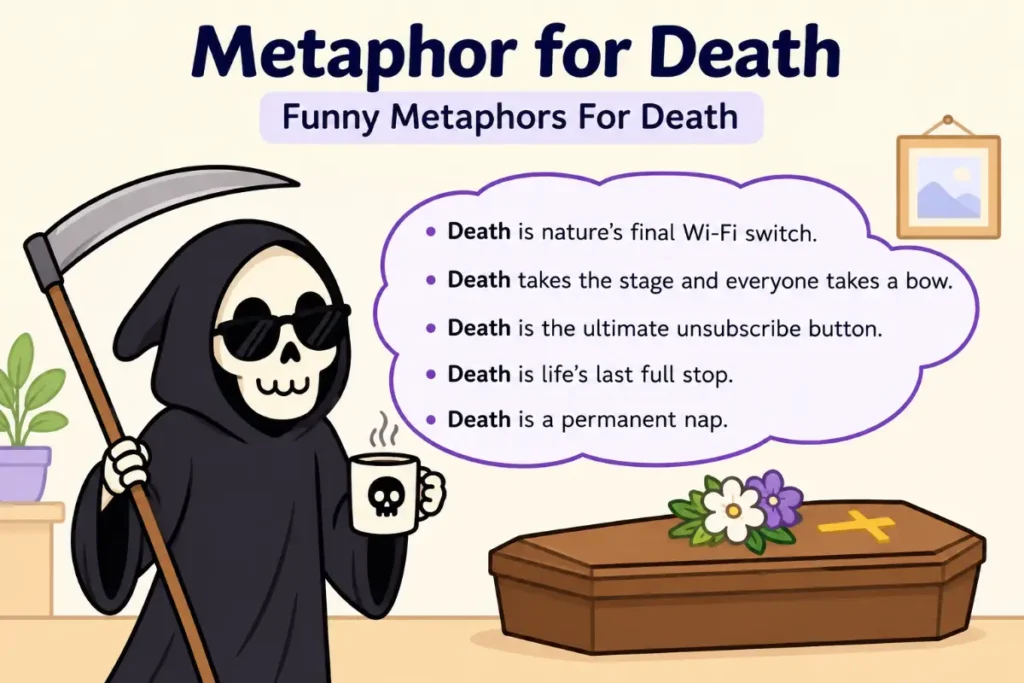
Funny Metaphors For Death
Humor and death have a complicated relationship. People sometimes use humor to cope with grief, reduce tension, or explore uncomfortable subjects. Writers also use dark humor in fiction, comedy, satire, and personal conversations.
A funny comparison can work when the audience understands the tone. It can fail badly when used with someone who is actively grieving.
Here are examples suitable for fictional or intentionally dark humorous writing.
- He finally clocked out for good.
- She took the ultimate day off.
- He retired from the business of being alive.
- She finally left the group chat of life.
- He closed his account with the universe.
- She took the longest vacation imaginable.
- He reached the world’s final checkout counter.
- She officially stopped attending meetings with mortality.
- He handed in his permanent resignation.
- She finally punched out of life’s time clock.
These are intentionally playful. They should not be presented as compassionate language for a grieving family.
Humor works best when the writer understands the social setting. A joke between close friends can feel affectionate. The same joke from a stranger can sound cruel.
Death Metaphors In Literature
Writers have used figurative language about death for centuries. Literature often treats death as a journey, sleep, darkness, winter, a final curtain, or a force that arrives without warning.
Shakespeare frequently used metaphorical language to explore mortality. His plays and poems connect life with seasons, sleep, dreams, and temporary stages. The famous idea that the world is a stage also provides a useful framework for thinking about life as a performance with an eventual exit.
Emily Dickinson frequently approached death through unusual and intimate imagery. Her poem Because I could not stop for Death famously personifies Death as a carriage companion. This is a strong example of how figurative language can transform an abstract concept into a character and an experience.
Literature shows why the best comparisons do not always soften death. Sometimes they make death more vivid.
A writer might portray death as:
- A visitor.
- A traveler.
- A thief.
- A shadow.
- A winter.
- A sleep.
- A river.
- A door.
- A final performance.
- A destination.
Each image creates a different relationship between the living and the idea of mortality.
While death is often associated with darkness and endings, metaphors that capture happiness offer a brighter way to explore emotions, using images of light, sunshine, warmth, and celebration.
Death Metaphors In Everyday Language
People use figurative expressions about death in ordinary conversation far more often than they realize.
Someone may say:
We lost my grandfather last year.
The verb lost does not literally mean that the family misplaced the person. It is a familiar euphemistic expression for death.
Someone else might say:
She is no longer with us.
Again, the phrase communicates death indirectly.
Other everyday expressions include:
- He passed away peacefully.
- We lost her last winter.
- He is at rest now.
- She is no longer with us.
- He has gone home.
- She left us peacefully.
- He is in a better place.
- Her memory lives on.
- He is watching over us.
- She will always be with us in spirit.
These expressions vary in their religious and emotional assumptions. Her memory lives on focuses on remembrance without making a specific claim about an afterlife. She is in a better place carries a stronger spiritual implication.
Common Mistakes When Writing About Death
Writing about death requires more than finding a clever comparison. Some expressions can sound insensitive, overly dramatic, or inappropriate for the audience.
Choosing Humor For A Serious Situation
A funny expression may work in fiction but feel cruel in a sympathy card.
Before using humor, consider the relationship between the writer and reader. If you are writing for someone who has just lost a loved one, prioritize compassion.
Using Too Many Metaphors
One strong image can be powerful. Five unrelated images in the same paragraph can become confusing.
For example, moving from a journey to a candle, then to a river, then to a garden, then to a book gives readers too many symbolic systems to follow.
Choose one central image and develop it naturally.
Mixing Contradictory Images
A sentence can become awkward when two metaphors fight for attention.
For example:
His journey sailed into the final chapter beneath a fading candle.
The writer is combining a journey, a ship, a book, and a candle. Each image could work alone, but together they compete.
A cleaner version would be:
His journey had finally reached its quiet destination.
Using Clichés Without Personal Meaning
Expressions such as gone to a better place are familiar because they are widely used. That does not make them wrong, but they can feel impersonal.
Adding a specific memory can make the writing much stronger.
Instead of:
She is in a better place now.
You might write:
She left us peacefully, but the warmth she brought into every family gathering remains with us.
The second sentence gives readers something personal to remember.
Treating Every Audience The Same
Religious language, dark humor, and poetic imagery all have their place. None of them works equally well for every reader.
Think about the setting before choosing the expression.
Writing About A Loved One With Care
When the subject is the death of a loved one, the goal should not be to impress the reader. The goal should be to honor the person and express genuine feeling.
Start with something real about the person.
Think about:
- What made them special.
- What they loved.
- How they treated people.
- What they taught you.
- What memory immediately comes to mind.
- What part of their personality you will miss most.
Then build the figurative image around that detail.
If the person loved music, a song metaphor may feel natural.
Her song has ended, but its melody still fills our lives.
If the person loved the sea, a journey across water may feel more personal.
He sailed beyond the horizon, leaving a lifetime of memories on our shore.
If the person was known for kindness, light imagery may fit.
His light made difficult days easier for everyone around him.
This approach creates language that feels personal rather than copied from a collection of stock phrases.
How To Make A Death Metaphor Sound Natural
Natural figurative language usually has three qualities. First, the image is easy to understand. Readers should not need to decode an elaborate puzzle. Second, the image fits the emotion. A peaceful situation needs a different image from a tragic or angry one.
Third, the metaphor supports the surrounding writing. It should feel like part of the sentence rather than something inserted simply because the writer wanted to sound poetic.
A useful editing test is to remove the metaphor and read the sentence again. Then put it back. Ask yourself if the image adds something meaningful.
If the sentence becomes clearer and more emotionally precise with the metaphor, keep it. If it merely makes the sentence longer, cut it.
Metaphor Versus Simile And Other Figurative Language
Death related expressions often get placed into the same category even though they are not technically identical. Understanding the differences helps you choose the right term when you are writing an article, teaching language, analyzing literature, or creating your own examples.
A metaphor makes a direct comparison between two things.
His life was a journey.
The person did not literally travel along a road that represents life. The journey is an image used to describe the stages and experiences of living.
A simile makes a comparison using words such as like or as.
His life was like a long journey.
The meaning is similar, but the grammatical construction is different.
An idiom is an established expression whose meaning is understood as a whole.
He kicked the bucket.
The phrase does not literally describe someone kicking a bucket. It is a familiar informal expression for dying.
A euphemism replaces a direct or potentially uncomfortable expression with softer language.
She passed away.
The phrase avoids the direct statement she died.
Symbolism uses an object, image, action, or idea to represent something beyond its literal meaning. A candle can symbolize life, hope, memory, or mortality depending on the context.
Personification gives human qualities to something that is not human.
Death came knocking at his door.
Death is treated as if it were a person who could physically arrive and knock.
These categories can overlap. A writer might personify death through a metaphor while also using symbolism. The important point is to understand what the language is doing rather than forcing every example into one rigid category.
Related Words And Confused Terms
Death related language has a broad semantic field. Writers often use several related concepts in the same passage.
Death
This is the direct term for the end of biological life. It is factual and unambiguous.
Dying
This describes the process or condition of approaching death. It can refer to a gradual process rather than the completed event.
Passing Away
This is a common euphemistic expression for dying. It generally sounds softer and more respectful than direct language.
Passing
This shortened form can work in conversation and writing, although the surrounding context should make the meaning clear.
Mortality
Mortality refers to the condition of being subject to death. It is common in academic, philosophical, literary, and formal writing.
Bereavement
Bereavement refers to the state of grieving after someone close has died. It describes the experience of the living rather than the death itself.
Grief
Grief is the emotional response to loss. It is broader than death because people can experience grief after many types of loss.
Mourning
Mourning refers to the outward expression of grief. It can include ceremonies, rituals, clothing, memorials, writing, and other cultural practices.
Loss
Loss is often used as a gentler way to refer to death. We lost her last year is a familiar example.
Legacy
Legacy refers to what a person leaves behind through memories, relationships, achievements, ideas, values, or influence.
These terms matter because strong writing does not treat death and grief as exactly the same thing. Death is the event. Grief is the emotional response. Mourning is the outward expression. Legacy is what remains through influence and memory.
Expert Language Insight
From an editorial perspective, the strongest figurative language about death is usually simple. Writers sometimes assume that a serious subject requires complicated wording. It does not.
A plain image can carry enormous emotional weight.
Her chair was empty.
That sentence is not technically a traditional death metaphor, but the empty chair can function as powerful symbolic imagery. Readers understand the absence without being told how to feel.
Another example is:
The house was quieter without him.
Again, the language is simple. Its strength comes from what the reader understands behind the words.
This is an important principle in professional editing. Emotional writing becomes stronger when the writer trusts the reader. You do not need to explain every feeling after presenting a meaningful image.
Compare these sentences:
His life was a beautiful journey that represented all the wonderful experiences he had throughout his existence and now that journey had sadly reached its final destination.
The idea is understandable, but the wording explains too much.
A tighter version is:
His journey had reached its final destination.
The second sentence gives the reader room to feel the meaning.
Another useful principle is consistency. If you introduce a journey image, stay within that image long enough for it to develop.
For example:
Her journey took her through difficult roads and beautiful seasons. She carried many people with her and left footprints wherever she went. Now the road has ended, but the memories remain.
The images belong to the same conceptual world. Road, journey, seasons, footprints, and ending work together.
That is much stronger than mixing unrelated metaphors in every sentence.
How Native Speakers Actually Use These Expressions
Native speakers do not usually stop during conversation to identify a phrase as a metaphor, simile, or euphemism. They choose familiar expressions based on context, relationship, and emotion.
In everyday American English, phrases such as passed away, lost someone, and no longer with us are common because they allow people to discuss death with some emotional distance.
In formal writing, direct language is often preferred when precision matters. Medical, legal, academic, and factual writing may need to state that someone died rather than replacing the fact with poetic imagery.
Creative writing is different. A novelist or poet can make death a visitor, a shadow, a river, a winter, a journey, or a final song.
The key is register.
Register refers to the level and style of language appropriate for a particular situation.
A funeral speech usually calls for dignity.
A personal poem can be intimate.
A comedy script can be irreverent.
A medical document should be precise.
A children’s story may use gentle language that avoids frightening detail.
Good writers adjust their language to the situation rather than using the same expression everywhere.
How To Create Your Own Death Metaphor
You do not need to copy familiar expressions. You can create an original image by starting with an emotion or personal detail.
Use this simple process.
- Choose the feeling. Decide if you want peace, sadness, love, hope, finality, mystery, or humor.
- Choose a familiar image. Think about nature, travel, music, books, light, seasons, water, or home.
- Connect the image to the person. A personal detail makes the comparison more meaningful.
- Keep the image consistent. Do not switch from one symbolic world to another without a reason.
- Remove unnecessary explanation. Let the image do some of the work.
- Read it aloud. If the sentence sounds forced when spoken, rewrite it.
- Check the audience. Make sure the tone fits the situation.
For example, suppose you want to express peaceful loss.
Start with the emotion: peace.
Choose an image: sunset.
Create the connection:
Her day had finally come to a quiet close.
Now suppose the person was a musician.
Emotion: memory.
Image: song.
Result:
Her song has ended, but its melody remains with everyone who loved her.
The second example feels more personal because the metaphor grows from the person’s identity.
Death Metaphors For A Sympathy Message
A sympathy message should usually be brief, sincere, and compassionate. Avoid trying too hard to sound poetic.
Here are some examples that can be adapted to a personal message.
Your father brought warmth wherever he went. His light may no longer be beside you, but the memories he created will continue to shine.
Your mother gave so much love to the people around her. Her journey may have ended, but the love she gave you will remain part of your life.
I am deeply sorry for your loss. The empty space left behind is a reminder of how much she meant to everyone who knew her.
His story has reached its final chapter, but the lessons, memories, and kindness he shared will continue through the people he touched.
These examples work because they do not focus only on death. They acknowledge the person’s influence and the relationship left behind.
Thinking about death naturally invites us to reflect on existence itself, and describing life as a journey can provide a meaningful contrast between beginnings, transitions, and endings.
Death Metaphors For A Eulogy
A eulogy has more space for storytelling. Instead of relying on one dramatic phrase, develop an image throughout the speech.
Suppose the person loved gardening.
You might say:
He treated every garden like a promise. He planted patiently, waited through difficult seasons, and celebrated every new bloom. His life was much the same. He gave people time, care, and encouragement, and many of us became stronger because he believed in us. His own season has now ended, but the garden he created in our lives will keep growing.
This works because the metaphor is connected to a real characteristic of the person. The garden is not decorative. It tells the audience something about who he was.
That is the standard worth aiming for in a eulogy. Use figurative language to reveal personality rather than simply decorate the speech.
Death Metaphors For Poetry
Poetry allows greater freedom, but restraint still matters.
Consider a simple image:
The house kept its silence after she left.
You could develop that image through several related details.
Her cup remained beside the window. The chair waited in the afternoon light. The rooms held the shape of her laughter, but the house had learned a new kind of silence.
The language does not need to mention death repeatedly. The absence itself communicates the loss.
This is one of the most effective techniques in poetic writing. Instead of explaining grief directly, show what has changed.
The empty chair, untouched room, fading photograph, quiet garden, missing voice, or unused cup can become symbols of absence.
Death Metaphors For Creative Writing
Fiction gives writers the freedom to choose imagery based on character and atmosphere.
A peaceful death scene might use:
The evening gathered him gently into its darkness.
A tragic scene might use:
The light vanished from the room before anyone was ready for the darkness.
A mysterious scene might use:
He stepped beyond the door, and no one ever saw him again.
A supernatural story might personify death:
Death had been waiting at the end of the street.
A historical novel might use language appropriate to its setting rather than modern expressions.
The important point is character. A sophisticated character may think about death philosophically. A frightened child may describe it through simple images. A soldier may use blunt language. A poet may see it through nature.
The metaphor should sound like something the character would actually think or say.
Common Questions
What Is A Good Metaphor For Death
A good expression depends on the tone and context. Common choices include a final journey, fading light, final chapter, sunset, final rest, or crossing to another shore. For a loved one’s death, choose an image that feels sincere and connects naturally with the person’s life or personality. The most effective comparison adds emotional meaning instead of simply replacing the word death.
What Is A Short Metaphor For Death
Short options include the final journey, the last chapter, the fading light, the final rest, the closing door, and the last page. Each creates a different feeling. The final journey suggests transition, the last chapter suggests completion, and fading light suggests loss. Choose the phrase that matches the tone of the surrounding message.
What Is A Poetic Way To Describe Death
Poetic writing often describes death through nature, music, light, travel, or changing seasons. Examples include the last light slipped beyond the horizon, her song faded into the evening, and the final leaf fell from the tree. These images can make a passage more emotional without directly repeating words such as death or died.
What Is A Metaphor For The Death Of A Loved One
A gentle metaphor can describe a loved one as a light that has gone from the room, a traveler who has reached the end of a journey, or a song whose final note has faded. Personal details make these expressions stronger. Connecting the image to the person’s character, interests, or influence usually creates more meaningful writing.
What Is A Simile For Death
A simile compares death or grief to something else using like or as. Examples include her passing was like a sunset after a long day and his absence felt like a room losing its light. Similes differ from metaphors because they openly signal the comparison instead of presenting one thing directly as another.
What Are Some Metaphors For Death In The Bible
Biblical imagery includes death as sleep, returning to dust, passing through a dark valley, and moving toward eternal life. Psalm 23 contains the well known image of the valley of the shadow of death. Biblical writing also uses ideas of resurrection, rest, light, darkness, shepherding, and homecoming when discussing mortality and life beyond death.
What Is A Funny Metaphor For Death
Funny expressions about death are usually informal and work best in comedy, fiction, or conversations between people who share the same sense of humor. Examples include he finally clocked out for good, she retired from the business of being alive, and he handed in his permanent resignation. These expressions should be avoided in sensitive condolence situations.
What Are Death Idioms And Expressions
Common death related expressions include pass away, rest in peace, kick the bucket, breathe one’s last, leave this world, and return to dust. They vary greatly in tone. Some are gentle and respectful, while others are informal or humorous. Always consider the audience and setting before choosing an expression.
Final Takeaway
Death is difficult to describe because it carries more than one meaning. It can represent loss, separation, peace, finality, transformation, memory, or spiritual hope. Figurative language gives writers a way to express those layers without relying on the same direct wording every time.
The most useful images come from familiar experiences. A journey can represent the path of life. A sunset can represent an ending. A fading light can represent absence. A final chapter can represent completion. A song can represent a person’s life and the memories that remain after the final note.
When writing about someone you love, make the language personal. Connect the image to who that person was rather than choosing a phrase simply because it sounds poetic.
When writing creatively, experiment with imagery but keep the metaphor consistent. Choose compassion over cleverness when writing for a grieving person. When writing humor, understand the audience before taking the joke too far.
Most importantly, remember that the best figurative language does not try to make death sound beautiful. It helps the reader understand the life, love, absence, and memory surrounding it.
A strong image can turn a difficult sentence into something human. The right words do not remove grief, but they can give grief a voice.