Sadness is easy to recognize but surprisingly hard to describe. You can tell someone you feel sad, but that simple word does not always capture what is happening inside. Sometimes sadness feels heavy. Sometimes it feels like standing alone in a dark room. It can feel like a storm that refuses to pass or like a quiet emptiness after someone leaves.
That is why writers often use figurative language to describe difficult emotions. A good metaphor turns an invisible feeling into something we can see, touch, hear, or imagine. Instead of simply saying someone is deeply sad, you can describe sadness as a weight on the heart or a cloud blocking the sunlight.
The most useful metaphors do more than make writing sound poetic. They help readers understand the specific kind of emotion being described. A metaphor for heartbreak should feel different from one for loneliness. Grief should not sound exactly like ordinary disappointment.
In this guide, we will look at the most useful ways to describe sadness, including short expressions, poetic imagery, metaphors for loneliness and heartbreak, and examples you can actually use in writing. We will also look at why certain images feel so natural when we talk about emotions.
Quick Definition
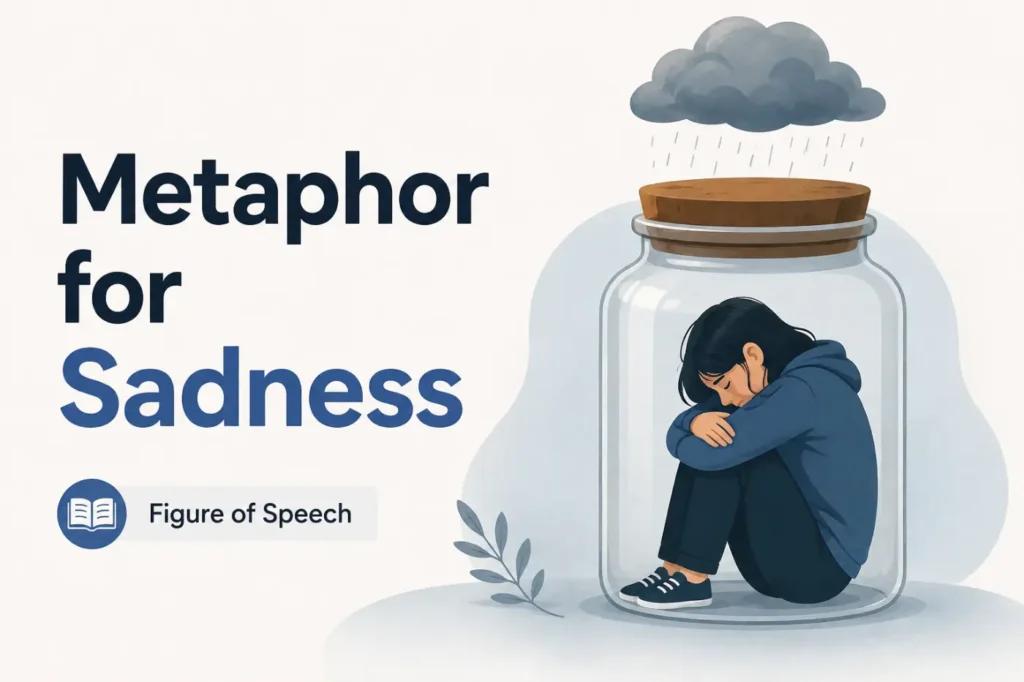
A metaphor for sadness describes sadness by comparing it directly with something more concrete. Common images include darkness, heavy weight, storms, coldness, empty spaces, broken objects, and fading light. These comparisons help readers understand an emotional experience by connecting it with something familiar and easier to visualize.
Quick Answer
The best sadness metaphors depend on the feeling you want to express. Sadness is a heavy weight suggests emotional pressure. Sadness is a dark cloud suggests a mood that hangs over someone. Metaphor sadness is a storm suggests intense emotion. Sadness is an empty room suggests loneliness and absence.
There is no single perfect comparison. The strongest choice matches the person’s experience and the tone of the writing.
Comparison Of Common Sadness Metaphors
| Metaphorical image | What it suggests | Best use |
|---|---|---|
| Heavy weight | Emotional pressure | Deep sadness |
| Dark cloud | Persistent low mood | Everyday writing |
| Storm | Intense emotional pain | Dramatic writing |
| Empty room | Loneliness and absence | Personal writing |
| Broken heart | Heartbreak | Relationships |
| Cold winter | Emotional emptiness | Poetry |
| Fading light | Loss of hope | Reflective writing |
| Deep ocean | Overwhelming emotion | Poetic writing |
| Shadow | Sadness that follows | Emotional reflection |
| Wound | Emotional pain | Grief and heartbreak |
| Prison | Feeling trapped | Severe emotional struggle |
| Rain | Tears or melancholy | Poetry |
| Heavy fog | Confusion and hopelessness | Reflective writing |
| Fallen leaf | Change and loss | Nature based poetry |
| Empty chair | Absence of someone | Grief |
These images are not interchangeable. That is one of the most important things to understand when choosing figurative language.
If your character feels overwhelmed, a heavy weight works naturally. If the character feels abandoned, an empty room may be more powerful. If the sadness comes and goes but never seems completely gone, a shadow can communicate that feeling better.
The image should carry part of the emotional meaning for you.
What A Sadness Metaphor Does
Sadness is an abstract emotion. You cannot hold sadness in your hand or point to it in the same way you can point to a chair or a tree. Metaphor gives that invisible experience a physical shape.
Think about the sentence:
She felt sad.
It is clear, but it tells the reader very little about the quality of her sadness.
Now compare it with:
Sadness sat on her shoulders like a heavy coat.
The second sentence gives the reader something to imagine. The emotion becomes weight, pressure, and physical discomfort.
This is one reason metaphor is so common in emotional language. Human beings often understand abstract experiences through physical sensations and familiar events.
We describe happiness as something that lifts us. We describe sadness as something that weighs us down. We talk about being overwhelmed by emotion, trapped in grief, drowning in sorrow, frozen with fear, or burning with anger.
The language feels natural because the comparison connects an emotional experience with something physical.
Why Sadness Is Often Described As Darkness
Darkness is one of the most familiar images for sadness.
When someone is sad, the world can feel smaller and less bright. Ordinary things may lose their appeal. A person may withdraw from others and feel as though they are surrounded by something they cannot escape.
That makes darkness an effective emotional image.
Consider these examples:
- Sadness covered her world in darkness.
- He felt trapped beneath a sky without light.
- The room seemed darker after she left.
- A shadow followed him through every happy moment.
- Her sadness dimmed everything around her.
Darkness can represent different kinds of sadness. It can suggest hopelessness, loneliness, uncertainty, grief, or emotional exhaustion.
Light can then become a natural contrast. A writer might describe hope as a small light returning to a dark room. That contrast gives the reader a clear emotional movement from pain toward recovery.
For example:
For months, grief had filled his world with darkness. Then one morning, a small memory made him smile again, like a candle appearing at the edge of a long night.
The image works because the darkness and light belong to the same conceptual world.
Sadness As A Heavy Weight
Another common way to describe sadness is as something physically heavy.
People often say that grief weighs on them or that they carry emotional pain. These expressions make sense because deep sadness can affect the body. A person may move more slowly, lose energy, or feel physically drained.
Here are some natural examples:
- Her grief was a weight she carried everywhere.
- Sadness pressed against his chest like a stone.
- He carried the loss on his shoulders.
- The memory became a weight he could not put down.
- Her heart felt heavy with everything she had lost.
This type of imagery is especially useful for serious writing because it communicates emotional pressure without exaggerating the situation.
It also gives you room to show change.
At first, grief felt like a mountain on his shoulders. With time, it became a stone he could carry.
The sadness has not disappeared, but the person’s relationship with it has changed. That is a much richer idea than simply saying that the character eventually felt better.
Sadness As A Storm
Storm imagery is useful when sadness feels powerful, unpredictable, or difficult to control.
A storm can arrive suddenly. It can become violent. It can darken the sky and make ordinary movement difficult. Eventually, it can pass.
That makes it a natural comparison for intense emotional experiences.
- Grief swept through her like a storm.
- His mind was a sky crowded with dark clouds.
- The sadness raged inside him like a summer storm.
- Tears fell as the emotional storm broke.
- She waited for the storm inside her to quiet down.
Storm imagery also allows writers to describe different stages of sadness.
The dark clouds can represent the first signs of trouble. Heavy rain can represent crying. Thunder can represent anger. The clearing sky can suggest acceptance or healing.
Still, do not force every part of a storm into the same passage. A metaphor becomes awkward when the writer tries to explain every detail. One strong image is often enough.
If sadness is a difficult chapter, exploring powerful metaphors for life can also help us understand how people describe the journey through both joyful and painful experiences.
Sadness As An Empty Room
An empty room can say something about sadness without mentioning emotion at all.
Imagine walking into a room that once belonged to someone you loved. The furniture is still there. The photographs are still on the wall. Yet the person is missing. That physical absence becomes an emotional image.
Examples include:
- Her absence left an empty room inside him.
- The house felt like a room after everyone had gone home.
- His heart became an empty house.
- The silence filled every room she had once brightened.
- He lived among memories like furniture in an abandoned house.
This image works particularly well for grief and loneliness.
It can also be subtle. You do not always need to say that the room represents sadness. Let the reader make the connection.
Her coffee cup remained on the shelf, untouched since the morning she left.
The object becomes a symbol of absence. The sadness comes from what the reader understands.
Short Metaphors For Sadness
Sometimes you need a short phrase rather than a complete sentence. Short metaphors can work well in captions, poems, titles, creative writing, or quick descriptions.
Here are useful options:
- A cloud over the heart.
- A stone in the chest.
- A shadow that follows.
- A storm inside.
- A room without light.
- A heart wrapped in winter.
- A wound that remembers.
- A song with no ending.
- A river of tears.
- A fading flame.
- An anchor on the heart.
- A sky without stars.
- A door left open to emptiness.
- A winter that will not leave.
- A quiet ache.
Short expressions are powerful because they leave room for interpretation. The surrounding sentence should provide enough context to tell the reader what kind of sadness you mean.
For example:
He carried a stone in his chest after the funeral.
The image is simple, but the context gives it emotional weight.
Deep Metaphors For Sadness
Deep sadness often needs imagery that communicates more than temporary disappointment. A person experiencing grief, loneliness, or emotional exhaustion may feel disconnected from the world around them.
These metaphors can help express that deeper experience.
- Sadness was an ocean with no visible shore.
- Grief was a house with every window closed.
- His heart became a garden after winter had taken everything.
- She was carrying a sky full of rain inside her.
- The past was an anchor pulling her away from the present.
- His memories were ghosts walking through an empty house.
- Sadness had built a wall between him and the rest of the world.
- Her hope was a small candle fighting a room full of darkness.
These examples are deeper because they describe emotional conditions rather than simply naming sadness.
An ocean suggests depth and overwhelming scale. An anchor suggests something holding a person back. A wall suggests separation. A candle suggests fragile hope.
That is the real value of metaphor. The image gives the emotion additional dimensions.
Poetic Metaphors For Sadness
Poetry often benefits from images drawn from nature because natural processes already contain ideas of change, loss, silence, and renewal.
A falling leaf can suggest something leaving. Winter can represent emotional coldness. Rain can represent tears. A fading sunset can suggest an ending.
Try these examples:
- Her sadness was autumn taking the color from every tree.
- His hope faded like the last light of evening.
- Tears became rain falling through the quiet garden of her heart.
- Grief arrived like winter and settled into every corner.
- Her memories were birds that kept returning to an empty window.
- The old happiness was a flower pressed between the pages of time.
- His loneliness stretched like a road beneath a starless sky.
- Her heart was a garden waiting for spring.
- The silence grew around him like snow.
- His sorrow was a river carrying old memories downstream.
Notice that these examples do not all describe sadness in exactly the same way. Some suggest loss. Others suggest loneliness, memory, waiting, or the possibility of healing.
That variety is important.
A good collection of metaphors should give readers choices rather than repeat the same image with different wording.
Metaphors For Feeling Alone
Loneliness has a close relationship with sadness, but they are not identical. Someone can feel sad while surrounded by people. Someone can also be physically alone without feeling lonely.
When the emotional focus is isolation, use images of distance, silence, separation, and empty spaces.
- She felt like an island surrounded by people but connected to no one.
- His loneliness was a long road with no one walking beside him.
- The world felt like a crowded room where nobody knew his name.
- She lived behind an invisible wall.
- His voice disappeared into an empty room.
- Loneliness was a locked door between him and everyone else.
- She was a single star in a sky that felt impossibly large.
- His heart became a house with every light turned off.
The strongest examples use concrete images that readers can picture immediately.
A locked door communicates separation. An island communicates distance. An empty room communicates absence. A single star communicates isolation within a much larger world.
These images are especially useful in novels, personal essays, poetry, and emotional storytelling.
Metaphors For Heartbreak
Heartbreak has its own emotional vocabulary. Broken objects are especially common because a broken thing suggests that something once whole has been damaged.
The heart itself is often described as something that can break, crack, heal, bleed, or mend.
Some useful examples include:
- Her heart was a mirror shattered across the floor.
- His love became an empty chair at the table.
- The breakup left a crack running through everything he remembered.
- Her heart felt like a house after a fire.
- Their relationship became a bridge with one side missing.
- His memories were photographs with pieces torn away.
- She carried the relationship like a book with its final pages ripped out.
- His love was a song that had lost its final note.
These images communicate different kinds of heartbreak.
A shattered mirror suggests damage and a changed sense of self. A burned house suggests devastation. A bridge with one side missing suggests a connection that can no longer be crossed.
For relationship writing, specificity makes the metaphor stronger. If the couple met while traveling, a road or journey metaphor may feel more personal than a generic broken heart.
Metaphors For Emotional Pain
Emotional pain is often described through physical sensations because the two experiences can feel closely connected.
Writers may describe emotional pain as a wound, burn, pressure, ache, or bruise.
Examples include:
- The memory was a wound that refused to close.
- Her words left a bruise no one could see.
- Grief burned quietly beneath his calm expression.
- The loss was an ache buried deep in his chest.
- His regret was a splinter he could never remove.
- The sadness reopened an old wound.
- Her disappointment felt like a crack spreading through glass.
- The pain sat beneath every happy conversation.
Physical pain metaphors work because they make an invisible emotional experience easier to imagine.
They also allow you to show that emotional pain can remain hidden. A visible wound can be examined. An emotional wound may be invisible to everyone except the person carrying it.
Why The Best Metaphors Feel Natural
A metaphor becomes effective when the comparison feels intuitive.
If you describe sadness as heavy, readers immediately understand the idea. If you describe it as dark, they can picture the image. If you describe loneliness as an empty room, the emotional connection is easy to grasp.
A forced comparison creates the opposite effect.
For example:
Her sadness was like a purple calculator floating through the emotional architecture of Tuesday.
It is unusual, but unusual does not automatically mean creative. The reader has no clear reason to connect those ideas.
Good figurative language has an internal logic.
Ask yourself:
- Can the reader picture the image?
- Does the image match the emotion?
- Does it fit the tone?
- Does it add meaning?
- Does it sound natural when read aloud?
If the answer is yes, the metaphor is probably doing useful work.
Some expressions of sadness are closely connected to loss, which is why metaphors that describe death can offer a deeper way to understand grief and the emotions surrounding it.
Metaphors For Grief And Loss
Grief has a different texture from ordinary sadness. It can arrive suddenly after a loss and then change shape over time. Some days it feels sharp. Other days it feels distant. Sometimes a small memory can bring it rushing back.
That changing nature makes grief difficult to describe with one fixed image. A useful metaphor should leave room for movement.
A storm can describe the first overwhelming wave of grief. A wound can describe pain that slowly changes. An empty chair can represent the person’s absence. A shadow can represent a memory that remains nearby.
Here are several examples.
- Grief was a tide that kept returning to the shore.
- Her absence was an empty chair at the center of the family.
- His memories were photographs scattered across an empty room.
- Grief followed her like a long shadow.
- The loss was a door that had closed forever.
- His heart became a house filled with echoes.
- Her sorrow was an old wound that sometimes opened again.
- Grief settled over the family like winter snow.
- His memories were candles burning in the darkness.
- The silence left behind was louder than words.
The image of a tide is particularly useful because grief often comes in waves. Someone can feel peaceful for several hours and then suddenly become overwhelmed by a song, photograph, smell, or familiar place.
That does not mean the person has gone backward. It simply shows how memory works.
Metaphors For Crying And Tears
Tears are one of the easiest parts of sadness to turn into imagery because water already has strong emotional associations.
Rain, rivers, oceans, waterfalls, and overflowing containers can all represent tears. Still, the best choice depends on the intensity of the emotion.
A light drizzle can suggest quiet sadness. A flood can suggest overwhelming grief. An ocean can suggest emotions that feel almost impossible to contain.
Consider these examples.
- Her tears were rain falling through the cracks in her heart.
- His eyes became rivers after the news arrived.
- She cried until her sorrow felt like an ocean.
- Tears spilled from her like water breaking through a dam.
- His grief came down like endless rain.
- Her eyes held a storm she could no longer contain.
- The tears carried memories she could not put into words.
- His face became a quiet river of grief.
- She let the rain of her sadness fall without hiding it.
- Her tears were tiny drops of everything she had been holding inside.
The dam image is especially useful for writing about someone who has suppressed emotion for a long time.
The tears finally broke through the dam.
That short sentence immediately suggests that the person had been controlling or containing strong feelings.
Metaphors For Emotional Exhaustion
Sadness does not always look dramatic. Sometimes it feels like having nothing left to give.
A person can become emotionally tired after prolonged grief, disappointment, loneliness, or stress. In these situations, metaphors involving empty batteries, drained wells, worn roads, and fading fires can communicate the feeling effectively.
Examples include:
- Her emotional battery had finally run empty.
- His heart was a well that had run dry.
- She had walked so far that even hope felt tired.
- His inner fire had burned down to a single ember.
- Her strength was a candle near the end of its wick.
- He felt like an old road worn down by too many storms.
- Her spirit was a room with nothing left on the shelves.
- The sadness had drained the color from his days.
These comparisons are useful because they describe sadness as depletion rather than pain.
That distinction can make writing feel much more accurate. Someone who is emotionally exhausted may not be crying. They may simply feel numb, tired, detached, or unable to react.
Metaphors For Numbness
Numbness can be harder to describe than sadness itself. A person may know something is wrong but feel unable to access the emotion.
Cold and frozen imagery works naturally here.
- Her heart had turned to ice.
- His emotions were frozen beneath a layer of silence.
- She moved through the day like a person behind glass.
- His feelings had gone quiet like a frozen river.
- The world looked distant through the fog around her.
- Her heart was winter waiting for spring.
- He felt sealed inside a room without a door.
- The sadness had frozen every word inside him.
The image of being behind glass is especially useful. It suggests that the person can see the world but feels separated from it.
That is different from darkness. Darkness suggests not being able to see. Glass suggests seeing clearly but being unable to connect.
Small distinctions like this can make figurative writing much more precise.
Metaphors For Disappointment
Disappointment is usually lighter than grief but can still create strong emotional pain. The most useful images often involve something falling apart, fading, breaking, or failing to arrive.
Try these examples.
- Her hopes fell like leaves from a dying tree.
- His expectations were a balloon losing air.
- The dream slipped through her fingers like sand.
- His excitement collapsed like a house of cards.
- The promise became a bridge leading nowhere.
- Her plans hit a wall she never saw coming.
- Hope flickered and went out.
- The future she imagined slowly faded from view.
- His confidence cracked like thin ice.
- The good news she expected became a door that never opened.
These comparisons are useful because disappointment often involves a gap between expectation and reality.
The person imagined one outcome, but something else happened.
The door that never opened captures that idea particularly well. The opportunity seemed possible, but it never became real.
Metaphors For Loneliness
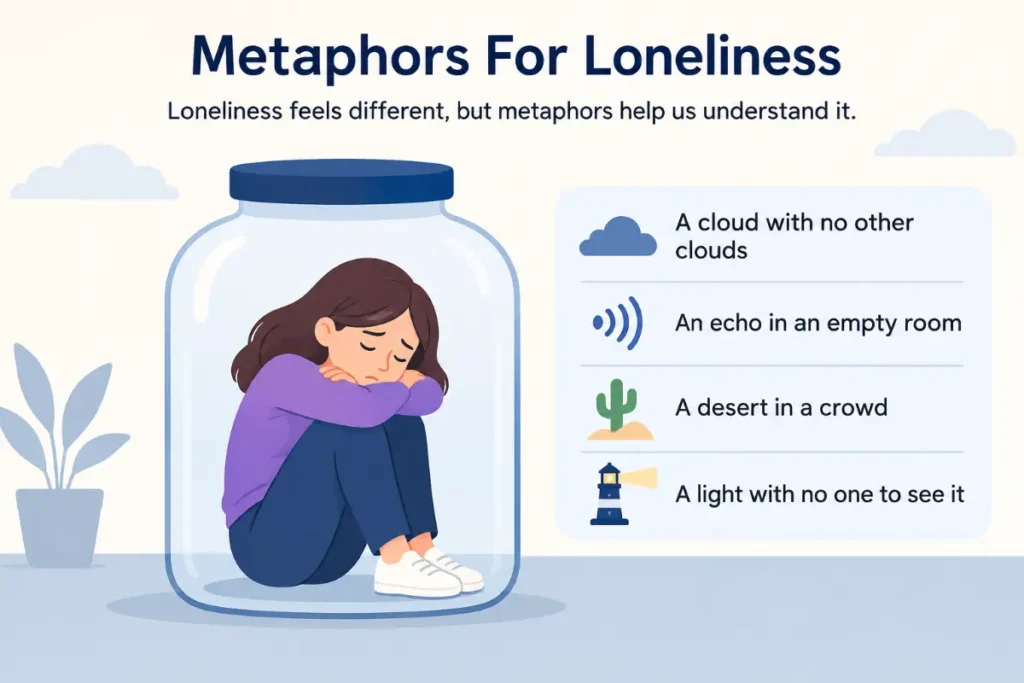
Loneliness deserves its own category because sadness and loneliness can overlap without meaning the same thing. Loneliness is about connection and separation. A person can feel lonely in a crowded room, surrounded by friends, or even inside a loving family.
That is why images of distance and isolation work so well.
- Loneliness was an island in the middle of a crowded sea.
- She lived behind a wall no one else could see.
- His voice disappeared into the empty distance.
- The crowd around her felt like another planet.
- He stood at a window looking into a world that felt far away.
- Her loneliness was a road with no footprints beside hers.
- His heart became a house with no visitors.
- She was surrounded by voices but trapped inside silence.
- The distance between them felt wider than an ocean.
- He carried an empty seat wherever he went.
The final example is intentionally abstract. An empty seat can represent the absence of companionship even when the person is physically moving through a crowded world.
That kind of image works especially well in fiction because the writer can introduce the object early and allow its meaning to develop.
Metaphors For Depression And Deep Emotional Darkness
When writing about depression, precision matters. Depression is a mental health condition and should not be reduced to ordinary sadness. A metaphor can describe someone’s experience, but it should not suggest that every person experiences depression in exactly the same way.
For creative writing, some images can communicate feelings associated with profound emotional darkness.
- The days became a hallway with no visible exit.
- She felt buried beneath a mountain of silence.
- His world had lost its color.
- The fog inside his mind refused to lift.
- Every morning felt like climbing a mountain without moving.
- She lived beneath a sky that never seemed to brighten.
- His thoughts became a maze with no clear path out.
- The sadness was a locked room inside his mind.
These are descriptions of emotional experience rather than definitions of depression.
That distinction is important. Good writing can capture the feeling without pretending that one metaphor explains a complex mental health condition.
Metaphors For A Broken Heart
The broken heart is one of the oldest and most recognizable images in emotional language. It works because the heart has long been associated with love, affection, courage, and emotional life.
Still, you can move beyond the familiar phrase and create more specific images.
- Her heart was a mirror cracked by one terrible blow.
- His love was a house left empty after the fire.
- Their relationship was a bridge collapsing between two shores.
- She carried a heart full of loose threads.
- His memories were pages torn from a favorite book.
- Her love became a song she could no longer finish.
- The breakup left a door swinging in an empty house.
- His heart felt like glass beneath a falling stone.
- Their promises became footprints washed away by rain.
- She was trying to rebuild a home from the pieces of yesterday.
The last image is useful because it introduces recovery without pretending that healing happens instantly.
Metaphors For Sad Memories
Memories can make sadness complicated. A happy memory can hurt because it reminds someone that a particular moment cannot return.
That is why images involving old photographs, echoes, books, rooms, and music work well.
- The memory was a photograph with a tear running through it.
- His past was an old song playing in another room.
- Her memories were ghosts that knew exactly where to find her.
- The past was a book she could not stop reopening.
- His childhood lived like an echo inside the old house.
- Every familiar street carried a piece of yesterday.
- Her memories were flowers pressed between old pages.
- The past sat quietly beside her at the dinner table.
- His happiest memories had become the sharpest ones.
- She carried yesterday like a photograph in her pocket.
These metaphors are especially effective in reflective writing because they connect sadness with time.
Metaphors For Missing Someone
Missing someone creates a particular kind of sadness. The person is absent but remains emotionally present through memories, routines, objects, and places.
Good metaphors can capture that strange tension.
- Your absence is an empty chair I notice every day.
- Missing you is a song stuck on its final note.
- You left a silence where your voice used to live.
- Your absence is a door I still expect to open.
- I carry your memory like a photograph close to my heart.
- The distance between us feels like an ocean without a bridge.
- Every familiar place is a reminder of the space you left behind.
- Your memory is a light that appears whenever the room gets dark.
- I keep finding pieces of you in ordinary moments.
- Missing you is living in a house where one room is always empty.
The strongest examples focus on everyday details. That makes the emotion believable.
A missing person is not only remembered during dramatic moments. Their absence can appear when someone reaches for the second coffee cup, hears their favorite song, walks past a familiar restaurant, or sees an old photograph.
Those small moments often carry more emotional weight than grand declarations.
Metaphors For Unspoken Sadness
Not every sad person talks about what they feel. Sometimes the emotion is hidden behind silence, routine, humor, or a calm expression.
That makes silence a useful source of imagery.
- Her silence was a locked diary.
- His smile was a curtain hiding the storm behind it.
- She carried a thunderstorm beneath a quiet face.
- His words stopped at the door of his heart.
- Her silence held more grief than her voice could explain.
- He wore happiness like a mask over a tired face.
- The words he never said became stones in his chest.
- Her sadness lived between the lines of everything she wrote.
These images work especially well for character development. Instead of telling readers that a character is secretly unhappy, show the contrast between appearance and internal experience.
That creates emotional tension.
Sadness As A Fading Flame
Fire and light are useful images because they can represent hope, energy, love, and life. When the flame becomes weaker, readers naturally understand that something is fading.
Examples include:
- Her hope was a candle struggling against the wind.
- His happiness became a fading flame.
- The last spark of optimism disappeared into the darkness.
- Her confidence burned down to a tiny ember.
- His joy flickered like a candle near the end of its wick.
- The warmth inside her slowly gave way to cold.
- One small memory kept the flame alive.
- His spirit was an ember waiting for air.
This metaphor becomes particularly powerful when the writer introduces the possibility of renewal. A candle can be relit. An ember can grow into a fire. A dark room can become bright again. That gives the image emotional movement.
Sadness As A Journey
Journey imagery works because sadness often changes over time. A person can enter grief, move through it, lose their way, find a new path, or eventually reach a place of acceptance.
Examples include:
- Grief was a road she never expected to travel.
- He walked through sadness one day at a time.
- Her sorrow became a long road through unfamiliar country.
- He lost his direction after the loss.
- She carried her memories like a traveler carrying an old map.
- The road was difficult, but it did not last forever.
- He eventually found a path through the darkness.
- Her healing began when she stopped expecting the old road to return.
The journey metaphor is useful because it avoids suggesting that healing is instant. It also gives writers a way to describe change without claiming that sadness completely disappears.
How To Choose The Right Metaphor
When you have several options, start with the emotion rather than the metaphor. Ask what the person is actually experiencing.
- Feeling overwhelmed. Use oceans, storms, floods, or mountains.
- Feeling lonely. Use islands, empty rooms, distance, walls, or deserted roads.
- Feeling hopeless. Use darkness, closed doors, fading light, or endless night.
- Feeling emotionally exhausted. Use empty batteries, dry wells, dying flames, or worn roads.
- Feeling heartbroken. Use broken glass, damaged homes, torn pages, or unfinished songs.
- Missing someone. Use empty chairs, echoes, photographs, familiar places, or unfinished songs.
- Feeling numb. Use ice, frozen rivers, glass walls, fog, or winter.
- Remembering the past. Use photographs, old books, echoes, pressed flowers, or distant music.
This approach prevents random metaphor selection.
You are not simply looking for something that sounds beautiful. You are looking for an image that communicates the emotional experience accurately.
How Writers Can Avoid Clichés
Some sadness metaphors have become so common that they may feel predictable.
Broken heart, dark cloud, tears like rain, and heavy heart are all familiar expressions. Familiar does not mean bad, but context can make them feel fresh or stale. One way to refresh a familiar image is to make it personal.
Instead of:
Her heart was broken.
Try:
The breakup left her staring at the half packed suitcase they had planned to carry together.
The suitcase becomes a symbol of the relationship and the future that never happened. Another approach is to use an unexpected but understandable image.
Instead of:
He was lonely.
Try:
His phone had become a museum of conversations that never happened.
The image feels modern and specific while still being easy to understand. That is often the sweet spot for original figurative writing.
Metaphor Versus Simile For Sadness
Metaphor and simile are closely related, but they do not build a comparison in exactly the same way. A metaphor directly presents one thing as another.
Her sadness was a heavy stone.
Her sadness is not literally a stone. The stone represents emotional weight and pressure. A simile makes the comparison more openly by using words such as like or as.
Her sadness felt like a heavy stone.
Both sentences communicate emotional heaviness. The metaphor sounds more direct and compact, while the simile makes the comparison explicit.
Here are a few more examples.
- Metaphor: His grief was an ocean.
- Simile: His grief was like an ocean.
- Metaphor: Her heart was winter.
- Simile: Her heart felt as cold as winter.
- Metaphor: Loneliness was a locked room.
- Simile: Loneliness felt like being trapped in a locked room.
Neither form is automatically better. A metaphor often works well when you want a strong image. A simile can feel more conversational and explanatory.
For poetry and creative writing, direct metaphors can create a stronger emotional impression. For explanations and everyday writing, similes can sometimes make an unfamiliar comparison easier to understand.
Metaphor Versus Idiom
An idiom is an established expression whose meaning is understood as a whole.
For example:
She was feeling blue.
The phrase feeling blue is an established expression meaning sad or unhappy. A reader familiar with English does not normally interpret blue as a literal color in this context. A metaphor can be newly created by the writer.
Her sadness was a blue room with no windows.
The writer has created a specific image rather than relying on an established expression.
The difference matters when you want your writing to feel original. Idioms are convenient and familiar. Fresh metaphors give you more control over the exact emotion you want to communicate.
Metaphor Versus Symbolism
Symbolism is broader than metaphor. A symbol is an object, image, place, action, or event that represents an idea beyond its literal meaning.
- A dead flower might symbolize lost love.
- A dark room might symbolize despair.
- A broken mirror might symbolize a damaged identity.
The same object can have different symbolic meanings depending on the story. A rose might symbolize love in one poem and loss in another. A winter landscape might suggest death, loneliness, stillness, or simply the passing of time.
Metaphor creates a comparison. Symbolism gives something a larger meaning within a particular context. The two can work together.
Her heart was a winter garden.
That sentence is a metaphor. If the garden continues appearing throughout a poem and represents her emotional life, it can also become a symbol.
Metaphor Versus Personification
Personification gives human qualities to something that is not human.
For example:
Sadness followed him home.
Sadness cannot literally walk behind someone. The writer treats sadness like a person capable of following. Another example is:
Grief knocked on her door every morning.
Grief is presented as a visitor. Personification can make an abstract emotion feel like a character. That gives writers an opportunity to create movement and interaction.
You can make sadness arrive, whisper, wait, follow, hide, knock, or refuse to leave. This technique is especially useful in poetry and fiction.
Common Sadness Idioms And Expressions
English contains many familiar expressions for sadness. Some are metaphorical, some are idiomatic, and some function as euphemistic or conventional phrases.
Here are several common examples.
- Feeling blue. Feeling sad or unhappy.
- Down in the dumps. Feeling discouraged or unhappy.
- Heavy heart. Experiencing sadness or emotional concern.
- Cry one’s eyes out. Cry intensely.
- Heartbroken. Deeply hurt by emotional loss.
- In low spirits. Feeling discouraged or unhappy.
- A lump in the throat. Feeling strong emotion that makes speaking difficult.
- Tear up. Begin to cry or become emotional.
- A broken heart. Deep emotional pain caused by loss or romantic disappointment.
- Downcast. Looking or feeling sad and discouraged.
These expressions are useful in everyday English because native speakers already understand them.
Still, writers should not confuse familiarity with originality. If you are creating poetry or literary prose, a fresh image can be more memorable than a familiar idiom.
How Native Speakers Describe Sadness Naturally
Native speakers rarely use figurative language simply to show that they know figurative language.
They usually use it because the image makes the feeling easier to communicate.
Someone might say:
I have been carrying a lot lately.
That sentence does not explicitly mention sadness. Yet the image of carrying something heavy suggests emotional pressure. Another person might say:
I feel like I am stuck in a fog.
The fog represents confusion, uncertainty, or emotional difficulty. Someone grieving might say:
It comes in waves.
That short expression communicates something important. The sadness is not constant at the same intensity. It rises and falls.
This is a useful lesson for writers. Natural language often uses simple images. You do not need a complicated metaphor to sound thoughtful.
How To Make Your Metaphors Sound Human
A strong metaphor should sound like something a real person might actually say or write. One of the easiest ways to achieve that is to start with ordinary experiences.
Think about things people understand physically:
- Carrying something heavy.
- Walking through darkness.
- Standing alone.
- Waiting for someone.
- Watching something disappear.
- Losing something valuable.
- Feeling cold.
- Being trapped.
- Running out of energy.
- Hearing an echo.
Then connect one of those experiences to the emotion.
For example:
I have been carrying this sadness for months.
That sounds natural because carrying weight is familiar.
Compare it with:
My sorrow has become an existential gravitational architecture within the psychological landscape of my emotional consciousness.
The second sentence may sound intellectual, but it does not sound human. It adds complicated words without adding emotional clarity.
Good writing does not need to show off.
How To Create An Original Metaphor For Sadness
If you want to write your own metaphor, start with a specific situation rather than the broad word sadness. Ask yourself what the person is doing.
- Are they sitting alone?
- Walking through an old neighborhood?
- Looking at a photograph?
- Waiting for a phone call?
- Cleaning out someone’s room?
- Driving past a familiar place?
Then find an object or experience that resembles that situation. Suppose your character is grieving someone who used to sit beside them at breakfast.
You could write:
The second chair at the table had become an empty reminder.
That is more personal than simply saying:
He was sad because he missed her.
Now suppose the character keeps rereading old messages. You could write:
His phone had become a small museum of everything they used to be.
The metaphor works because it comes from the character’s actual behavior. That is one of the best ways to create original figurative language. Look at the details first. Find the metaphor second.
Real Life Examples Of Sadness Metaphors
Figurative language appears in many forms of communication.
Daily Conversation
People often use simple expressions such as:
- I feel like I am carrying the world on my shoulders.
- I have been stuck in a fog lately.
- The breakup left a hole in my life.
These expressions are conversational and easy to understand.
Personal Writing
Personal essays and journal writing often use more intimate images.
The house still feels different without Dad’s voice in the hallway.
The hallway becomes part of the emotional memory.
Professional Communication
Professional writing usually requires more restraint. Instead of using an elaborate metaphor, a writer might say:
The loss cast a shadow over the entire team.
This can work in a workplace announcement because it communicates the emotional impact without becoming overly poetic.
Academic Writing
Academic writing generally requires precision. Metaphors can appear when discussing emotional concepts, but the writer should not allow figurative language to replace evidence or definitions.
For example:
Participants described grief as a heavy burden that affected their daily routines.
Here the metaphor can report how participants described their experience while maintaining a clear academic structure.
Literature
Literary writing gives the writer much more freedom.
The house remembered her better than he did.
That sentence uses personification and metaphorical thinking to suggest that familiar objects and places hold memories. The context determines how far the writer can take the imagery.
Just as sadness can shape the way we view difficult experiences, school as a metaphor can represent growth, challenges, lessons, and the emotional ups and downs of learning.
Why Darkness And Heaviness Are So Common
There is a linguistic reason certain sadness metaphors appear again and again.
People often understand abstract emotions through physical experience. Sadness can affect posture, energy, movement, sleep, breathing, appetite, and attention. That makes physical concepts such as heaviness, downward movement, darkness, distance, coldness, and exhaustion natural sources for emotional language.
Research on conceptual metaphors has found recurring patterns in how sadness is represented across language and culture. Common source domains include darkness, downward movement, natural forces, physical isolation, lack of warmth, and physical burden. These patterns help explain why expressions involving clouds, shadows, weight, storms, coldness, and distance feel intuitive rather than random.
This does not mean every person experiences sadness in the same way. Culture, personal history, language, and individual circumstances all influence emotional expression.
For writers, the practical lesson is simple. Start with a physical experience that genuinely resembles the emotion you want to describe.
Common Mistakes When Using Sadness Metaphors
Making Every Sentence Figurative
A paragraph becomes exhausting when every sentence contains a metaphor.
Consider:
Her heart was an ocean. Her thoughts were storms. Her memories were ghosts. Her hope was a candle. Her loneliness was an island.
Each image could work alone. Together, they compete. Give the reader a few clear images instead of covering every sentence in figurative language.
Mixing Too Many Images
A metaphor should usually have a clear internal world. If you start with a storm, stay with weather imagery long enough to make it meaningful.
The clouds gathered over his thoughts. Rain filled his eyes. Thunder rolled through his memories.
That feels coherent. Switching immediately from storms to broken glass to deserts to clocks can make the writing feel assembled rather than written.
Choosing Drama Over Accuracy
A sad person is not always devastated. Sometimes sadness is quiet. Sometimes it is a small ache that appears while driving home. Sometimes it is missing someone during an ordinary morning. Sometimes it is disappointment that fades after a few days.
Use the size of the metaphor to match the size of the emotion.
Explaining The Metaphor Too Much
Once readers understand the image, trust them.
For example:
Her heart was an empty house. This means that she felt sad because the house represents her emotional emptiness and loneliness.
The explanation destroys some of the emotional effect.
Simply write:
Her heart was an empty house.
Then continue the story.
Using Clichés Without Personal Details
Familiar expressions are useful, but original details make them stronger.
Instead of:
He had a broken heart.
Try:
He still reached for his phone every evening before remembering that she was no longer going to call.
The second version shows heartbreak instead of naming it.
A Practical Formula For Better Metaphors
When you get stuck, use this simple pattern.
Emotion + physical experience + specific detail.
For example:
Loneliness + distance + an empty chair.
Result:
The empty chair beside her made the whole table feel miles wide.
Another example:
Grief + weight + a personal memory.
Result:
Every time he opened the old photo album, another stone seemed to settle on his heart.
Another:
Heartbreak + damage + an ordinary object.
Result:
Her favorite coffee mug was still in the cupboard, but the future they had planned for had cracked like its broken handle.
The goal is not to follow a formula forever. Use it as a starting point when you need an idea.
Choosing The Right Tone
The same emotion can require completely different language depending on the situation.
- A sympathy message should be gentle.
- A poem can be intimate.
- A novel can be dramatic.
- A comedy piece can use dark humor.
- A school essay should be clear.
- A professional announcement should be restrained.
For example, a humorous writer might describe sadness as a phone battery stuck at one percent. That could work in a casual social post. It would not be appropriate in every situation. Good language choices show awareness of the reader. That is part of strong writing.
FAQs About Sadness Metaphors
What Is A Good Metaphor For Sadness
A good comparison depends on the kind of sadness you want to describe. A heavy weight suggests emotional pressure. A dark cloud suggests a mood that hangs over someone. A storm suggests intense emotion. An empty room suggests loneliness or absence. Choose the image that best matches the experience instead of using the most dramatic phrase available.
What Is A Short Metaphor For Sadness
Short options include a heavy heart, a dark cloud, a fading light, a quiet ache, a frozen heart, an empty room, and a long shadow. These phrases work well in poetry, captions, creative writing, and emotional descriptions. A short metaphor becomes more powerful when the surrounding sentence gives it a specific personal context.
What Is A Deep Metaphor For Sadness
A deep metaphor connects sadness with an experience that has several emotional layers. For example, grief was an ocean with no visible shore suggests depth, uncertainty, and emotional overwhelm. Her heart was a winter garden can suggest emptiness while leaving room for the possibility of renewal. Strong metaphors create meaning without explaining every detail.
What Is A Metaphor For Feeling Lonely
Loneliness can be described as an island surrounded by people, a locked room, an empty chair, or a road with no footprints beside you. These images focus on separation rather than sadness alone. They work particularly well because loneliness is often about feeling disconnected even when other people are physically nearby.
What Is A Metaphor For A Broken Heart
A broken heart can be described as a shattered mirror, a burned house, a torn book, a bridge with one side missing, or a song without its final note. Each image creates a slightly different feeling. A shattered mirror suggests damage, while an unfinished song suggests something meaningful that ended before it felt complete.
What Is A Metaphor For Crying
Crying is commonly described through water and weather imagery. Tears can become rain, a river, an ocean, or water breaking through a dam. The best choice depends on intensity. A drizzle can suggest quiet sadness, while a flood or broken dam can communicate overwhelming emotion. Personal details can make these familiar images feel fresh.
What Is A Metaphor For Grief
Grief can be described as a tide that keeps returning, a long shadow, a heavy stone, an empty room, or a wound that slowly changes. These images work because grief often changes over time rather than disappearing all at once. A useful metaphor should leave room for memories, difficult days, quiet moments, and gradual adjustment.
What Is A Metaphor For Emotional Pain
Emotional pain can be described as a wound, a bruise, a burning ember, a stone in the chest, or a splinter that will not come out. Physical pain provides a concrete way to describe an invisible experience. The comparison becomes stronger when you connect it to a specific event or memory instead of leaving it as a generic phrase.
Final Takeaway
The best figurative language for sadness does not simply replace the word sad with something more poetic. It shows the reader what the sadness feels like.
A storm can make sadness feel powerful and uncontrollable. A heavy stone can make it feel exhausting. Darkness can suggest hopelessness. An empty room can communicate loneliness. A broken mirror can capture heartbreak. A fading flame can show hope becoming weaker.
The strongest writers also know when to stop. You do not need five metaphors in every paragraph. One clear image supported by a real detail can be more powerful than a page full of elaborate comparisons.
If you are writing about someone you love, make the language personal. If you are writing poetry, choose images that create emotion without explaining everything. If you are writing an essay, keep the comparison clear and support it with precise language. If you are writing dialogue, make sure the metaphor sounds like something that character would actually say.
Most importantly, do not choose a metaphor just because it sounds impressive. Choose the image that feels true. That is what makes figurative language memorable. A reader may forget the exact sentence, but they will remember the feeling of a dark room, an empty chair, a fading light, or a storm finally beginning to clear.