Anxiety can be difficult to explain because it is often invisible to everyone except the person experiencing it. You may know exactly what you feel, yet struggle to put that feeling into words. Saying you are worried or nervous does not always capture the pressure, racing thoughts, dread, or sense of danger that can come with anxiety. That is where a good metaphor for anxiety can help.
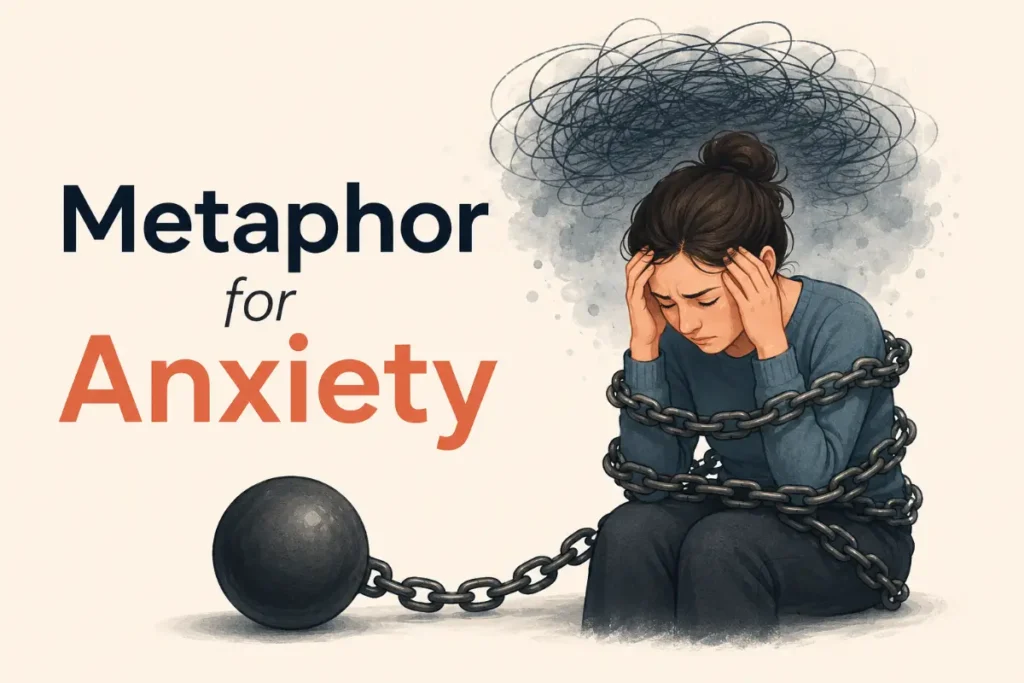
A metaphor gives an invisible experience a visible shape. Anxiety can become a storm that will not clear, a smoke alarm that keeps ringing, a weight pressing against your chest, or a maze with no obvious exit. Each image communicates something slightly different. Some describe fear. Others capture overthinking, social pressure, panic, exhaustion, or the feeling of being trapped inside your own thoughts.
The best metaphor is not necessarily the most dramatic one. It is the one that makes the emotional experience easier to recognize. In this guide, you will find practical and creative metaphors for different forms of anxiety, along with explanations of what each image communicates and when it works best.
Quick Definition
A metaphor for anxiety compares anxiety to something familiar so an invisible emotional experience becomes easier to picture. A storm can represent emotional chaos. A cage can represent feeling trapped. A constantly ringing alarm can represent a mind that keeps warning you about danger even when you are safe.
Quick Answer
A strong metaphor for anxiety turns an internal feeling into a concrete image. Common examples include anxiety as a storm, a heavy weight, a smoke alarm, a tangled knot, a maze, a shadow, or a runaway train. The best choice depends on the experience you want to describe. Panic may feel like an alarm, while overthinking may feel more like a maze.
Why Anxiety Is So Difficult To Describe
Anxiety is not one single feeling. It can involve fear, uncertainty, physical tension, anticipation, self doubt, racing thoughts, restlessness, and a constant sense that something might go wrong.
That variety makes simple descriptions feel inadequate. Someone might say, “I am anxious,” but that sentence tells you very little about the actual experience. It does not tell you if their thoughts are racing, their body feels tense, they are afraid of being judged, or they are waiting for an imagined disaster.
Metaphors solve part of that communication problem by giving the feeling a physical form.
Imagine saying, “My mind is a browser with fifty tabs open and none of them will close.” That image immediately communicates mental overload. You do not need several paragraphs explaining what overthinking feels like.
Or imagine saying, “My anxiety is a smoke alarm that goes off whenever I burn toast.” The comparison suggests that the warning system is sensitive and reacts to something harmless as if it were a serious threat.
That is the real strength of figurative language. It compresses a complicated emotional experience into an image people can understand quickly.
Anxiety can make everyday environments feel overwhelming, especially when school pressure becomes difficult to manage.
How Metaphors Make Anxiety Easier To Understand
A metaphor works by connecting something abstract with something concrete. Anxiety happens inside the mind and body, while a storm, locked door, alarm, or heavy backpack can be imagined immediately.
This creates several useful effects.
- It makes an invisible feeling visible. A reader cannot see someone’s worry, but they can picture a storm or a weight.
- It communicates intensity. A light breeze feels very different from a hurricane. The image can show how powerful the experience feels.
- It adds emotional detail. A cage suggests restriction. A maze suggests confusion. A shadow suggests something that follows you.
- It helps people relate. Someone who has never experienced a particular form of anxiety may still understand what it means to feel trapped or overwhelmed.
- It gives writers stronger language. Instead of repeatedly saying someone is nervous, a writer can show the emotional experience through imagery.
A thoughtful metaphor can therefore do more than decorate a sentence. It can explain an experience.
Different Types Of Anxiety Metaphors
There is no single perfect image for anxiety because anxiety changes from person to person and from moment to moment. The metaphor should match the emotional feature you want to emphasize.
Anxiety As A Storm
The storm is one of the most familiar images for emotional turmoil. It works because anxiety can arrive suddenly, become intense, and make everything around you feel threatening.
You might describe it like this:
“Anxiety is a storm gathering inside a clear sky.”
This version is especially useful when someone looks calm from the outside but feels overwhelmed internally.
A storm metaphor can also communicate different levels of intensity. Dark clouds might represent the beginning of worry. Heavy rain can represent escalating distress. Thunder can represent sudden frightening thoughts. A hurricane can represent an overwhelming episode.
The image works particularly well in poetry and creative nonfiction because it gives you plenty of room to develop the scene.
Anxiety As A Heavy Weight
A weight metaphor focuses less on fear and more on emotional pressure.
“Anxiety is a weight I carry even when nobody else can see it.”
This image works well for persistent anxiety. It suggests that the feeling does not necessarily explode. Instead, it stays present and consumes energy.
A backpack filled with stones can make the same point. You may continue walking, working, talking, and smiling, but everything requires more effort.
This metaphor is useful when writing about long periods of worry or emotional exhaustion.
Anxiety As A Smoke Alarm
The smoke alarm metaphor is particularly effective because it captures the difference between a warning and an actual emergency.
“My anxiety is a smoke alarm that cannot tell the difference between burnt toast and a house fire.”
The image suggests that the mind is trying to protect you but has become overly sensitive. A small problem can trigger a response that feels much larger than the situation requires.
This metaphor is useful in educational writing because it explains anxiety without suggesting that the person’s feelings are imaginary or meaningless.
The alarm is responding to something. The problem is that its response may be too strong for the situation.
Anxiety As A Maze
A maze is a strong metaphor for overthinking.
“Anxiety turns every decision into a maze with another dead end around the corner.”
This image captures the way anxious thinking can generate more questions instead of answers.
You make one decision and immediately imagine another possible problem. Then you consider a second possibility. Then a third. Soon, the original issue is buried under a network of hypothetical outcomes.
The maze metaphor works especially well when describing indecision, rumination, and analysis paralysis.
Anxiety As A Shadow
A shadow suggests something that follows you without always being visible to other people.
“Anxiety followed me like a shadow I could never quite outrun.”
This is a useful image for persistent worry. It does not necessarily suggest that anxiety is always loud or dramatic. Sometimes it is simply there in the background.
The metaphor can also communicate the difference between appearance and internal experience. A person may walk into a room smiling while privately carrying the same fear that followed them there.
Anxiety As A Cage
A cage emphasizes restriction.
“Anxiety built a cage out of all the things I was afraid might happen.”
This metaphor is especially effective when anxiety causes avoidance. The physical world may remain open, but fear makes the person’s choices feel smaller.
The cage can be made from imagined consequences rather than physical barriers. That detail gives the metaphor emotional depth. Nothing may literally be stopping the person, yet the fear still feels powerful enough to keep them inside.
Metaphors For Anxiety Attacks
An anxiety attack can feel more immediate and intense than background worry. Metaphors for this experience often work best when they communicate sudden escalation, physical pressure, urgency, or loss of control.
A Fire Alarm Going Off
“An anxiety attack felt like every alarm in my body started ringing at once.”
This metaphor emphasizes urgency. It communicates the sensation that something is terribly wrong even when there may be no immediate external danger.
A Wave That Comes Out Of Nowhere
“The panic hit me like a wave that rose before I had time to prepare.”
A wave metaphor captures sudden intensity and the feeling of being overwhelmed by something larger than yourself.
It also gives the experience a beginning and an end. A wave rises, reaches its peak, and eventually recedes. That can make it useful in reflective writing.
A Runaway Train
“My thoughts became a runaway train with no brakes.”
This image focuses on speed and loss of control. It is particularly effective when thoughts accelerate quickly and become difficult to interrupt.
A Room Filling With Water
“It felt as if the room were filling with water and I could not find the door.”
This metaphor communicates pressure, urgency, and the desperate search for relief.
The important feature is not the literal water. It is the sense that the person’s available space is shrinking while the emotional pressure continues to rise.
Metaphors For Social Anxiety
Social anxiety often involves fear of judgment, embarrassment, rejection, or being watched. Metaphors for this experience work best when they capture visibility and self consciousness.
Standing Under A Spotlight
“Walking into the room felt like stepping onto a stage beneath a spotlight.”
The image communicates the feeling that everyone is watching you even when most people are focused on themselves.
Speaking Through A Megaphone
“Every word felt as if it were coming through a megaphone.”
This metaphor captures the uncomfortable feeling that ordinary mistakes seem much louder and more noticeable than they really are.
A Room Full Of Mirrors
“Social anxiety turned every conversation into a room full of mirrors.”
The mirrors represent excessive self awareness. Instead of simply participating in a conversation, the person becomes preoccupied with how they look, sound, and appear to others.
Walking Onto Thin Ice
“Every conversation felt like walking across thin ice.”
This image communicates caution and fear of making one wrong move. It works well when someone constantly monitors their words because they expect a social mistake to have serious consequences.
Metaphors For Overthinking
Overthinking is not simply having many thoughts. It often involves repeatedly examining possibilities, replaying events, and imagining negative outcomes.
That makes certain images especially effective.
A Hamster Wheel
“My thoughts were running on a hamster wheel and getting nowhere.”
This is a familiar metaphor because it captures repetition. The mind stays busy but does not necessarily move toward a solution.
A Broken Record
“The same question kept playing in my head like a broken record.”
This image works well for repetitive thoughts. It is especially useful when someone keeps replaying a conversation or mistake.
A Computer With Too Many Tabs
“My brain had too many tabs open and every one of them was making noise.”
This modern metaphor is easy to understand and works particularly well in casual writing.
It captures mental clutter without making the experience sound dramatic. Each tab represents another concern competing for attention.
A Maze With Moving Walls
“Every answer led to another hallway, and the walls of the maze kept moving.”
This version is stronger than a simple maze metaphor because it communicates why overthinking can feel impossible to escape. Even after finding a possible answer, another question appears.
Metaphors For Fear And Dread
Fear and dread overlap with anxiety, but they do not always feel the same. Fear can be sharp and immediate. Dread often feels slower, heavier, and more anticipatory.
Fear As A Door You Cannot Stop Watching
“Fear was a door I kept expecting to open.”
This metaphor captures anticipation. Nothing has happened yet, but the person remains focused on the possibility.
Dread As A Dark Cloud
“Dread hung over the day like a dark cloud that refused to move.”
The cloud creates a sense of persistent heaviness. Unlike a sudden panic response, dread can linger quietly for hours.
Fear As Footsteps Behind You
“Fear sounded like footsteps behind me even when the street was empty.”
This metaphor communicates vigilance. The person feels as if danger is close even when they cannot identify a clear threat.
Dread As Waiting For Bad News
“Dread felt like staring at a phone that might ring with terrible news.”
This image is powerful because it captures uncertainty. The feared event has not happened, but the anticipation is already affecting the present moment.
How To Choose The Right Metaphor
A good metaphor should match the emotional experience rather than simply sound poetic.
Start by identifying the dominant feeling.
- Overwhelmed: Try a storm, flood, avalanche, or rising tide.
- Trapped: Try a cage, locked room, maze, or shrinking hallway.
- Constant worry: Try a shadow, background hum, ticking clock, or alarm.
- Racing thoughts: Try a runaway train, spinning wheel, or computer with too many tabs.
- Fear of judgment: Try a spotlight, stage, courtroom, or room full of mirrors.
- Sudden panic: Try a wave, fire alarm, explosion, or runaway vehicle.
- Emotional heaviness: Try a backpack full of stones, heavy coat, anchor, or weight.
- Anticipatory dread: Try a door waiting to open, dark cloud, countdown, or distant thunder.
The strongest comparisons usually contain a small amount of tension. They give the reader something concrete to picture while leaving enough room for interpretation.
A metaphor also becomes more effective when it fits the voice of the writing. A computer metaphor may sound natural in a casual blog post, while a storm or shadow may work better in poetry. A professional article may benefit from a smoke alarm or warning system because the comparison explains the experience without becoming overly dramatic.
The goal is not to find the fanciest image. The goal is to find the image that makes the feeling recognizable.
Metaphors For Panic Attacks
Panic can feel different from ordinary worry because it often arrives with a sudden sense of urgency. The body may feel activated while the mind searches for an explanation. For writing purposes, the strongest images usually communicate speed, intensity, physical pressure, or the feeling that control has slipped away.
A runaway train is one of the clearest images. The train starts moving faster and faster while the person desperately looks for a brake. It captures the experience of thoughts and physical sensations escalating before the person feels ready for them.
A wave crashing over someone gives the experience a different quality. Instead of focusing on speed, it emphasizes overwhelming force. The person is not choosing to enter the water. The wave simply arrives and becomes larger than they can comfortably manage.
An alarm system going off inside the body can communicate another important aspect. The body is acting as if immediate danger is present. This image can be particularly effective in explanatory writing because it does not reduce the experience to simply being afraid.
You can also use a room with shrinking walls to represent the feeling that there is less and less space to breathe or think. A fire spreading through a building can represent rapidly escalating intensity. A tornado can represent sudden internal chaos that seems to pick up everything at once.
The best choice depends on what you want the reader to notice. A train emphasizes momentum. A wave emphasizes force. An alarm emphasizes danger signals. A shrinking room emphasizes pressure.
Metaphors For Depression And Emotional Exhaustion
Anxiety and depression are different experiences, but writers sometimes need imagery that describes the emotional heaviness that can accompany prolonged distress. The language should remain precise because not every person experiences these feelings in the same way.
A heavy backpack is useful for describing emotional exhaustion. Someone can continue walking while carrying it, but every step requires more effort.
A foggy road can represent uncertainty and difficulty seeing what comes next. The road still exists, but the destination is difficult to make out.
An empty battery communicates depleted energy. It works particularly well when someone wants to describe the feeling of having little emotional capacity left after prolonged stress.
A room with the curtains closed can suggest withdrawal or emotional isolation. Unlike a storm metaphor, it is quieter. Nothing dramatic has to happen. The outside world simply feels distant.
An anchor can represent emotional heaviness when the writer wants to emphasize being pulled downward or struggling to move forward.
These images are useful because they avoid turning emotional difficulty into a character flaw. The person is not lazy or weak. The metaphor shows that continuing to function can require substantial effort.
Metaphors For Emotional Exhaustion
Anxiety can consume attention even when nothing visibly dramatic is happening. A person may spend hours anticipating problems, replaying conversations, checking possibilities, or preparing for things that may never happen. That mental activity can be exhausting.
One effective image is a phone battery that keeps losing power because too many apps are running in the background. The person may not be doing anything physically demanding, yet energy continues to disappear.
Another is a motor that never switches off. The engine keeps running even when the car is parked. This captures the idea of constant internal activity.
A light that never turns off works in a similar way. The mind stays alert long after the situation has stopped requiring attention.
You could also describe anxiety as carrying a suitcase that nobody else knows is there. This emphasizes the hidden nature of emotional effort. From the outside, someone may appear to be doing ordinary things. Internally, they are carrying something heavy.
These metaphors are especially effective in personal essays because they show why rest is not always as simple as stopping physical activity. Mental strain can continue even during quiet moments.
Metaphors For Feeling Trapped
Feeling trapped is one of the strongest recurring themes in descriptions of anxiety. The person may have physical freedom while still feeling unable to act because every possible choice seems connected to danger or failure.
A cage is the most direct image. It communicates restriction immediately.
A locked door creates a slightly different feeling. It suggests that an exit exists but cannot be reached.
A maze emphasizes confusion rather than confinement. The person can move but cannot find the right direction.
A hallway with no exit suggests helplessness. Every path appears to lead somewhere, yet none provides a way out.
A room with invisible walls can be especially powerful because the barriers cannot be seen by other people. The person knows they are there, but someone watching from outside may not understand why the person cannot simply walk forward.
For creative writing, this distinction matters. A cage says, “I cannot leave.” A maze says, “I cannot find my way.” Invisible walls say, “I cannot explain what is stopping me.” Each image tells a different story.
Metaphors For Racing Thoughts
When thoughts move rapidly, writers often need imagery that communicates speed without simply repeating the phrase racing thoughts.
A busy intersection with every traffic light stuck on green suggests that thoughts keep entering without giving the mind a chance to slow down.
A radio scanning through dozens of stations communicates constant mental switching. One thought begins, another interrupts it, and a third takes over before the first one has finished.
A browser with dozens of tabs open is a modern and accessible comparison. Every tab represents another question, concern, memory, possibility, or imagined problem.
A snowball rolling downhill emphasizes escalation. A small concern can gather more thoughts as it moves until the original issue becomes difficult to recognize.
A spinning carousel captures repetition. The mind keeps moving, but it repeatedly returns to the same place.
These images work particularly well for conversational writing because readers can recognize the experience without needing technical terminology.
Metaphors For Constant Worry
Constant worry is quieter than panic but can be just as disruptive. It may feel like a background process that never completely stops.
A radio playing softly in another room is a useful metaphor. The sound may not dominate every moment, but you never completely forget it is there.
A low engine hum creates a similar effect. The noise is not necessarily loud, but its constant presence becomes tiring.
A ticking clock emphasizes anticipation. Every second seems to bring the possibility of something going wrong.
A cloud following someone through the day communicates persistence. The person may have good moments, but the worry remains nearby.
A notification that never clears from the screen is another modern comparison. The mind keeps signaling that something needs attention even when there is nothing immediate to solve.
These quieter metaphors are often better than dramatic images when describing everyday anxiety because they capture the background quality of persistent worry.
Metaphors For Anticipatory Anxiety
Anticipatory anxiety is focused on what might happen. The feared event has not necessarily occurred, yet the mind behaves as though it is already approaching.
A countdown clock captures this perfectly. Each passing second increases the feeling that something unavoidable is getting closer.
A door at the end of a hallway can represent an upcoming event. The person cannot see what is behind it, but the uncertainty creates tension.
A dark cloud on the horizon suggests that something unpleasant may be approaching.
A roller coaster climbing toward its highest point communicates anticipation through physical tension. The drop has not happened yet, but the body already reacts to the expectation.
A phone waiting to ring creates a more ordinary and subtle image. The uncertainty is the central issue. The person does not know what will happen, so the mind fills the silence with possibilities.
These comparisons can be useful in stories about job interviews, examinations, public speaking, medical appointments, difficult conversations, travel, or major life changes.
Metaphors For Hidden Anxiety
Not all anxiety looks dramatic. Sometimes the most accurate metaphor is one that captures the difference between external appearance and internal experience.
- A calm lake hiding a strong current underneath is a strong example. The surface appears peaceful while something powerful moves below it.
- A house with a quiet room behind a locked door can suggest an internal struggle that other people cannot see.
- A smiling mask over a tired face communicates the effort involved in appearing fine.
- A phone vibrating silently in a pocket is another useful image. Nobody else hears it, but the person carrying it knows it is there.
These metaphors are valuable because they avoid the assumption that distress must always be visible. A person can laugh, work, socialize, and complete ordinary responsibilities while still dealing with significant internal pressure.
Metaphors For Anxiety In Everyday Conversation
A good everyday metaphor does not need to sound poetic. In fact, simple language often feels more authentic.
Someone might say:
- “My brain feels like it has too many tabs open.”
- “I feel like I am waiting for the other shoe to drop.”
- “It feels like my mind will not stop sounding the alarm.”
- “I have a knot in my stomach.”
- “My thoughts are going in circles.”
- “I feel like I am carrying a backpack full of rocks.”
- “It feels like there is a storm in my head.”
- “My mind keeps finding another thing to worry about.”
These expressions work because they sound like things people might actually say. They do not require the listener to interpret complicated literary imagery.
For everyday communication, clarity usually matters more than originality. A familiar image can be more powerful than an elaborate one if the listener understands it immediately.
Anxiety can also overlap with emotional heaviness, making it harder to process difficult feelings.
Metaphors In Creative Writing
Creative writing gives you more freedom. You can develop one metaphor across an entire paragraph, scene, poem, or story rather than using it for a single sentence.
Imagine a character experiencing anxiety before an important meeting. Instead of repeatedly writing that the character feels nervous, you could describe the office as a courtroom, the conference table as a witness stand, and every question as an accusation.
That extended metaphor changes the reader’s experience. The character is not simply nervous. They feel judged and exposed.
Another writer might use weather. Clouds gather as the character approaches the building. Wind pushes against the windows during the meeting. The storm reaches its peak when the character is asked to speak. Later, the clouds begin to break. The metaphor becomes part of the story’s structure.
This is where figurative language becomes more than decoration. It can influence pacing, atmosphere, characterization, and theme.
How To Create Your Own Anxiety Metaphor
Creating an original metaphor becomes easier when you start with the feeling rather than the object.
Ask yourself what the anxiety actually does.
Does it:
- Follow you.
- Trap you.
- Warn you.
- Exhaust you.
- Confuse you.
- Rush you.
- Silence you.
- Make ordinary situations feel dangerous.
- Keep you awake.
- Make every decision feel uncertain.
Then find something in the physical world that behaves in a similar way.
- If anxiety follows you, think about a shadow.
- If it traps you, think about a cage.
- If it keeps warning you, think about an alarm.
- If it exhausts you, think about a heavy backpack.
- If it confuses you, think about a maze.
- If it moves too quickly, think about a runaway train.
The strongest original metaphors often come from ordinary experiences. You do not need an unusual object. You need an accurate relationship between the object and the emotion.
Examples Of Anxiety Metaphors In Sentences
Here are original examples that demonstrate different emotional shades.
- Anxiety was a shadow that stretched longer every time I tried to outrun it.
- My thoughts became a hallway full of doors, and every door opened onto another question.
- Fear sat beside me like an unwanted passenger who refused to get out of the car.
- Worry was a dripping faucet that never gave the room complete silence.
- My mind was a crowded station where every train announced an emergency.
- Anxiety wrapped around my chest like a belt pulled one notch too tight.
- Dread was a storm cloud parked above tomorrow.
- Social fear turned ordinary conversations into exams I had not studied for.
- Overthinking was a treadmill that kept me moving without taking me anywhere.
- Panic arrived like a wave that covered the shore before I could step back.
- My worries were stones in my pockets, small enough to carry but heavy enough to slow every step.
- Anxiety was a guard dog barking at every movement beyond the fence.
- My mind kept turning the same thought over like a coin between restless fingers.
- Fear was a doorbell that rang long after the visitor had gone.
- Dread felt like watching a dark cloud move toward a town where I was waiting.
Notice that these images do not all communicate the same thing. That is intentional. A strong metaphor should add information rather than simply replace the word anxiety.
How Different Metaphors Change The Meaning
Choosing an image is also choosing an interpretation.
- If you describe anxiety as a storm, the experience becomes chaotic and powerful.
- If you describe it as an alarm, the focus shifts toward warning and perceived danger.
- If you describe it as a cage, the focus becomes restriction.
- If you describe it as a shadow, the emphasis is persistence.
- If you describe it as a maze, the central idea becomes confusion.
- If you describe it as a weight, the focus becomes exhaustion.
- If you describe it as a wave, the emphasis becomes overwhelming force.
This is why writers should not simply search for the most beautiful comparison. They should ask what they want the reader to understand.
A metaphor is a lens. Change the lens and the emotional picture changes with it.
Anxiety Metaphors In Literature
Writers have long used weather, darkness, confinement, storms, ghosts, shadows, and physical landscapes to represent internal emotional states. The technique works because readers understand physical experiences directly and can transfer that understanding to an abstract feeling.
- A dark room can suggest uncertainty.
- A locked door can suggest repression or fear.
- A storm can suggest emotional turmoil.
- A labyrinth can suggest confusion.
- A battlefield can suggest internal conflict.
- A character’s surroundings can therefore become an external representation of what is happening inside the character.
This technique is especially useful in fiction because it allows writers to show an emotional state rather than repeatedly tell the reader what the character feels.
Instead of writing, “She was anxious,” a writer might describe her checking the same locked door three times, listening to every sound outside, and imagining danger in ordinary noises. The physical actions become evidence of the internal state.
Anxiety Metaphors In Popular Culture
Popular culture frequently uses imagery to represent fear, pressure, uncertainty, and internal conflict. Movies, television, games, music, and advertising all rely on visual metaphors because audiences understand images quickly.
- A character surrounded by walls may represent confinement.
- A character drowning in water may represent emotional overwhelm.
- A character walking through a maze may represent confusion.
- A constantly ringing alarm may represent a mind stuck in threat detection.
The same principle applies to game design. A hostile environment, narrowing corridor, countdown, or distorted sound can communicate tension without directly explaining it.
This is one reason metaphor matters beyond writing. It is a communication system shared by language, visuals, sound, and storytelling.
Anxiety Metaphor ReFantazio
The phrase Anxiety Metaphor ReFantazio deserves separate attention because it connects the broader idea of metaphor with Metaphor: ReFantazio, the role playing game created by Studio Zero and published by Atlus.
The title itself makes metaphor central to the game’s identity. In this context, searching for anxiety related metaphors is not simply a language question. It can also reflect interest in how fictional worlds use symbolic storytelling to explore fear, social pressure, uncertainty, identity, and human struggle.
This is a good example of why context matters in semantic search. The same word can belong to different topic clusters. A person searching for an anxiety metaphor for a poem has a very different goal from someone searching for the meaning of metaphorical themes in a game.
For writers and content creators, the lesson is useful. Always consider the surrounding intent before deciding what a search phrase means.
During stressful moments, family support can provide comfort and a sense of security.
Metaphor Versus Simile For Describing Anxiety
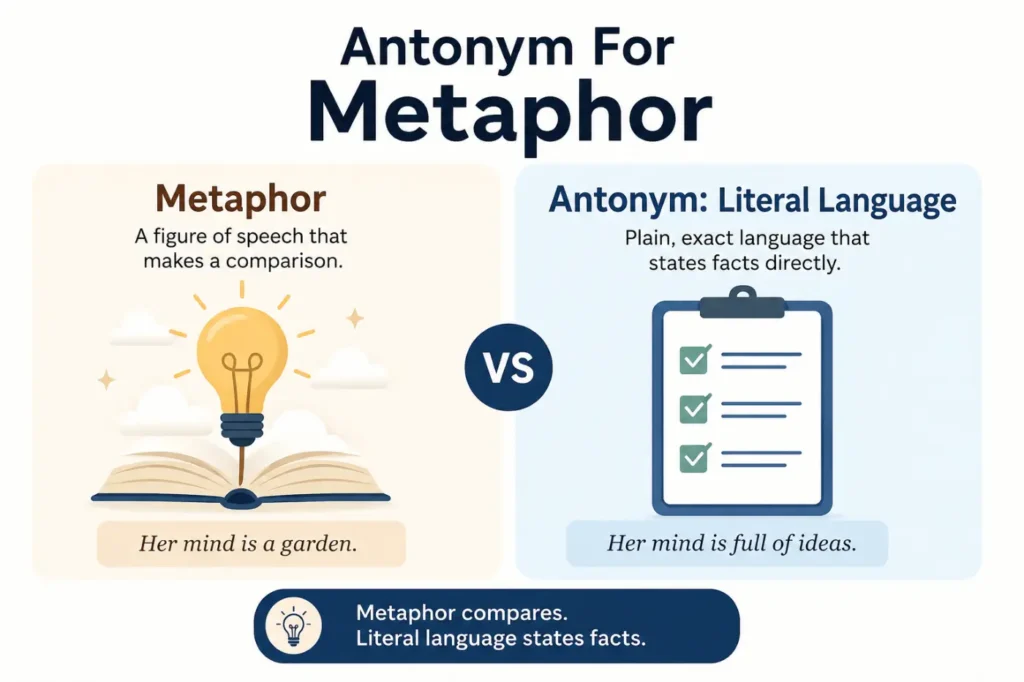
Metaphors and similes both make comparisons, but they do so differently. A metaphor directly identifies one thing with another.
“Anxiety is a storm inside my head.”
A simile uses words such as like or as.
“Anxiety feels like a storm inside my head.”
Both can be effective. The metaphor often sounds more direct and poetic, while the simile can feel more conversational and clearly signals that a comparison is being made.
For personal writing, either form can work. The better choice depends on your voice and the effect you want.
Clichéd Comparisons To Use Carefully
Some images are so common that they can lose their impact if they appear without a fresh detail.
Storms, cages, waves, and shadows are useful, but they are familiar. That does not make them bad. It simply means the surrounding language needs to do some work.
Compare these two sentences.
“Anxiety was a storm.”
That is understandable but generic.
“Anxiety was a storm that kept forming on perfectly clear mornings.”
The second version adds tension. The problem is no longer simply that anxiety is powerful. It arrives when the person least expects it.
Originality often comes from the details around a familiar metaphor rather than from inventing an entirely new image.
How Writers Show Anxiety Instead Of Telling
One of the most useful techniques in creative writing is showing instead of telling.
Telling says:
“He was anxious about the interview.”
Showing might say:
“He checked the time three times before the elevator reached the fourth floor.”
The second sentence gives the reader evidence. Metaphor can strengthen that technique.
“The interview room looked like a courtroom, and every chair seemed to face a witness stand.”
Now the environment reflects the character’s emotional state. This approach gives readers something to experience rather than simply asking them to accept an emotional label.
Related Concepts And Confused Terms
Several ideas overlap with metaphor but should not be treated as identical.
Metaphor
A metaphor creates a direct comparison between two different things.
Simile
A simile makes a comparison using terms such as like or as.
Analogy
An analogy explains one idea by comparing it with another idea that is easier to understand.
Symbolism
A symbol represents a broader idea or meaning. A storm in a story might symbolize emotional conflict, but a storm is not automatically a symbol every time it appears.
Personification
Personification gives human qualities to something nonhuman. A writer might describe anxiety as a voice that whispers warnings.
Imagery
Imagery uses sensory language to help readers picture or experience something.
Hyperbole
Hyperbole intentionally exaggerates for effect. Saying “I have a million worries” is not normally a literal statement.
These devices can overlap. A writer might use metaphor, personification, and imagery in the same passage.
Expert Language Insight
The strongest emotional metaphors usually do one job exceptionally well. They do not try to explain every aspect of an experience at once.
For example, a maze is excellent for confusion but less effective for sudden physical intensity. A siren is excellent for perceived danger but less useful for describing long term exhaustion. A heavy backpack communicates burden but does not naturally explain racing thoughts.
That distinction matters because weak figurative language often comes from choosing an image simply because it sounds dramatic.
Experienced writers work in the opposite direction. They identify the emotional quality first and then search for an object or situation that behaves in a similar way.
There is another important point. A metaphor should never be used to dismiss or trivialize someone’s experience. Saying that anxiety is “just a storm” may sound comforting in one context but minimizing in another. Good writing leaves room for the person’s experience instead of pretending that one image explains everything.
The most effective language also allows variation. Someone may experience anxiety as a storm one day and as a quiet background hum the next. Emotional metaphors are tools for communication, not permanent definitions.
Conclusion
A powerful metaphor does not simply replace the word anxiety with something more colorful. It gives the reader a way to understand an experience that can otherwise be difficult to explain.
A storm can show emotional chaos. A maze can show overthinking. A cage can show restriction. A shadow can show persistence. A smoke alarm can show a mind that keeps warning about danger. A heavy backpack can show the exhausting weight of constant worry. A wave can show the overwhelming force of a sudden episode.
The key is to match the image to the feeling.
If you are writing about racing thoughts, choose an image that moves. If you are writing about dread, choose something that approaches. If you are writing about social anxiety, choose an image involving observation or judgment. If you are writing about emotional exhaustion, choose something that communicates weight or depleted energy.
You do not need the most unusual comparison. You need the most accurate one.
That is what makes figurative language powerful. It takes something invisible and gives it a shape the reader can recognize.