If you’ve ever paused while typing because you couldn’t decide between is it gray or grey you’re not alone. Even native English speakers second guess this pair. The good news is that this isn’t a trick question. Both spellings are correct. The right choice depends on the variety of English you’re using and the audience you’re writing for.
The confusion comes from the fact that both words refer to the exact same color. Unlike many spelling differences that change meaning these two forms don’t. They simply reflect regional spelling preferences that developed over time. That’s why you’ll see one spelling in American books and another in British publications.
This guide clears up the confusion once and for all. You’ll learn which spelling fits American English and British English how each form developed where they’re commonly used and how professional editors decide which one to choose. You’ll also find real world examples pronunciation guidance grammar tips and practical advice you can use in school business writing and everyday conversations.
By the end you’ll know exactly when to write gray and when grey makes more sense.
Quick Definition
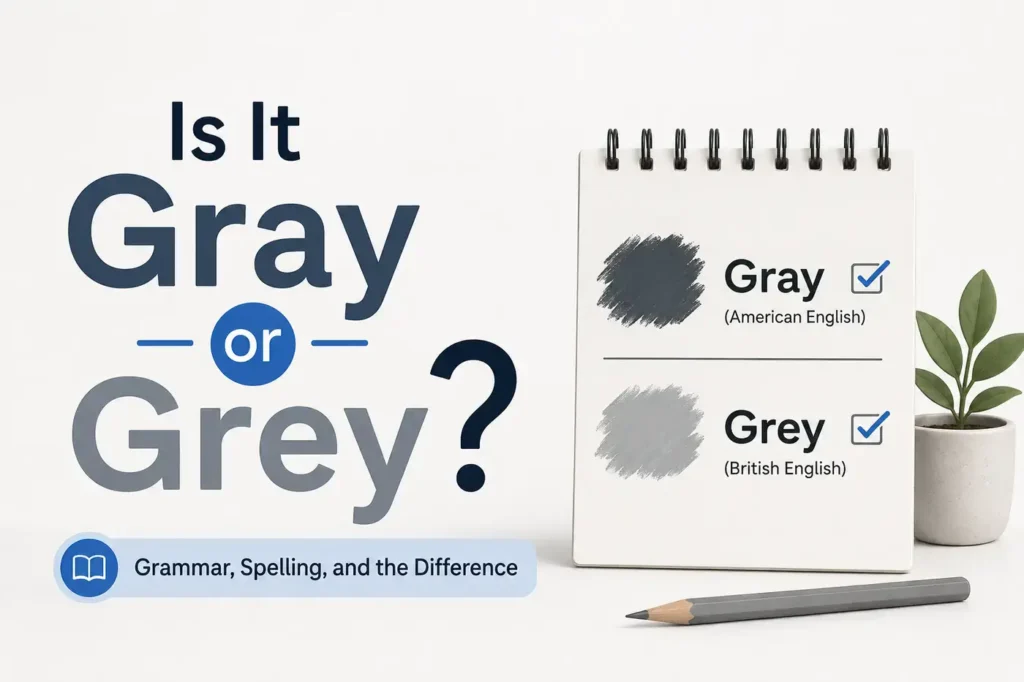
Both gray and grey are correct spellings of the same color. Gray is the preferred spelling in American English while grey is more common in British English Australian English and most other English speaking countries. The meaning pronunciation and grammar stay exactly the same. Only the regional spelling changes.
Is It Gray or Grey Quick Answer
The short answer is simple.
- Use gray if you’re writing for an American audience.
- Use grey if you’re writing for readers in the United Kingdom Australia or many other countries that follow British English.
- Neither spelling is more correct than the other.
- Pick one spelling and stay consistent throughout your writing.
Think of it like the difference between color and colour. Both are accepted English spellings. The choice depends on your audience.
Is It Gray or Grey Comparison Table
| Feature | Gray | Grey |
|---|---|---|
| Part of speech | Noun Adjective Verb | Noun Adjective Verb |
| Meaning | A neutral color between black and white | A neutral color between black and white |
| Preferred spelling | American English | British English |
| Origin | Same historical English root | Same historical English root |
| Formality | Standard | Standard |
| Common contexts | American schools media business books | British schools media government books |
| Usage frequency | Higher in the United States | Higher in the United Kingdom Australia and Canada in many contexts |
| Pronunciation | Same as grey | Same as gray |
| Correct form | Correct in American English | Correct in British English |
| Example | The sky turned gray before the storm. | The sky turned grey before the storm. |
Meaning of Gray
Gray is a color that sits between black and white on the color spectrum. It often represents balance neutrality maturity wisdom and simplicity. The word can describe physical objects emotions weather hair and even ideas.
You’ll commonly see gray in American newspapers school textbooks style guides product descriptions and everyday conversations.
Examples include.
- The clouds turned gray before it started raining.
- My grandfather has gray hair.
- She painted the living room gray.
- The company chose a light gray logo.
- The road looked gray after the snowfall.
Gray also appears in figurative expressions.
- A gray area describes something that isn’t completely clear.
- Gray skies often symbolize sadness or uncertainty.
- Gray matter refers to brain tissue responsible for processing information.
Meaning of Grey
Grey carries the exact same meaning as gray. The only difference is its spelling preference across regions.
Readers in the United Kingdom Australia New Zealand and many international publications expect to see grey instead of gray.
Examples include.
- He bought a grey jacket for winter.
- The old castle stood beneath grey clouds.
- Her cat has soft grey fur.
- The artist mixed black and white to create grey.
- They painted the kitchen walls light grey.
Just like gray the word also appears in familiar expressions.
- A grey area means something isn’t completely defined.
- Grey hair often represents age or experience.
- Grey weather usually describes cloudy conditions.
Gray or Grey Key Differences
Even though the words mean the same thing there are a few practical differences worth knowing.
Regional Preference
- Gray is the standard spelling in the United States.
- Grey is the preferred spelling across most countries that follow British English.
Meaning
There isn’t any difference in meaning. Both words describe the same color.
Pronunciation
People pronounce both words exactly the same.
IPA pronunciation.
/ɡreɪ/
Syllable breakdown.
Gray
One syllable.
Grey
One syllable.
Grammar
Both spellings function in the same way.
They can work as.
- An adjective.
- A noun.
- A verb in limited contexts.
Examples.
- The gray sweater looks warm.
- Gray is one of my favorite colors.
- His beard began to gray with age.
The same grammar applies to grey.
Style Guides
Many editorial style guides recommend matching the spelling to the audience instead of mixing both forms.
Professional editors almost never switch between gray and grey in the same article unless they’re explaining the difference.
Is It Gray or Grey Which One Is Correct
Both spellings are correct. The better question isn’t which spelling is correct. It’s which spelling matches your audience.
Choose gray when writing for.
- American readers.
- American businesses.
- Schools in the United States.
- American publishers.
Choose grey when writing for.
- British readers.
- Australian audiences.
- New Zealand publications.
- International organizations that follow British English.
If you’re writing for a worldwide audience and don’t have a specific style guide pick one spelling and use it consistently from beginning to end.
Editors value consistency because it helps readers stay focused on the content instead of noticing spelling changes.
Gray vs Grey Pronunciation Guide
One reason people get confused is that both spellings sound exactly alike.
IPA pronunciation.
/ɡreɪ/
Phonetic pronunciation.
Gray
Gray.
Grey
Gray.
Common pronunciation mistakes.
- Adding an extra syllable.
- Stretching the vowel sound.
- Confusing it with words ending in ee.
Native speakers pronounce both words exactly the same. The spelling changes but the spoken word doesn’t.
Expert Language Insight
Professional editors rarely think about gray and grey as competing spellings. They think about consistency.
If an article follows American English every spelling should match American conventions. That means gray belongs alongside color favorite and organize.
If the article follows British English grey naturally fits beside colour favourite and organise.
Readers usually notice inconsistent spelling faster than they notice the spelling itself. That’s why experienced writers choose one style and stick with it.
Professional copy editors also look at the publication’s style guide before making changes. News organizations universities publishers and businesses all maintain spelling standards to keep their content consistent and trustworthy.
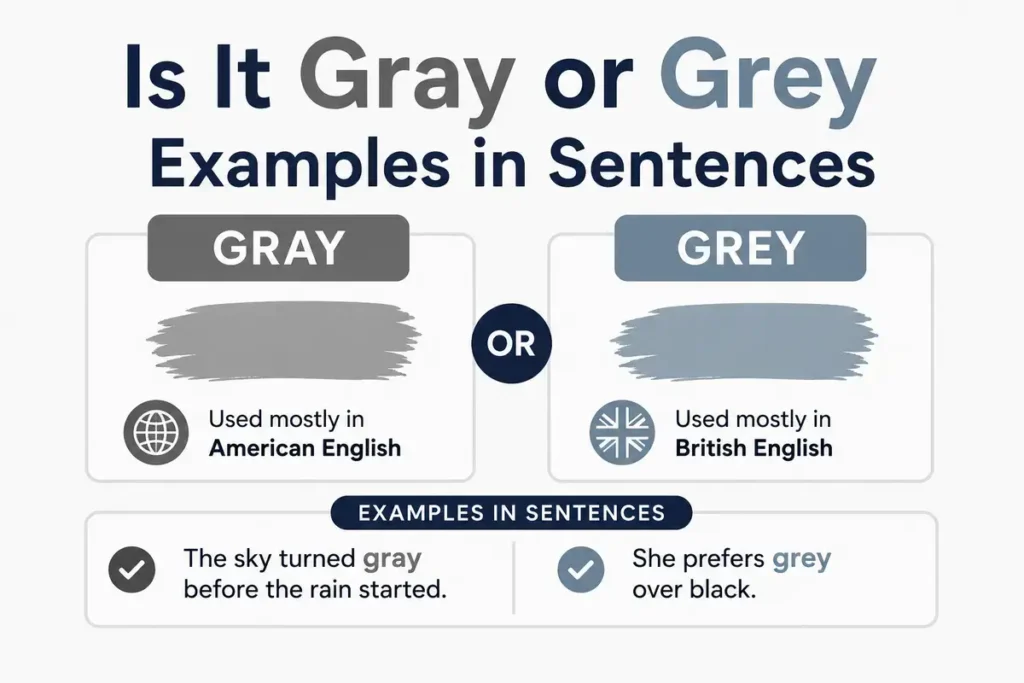
Is It Gray or Grey Examples in Sentences
Seeing words in context makes them much easier to remember. Since both spellings share the same meaning the only real difference is the audience you’re writing for.
Gray Examples
These examples follow American English.
- The sky turned gray just before the storm rolled in.
- My dog has a soft gray coat.
- She painted the bedroom a warm gray.
- His gray suit looked perfect for the interview.
- The mountains faded into the gray morning fog.
- My grandfather’s gray hair makes him look distinguished.
- We picked a light gray sofa for the living room.
- The old building had gray stone walls.
- The designer recommended a cool gray background for the website.
- After the fire the smoke left the sky a dull gray.
Grey Examples
These examples follow British English.
- The garden looked beautiful beneath the grey clouds.
- She wore a grey scarf on the chilly morning.
- The kitten has bright eyes and soft grey fur.
- He chose a dark grey jacket for the ceremony.
- The sea looked grey during the winter afternoon.
- The old castle stood against a grey sky.
- Her favourite jumper is light grey.
- The artist mixed white and black to create grey.
- The walls were painted a calming shade of grey.
- The hills disappeared into the grey mist.
Is It Gray or Grey Common Mistakes
The spelling itself isn’t difficult. Most mistakes happen because writers mix language styles or assume one version is wrong.
Mixing American and British English
A common mistake is writing gray in one paragraph and grey in the next.
Instead choose one spelling and use it throughout the entire article.
Thinking One Spelling Is Incorrect
Many people believe only one spelling is accepted.
That isn’t true.
Both spellings are correct. The choice depends on the audience and the writing style.
Copying Different Sources
Research often includes American and British websites.
If you copy examples from several sources without editing them your article can end up using both spellings.
Professional editors always standardize spelling before publishing.
Ignoring Your Style Guide
Businesses schools publishers and websites usually follow one English standard.
Changing spellings without checking the style guide creates inconsistency.
Assuming Search Results Decide Correctness
Search engines may show more results for one spelling based on your location.
That doesn’t mean the other spelling is wrong.
Search engines personalize results according to region language settings and search history.
Is It Gray or Grey Etymology and Word Origin
The story behind these spellings goes back hundreds of years. The word comes from Old English grǣg which described the color between black and white.
As English changed over time spelling became less predictable. Different regions developed different preferences and both spellings continued to exist.
By the nineteenth century American publishers began favoring gray while British publishers increasingly preferred grey.
The shift wasn’t about meaning. It reflected broader spelling conventions that separated American English from British English.
The same pattern appears in many familiar words.
- Color and colour.
- Honor and honour.
- Favorite and favourite.
- Center and centre.
- Theater and theatre.
Gray and grey simply followed that same path.
Is It Gray or Grey Regional Usage
Regional spelling is the biggest difference between these two forms.
American English
American English almost always uses gray.
You’ll see it in.
- Newspapers.
- Government publications.
- Schools.
- Books.
- Business writing.
- Marketing materials.
If your readers are in the United States gray is the natural choice.
British English
British English strongly prefers grey.
It’s the standard spelling across.
- Newspapers.
- Universities.
- Government documents.
- Publishing houses.
- Everyday communication.
British readers expect to see grey just as they expect colour instead of color.
Australian English
Australian English follows British spelling conventions.
That makes grey the standard spelling in schools media and professional writing.
Canadian English
Canadian English is interesting because it blends American and British influences.
In many Canadian publications grey appears more often.
Still some businesses especially those working closely with American companies choose gray to match their audience.
The most important rule for Canadian writers is consistency.
Is It Gray or Grey Grammar Rules
The spelling changes by region but the grammar stays exactly the same.
As An Adjective
This is the most common use.
Examples.
- She bought a gray sweater.
- He wore a grey jacket.
As A Noun
The word can also name the color itself.
Examples.
- Gray goes well with blue.
- Grey remains popular in modern design.
As A Verb
The verb form describes something becoming gray with age or time.
Examples.
- His beard started to gray.
- Her hair slowly began to grey.
The spelling of the verb also follows regional preference.
Plural Forms
The noun has a regular plural.
- Grays.
- Greys.
Examples.
- The painting used several grays.
- The designer preferred warm greys.
Common Sentence Structures
You’ll often see these patterns.
- Gray or grey plus noun.
- Turn gray or turn grey.
- Shades of gray or shades of grey.
- Light gray or light grey.
- Dark gray or dark grey.
These combinations sound natural because native speakers use them every day.
Real Life Usage Examples
The words appear across almost every type of writing.
Daily Conversation
- I think the gray car looks better.
- That grey sweater matches your shoes.
Academic Writing
American universities usually write gray.
British universities usually write grey.
The spelling matches the institution’s language standard.
Professional Communication
Businesses normally follow their company style guide.
A company serving American customers often chooses gray.
A company based in the United Kingdom generally prefers grey.
Literature
Authors keep the spelling that matches their audience or publisher.
American novels usually contain gray.
British novels usually contain grey.
Media And Journalism
News organizations rarely mix spellings.
Editorial teams keep language consistent across every article because consistency builds trust with readers.

Editor Tips For Choosing The Right Spelling
Experienced editors ask one simple question before changing the spelling. Who is the audience?
- If the answer is American readers use gray.
- If the answer is British readers use grey.
- If the audience is international follow the publication’s style guide and stay consistent.
This approach prevents confusion and creates polished writing that feels professional. Consistency matters far more than trying to use both spellings to satisfy everyone.
Is It Gray or Grey Related Words And Confused Terms
Gray and grey belong to a group of words that often confuse English learners because the spelling changes by region instead of meaning. Learning these related terms makes it easier to spot the pattern.
Similar Spelling Pairs
- Color and colour.
- Honor and honour.
- Favorite and favourite.
- Labor and labour.
- Center and centre.
- Theater and theatre.
- Traveler and traveller.
- Organize and organise.
- Analyze and analyse.
- Catalog and catalogue.
These pairs follow the same idea. One spelling is more common in American English while the other is preferred in British English.
Related Color Terms
You may also come across words connected to gray or grey.
- Silver.
- Charcoal.
- Ash.
- Slate.
- Smoke.
- Graphite.
- Steel.
- Pewter.
- Neutral.
- Monochrome.
These words describe shades or colors that sit close to gray on the color spectrum.
Common Expressions
Gray and grey appear in many everyday expressions.
- Gray area or grey area means something isn’t completely clear.
- Gray matter or grey matter refers to brain tissue and is also used to describe intelligence.
- Gray skies or grey skies often suggest cloudy weather or a gloomy mood.
- Gray hair or grey hair describes hair that has lost its natural pigment.
- Shades of gray or shades of grey can describe colors or situations that aren’t simply black and white.
These expressions work the same way in American and British English. Only the spelling changes.
Is It Gray or Grey Expert Language Insight
Professional editors rarely stop to debate gray versus grey because editorial style guides already answer the question. The first step is identifying the audience.
An American magazine naturally uses gray because that’s what readers expect. A British newspaper writes grey for the same reason. Neither publication thinks the other spelling is wrong. They’re simply following established language conventions.
Native speakers don’t usually notice one spelling until it appears in the wrong variety of English. An American reader may find grey slightly unusual. A British reader may think the same about gray. Still both groups immediately understand the meaning.
From an editing perspective consistency matters more than the spelling itself. Switching back and forth distracts readers and makes the writing feel less polished.
If you’re writing online think about your primary audience before you publish.
- Targeting readers in the United States. Use gray throughout the article.
- Targeting readers in the United Kingdom Australia or New Zealand. Use grey consistently.
- Writing for an international audience. Follow your website’s style guide and stick with one spelling.
That simple habit makes your writing look more professional and trustworthy.
Is It Gray or Grey Frequently Asked Questions
Is gray or grey correct?
Both spellings are correct. Gray is the standard spelling in American English while grey is preferred in British English and many other countries that follow British spelling conventions. The meaning pronunciation and grammar stay exactly the same.
Is gray used only in the United States?
Gray is strongly associated with American English and appears in schools media books and business writing across the United States. People in other countries still understand it because the meaning doesn’t change.
Why do British people spell it grey?
British English kept grey as its preferred spelling through historical language development. Over time American English adopted gray as the standard form. The difference reflects regional spelling traditions instead of different meanings.
Is there any difference in pronunciation?
No. Gray and grey share the same pronunciation. The IPA pronunciation is /ɡreɪ/. Native speakers pronounce both words exactly the same.
Can I use both spellings in one article?
It’s best not to. Choose the spelling that matches your audience and use it consistently from beginning to end. Consistency improves readability and gives your writing a more professional appearance.
Which spelling should students use?
Students should follow the spelling rules required by their school teacher or institution. American schools almost always expect gray while schools following British English generally expect grey.
Which spelling is better for SEO?
Neither spelling is better on its own. The best choice depends on the audience you’re targeting. An American website will usually perform better using gray consistently. A British focused website should use grey. Matching the language preference of your readers creates a better user experience.
Do dictionaries accept both spellings?
Yes. Major English dictionaries recognize both gray and grey as correct spellings. They simply note the regional preference for each version.
Conclusion
The answer to is it gray or grey is refreshingly simple. Both spellings are correct. Gray is the preferred spelling in American English.
Grey is the preferred spelling in British English Australian English and many other countries that follow British spelling conventions.
The pronunciation never changes. The meaning never changes. The grammar never changes. The only thing that changes is the audience.
If you’re writing for readers in the United States choose gray. If your audience follows British English choose grey. Once you’ve made that choice keep the spelling consistent throughout your writing.
That small detail makes your content look polished builds trust with readers and matches the expectations of your audience.