The spelling until or untill can trip up even strong English writers because the two forms look so similar. If you have ever paused while writing a sentence such as I will wait until Friday or Stay here until I return then you may have wondered if the word needs one l or two.
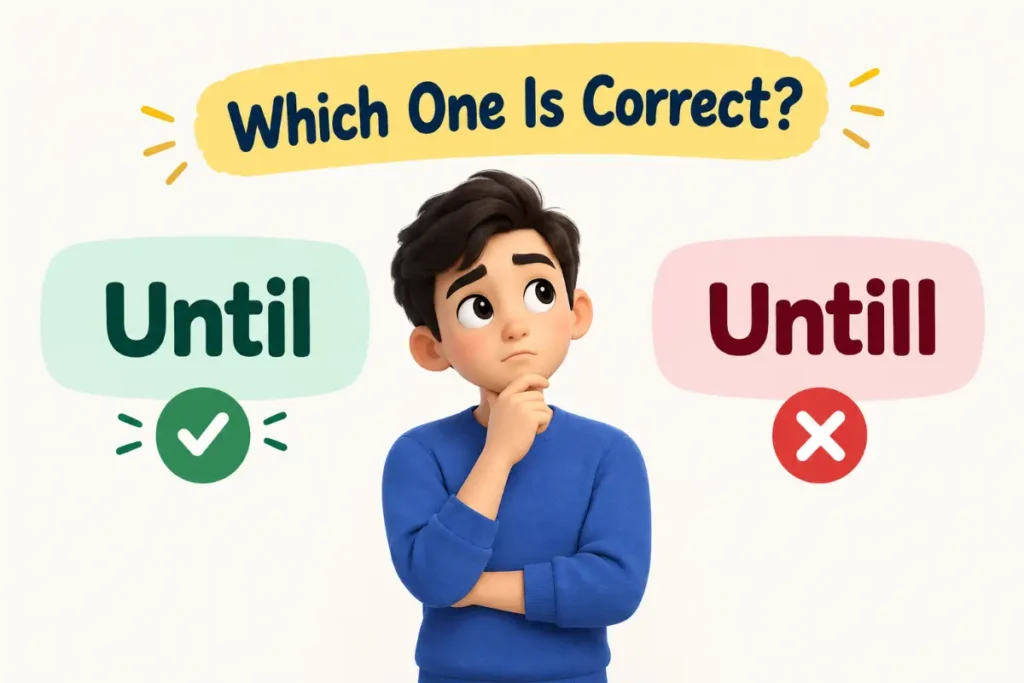
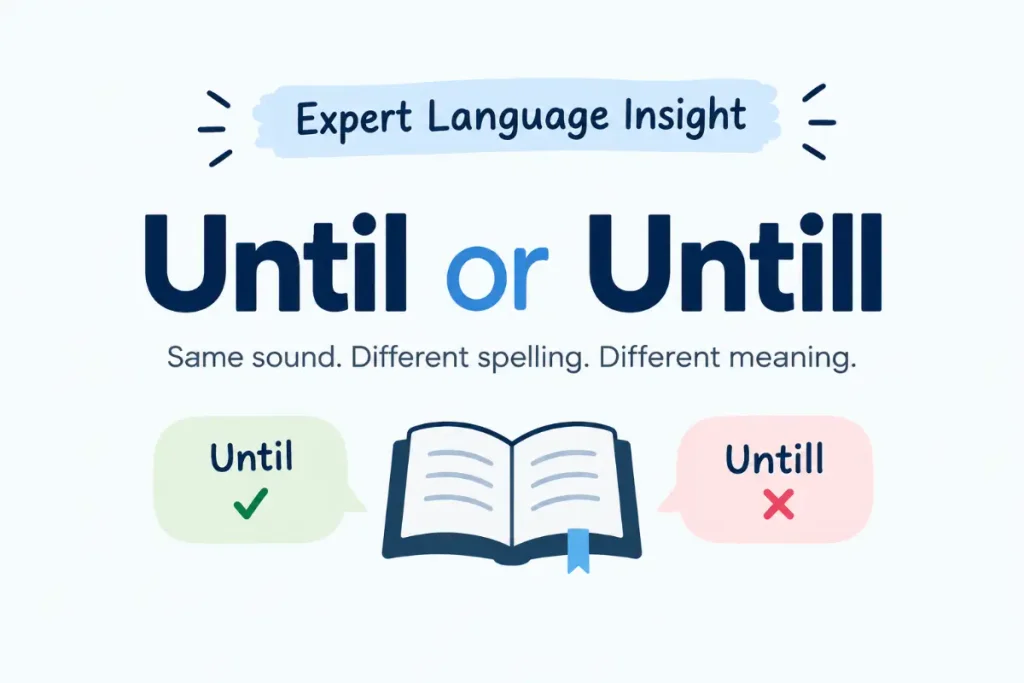
The answer is clear. Until is the correct standard spelling. Untill is a misspelling and should not be used in standard English. The confusion usually comes from pronunciation and from the fact that many English words double their final consonant in certain forms. That pattern does not apply here.
The word itself is extremely common. It works naturally in conversations, emails, academic writing, news reports, stories, and everyday instructions. It can introduce a time when used as a conjunction, and it can also function as a preposition before a noun or time expression.
This guide explains the spelling difference, meaning, grammar, pronunciation, history, regional usage, and common mistakes. You will also see natural examples that show how native English speakers actually use the word.
Quick Definition
Until is the correct spelling. It means up to a particular time or point. It can work as a preposition or conjunction depending on how it is used. Untill is not the standard spelling and should be corrected to until in formal and everyday English.
Quick Answer
If you only need the answer, remember this:
- Until is correct.
- Untill is incorrect in standard English.
- The word means up to a particular time or point.
- It can function as a preposition or conjunction.
- Its pronunciation is the same regardless of the mistaken spelling.
- Use until in American English, British English, Australian English, and Canadian English.
The easiest memory trick is simple: until has only one l at the end.
Comparison Table
| Feature | Until | Untill |
|---|---|---|
| Standard spelling | Correct | Incorrect |
| Part of speech | Preposition and conjunction | Not a standard English word |
| Meaning | Up to a specified time or point | Intended to mean until |
| Origin | Old English and Middle English development | Misspelling |
| Formality | Standard in all forms of writing | Nonstandard |
| Common contexts | Time expressions, conditions, instructions, conversation | Typing mistakes and informal online posts |
| Usage frequency | Very common | Uncommon |
| Pronunciation | /ənˈtɪl/ or /ʌnˈtɪl/ depending on speech | Usually pronounced like until |
| Example | I will stay until noon. | Incorrect: I will stay untill noon. |
The table reveals an important point. There is no real difference in meaning between the two forms because untill is not an established alternative spelling. When someone writes it, they almost always intend the standard word until.
Meaning Of Both Terms
Until Meaning
Until expresses a limit in time or sometimes a limit in a process or situation. It tells the reader that something continues up to a particular point.
Consider this sentence:
We waited until midnight.
The waiting continued and reached the point of midnight. The word identifies the endpoint of that period.
You can use it with specific times, days, dates, events, actions, and clauses.
Examples include:
- I worked until five.
- She stayed until the meeting ended.
- We will wait until tomorrow.
- Do not open the package until Monday.
- He lived there until 2020.
The basic idea remains the same: something continues up to a stated limit.
Untill Meaning
Untill does not have a separate standard meaning. In normal English writing, it is simply a spelling error.
If someone writes:
I waited untill noon.
The intended sentence is:
I waited until noon.
This distinction matters because learners sometimes assume that one version belongs to American English and the other belongs to British English. That is not the case. The spelling difference between until and untill is not a regional English variation.
English has many easily confused word pairs, from questions about similar word choice confusion to spelling differences like until and untill.
Key Differences
The most important difference is that one form is standard and the other is not.
Spelling Difference
- Until contains one l at the end.
- Untill contains two l letters and is considered a misspelling.
This is the main distinction you need to remember.
Meaning Difference
There is no standard meaning difference because untill is not recognized as a separate standard word.
When readers encounter it, they normally understand what the writer intended. Still, understanding the meaning does not make the spelling correct.
Grammar Difference
- Until has an established grammatical role. It can function as a preposition or conjunction.
- Untill has no standard grammatical role because it is simply an incorrect spelling.
Regional Difference
There is no legitimate US versus UK spelling distinction here.
- American writers use until.
- British writers use until.
- Australian writers use until.
- Canadian writers use until.
The same spelling applies across these major varieties of English.
Tone Difference
There is no meaningful tone difference between the two forms. However, using until makes your writing look polished and accurate. Using untill can make the text appear careless or poorly edited.
That matters in school assignments, job applications, professional emails, published articles, and other situations where spelling affects the reader’s impression.
Which One Is Correct
Until is the correct form. Use it whenever you mean up to a particular time or point.
For example:
- I will be here until six o’clock.
- Please wait until the doctor calls your name.
- The store is open until midnight.
The spelling untill should be corrected whenever it appears in ordinary writing.
There is one useful distinction to keep in mind. A misspelling can appear inside a quotation, a username, an informal title, or a historical document. In those cases, an editor may preserve the original wording for accuracy. Outside those special situations, there is no reason to choose the double l spelling.
Pronunciation Guide
The pronunciation is another reason this spelling question causes confusion. The correct form and the misspelled form are normally pronounced the same way.
IPA Pronunciation
The most common pronunciation is:
/ənˈtɪl/
You may also hear:
/ʌnˈtɪl/
The exact vowel at the beginning can vary with accent and speaking style.
Syllable Breakdown
The word has two syllables:
un til
The stress normally falls on the second syllable.
un TIL
Common Pronunciation Mistakes
English learners sometimes give the first syllable too much emphasis. In natural speech, the first vowel is often reduced, especially when the word appears in the middle of a sentence.
For example:
I will wait until you arrive.
A natural speaker may pronounce the beginning almost like a quick unstressed uhn before stressing the second syllable.
The important point is that the pronunciation does not tell you how many l letters to write. English spelling does not always provide a perfect guide to pronunciation.
How To Remember The Correct Spelling
A simple memory rule can save you from this mistake permanently.
Think of the word as:
UN + TIL
There is only one l at the end.
You can also connect it with common phrases that you already know:
- Until tomorrow.
- Until Monday.
- Until then.
- Until later.
- Until now.
- Until next time.
Seeing these phrases repeatedly helps the correct spelling become automatic.
Another useful trick is to remember that adding a second l does not create a new word. If you see untill in your draft, stop and check it. In standard English, you almost certainly want until.
This is especially useful when typing quickly. The double l often appears because writers unconsciously apply spelling patterns from other words. English contains many words where consonants double, so the mistake feels natural even though the rule does not apply here.
Why The Double L Mistake Happens
The spelling error has a few common causes. First, English contains many words with doubled consonants. Writers may transfer that pattern to until without realizing it.
Second, pronunciation does not help. The word sounds the same regardless of how someone spells it.
Third, fast typing encourages mistakes. A writer may know the correct spelling perfectly well but accidentally add an extra letter.
Fourth, repeated exposure to incorrect online writing can reinforce the error. Social media, comments, forums, and informal messages often contain spelling mistakes. Seeing untill repeatedly can make it look more legitimate than it really is.
This is a useful lesson about English in general. Frequency on the internet does not automatically make a spelling standard.
Is Until A Preposition Or Conjunction
It can be both. Its grammatical role depends on what comes after it.
Until As A Preposition
When until is followed by a noun or noun phrase that identifies a time or point, it functions as a preposition.
Examples:
- We stayed until midnight.
- She worked until Friday.
- The office will remain open until noon.
- I had never seen him until that day.
- They waited until the end of the show.
- In until midnight, the word introduces the noun midnight.
- In until Friday, it introduces the noun Friday.
Until As A Conjunction
When until introduces a clause containing its own subject and verb, it can function as a subordinating conjunction.
Examples:
- Wait until I call you.
- We stayed until the rain stopped.
- Do not leave until the teacher arrives.
- She worked until her manager asked her to stop.
- I did not understand the problem until he explained it.
Look at the sentence:
Wait until I call you.
The words I call you form a clause because they contain a subject and a verb. In this structure, until connects the main clause with the dependent clause.
This distinction is useful for grammar students because it explains why the word can appear in different sentence patterns while keeping essentially the same meaning.
Until In Time Expressions
The word appears in many common expressions that native speakers use every day.
Until Now
Until now means up to the present moment.
Example:
Until now, I had never considered that option.
It often introduces a change in understanding, experience, or circumstances.
Until Then
Until then refers to a future point that has already been mentioned.
Example:
The new office opens next month. Until then, we will work from home.
Until Later
Until later is an informal way to refer to the next time you expect to see or speak with someone.
Example:
I have to go now. Until later.
Until Tomorrow
This phrase means that something continues up to tomorrow or that an action should wait until tomorrow.
Example:
The report can wait until tomorrow.
These expressions are so common that most native speakers use them without consciously thinking about the grammar behind them.
Until Or Till
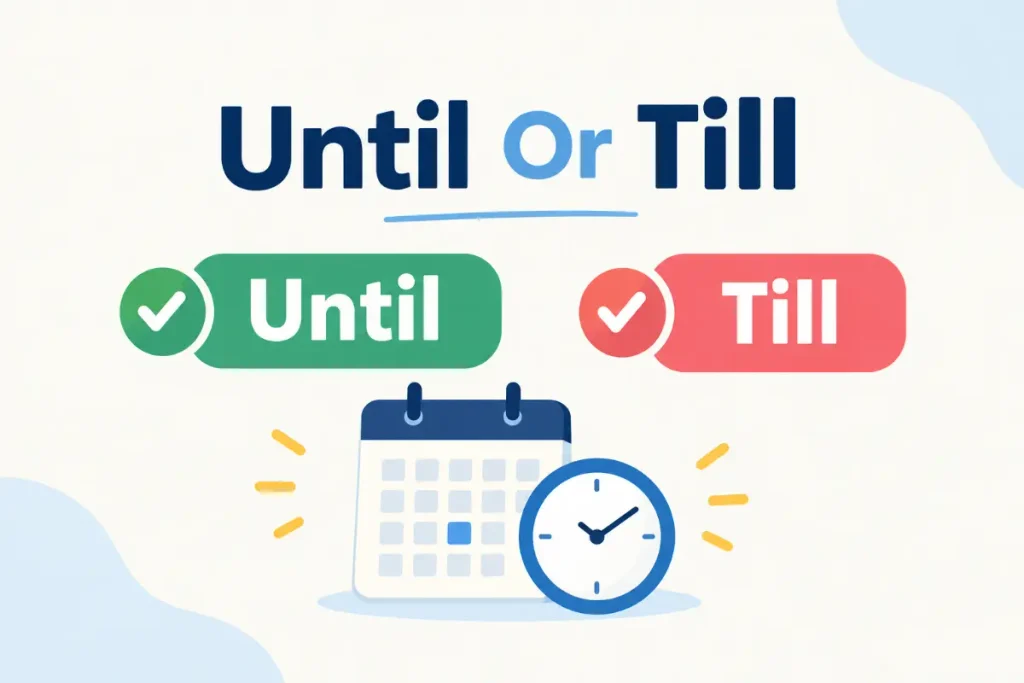
Another spelling and usage question often appears alongside this one: until or till. Both are legitimate English words.
Till can function as a preposition, conjunction, or noun in other contexts. As a time word, it has essentially the same meaning as until.
For example:
- I will wait until noon.
- I will wait till noon.
Both sentences are grammatically acceptable. However, until is generally the safer choice for formal writing because it is less likely to feel conversational or informal.
Do not confuse till with ’til. The shortened form ’til is common in informal writing and lyrics, but it is not the same thing as the standard spelling question involving untill.
Until is always the correct standard spelling for the word discussed in this article.
Examples In Sentences
The easiest way to understand until is to see how it behaves in ordinary sentences. The word can describe an endpoint in time, connect two actions, or show that a situation continues up to a particular moment. The examples below also show the difference between using it before a noun or time expression and using it before a complete clause.
Until Meaning Example
- I will stay here until noon.
- The store remains open until midnight.
- We waited until the rain stopped.
- She did not call me until Friday.
- Please keep the door closed until the meeting ends.
- He worked until three o’clock.
- They lived in Chicago until 2018.
- Do not start the engine until I give you the signal.
- I had never visited the museum until last summer.
- The children played outside until it became dark.
Notice how naturally the word connects an action with its endpoint. In some sentences the endpoint is a noun such as noon, Friday, or 2018. In others it introduces a clause such as the rain stopped or I give you the signal.
Common Mistakes
The most obvious mistake is adding an unnecessary second l. The standard form has one l at the end. This error is especially common when people type quickly or rely on the spelling patterns of other English words.
Another mistake involves assuming that the word changes spelling depending on the country. It does not. American English and British English both use the same standard form. The same is true in Australian and Canadian English.
There are also a few grammar mistakes worth watching for.
- Do not write untill when you mean the standard word.
- Do not assume the spelling changes in British English.
- Do not add a second l because the word sounds as if it might need one.
- Do not confuse until with till when a formal style is required.
- Do not automatically use the past tense after a time clause referring to the future.
That final point deserves attention. English commonly uses the present tense after until when the main clause refers to the future.
For example:
I will wait until she arrives.
Not:
I will wait until she will arrive.
The future meaning is already carried by will wait. The clause after until normally uses the present tense.
Until Grammar In Detail
Understanding the grammar behind this small word is useful because it appears in several different structures.
Present And Future Time
When talking about the future, English usually uses the present simple after until.
For example:
I will stay here until you come back.
The phrase you come back refers to a future event, but English does not normally use will in that dependent time clause.
More examples include:
- We will wait until the manager arrives.
- I will not leave until you finish.
- She will stay at the office until the work is complete.
- They will keep practicing until they feel confident.
This pattern is common in both spoken and written English.
Past Time
The past tense can appear naturally when the entire situation belongs to the past.
For example:
We waited until the bus arrived.
Both actions happened in the past. The first action continued up to the point when the second event occurred.
Another example is:
She stayed until the concert ended.
The word ended is past tense because the concert had already finished.
Present Situations
The word can also describe something that continues up to the present.
For example:
I have lived here until now.
However, native speakers often choose a different structure depending on the intended meaning. For an action that began in the past and continues into the present, since or up to now may be more natural.
For example:
I have lived here since 2019.
This is an important editorial point. A sentence can be grammatically possible yet still sound less natural than another construction. Good writing is not only about avoiding errors. It is also about choosing the expression that best fits the intended meaning.
Until Or Till
Until and till can often express the same time relationship.
Compare:
- I will stay until Friday.
- I will stay till Friday.
Both are understandable and grammatically acceptable.
The difference is mainly one of style and frequency. Until works comfortably in formal and informal writing. Till is common in conversation and informal writing, although it is not incorrect simply because it is shorter.
A related form is ’til, which appears frequently in informal writing. It is a shortened form used in expressions such as ’til tomorrow. For professional or academic writing, until is usually the cleaner choice.
One common misconception is that till must be an abbreviation of until. Historically, the relationship is more complicated. Till is actually an old English word that predates the shortened written form ’til.
Until And By
Learners sometimes confuse until with by because both can refer to time.
They do not express the same idea.
Until describes something that continues up to a particular point.
By usually identifies the latest time something should happen.
Compare these sentences:
I will work until five.
This means the work continues up to five.
I will finish the report by five.
This means the report should be finished no later than five.
That distinction becomes especially important in professional communication.
If your manager says:
Please send the report by Friday.
The message usually means Friday is the deadline.
If someone says:
I will be working until Friday.
The meaning is that the activity continues through that point.
Understanding regional spelling differences can also help you recognize why some English words have more than one accepted form, depending on whether you use American or British English.
Until And Before
Until and before can also look similar because both relate events to time.
Consider:
Wait until I return.
This tells you to continue waiting up to the point of my return.
Now compare:
Leave before I return.
This tells you to leave at some point earlier than my return.
The relationship is almost opposite.
A useful way to think about it is this:
- Until focuses on continuation up to an endpoint.
- Before focuses on something happening earlier than a particular event.
This distinction is useful in instructions because a small change in wording can completely alter the intended action.
Until And While
Another useful comparison is until versus while.
While normally focuses on two things happening during the same period.
Until focuses on the endpoint of an activity.
For example:
I read while I waited for the train.
Both activities overlap.
I read until the train arrived.
The reading continued up to the arrival of the train.
These words can appear in similar situations, but they organize time differently.
Until In Negative Sentences
Negative sentences with this word can sometimes confuse learners because the meaning depends heavily on the surrounding verb.
Consider:
I did not know about the problem until Monday.
This means the speaker was unaware of the problem before Monday and became aware of it on or around Monday.
Another example:
She did not leave until noon.
This means she stayed until noon and left at that point or shortly afterward.
The pattern not … until is extremely common in English.
Examples include:
- I did not understand the answer until the teacher explained it.
- He did not arrive until late at night.
- We did not hear the news until the next morning.
- She did not realize the mistake until she checked the document.
For language learners, these structures are worth practicing because translating them directly from another language can sometimes produce unnatural English.
Etymology And Word Origin
The history of until reaches back to Old English. The modern form developed through earlier expressions involving the idea of reaching a particular point in time.
The word is related historically to till, an older English form that has been used for centuries to express a time limit. Over the course of English development, the longer form became established alongside it.
The important point is that the modern spelling is not the result of a recent grammar rule. It developed gradually through the history of the English language.
This also helps explain why adding another l is unnecessary. The standard spelling was established long before modern typing habits created the kind of spelling uncertainty people experience today.
English contains many words whose modern forms cannot be predicted simply by pronunciation. Historical development, borrowing, sound changes, and spelling conventions all influence the written language. Until is one of many everyday examples of this larger pattern.
Regional Usage
The standard spelling remains the same across the major English varieties.
American English
American writers use until in formal and casual communication. The word appears frequently in everyday phrases such as until tomorrow, until Monday, and until then.
British English
British English also uses until as the standard spelling. Till is common as well, especially in informal contexts.
Australian English
Australian English follows the same spelling convention. Writers use until in professional, academic, and everyday contexts.
Canadian English
Canadian English also uses until. The word does not have a separate Canadian spelling.
The search phrase until or untill UK can therefore be answered clearly: British English does not use untill as a standard alternative. The correct form remains until.
Real Life Usage
This word is so common that you may not notice how often it appears in ordinary communication.
Daily Conversation
You might hear:
I will call you until I get home.
However, a native speaker would usually choose when or another structure depending on the intended meaning. This illustrates why understanding grammar matters as much as knowing the spelling.
More natural examples include:
- Wait here until I come back.
- I cannot stay until tomorrow.
- We are open until six.
- I will see you until next week.
The last example would normally be expressed differently if the intended meaning is that you will not see someone before next week. Natural usage depends on the relationship between the actions.
Academic Writing
Academic writers use the word to establish time limits and sequences.
For example:
The samples were stored at a controlled temperature until the experiment began.
This tells the reader exactly how long the storage condition continued.
Professional Communication
The word frequently appears in instructions and deadlines.
Examples include:
- Please keep the equipment switched off until further notice.
- The office will remain closed until Monday.
- Employees must wait until the system administrator approves access.
- The temporary policy remains in effect until the review is complete.
Literature
Writers use the word to create a clear sense of time and anticipation.
A character might wait until dawn, remain silent until someone speaks, or continue walking until reaching a destination. The word is especially useful for showing that one action continues until another event changes the situation.
Media
News articles frequently use the term when describing schedules, closures, weather conditions, investigations, and upcoming events.
For example:
The road will remain closed until crews complete the repairs.
The construction activity provides the endpoint for the closure.
Until Or Till In Formal Writing
For most formal writing, until is the better default. It is completely standard and works naturally in reports, essays, business documents, academic papers, and professional correspondence.
Till is also legitimate, but some writers associate it more strongly with conversational English. That does not make it wrong. It simply means that until often feels more neutral across different writing situations.
An editor choosing between the two would usually consider the tone of the document rather than treating till as a grammatical error.
The important mistake to avoid is untill. That spelling is not an alternative formal version of the word.
Search Intent Around Until Or Untill Reddit
People often encounter spelling questions on Reddit and other online communities because users write quickly and informal posts are rarely edited. A search for this spelling pair may therefore produce discussions where people debate the extra l.
Online comments can be useful for seeing how people actually write, but they are not the best authority for standard spelling. A Reddit post can demonstrate common usage without establishing a formal language rule.
For spelling and grammar questions, a better approach is to distinguish between what people type and what standard English accepts.
That distinction matters far beyond this single word. Internet frequency can reveal a common mistake without turning that mistake into a standard form.
A Practical Editing Test
When proofreading your own writing, use this quick test.
- Find every instance of untill.
- Change it to until unless it belongs to an official name or historical quotation.
- Check sentences containing future time clauses.
- Make sure you are using by, before, when, or while when those words express your intended meaning more precisely.
- Read the complete sentence aloud to make sure the time relationship is clear.
This takes only a few seconds and catches most problems.
The bigger lesson is useful for any language learner: correct spelling is only the first step. Strong writing also depends on choosing the right word for the exact relationship you want to express.
Related Words And Confused Terms
English learners often confuse until with other time words because several expressions can describe similar situations. The key is to understand the specific relationship each word creates.
Until And Since
Until points toward an endpoint. Since points back to a starting point.
Compare these sentences.
I stayed there until Friday.
The stay continued up to Friday.
I have lived here since Friday.
The living situation began on Friday and continues from that point.
This simple contrast can help you remember the basic direction of each word. Until looks forward to the end of a period, while since connects the present situation to its beginning.
Until And During
During describes something happening within a period. It does not necessarily tell you when that period ends.
For example:
I fell asleep during the movie.
The action happened at some point while the movie was playing.
Compare that with:
I stayed awake until the movie ended.
The second sentence gives a clear endpoint.
Until And Through
Through can sometimes express a similar idea, especially when describing a period that includes its endpoint.
For example:
- The museum is open until Sunday.
- The museum is open through Sunday.
The second sentence can strongly suggest that Sunday itself is included. The exact interpretation depends on context and local usage.
For precise professional communication, it can be useful to state the date and time directly instead of relying on a potentially unclear time expression.
Until And Up To
Up to can sometimes replace until when describing a limit.
For example:
- The offer is available until Friday.
- The offer is available up to Friday.
The first version is usually more natural when discussing time. Up to has broader uses and can also describe amounts, levels, or limits.
Expert Language Insight
From a language perspective, until is interesting because its grammatical role depends on what comes after it. When it introduces a noun phrase, it functions as a preposition.
For example:
We waited until sunset.
Here sunset is a noun.
When it introduces a clause containing a subject and verb, it functions as a subordinating conjunction.
For example:
We waited until the sun set.
Here the sun set is a complete clause.
The meaning remains closely connected in both structures, but the grammatical analysis changes.
This distinction is useful for students who are learning parts of speech because the same word can perform different grammatical jobs depending on the structure around it.
Another important point is that spelling and grammar are separate issues. Someone can spell the word correctly and still use it in an awkward sentence. Strong English requires both accurate spelling and appropriate sentence structure.
How Native Speakers Use Until Naturally
Native speakers often use this word without thinking about its grammatical category. It appears in everyday instructions, plans, conversations, schedules, stories, and descriptions.
Common expressions include:
- until then
- until now
- until tomorrow
- until next time
- until further notice
- until the end
- not until
These expressions are useful because they occur frequently in natural English.
For example:
I will see you next week. Until then, take care.
The phrase until then refers to the period leading up to a previously mentioned time.
Another example is:
The rule will remain in place until further notice.
This means the rule continues with no specific ending date currently given.
The same principle applies to commonly confused technical terms, where one incorrect letter can completely change whether a word is recognized as standard English.
Common Phrases To Remember
Learning natural phrases can make correct usage easier because you begin to recognize the word as part of familiar patterns.
- Until then means up to that previously mentioned time.
- Until now refers to the period leading up to the present.
- Until tomorrow means up to tomorrow.
- Until next time is commonly used when saying goodbye.
- Until further notice means something continues without a stated end date.
- Not until emphasizes that something happened later than expected.
- Wait until tells someone to continue waiting before taking an action.
- Stay until indicates remaining somewhere up to a particular time or event.
These phrases appear so often in everyday English that learning them as complete patterns can be more useful than memorizing isolated grammar rules.
Frequently Asked Questions
Is Until The Correct Spelling
Yes. Until is the standard spelling in modern English. Untill is considered a misspelling in standard English. The correct form contains one l at the end.
Why Do People Spell Until With Two Ls
The extra l is usually a spelling mistake caused by pronunciation, typing habits, or confusion with words that contain double consonants. English spelling does not always allow you to predict the correct form from sound alone, so familiar visual patterns can sometimes lead writers to add an unnecessary letter.
Is Untill A Word
Untill is not the standard spelling of the common English time word. If you are writing an essay, email, article, report, message, or professional document, use until.
Is Until A Preposition Or Conjunction
It can be either. When until is followed by a noun or noun phrase, it functions as a preposition, as in until Friday. When it introduces a clause containing a subject and verb, it functions as a subordinating conjunction, as in until the meeting ends.
What Is The Difference Between Until And Till
Both can describe a time endpoint and are often interchangeable. Until is generally the safer choice for formal and neutral writing, while till is very common in conversation and informal writing. Neither should be confused with the incorrect spelling untill.
Do You Use Will After Until
Usually not when until introduces a future time clause. English normally uses the present tense in that dependent clause.
For example:
I will wait until she arrives.
Not:
I will wait until she will arrive.
The main clause already establishes the future meaning.
Is Until Used In British English
Yes. British English uses until as the standard spelling. The same spelling is used in American English and other major varieties of English. Till is also used in British English, particularly in informal contexts.
Is Until Formal English
Yes. Until is completely standard and appropriate for formal English. It can be used in academic writing, professional documents, business communication, journalism, and everyday conversation.
A Simple Rule For Correct Usage
If you are unsure how to spell the word, remember one straightforward rule:
Use until with one l.
You do not need to add another l.
Then check the grammar around it. Ask yourself what time relationship you want to express. If an action continues up to a particular point, until may be the right choice. If you are describing a deadline, by may be more accurate. If something must happen earlier than another event, before may be the better option.
This approach is more reliable than memorizing spelling alone because it helps you understand the function of the word.
Why Correct Spelling Matters
A single extra letter might seem insignificant, especially in casual online communication. However, repeated spelling mistakes can affect how readers perceive written communication.
In professional writing, correct spelling shows attention to detail. In academic writing, it helps maintain credibility. In website content, it improves readability and gives readers confidence in the information they are consuming.
That does not mean every spelling mistake reflects poor language ability. Everyone makes typing errors. The important thing is to recognize recurring mistakes and correct them.
The extra l in untill is easy to remove once you have seen the correct pattern several times.
Final Answer
The correct spelling is until. Untill is a common spelling mistake, not an accepted alternative spelling of the standard English word. The correct form has one l at the end.
The word describes a point in time up to which an action or situation continues. It can function as a preposition before a noun phrase and as a subordinating conjunction before a clause.
For example:
- I will wait until Friday.
- I will wait until you arrive.
The first example uses until before a noun phrase. The second uses it before a clause.
If you are writing for a professional, academic, or general audience, until is the clear choice. Remember the simple spelling rule, use one l, and then focus on the time relationship your sentence needs to express.