Good vs well is a common grammar question because the two words are closely related but usually perform different jobs in a sentence. The basic rule is simple: good is usually an adjective that describes a person, thing, or condition, while well is usually an adverb that describes how an action happens. However, that rule does not explain every sentence. Well can also work as an adjective, especially when talking about health, and good can appear after linking verbs such as feel, look, sound, smell, and taste.
That is why sentences such as She sings well, She is a good singer, I feel good, and I feel well can all be correct, but they do not mean exactly the same thing. The right choice depends on what you are describing and how the sentence is structured.
This guide explains the difference in clear American English. You will learn when to use good and well, how to handle common expressions such as I am doing well and I am doing good, why I feel good is different from I feel well, and how to avoid the mistakes that often appear in everyday speech and writing.
Quick Answer
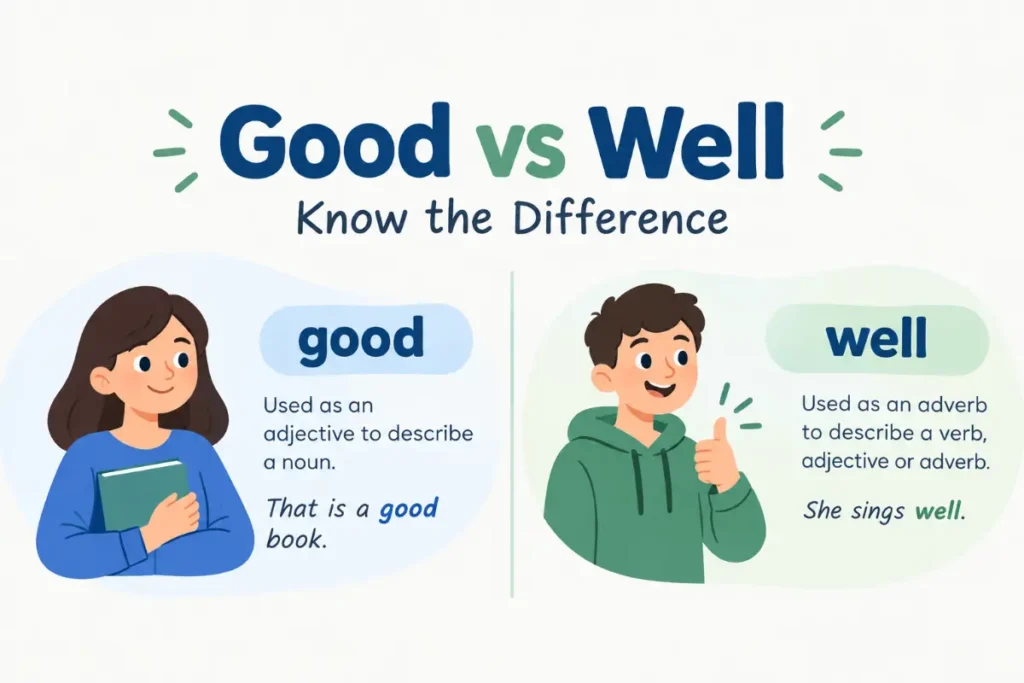
Good is usually an adjective that describes a noun or follows a linking verb. Well is usually an adverb that describes how an action happens. Say She is a good writer but She writes well. Well can also describe health, as in I am well. In everyday speech, good is also common after linking verbs.
What Is The Difference Between Good And Well
The main difference is grammatical function. Good is normally an adjective, so it describes a noun or pronoun. Well is normally an adverb, so it modifies a verb and explains how an action is performed.
Compare these sentences:
- He is a good driver.
- He drives well.
- She is a good speaker.
- She speaks well.
- They are good students.
- They study well.
In the first sentence of each pair, good describes a person or thing. In the second sentence, well describes an action. This gives you a reliable starting point for choosing between the two words.
However, English has an important exception. Well can function as an adjective when it refers to someone’s health. You can say I am well to mean that you are healthy or not sick. You can also say I feel well, particularly when you are talking specifically about your physical health.
There is another important point. Linking verbs do not normally take an adverb in the same way action verbs do. After verbs such as feel, look, sound, smell, and taste, good can describe the subject.
- The soup tastes good.
- You look good today.
- That sounds good.
- I feel good.
- The flowers smell good.
Here, good is describing the subject rather than explaining how someone performs an action.
If you’re dealing with common abbreviation mix-ups, knowing when to use i.e. vs. e.g. can help make your writing clearer and more precise.
What Does Good Mean
Good is one of the most common adjectives in English. It describes people, objects, experiences, results, choices, behavior, qualities, and conditions. Its exact meaning depends on context, but it generally expresses a positive quality, satisfactory result, or desirable condition.
You can use good before a noun:
- a good book
- a good teacher
- a good idea
- a good meal
- a good opportunity
- a good decision
You can also use good after a linking verb:
- The book is good.
- The teacher is good.
- The meal was good.
- The idea sounds good.
- The plan looks good.
In these examples, good describes the subject. It does not tell us how an action is performed.
Good Before A Noun
The most straightforward use of good is before a noun. It describes the quality or characteristics of the person or thing that follows.
Consider these examples:
- She is a good manager.
- He bought a good computer.
- That was a good question.
- We had a good conversation.
- They made a good choice.
- This is a good restaurant.
The word good gives information about the noun. This is a standard adjective function.
A useful test is to ask, What person or thing am I describing? If the answer is the noun after or around the word, good is often the correct choice.

Good After Linking Verbs
Good can also follow linking verbs because these verbs connect the subject with a description.
Common linking verbs include:
- be
- feel
- look
- sound
- smell
- taste
- seem
- appear
For example:
- The movie looks good.
- The plan sounds good.
- The food tastes good.
- The flowers smell good.
- You seem good at this.
The word good describes the subject or its condition. It is not modifying the verb in the same way that an adverb would modify an action.
What Does Well Mean
Well is most commonly an adverb. It describes how an action is performed or how successfully something happens.
Compare:
- She is a good singer.
- She sings well.
The first sentence describes the singer. The second describes the quality of her singing.
More examples include:
- He drives well.
- She writes well.
- They work well together.
- The machine works well.
- You explained the topic well.
- The team played well.
In each sentence, well modifies an action or tells us about the manner or quality of performance.
Well As An Adjective
Well can also be an adjective when it means healthy. This is one of the most important exceptions to the simple adjective versus adverb rule.
- I am well.
- She is well after her surgery.
- He does not feel well today.
- The patient is well enough to go home.
In these sentences, well describes a person’s state of health.
This creates an important distinction between I feel good and I feel well. Both can be grammatical, but they can communicate different ideas.
I feel good usually describes a positive emotional, physical, or general state.
I feel well traditionally emphasizes health and means that you are not sick or that your health is satisfactory.
In ordinary American conversation, I feel good is extremely common and natural. It does not automatically mean that the speaker is using poor grammar.
Good vs Well Comparison
The simplest way to see the difference is to compare their grammatical roles.
| Feature | Good | Well |
|---|---|---|
| Usual part of speech | Adjective | Adverb |
| Main function | Describes a noun or subject | Describes an action |
| Common position | Before a noun or after a linking verb | Usually near the verb it modifies |
| Health meaning | Can describe general condition | Common adjective meaning healthy |
| Example | She is a good writer. | She writes well. |
| Common question | What is it like? | How does it happen? |
The table gives you the basic rule, but context still matters. Good can appear after linking verbs, and well can function as an adjective when discussing health. These exceptions are not random. They follow the grammatical role of the words in each sentence.
How To Choose Between Good And Well
Start by identifying what you are describing. If you are describing a person, object, idea, experience, or other noun, good is usually the right choice. If you are describing how an action is performed, well is usually the right choice.
Compare:
- She is a good writer.
- She writes well.
The first sentence describes she as a writer. The second describes writes, which is an action.
Another useful pair is:
- He is a good cook.
- He cooks well.
The first sentence describes the person and his ability as a cook. The second describes how he performs the action of cooking.
A quick practical test is to look for the word being described. If the word describes a noun, consider good. If it modifies an action verb, consider well.
Good vs Well Examples
Examples make this distinction much easier to recognize because the two words often appear in very similar sentences.
Examples With Good
Use good when it describes a noun or follows a linking verb.
- She is a good teacher.
- That is a good idea.
- We had a good meeting.
- He made a good decision.
- This coffee tastes good.
- You look good today.
- That sounds good to me.
- The new restaurant is good.
- They are good friends.
- I feel good about the decision.
Notice that several examples use good after a linking verb. Tastes good, looks good, sounds good, and feels good are standard expressions because good describes the subject or its resulting condition.
Examples With Well
Use well when it describes how an action is performed.
- She teaches well.
- He drives well.
- They work well together.
- You explained that well.
- The computer runs well.
- She writes well.
- He handled the situation well.
- The students performed well.
- The plan worked well.
- They communicate well with customers.
In each example, well tells us something about the action. It explains the quality or manner of teaching, driving, working, explaining, running, writing, handling, performing, working, or communicating.
I Am Doing Good Or I Am Doing Well
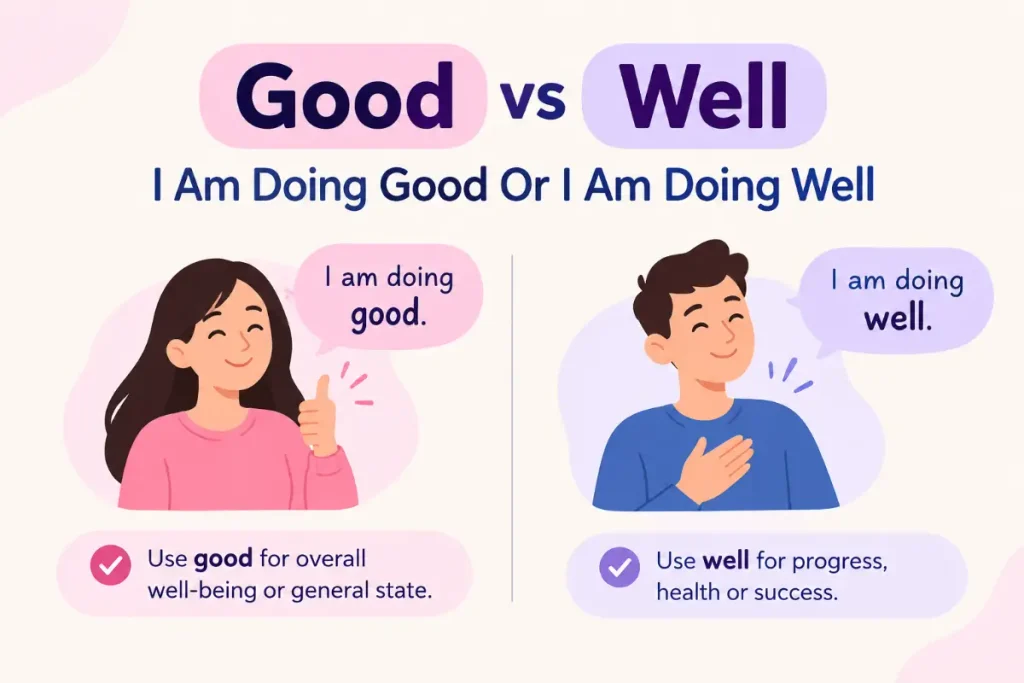
I am doing well is the traditional standard choice when you mean that your life or circumstances are going satisfactorily.
For example:
- How are you doing?
- I am doing well, thanks.
Here, well describes how the person is doing.
However, I am doing good has a different possible meaning. It can mean that someone is performing beneficial or helpful actions.
For example:
She is doing good in her community.
This can mean that she is helping people or contributing positively to the community.
In everyday American speech, however, I am doing good is also commonly used as a casual alternative to I am doing well. In careful formal writing, I am doing well is the safer choice when you are simply describing your condition or circumstances.
The distinction becomes clearer when the meaning is intentional:
- I am doing well at my new job. This means I am performing successfully or things are going satisfactorily.
- I am doing good in my community. This means I am helping others or producing a positive effect.
- I am doing good work. Here, good describes the noun work.
Context determines the intended meaning.
I Feel Good Or I Feel Well
Both I feel good and I feel well can be correct, but they can emphasize different meanings.
I feel good commonly expresses a positive overall feeling. It may describe physical comfort, emotional state, confidence, satisfaction, or general well being.
- I feel good about the decision.
- I feel good after exercising.
- I feel good today.
- I feel good about my progress.
I feel well traditionally focuses more specifically on health.
- I feel well enough to return to work.
- I feel well today.
- I did not feel well yesterday.
In modern American English, I feel good is completely natural in many contexts. The old idea that I feel good is always grammatically wrong is too simplistic. Because feel can function as a linking verb, good can describe the subject’s state.
When the intended meaning is specifically health, I feel well gives that meaning more clearly.
It Went Well Or It Went Good
It went well is the standard form when you are describing how an event or action happened.
For example:
- The interview went well.
- The meeting went well.
- The presentation went well.
- The trip went well.
- Everything went well.
Here, well modifies the verb went. It tells us how the event proceeded.
In casual American speech, some people say It went good, but It went well is the standard choice in careful writing and professional communication.
The same pattern appears with many other action verbs:
- The project went well.
- The experiment went well.
- The conversation went well.
- The event went well.
A useful rule is to remember that went describes an action or process. Well tells us how that process happened.
Good At Or Well At
When talking about someone’s ability, English normally uses good at before a noun or gerund.
- She is good at math.
- He is good at cooking.
- They are good at solving problems.
- I am good at explaining difficult ideas.
Do not normally say She is well at math when you mean that she has strong ability. The adjective good is used with at for ability.
You can also use well when describing the action itself:
She solves math problems well.
These two structures are closely related but grammatically different.
She is good at math describes her ability.
She solves math problems well describes how she performs the action.
Good And Well With Linking Verbs
Linking verbs deserve special attention because they explain why good can appear where learners expect well.
A linking verb connects the subject with information that describes the subject. Common examples include be, feel, look, sound, smell, and taste.
Consider:
- The food tastes good.
- The music sounds good.
- You look good.
- The flowers smell good.
- I feel good.
In each case, good describes the subject. The food has a good taste. The music has a good sound. You have a good appearance. The flowers have a pleasant smell. The speaker has a positive feeling.
This is different from an action sentence such as:
She sings well.
Here, sings is an action, and well tells us how she performs it.
The difference is easier to understand when you compare the structures rather than memorize a list of exceptions.
Just as farther and further have different traditional uses, choosing between “good” and “well” depends on the grammatical role each word plays in a sentence.
Common Mistakes With Good And Well
The most common mistakes happen when writers apply the simple adjective versus adverb rule too rigidly. Other mistakes happen because everyday speech sometimes uses forms that differ from traditional grammar advice. The best way to avoid these errors is to look at what the word describes and understand the special cases involving linking verbs, health, and common expressions.
Saying She Sings Good
In standard edited English, She sings well is the preferred form because well describes how she performs the action of singing. The word good is an adjective, so it normally describes the person, thing, or result rather than modifying an action verb.
Compare these sentences:
- She is a good singer.
- She sings well.
- He is a good writer.
- He writes well.
- She is a good dancer.
- She dances well.
- They are good players.
- They play well.
The pattern is simple. Use good to describe the person or thing, and use well to describe the action.
Saying He Did Good
When you mean that someone performed an action successfully, He did well is the standard choice. Here, well describes the quality of his performance.
He did well on the exam.
However, good can have a different meaning when it describes something beneficial or positive.
He did good for the community.
In this sentence, good refers to beneficial action rather than successful performance. In casual American speech, He did good is also sometimes used to mean He did well, but He did well is the safer choice in standard edited writing when you are talking about performance.
Saying The Food Tastes Well
The food tastes good is normally correct when you mean that the food has a pleasant flavor. In this sentence, taste functions as a linking verb, and good describes the food.
The food tastes good.
Compare that with a sentence in which someone performs the action of tasting:
She tasted the soup carefully.
Here, tasted is an action verb, so an adverb can describe how she performed the action. The key point is that taste can work differently depending on the sentence. Look at the grammatical function of the verb before choosing good or well.
Saying I Am Doing Good
I am doing well is the standard choice when you mean that you are doing satisfactorily or that things in your life are going well.
I am doing well, thanks.
However, doing good can communicate a different idea. It can mean helping people or producing a positive effect.
She is doing good in her community.
In casual American conversation, I am doing good is also commonly used to mean I am doing well. For professional, academic, or carefully edited writing, I am doing well is the clearer choice when you are describing your condition or circumstances.
Saying She Is Doing Well When You Mean She Is Helping Others
The opposite mistake can happen when someone uses well even though the intended meaning is beneficial action. If you are talking about the positive things someone does for other people, doing good can be the intended expression.
Compare:
- She is doing well at her new job.
- She is doing good in her community.
The first sentence describes successful performance. The second describes beneficial action. The distinction comes from meaning, not simply from memorizing a rule about adjectives and adverbs.
Saying I Feel Well In Every Situation
I feel well is grammatically correct, especially when you are talking about your health. However, using it in every situation can make the meaning less precise.
I feel well usually emphasizes physical health or the absence of illness.
I feel good commonly describes a positive emotional, physical, or general state.
For example:
- I feel well enough to return to work.
- I feel good about my decision.
- I feel good after finishing the project.
- I do not feel well today.
Do not automatically replace I feel good with I feel well. Both expressions can be correct, but they can communicate different ideas.
Saying He Looks Well When You Mean He Looks Attractive
After the linking verb look, good is normally used when you are describing someone’s appearance.
You look good today.
Here, good describes the person’s appearance or overall impression. Well can also occur with look, but it commonly relates to health or physical condition.
You look well after your vacation.
This can suggest that the person appears healthy or refreshed.
The distinction is subtle but useful. If you mean attractive, presentable, or pleasing in appearance, look good is natural. If you mean healthy, look well can express that specific idea.

Good And Well In Professional Writing
In professional writing, the safest approach is to follow standard grammar while also paying attention to meaning. Use good for qualities and descriptions, and use well when describing how an action is performed.
For example:
- She is a good manager.
- She manages the team well.
- The proposal is good.
- The proposal was presented well.
- The meeting was good.
- The meeting went well.
These distinctions make writing clearer without making it sound formal or unnatural.
When writing an email, report, resume, or academic assignment, avoid relying on casual forms such as did good or went good when you mean successful performance. Standard forms such as did well and went well are clear and widely accepted.
Good And Well In American English
American English follows the same basic grammatical distinction between good and well. However, everyday speech can be more flexible than formal edited writing.
Americans commonly say:
I feel good.
This expression is standard and natural when describing a positive state or feeling. The phrase should not automatically be corrected to I feel well. The intended meaning matters.
At the same time, I am doing well, She performed well, and The meeting went well remain standard choices when well describes performance or the way an action occurred.
British, Canadian, and Australian English use the same core distinction. There can be differences in conversational preferences and regional expressions, but good and well are not American versus British spelling variants. They are separate English words with related but different grammatical functions.
A Simple Trick To Remember Good And Well
The easiest memory trick is to connect good with things and well with actions.
Ask yourself:
Am I describing a person, thing, quality, or condition?
If so, good is often the answer.
Am I describing how an action happens?
If so, well is usually the answer.
Compare:
- He is a good driver.
- He drives well.
- She is a good student.
- She studies well.
- They are good performers.
- They perform well.
There is one important extra question:
Am I talking about health?
If so, well can be an adjective.
I am well.
You can also remember the common pattern good at for ability:
She is good at writing.
Then use well for the action:
She writes well.
These patterns cover a large share of everyday situations.
Related Grammar Confusions
The difference between good and well is part of a larger pattern in English where adjectives and adverbs are easy to confuse.
Consider quick and quickly. You might say She is a quick learner but She learns quickly. The adjective describes the person or thing, while the adverb describes the action.
A similar pattern appears with careful and carefully:
- He is a careful driver.
- He drives carefully.
The same basic distinction helps explain:
- She is a good speaker.
- She speaks well.
The important difference is that good and well have additional uses that do not fit a simple adjective and adverb formula. Well can describe health, and good commonly follows linking verbs.
Like another commonly confused pair, lay and lie, the difference between “good” and “well” becomes much easier to understand once you identify how each word functions in the sentence.
Expert Usage Tips
The most useful way to master this distinction is to stop treating good and well as interchangeable versions of the same word. They are related, but their grammatical roles are different.
First, identify the verb. If it is an ordinary action verb, well is often the natural choice when you want to describe the quality of the action. She answered well, he worked well, and they performed well all follow this pattern.
Next, check for a linking verb. After be, feel, look, sound, smell, and taste, good often works because it describes the subject. The plan sounds good and the food tastes good are natural examples.
Finally, consider meaning. Well can describe health, while good can describe positive qualities, moral behavior, or beneficial results. This is why I feel well and I feel good can both be correct without being identical in meaning.
For professional writing, clarity should guide your choice. Use well for successful performance and good for qualities. When a phrase has a special meaning, such as doing good, consider the intended message rather than applying a mechanical rule.
Frequently Asked Questions
Is good or well correct
Both words can be correct because they serve different grammatical functions. Good is usually an adjective that describes a person, thing, or condition. Well is usually an adverb that describes an action. She is a good writer and she writes well are both correct because each sentence uses the appropriate form.
Is it I am doing good or I am doing well
I am doing well is the standard choice when you mean that you are doing satisfactorily or that things are going well. I am doing good can mean that you are performing helpful or beneficial actions, although it is also common in casual American speech as an alternative to doing well. In formal writing, doing well is the clearer choice for personal circumstances.
Should I say I feel good or I feel well
Both are correct, but they can emphasize different meanings. I feel good commonly expresses a positive overall feeling, while I feel well traditionally emphasizes physical health. In everyday American English, I feel good is natural and widely used. Use I feel well when you specifically want to communicate that you are healthy or not sick.
Is it I did good or I did well
I did well is the standard form when you mean that you performed successfully. For example, I did well on the test describes your performance. I did good can have a different meaning when good refers to beneficial action, but it is also used casually by some speakers. In careful writing, use I did well for successful performance.
Is it good at or well at
Use good at when describing someone’s ability or skill. For example, She is good at math and He is good at cooking are standard constructions. Use well to describe the action itself, as in She solves problems well or He cooks well. The two structures express related ideas but use different grammar.
Is it went good or went well
It went well is the standard form when you mean that an event or process happened successfully or satisfactorily. For example, The interview went well tells us how the interview proceeded. It went good occurs in casual speech, but it went well is the preferred form in standard edited English and professional writing.
Can good be an adverb
In standard modern English, good is primarily an adjective, while well is the standard adverb for describing how an action is performed. However, good is used as an adverb in some informal and dialectal varieties of English. In careful edited writing, phrases such as She sings well are generally preferred over She sings good.
Why can I say I feel good
You can say I feel good because feel can function as a linking verb. In this use, good describes the subject’s state rather than modifying an action. The sentence can describe emotional or physical comfort, satisfaction, or a positive general condition. I feel well is also possible when the intended meaning specifically concerns health.
Conclusion
The basic distinction between good and well is easier once you focus on what each word describes. Good is usually an adjective used for people, things, qualities, and conditions. Well is usually an adverb that explains how an action is performed. Well can also be an adjective meaning healthy, while good commonly follows linking verbs such as feel, look, sound, smell, and taste.
Use good in She is a good writer, but well in She writes well. Say The food tastes good, but She cooks well. For everyday writing, these patterns will solve most usage questions. When a sentence involves health, feelings, or expressions such as doing good, consider the meaning as well as the grammar.