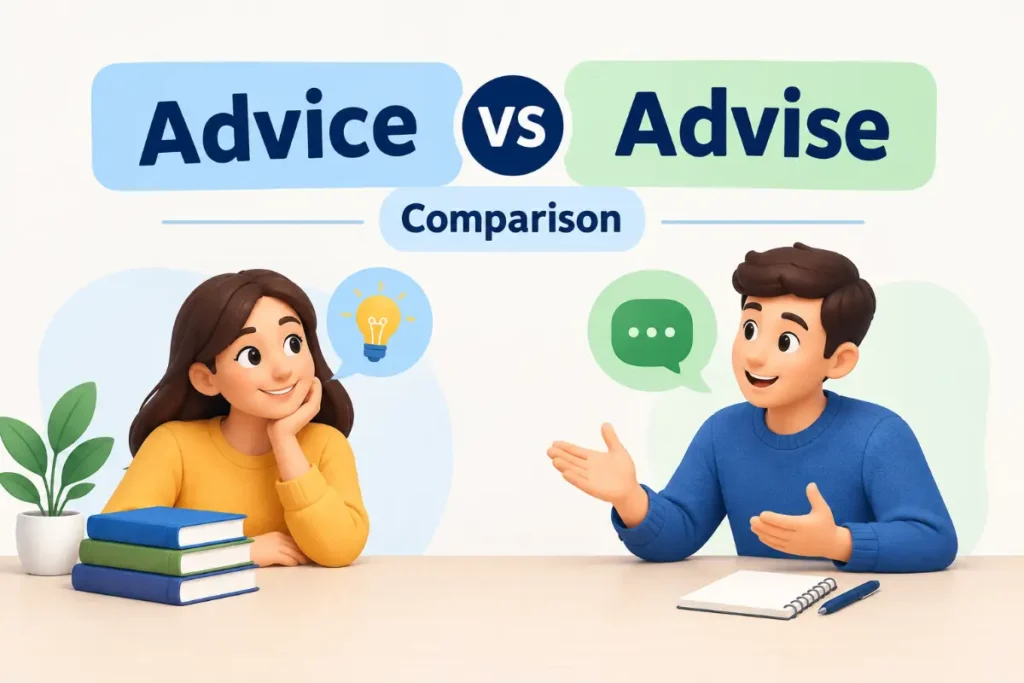
Advice vs advise is a common English usage question because the two words look almost identical and share the same basic idea. The difference becomes clear once you look at their grammatical roles. Advice is a noun that means a suggestion, recommendation, or guidance. Advise is a verb that means to give advice or recommend a course of action.
The pronunciation also causes confusion. In American English, the final sound differs between the two words even though the spelling difference is only one letter. Advice ends with an s sound, while advise ends with a z sound. That small pronunciation difference can help you recognize the words when speaking, but grammar is the best way to choose the correct form when writing.
This guide explains the meaning and usage of both words, shows the difference between them with practical examples, covers common mistakes, explains pronunciation and word history, and answers questions such as Please advise or advice and I need your advice or advise.
Quick Answer
Advice is a noun meaning a suggestion or recommendation, while advise is a verb meaning to give a suggestion or recommendation. Say I need your advice but I advise you to wait. A simple test is to ask if the sentence needs a thing or idea, which is advice, or an action, which is advise.
What Does Advice Mean
Advice is a noun that refers to an opinion, recommendation, suggestion, or guidance given to help someone make a decision or handle a situation. It can come from a friend, teacher, doctor, lawyer, manager, parent, or another person with useful knowledge or experience.
For example, when you say I need your advice, you are asking someone for guidance. When you say Her advice helped me make a decision, you are talking about the guidance itself. In both cases, advice names something that has been given or received.
Common examples include:
- I need some advice about my career.
- She gave me good advice.
- His advice helped me avoid a mistake.
- Thank you for your advice.
- My doctor gave me some useful advice.
- We asked our teacher for advice.
The key grammatical point is that advice is a noun. It can be the subject or object of a sentence, and it commonly appears after words such as some, good, helpful, useful, practical, and professional.
Advice Is Usually Uncountable
One important grammar rule is that advice is normally an uncountable noun in standard English. This means you generally do not say an advice or advices when referring to guidance.
Instead, use expressions such as some advice, a piece of advice, or a bit of advice.
- She gave me some advice.
- He offered a useful piece of advice.
- Can I give you a piece of advice?
- I received some excellent advice from my teacher.
If you need to count individual recommendations, a piece of advice is the standard expression. You can also say two pieces of advice when referring to two separate recommendations.
This distinction is especially useful for people learning English because some languages treat the equivalent of advice as a countable noun. In standard American English, however, advice normally does not take a directly.
If you often hesitate over whether something was done good and well in everyday writing, understanding the difference between good and well can make your sentences much clearer.
What Does Advise Mean
Advise is a verb. It means to give someone advice, recommend something, or tell someone what action may be appropriate. Because it is a verb, it describes an action rather than the guidance itself.
For example, I advise you to wait means that I recommend waiting. The doctor advised him to rest means that the doctor recommended rest.
Common examples include:
- I advise you to read the instructions carefully.
- She advised me to save some money.
- The lawyer advised us to review the contract.
- My teacher advised me to practice more.
- We advise customers to keep their receipts.
- He advised against making a quick decision.
A useful way to understand the distinction is to compare advice with advise in the same sentence.
Her advice was helpful.
Here, advice is the guidance itself.
She advised me to wait.
Here, advised describes the action of giving that guidance.
Advice vs Advise Comparison
The two words share the same general idea, but their grammatical roles are different. The following table makes the distinction easy to see.
| Feature | Advice | Advise |
|---|---|---|
| Part of speech | Noun | Verb |
| Basic meaning | A suggestion or recommendation | To give a suggestion or recommendation |
| Main function | Names guidance | Describes giving guidance |
| Pronunciation | Ends with an s sound | Ends with a z sound |
| Common pattern | some advice | advise someone to do something |
| Example | I need your advice. | I advise you to wait. |
| Countable | Usually uncountable | Not applicable |
| Common phrase | a piece of advice | advise against |
The easiest distinction is simple: advice is something you give or receive, while advise is what you do when you give it. This relationship is similar to other noun and verb pairs in English.
The Main Difference Between Advice And Advise
The central difference is grammatical rather than semantic. Both words relate to recommendations and guidance, but advice names the recommendation while advise describes the act of giving it.
Compare these sentences:
- I need your advice.
- I need you to advise me.
- Her advice was helpful.
- She advised me to wait.
The meaning is closely related, but the grammatical structure changes. In the first and third sentences, advice is a noun. In the second and fourth, advise is a verb.
A useful substitution test is to ask what the sentence needs. If you can replace the word with guidance, recommendation, or suggestion, you probably need the noun advice. If you can replace it with recommend, guide, or suggest, you probably need the verb advise.
Advice And Advise Examples
Seeing both forms in different sentence structures makes the distinction easier to remember. The following examples cover common situations in everyday conversation, school, work, and professional communication.
Examples With Advice
Use advice when you are talking about guidance, recommendations, or suggestions as a thing.
- I need some advice about my new job.
- She gave me good advice before my interview.
- His advice helped me solve the problem.
- Can you give me some advice?
- That was excellent advice.
- My parents gave me useful advice about saving money.
- I appreciate your advice.
- The doctor gave her practical advice about improving her diet.
- We asked the manager for advice.
- He ignored the advice of his friends.
Notice how advice works naturally with words such as some, good, useful, and excellent. It can also follow possessive words such as my, your, his, and her.
Examples With Advise
Use advise when the sentence needs a verb describing the act of giving guidance or making a recommendation.
- I advise you to check the details first.
- She advised me to arrive early.
- The doctor advised him to get more rest.
- Our teacher advised us to study for the exam.
- The company advises customers to keep their receipts.
- I would advise against making a rushed decision.
- The lawyer advised them to read the agreement carefully.
- My manager advised me to apply for the position.
- Experts advise consumers to compare prices.
- We advised him to speak with the supervisor.
The verb advise commonly appears with a person followed by to and a verb, as in I advised her to wait. It can also appear with against, as in The doctor advised against strenuous activity.
How To Remember Advice And Advise
A simple memory trick can make the difference almost automatic.
Think of advice as the thing and advise as the action.
Advice = the recommendation.
Advise = give the recommendation.
You can also connect the endings with their grammatical roles. The noun advice has the s sound at the end. The verb advise has the z sound. If you hear the word clearly, this pronunciation difference can help you identify which spelling is being used.
Another useful test is to change the sentence into a related form.
I need your advice.
Can you say I need your recommendation? Yes. That tells you the sentence needs a noun.
I advise you to wait.
Can you say I recommend that you wait? Yes. That tells you the sentence needs a verb.
Common Mistakes With Advice And Advise
The most common mistakes happen because the two words look and sound similar. Writers often choose the wrong ending because they remember the meaning but overlook the grammatical role.
Incorrect Advice As A Verb
Incorrect: I advice you to wait.
Correct: I advise you to wait.
The sentence needs a verb because it describes the action of giving a recommendation. The correct form is advise.
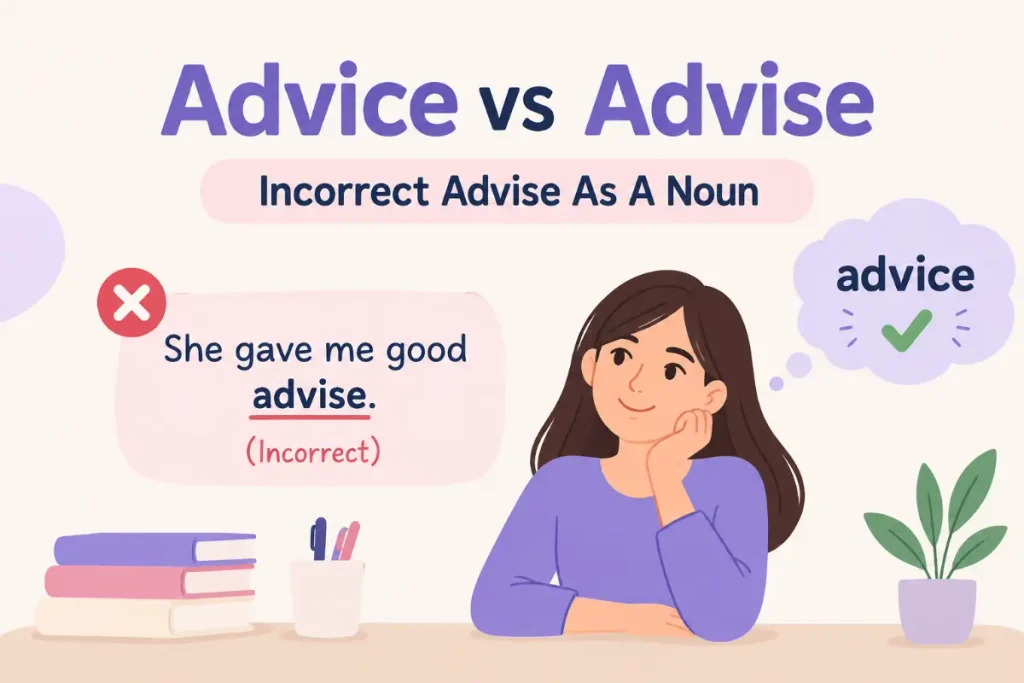
Incorrect Advise As A Noun
Incorrect: I need your advise.
Correct: I need your advice.
The sentence needs a noun because it refers to the guidance the person is asking for. The correct form is advice.
Using An Advice
Incorrect: She gave me an advice.
Correct: She gave me some advice.
You can also say She gave me a piece of advice when you want to identify one specific recommendation.
Using Advices
Incorrect: He gave me several advices.
Correct: He gave me several pieces of advice.
The noun advice is normally uncountable, so it does not become advices simply because you are talking about more than one recommendation.
Mixing Advice And Advise In One Sentence
Sometimes both words appear naturally in the same sentence.
I appreciate your advice, and I will advise my team to follow it.
Here, advice is the noun representing the recommendation. Advise is the verb describing the action of passing that recommendation to the team.
Another example is:
The doctor gave me some advice and advised me to get more rest.
The first form names the guidance. The second describes what the doctor did.
Please Advise Or Please Advice
The correct phrase is Please advise.
Advise is correct because the sentence contains an implied request for the reader to take an action. Please advise means something like Please tell me what you recommend or Please let me know what I should do.
For example:
- Please advise me on the next steps.
- Please advise if you need additional information.
- Please advise how we should proceed.
Please advice is incorrect in standard English because advice is a noun and cannot serve as the verb in this construction.
The phrase please advise is especially common in business emails and professional correspondence. However, it can sometimes sound abrupt or overly formal depending on the context. A more specific sentence can often sound friendlier.
Instead of:
Please advise.
You might write:
Please let me know what you recommend.
Or:
Could you let me know how you would like me to proceed?
The original phrase is grammatically correct, but the best choice depends on the tone of the message.
I Need Your Advice Or Advise
The correct phrase is I need your advice.
The reason is grammatical. The sentence needs a noun because you are asking for guidance. Advice names the guidance you want.
I need your advice about this job offer.
You would use advise in a sentence such as:
Can you advise me about this job offer?
Both sentences communicate a similar idea, but their structures are different. The first uses the noun advice. The second uses the verb advise.
Compare these examples:
- I need your advice.
- Can you advise me?
- She asked for my advice.
- She asked me to advise her.
- His advice was useful.
- He advised us to wait.
This noun and verb relationship explains many of the common questions surrounding these words.
Clear word choice matters beyond advice vs advise, and choosing between that and which can also help you build more precise and polished sentences.
Grammar Patterns With Advice
Because advice is a noun, it follows normal noun patterns. You can use possessives and descriptive words before it, and you can use it as the object of a verb.
Common patterns include:
- some advice
- good advice
- useful advice
- my advice
- your advice
- a piece of advice
For example, My advice is to wait uses advice as the subject complement of the sentence. I appreciate your advice uses it as the object of appreciate.
You can also use advice after verbs such as give, get, receive, offer, seek, follow, and ignore.
- She gave me some advice.
- He received professional advice.
- We sought advice from a teacher.
- They followed her advice.
Grammar Patterns With Advise
Advise is a verb, so it appears in different verb forms depending on tense and sentence structure.
The basic form is advise.
The third person singular form is advises.
The past tense and past participle form is advised.
The present participle form is advising.
Examples include:
- I advise you to wait.
- She advises customers to read the terms.
- He advised me to call tomorrow.
- They are advising us on the project.
A very common structure is advise someone to do something.
The teacher advised the students to review their notes.
Another common structure is advise against something or advise against doing something.
The doctor advised against driving after the procedure.
These patterns make it easier to identify advise because the word is functioning as an action.
Formal And Casual Usage
Both advice and advise are standard English words. Neither is inherently formal or informal.
Advice appears naturally in casual conversations:
Can I ask you for some advice?
It also works in professional settings:
We recommend seeking legal advice before signing the agreement.
Advise is similarly flexible. You might say:
I would advise you to wait.
In a professional context, you may see:
Please advise how you would like us to proceed.
The main difference between the words is grammatical function, not formality. Tone depends more on the surrounding sentence and context.
Advice And Advise In Professional Writing
Professional writing requires particular attention to the distinction because confusing a noun and verb can make an otherwise polished message look careless.
Consider an email that says:
I need your advise on this matter.
The intended meaning is clear, but advise is grammatically incorrect because the writer is requesting a thing, namely guidance. The corrected sentence is:
I need your advice on this matter.
Now consider:
Please advice us of any changes.
The intended meaning is that the recipient should inform the writer. The correct form is:
Please advise us of any changes.
These errors are easy to prevent by asking one question: Am I naming the guidance, or am I describing the action of giving it? The first requires advice. The second requires advise.
Pronunciation Of Advice And Advise
The pronunciation difference is one of the most useful clues when speaking American English.
Advice is commonly pronounced approximately /ədˈvaɪs/. The final sound is an s sound, as in ice.
Advise is commonly pronounced approximately /ədˈvaɪz/. The final sound is a z sound, as in the sound at the end of eyes.
The vowel sound in the stressed syllable is the same in both words. The important difference is the final consonant.
You can remember the distinction this way:
advice ends like ice.
advise ends like eyes.
The pronunciation difference is useful in conversation, but spelling still matters in writing. If you are proofreading an email or document, focus on the grammatical role rather than relying only on how the word sounds.
Word Origin And Etymology
Advice and advise come from the same historical word family. Their development can be traced through Old French and ultimately to Latin roots associated with seeing, considering, or taking something into consideration.
English developed the noun advice and the verb advise as related forms. Over time, the spelling and pronunciation differences became established in standard English.
The modern distinction is therefore not based on two unrelated ideas. The words are historically connected, which explains why their meanings are so closely related. Their grammatical functions are what separate them in modern usage.
This is also why learners often confuse them. English has many word families in which a noun and verb share a root but have different endings. Advice and advise are one such pair.
American English And British English
The distinction between advice and advise is essentially the same in American and British English. Both varieties use advice as the noun and advise as the verb.
For example, an American writer and a British writer would both normally write:
I need some advice.
And:
I advise you to wait.
The pronunciation may vary slightly across accents, but the spelling and core grammatical distinction remain the same.
This is not a case where one spelling is American and the other is British. Both forms are standard in both varieties. The difference comes from grammar and pronunciation rather than regional spelling.
Advice And Advise In Everyday Conversation
People ask for advice in many ordinary situations. You might ask a friend for advice about a restaurant, ask a coworker for advice about a project, or ask a family member for advice about a difficult decision.
The verb advise is also common, especially when describing what someone recommends.
For example:
My brother gave me some advice about buying a car.
He advised me to compare several models first.
This pair shows the relationship clearly. The first sentence talks about the recommendation as a thing. The second describes the action of giving the recommendation.
The same pattern works in many situations:
- Her advice helped me choose a college.
- She advised me to compare the programs carefully.
- His advice was practical.
- He advised us to start early.
Similar Word Pairs To Watch
English contains several word pairs that confuse writers because they look or sound similar. Learning the pattern behind advice and advise can help with some of these distinctions.
Practice And Practise
In American English, practice is normally used for both the noun and verb. British English traditionally distinguishes practice as a noun from practise as a verb.
This is an important regional difference that does not apply to advice and advise. American and British English both use advice for the noun and advise for the verb.
Device And Devise
Device is a noun referring to a tool, machine, or method. Devise is a verb meaning to create or plan something.
The spelling difference is similar to the pattern seen in advice and advise, although the meanings are different.
License And Licence
American English normally uses license as both a noun and verb. British English traditionally uses license for the verb and licence for the noun.
This contrast shows why regional usage should always be considered before labeling a spelling incorrect.
Expert Usage Tips
The fastest way to master these words is to stop treating them as two spellings of the same word. Think of them as two related words with different grammatical jobs.
When you see advice, mentally substitute guidance or recommendation. If the sentence still makes sense, the noun is probably correct.
When you see advise, mentally substitute recommend or tell someone what to do. If that meaning fits, the verb is probably correct.
There is also a useful structural clue. Advice often appears after words such as some, your, my, good, or useful. Advise often appears before an object or in a verb pattern such as advise someone to do something.
Most importantly, do not assume that the ending s automatically makes a word a plural noun. In advice, the final s is simply part of the spelling and pronunciation of the noun. The word does not become advices when you mean multiple recommendations.
Like advice vs advise, another commonly confused word pair is accept vs except, where choosing the wrong word can completely change the meaning of a sentence.
Frequently Asked Questions
What is the difference between advice and advise?
Advice is a noun meaning guidance, a recommendation, or a suggestion. Advise is a verb meaning to give guidance or make a recommendation. You can say I need your advice, but you should say I advise you to wait. The words are related in meaning but perform different grammatical functions.
Is it advice or advise?
The correct form depends on the sentence. Use advice when you need a noun, as in She gave me good advice. Use advise when you need a verb, as in She advised me to wait. If you can replace the word with recommendation, use advice. If you can replace it with recommend, use advise.
Is it please advise or please advice?
The correct phrase is please advise. Advise is a verb meaning to give information, guidance, or a recommendation. Please advice is incorrect because advice is a noun. In professional emails, please advise is common, although a more specific request such as Please let me know how you would like me to proceed may sound more natural.
Is it I need your advice or I need your advise?
The correct phrase is I need your advice. The sentence needs a noun because advice refers to the guidance you want to receive. Advise is a verb, so it would work in a sentence such as Can you advise me about this decision?
Can I say an advice?
In standard American English, advice is normally an uncountable noun, so an advice is not standard usage. Say some advice or a piece of advice instead. For example, She gave me some advice and He gave me a useful piece of advice are both correct.
Can I say advices?
Normally, no. In standard English, advice is generally uncountable and does not become advices simply because you are talking about multiple recommendations. Use pieces of advice when you need to count individual recommendations, as in She gave me two pieces of advice.
How do you pronounce advice and advise?
Advice ends with an s sound, while advise ends with a z sound. Their common American English pronunciations are approximately /ədˈvaɪs/ and /ədˈvaɪz/. A simple memory aid is that advice ends like ice, while advise ends like eyes.
Is advice more formal than advise?
Neither word is inherently more formal. They are different parts of speech. Advice is a noun and advise is a verb, so you choose between them based on grammar. Both are common in casual conversation, professional communication, academic writing, and formal contexts when used correctly.
Conclusion
The difference between advice and advise is simple once you focus on grammar. Advice is a noun that means guidance, a recommendation, or a suggestion. Advise is a verb that means to give guidance or make a recommendation.
Remember the basic pattern: advice is the thing, and advise is the action. Say I need your advice, but I advise you to wait. If you are unsure, replace the word with guidance or recommendation for the noun, or recommend for the verb. This quick test will help you choose the correct form in emails, schoolwork, professional writing, and everyday communication.