If you are trying to decide between council vs counsel, the key is to focus on meaning rather than sound. Council is a noun for a group of people chosen or elected to advise, govern, represent others, or make decisions. Counsel can be a noun meaning advice or a lawyer, and it can also be a verb meaning to advise someone. The two words sound the same in standard English, which makes them easy to confuse when writing.
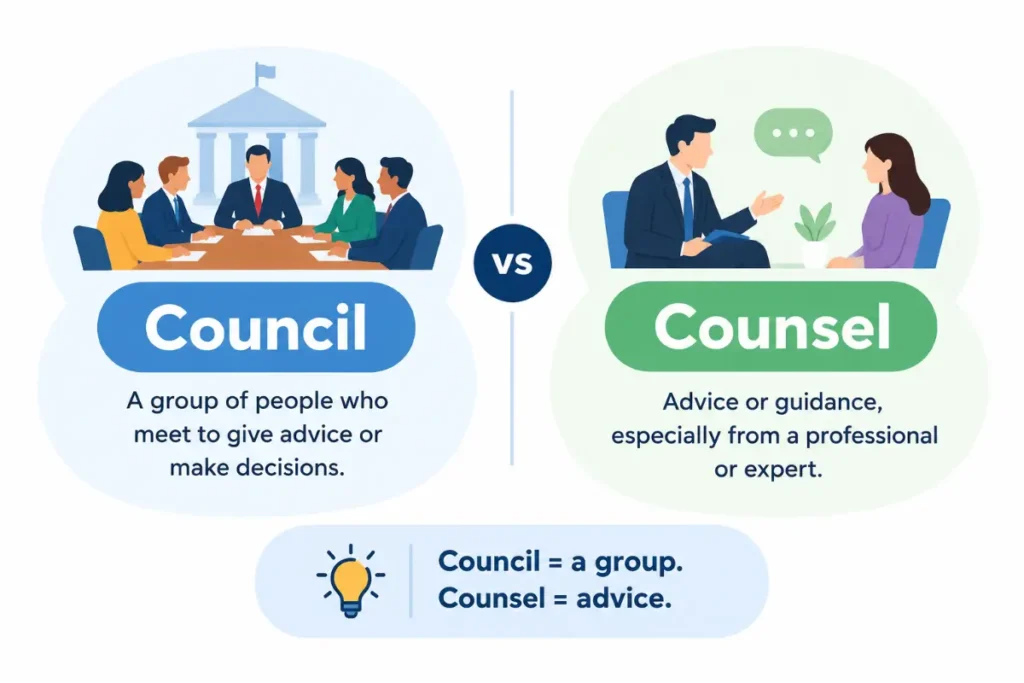
The distinction becomes much easier once you connect each spelling with its main idea. Think of council as a group and counsel as advice or a person providing professional advice. A city council is a group of officials, while legal counsel is a lawyer or legal representation. Counsel can also describe the advice itself, as in seeking counsel before making an important decision. This guide explains the difference, pronunciation, grammar, legal usage, common mistakes, examples, related words, and practical ways to remember the two forms.
Quick Answer
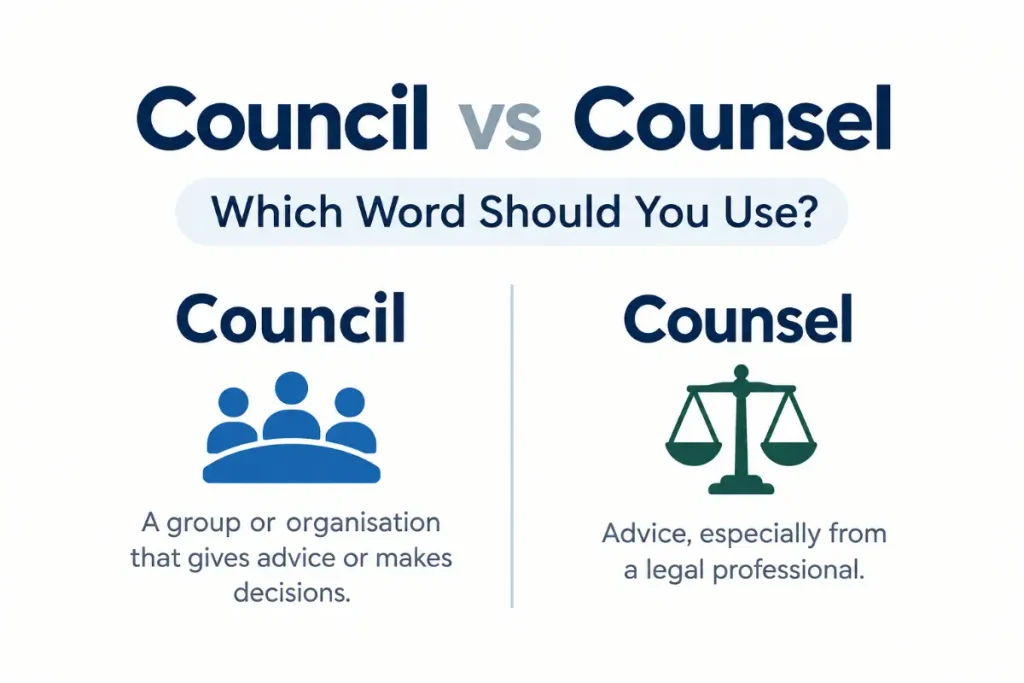
Council means an organized group that advises, governs, represents people, or makes decisions. Counsel means advice or guidance, can refer to a lawyer or legal representative, and can function as a verb meaning to advise. Both words are pronounced the same, but their spellings and meanings are different.
Council vs Counsel At A Glance
The simplest distinction is based on what the word represents in a sentence. Council names a group or organization. Counsel relates to advice, advising, or legal representation.
| Feature | Council | Counsel |
|---|---|---|
| Part of speech | Noun | Noun and verb |
| Main meaning | An organized group or official body | Advice, guidance, or a legal adviser |
| Can mean advice | No | Yes |
| Can mean a lawyer | No | Yes |
| Can be a verb | No | Yes |
| Verb meaning | Not applicable | To advise |
| Pronunciation | /ˈkaʊn.səl/ | /ˈkaʊn.səl/ |
| Common US contexts | City government, schools, organizations | Law, advice, professional guidance |
| Example | The city council approved the plan. | She sought legal counsel. |
Both words have the same standard pronunciation in American English. Cambridge gives both council and counsel as /ˈkaʊn.səl/ in US English. The difference is therefore mainly visible in writing rather than heard in ordinary speech.
If you’re unsure which word fits, understanding principal and principle can help you distinguish a person or position of authority from a guiding rule or belief.
What Does Council Mean
Council is a noun that refers to a group of people who are selected or elected to make decisions, provide advice, represent a group, or manage an organization or area. It is especially common in government, education, community organizations, and other formal groups.
In American English, one of the most familiar examples is city council. A city council is a governing body made up of elected officials who deal with local matters. The word can also appear in names such as student council, city council, town council, advisory council, and security council.
The important idea is that council refers to the group itself, not the advice the group gives. If several people meet as an organized body to discuss issues or make decisions, council may be the appropriate word.
For example:
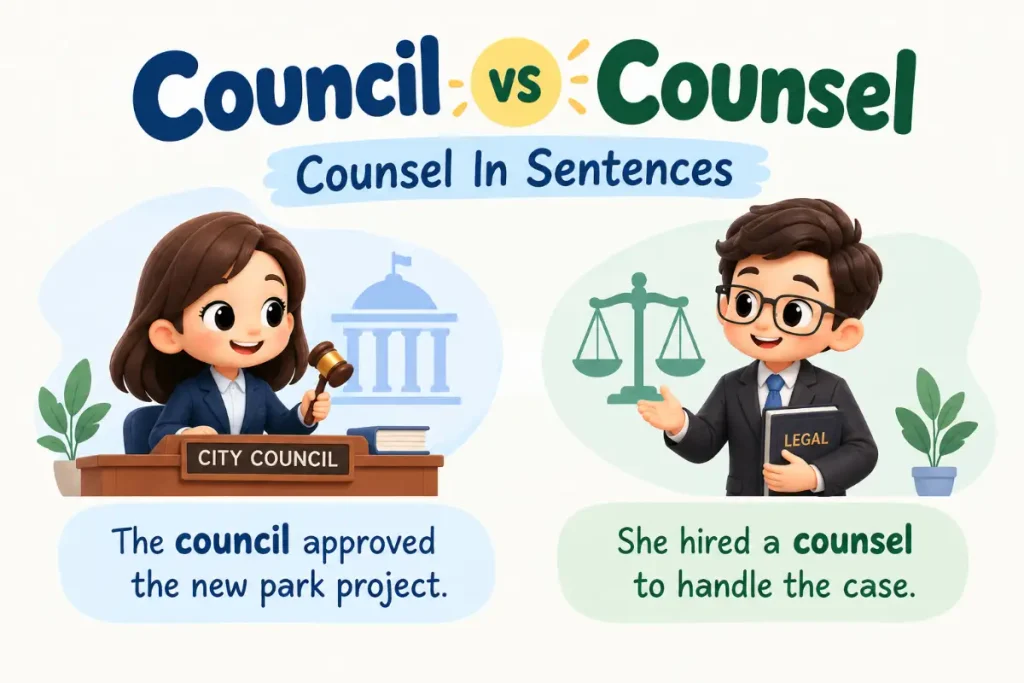
- The city council approved the new parking regulations.
- She was elected to the student council.
- The advisory council met on Tuesday.
- The council discussed plans for the new community center.
Council can also be used before another noun to describe something connected with that group. In phrases such as council member, council meeting, and council office, the word identifies the organization or governing body involved.
The plural is councils. For example, you can write, Several city councils adopted similar policies.
What Does Counsel Mean
Counsel has several closely related uses, but they all center on advice or professional guidance. As a noun, it can mean advice or guidance. In legal contexts, it can refer to a lawyer or lawyers representing someone. As a verb, counsel means to advise someone.
The noun form often sounds more formal than the everyday word advice. You might hear or read wise counsel, seek counsel, or professional counsel in formal writing.
For example:
- She sought counsel before accepting the offer.
- His parents gave him wise counsel.
- The company sought legal counsel before signing the contract.
- The attorney provided counsel to the organization.
As a verb, counsel means to give advice. The person receiving the advice is the object of the verb.
For example:
- The doctor counseled the patient about lifestyle changes.
- She counseled her son to think carefully before making a decision.
- The financial adviser counseled the couple about retirement planning.
The verb has regular past forms in American English. You will commonly see counseled and counseling in US writing. British English commonly uses counselled and counselling, although the core meaning remains the same.
The Main Difference Between Council And Counsel
The easiest way to separate the words is to ask what you are talking about.
If you mean a group of people, use council.
If you mean advice or guidance, use counsel.
If you mean a lawyer or legal representative, use counsel.
If you mean the act of giving advice, use counsel as a verb.
Consider these sentences:
- The council voted on the proposal.
- The manager sought counsel before making the decision.
- The defendant’s counsel addressed the judge.
- The therapist counseled the student.
The words can even appear in the same sentence because a council can provide counsel. For example, The council sought counsel from an outside legal adviser. Here, the first word names a group, while the second refers to professional advice.
That distinction is useful because it shows why the two spellings cannot simply be treated as interchangeable forms of the same word. Their meanings overlap historically and conceptually, but modern English uses them for different purposes.
Council In Sentences
The following examples show how council works in everyday American English. Notice that every example refers to a group, body, or organization.
- The city council held a public meeting last night.
- Maria joined the student council during her sophomore year.
- The council approved funding for the community center.
- Several council members attended the event.
- The council is reviewing the proposed changes.
- The local council announced a new recycling program.
- The school council discussed the schedule for the spring event.
- The advisory council submitted its recommendations.
- The council’s decision affected several neighborhoods.
- The committee will present its findings to the council next week.
In each case, replacing council with counsel would change or damage the meaning. A city counsel, for example, would not normally mean the elected city governing body. The established term is city council.
The word is also common in formal names. For example, United Nations Security Council refers to a specific international body. Council in that name identifies the group itself.
Counsel In Sentences
Counsel can appear in several grammatical roles, so its examples are more varied.
As a noun meaning advice:
- She valued her mentor’s counsel.
- He ignored his lawyer’s counsel.
- The board sought counsel from several experts.
- Her parents offered thoughtful counsel during a difficult decision.
As a noun referring to a lawyer or legal representative:
- The defendant’s counsel questioned the witness.
- The company retained legal counsel.
- Defense counsel requested additional time.
- The judge asked counsel to approach the bench.
As a verb meaning to advise:
- The teacher counseled the student about college applications.
- The doctor counseled him to reduce his workload.
- She counseled her clients to review the agreement carefully.
- The adviser counseled the team against making a rushed decision.
These different uses are why counsel requires a little more attention than council. Context tells you which sense is intended.
Just as council and counsel are often confused, learning the difference between stationary and stationery can help you avoid another common English usage mistake.
Legal Usage Of Counsel
Legal writing is one of the places where confusion between these words becomes especially noticeable. In legal contexts, counsel can refer to a lawyer, a group of lawyers, legal representation, or legal advice. Cambridge defines the legal noun as one or more lawyers involved in a legal case, and US usage also includes legal advisers working for organizations.
Common expressions include:
- legal counsel
- defense counsel
- opposing counsel
- general counsel
- counsel for the plaintiff
- counsel for the defendant
For example, The company consulted legal counsel before signing the agreement. Here, counsel refers to legal advice or the lawyers providing it, depending on the context.
Compare that with The city council passed the ordinance. The city council is a government body. The two expressions may sound identical when spoken, but their meanings are completely different in writing.
This is also why legal counsel is the established expression when you mean a lawyer or legal advice. Writing legal council will usually create the wrong meaning unless you specifically mean an organized group or body that has been given that name.
Council And Counsel Pronunciation
There is no useful pronunciation difference between council and counsel in standard American English. Both are pronounced approximately KOWN sul, with the first syllable receiving the main stress.
The IPA pronunciation is:
- Council: /ˈkaʊn.səl/
- Counsel: /ˈkaʊn.səl/
Cambridge lists the same US pronunciation for both words.
This identical pronunciation explains much of the confusion. If you hear someone say the city council, you cannot determine the spelling from the sound alone. You need to understand the meaning and context.
The same problem occurs when someone says legal counsel aloud. Since the listener hears the same sound as council, spelling becomes a matter of knowing which meaning is intended.
For writing, therefore, pronunciation is not a reliable way to choose between the two. Meaning is the better guide.
Councilor And Counselor
Two related words can create another layer of confusion: councilor and counselor.
A councilor is a member of a council, especially an elected local government official. In US English, councilor is the standard spelling, while British English commonly uses councillor.
A counselor, by contrast, is a person who provides advice or guidance. The word is related to counsel, not council.
Compare:
- The councilor attended the city meeting.
- The counselor helped the student discuss her concerns.
The first person belongs to a council. The second provides counseling or guidance.
This gives you a useful spelling connection:
Council → councilor → member of a council
Counsel → counselor → person who provides counsel
Keeping those families together makes the distinction easier to remember.
Common Mistakes With Council And Counsel
The most common mistake happens when writers choose the spelling based on sound rather than meaning. Since the words are homophones, hearing them does not tell you which spelling belongs on the page.
Mistake 1 Using Council For Advice
Incorrect: She asked her lawyer for council.
Correct: She asked her lawyer for counsel.
The sentence refers to legal advice, so counsel is required.
Mistake 2 Using Counsel For A Government Body
Incorrect: The city counsel voted on the proposal.
Correct: The city council voted on the proposal.
The sentence refers to the city’s governing body, so council is correct.
Mistake 3 Confusing Councilor And Counselor
Incorrect: The school counselor was elected to the city council.
This sentence is actually grammatically possible if the same person has both roles, but it is important not to confuse the titles. A councilor is a member of a council, while a counselor provides advice or guidance.
Mistake 4 Assuming Counsel Is Always A Lawyer
Counsel does not always mean a lawyer. It can simply mean advice or guidance.
For example, Her grandmother offered valuable counsel means that her grandmother offered valuable advice. No legal meaning is necessary.
Mistake 5 Assuming Council Always Means Government
Council often refers to government, but it is not limited to government bodies. Schools, organizations, professional groups, and other institutions can have councils.
For example:
The student council planned the fundraiser.
Here, the council is a student organization rather than a government body.
American And British English
The central distinction between council and counsel remains the same in American and British English. Council refers to a group or governing body, while counsel can mean advice, advising, or a lawyer.
One noticeable regional difference appears in related forms of counsel. American English commonly uses counseled and counseling, while British English often uses counselled and counselling. Cambridge notes the US spelling pattern with one l and the British pattern with two l’s.
There is also a difference in the related word for a member of a council:
- US: councilor
- UK: councillor
The underlying meaning does not change. The spelling reflects regional conventions.
For US focused writing, use councilor, counseled, and counseling in accordance with standard American spelling.
Word Origin And Etymology
The two words are closely related historically, which helps explain why they look and sound so similar today. Both ultimately trace back to Latin roots connected with consultation, deliberation, or taking counsel.
Over time, English developed separate forms for related concepts. Council became strongly associated with an assembly or body of people who deliberate or make decisions, while counsel developed uses connected with advice, consultation, and advising. The modern distinction is therefore not an arbitrary spelling difference. The words developed along related but distinct paths.
Their historical relationship also explains why they can occur together naturally. A council may seek counsel, and a person may receive counsel from members of a council.
For practical writing, however, modern meaning matters more than historical origin. You do not need to memorize the Latin roots to choose the right spelling. The group versus advice distinction is enough for most situations.
How To Remember The Difference
A simple memory trick can prevent most mistakes.
Think:
Council = committee
Counsel = advice
Both words begin with coun, but the endings point to different meanings.
When you see council, think about a group of people sitting together to discuss, advise, govern, or decide something.
When you see counsel, think about advice, guidance, or a lawyer.
You can also remember the common expressions city council and legal counsel. These two phrases cover two of the most frequent situations in which people encounter the words.
Ask yourself one quick question:
Am I naming a group or talking about advice?
If you are naming a group, choose council. If you are talking about advice, advising, or a lawyer, choose counsel.
Which Word Should You Use
Your choice depends entirely on the meaning you need.
Use council for:
- A city governing body
- A school organization
- An advisory body
- A committee or official group
- A group selected to represent others
- A formal decision making body
Use counsel for:
- Advice
- Guidance
- The act of advising
- A lawyer
- Legal representation
- Professional legal advice
Here are a few quick comparisons:
The council met this morning.
The group met.
She sought counsel from her mentor.
She sought advice.
The council hired an attorney.
The group hired a lawyer.
The company sought legal counsel.
The company sought legal advice or legal representation.
The counselor counseled the student.
The adviser gave the student guidance.
Once you identify the meaning, the spelling is usually straightforward.
Expert Usage Tips
For clear American English, do not try to distinguish these words by pronunciation. Native speakers hear the same basic sound, so the context must determine the spelling when you write.
The safest approach is to connect each word with a familiar phrase. City council points to a governing group. Legal counsel points to a lawyer or legal advice. Student council points to an organized student body. Wise counsel points to advice.
It is also useful to remember that counsel has greater grammatical flexibility. It can be a noun or a verb, while council functions as a noun. If you can naturally replace the word with advise, advice, or lawyer, you probably need counsel.
If you can replace it with committee, board, group, or governing body, council is probably the right choice. This meaning based test is more reliable than trying to remember an isolated spelling rule.
Another pair worth reviewing is how passed differs from past, especially when deciding whether you’re referring to an action, movement, or a previous time.
Frequently Asked Questions
Which is correct council or counsel
Both council and counsel are correct English words, but they have different meanings. Council refers to a group or official body. Counsel refers to advice or guidance, can mean a lawyer or legal representative, and can function as a verb meaning to advise.
Is legal counsel or legal council correct
Legal counsel is the standard expression when you mean a lawyer, legal representation, or legal advice. Council normally refers to an organized group or governing body. For example, The company hired legal counsel refers to legal representation, while The council met refers to a group.
Are council and counsel pronounced the same
Yes. In standard American English, council and counsel are pronounced the same, approximately KOWN sul. Cambridge gives both words the IPA pronunciation /ˈkaʊn.səl/. Their different meanings and spellings are therefore more important than pronunciation when choosing between them in writing.
What does counsel mean in law
In legal English, counsel can mean a lawyer or group of lawyers involved in a case or representing a person or organization. It can also refer to legal advice or representation. Common expressions include defense counsel, opposing counsel, legal counsel, and general counsel.
Can counsel be a verb
Yes. Counsel can be a verb meaning to advise someone. For example, The doctor counseled the patient about the treatment options means that the doctor gave the patient advice. American English commonly uses counseled as the past tense and counseling as the related noun or participle.
What is the difference between councilor and counselor
A councilor is a member of a council, especially an elected local government official. A counselor is someone who provides advice or guidance. In US English, councilor is the standard spelling, while British English commonly uses councillor.
Is council only used for government groups
No. Although council is very common in local government, it can describe many organized groups that advise, represent, or make decisions. Examples include student council, advisory council, arts council, and other institutional or professional councils. The central idea is an organized body of people rather than advice itself.
How can I easily remember council and counsel
Use the simple distinction council equals group and counsel equals advice. If you mean a city, school, advisory, or other organized body, use council. If you mean advice, advising, or a lawyer, use counsel. Familiar phrases such as city council and legal counsel can make the difference easier to remember.
Conclusion
The easiest way to understand council vs counsel is to focus on meaning. Council is a noun for an organized group that advises, represents, governs, or makes decisions. Counsel can mean advice or guidance, can refer to a lawyer or legal representative, and can work as a verb meaning to advise.
The two words sound the same, so pronunciation will not help you choose the spelling. Instead, ask what the sentence means. If you are talking about a group, use council. If you are talking about advice, advising, or legal representation, use counsel. That simple distinction covers most everyday, professional, academic, and legal uses and will help you avoid one of the more common homophone errors in English.