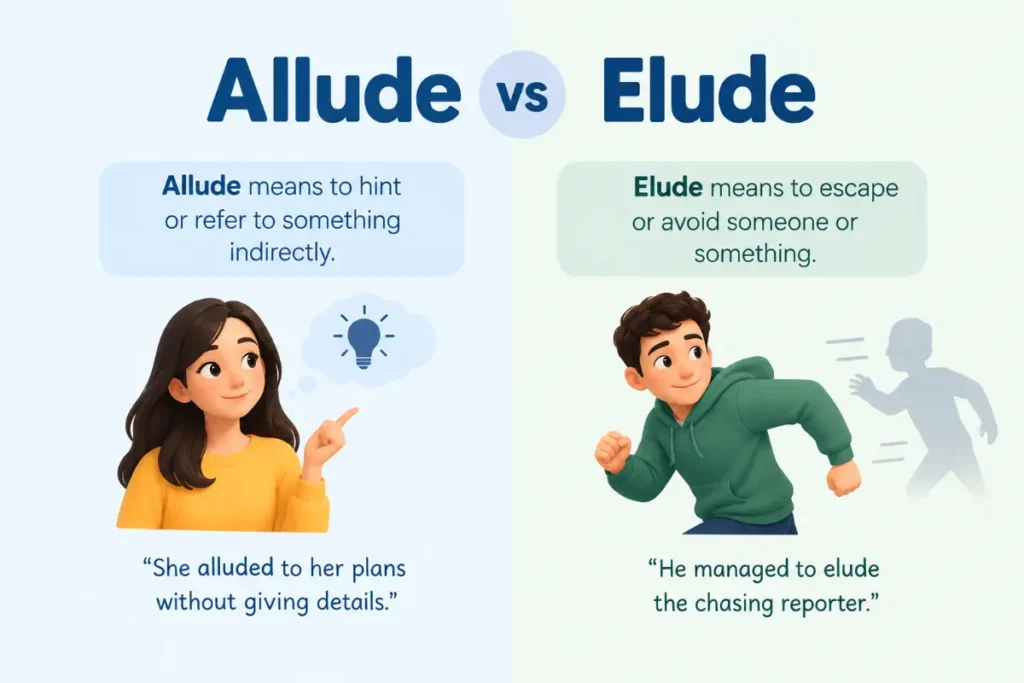
If you have ever paused over allude vs elude, you are not alone. The two verbs look and sound remarkably similar, but they describe completely different actions. Allude means to mention or refer to something indirectly, while elude means to avoid, escape, or remain beyond someone’s ability to grasp, remember, or achieve. The confusion comes mainly from their similar spelling and pronunciation.
The difference becomes much easier once you connect each word with its meaning. You allude to an idea, person, event, or subject when you refer to it without stating it directly. You elude a person when you manage to escape them, or something eludes you when you cannot understand, remember, find, or achieve it.
This distinction matters in everyday conversation, workplace writing, academic work, journalism, and formal communication. Using the wrong verb can change the meaning of an entire sentence. The sections below explain both words in plain American English, compare their grammar and pronunciation, provide practical examples, and show how to avoid the most common mistakes.
Quick Answer
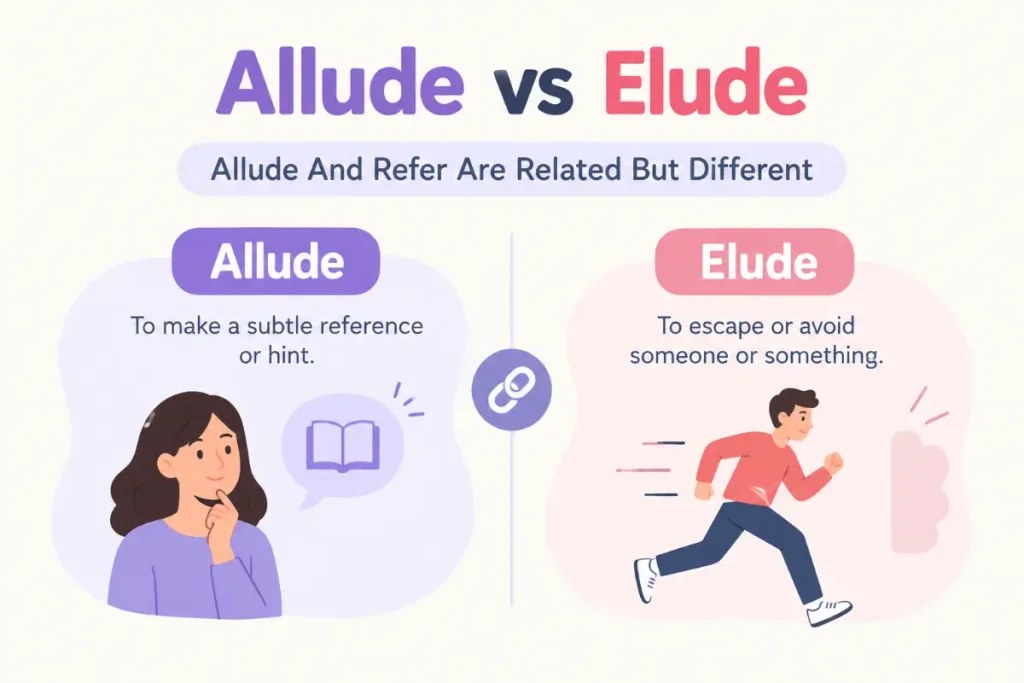
Allude means to refer to something indirectly, usually with allude to. Elude means to escape, avoid, or remain beyond someone’s ability to understand, remember, or achieve. For example, a writer may allude to a famous event, while a difficult answer may elude a student.
What Does Allude Mean
Allude is a verb meaning to refer to someone or something indirectly. Instead of naming the subject clearly, the speaker or writer gives a hint that allows the audience to recognize the reference.
The most common grammatical pattern is allude to + person, thing, idea, event, or subject. The word often appears in formal, academic, literary, journalistic, and professional writing.
For example:
- The speaker alluded to the controversy without naming anyone.
- The author alludes to several historical events in the novel.
- She alluded to problems within the company during the interview.
In each case, the person is referring to something without explaining it fully or naming it directly.
This is the central idea behind allude:
Allude means to refer to something indirectly.
The related noun allusion means an indirect reference to another person, event, idea, work, or subject. You may find allusions in literature, speeches, advertisements, movies, journalism, and everyday conversation.
For example:
- The novel contains an allusion to Greek mythology.
- The speaker made an allusion to the company’s earlier problems.
An allusion does not have to be mysterious. It simply needs to function as an indirect reference.
How Allude Works In A Sentence
The safest structure to remember is:
allude to + noun or noun phrase
Examples include:
- The professor alluded to an earlier study.
- She alluded to her childhood during the interview.
- The article alludes to several historical events.
- He alluded to the disagreement but did not explain it.
- The poem alludes to a famous biblical story.
One common mistake is leaving out to.
Incorrect: The author alluded the historical event.
Correct: The author alluded to the historical event.
When you identify the subject being indirectly referenced, allude to is the standard construction.
For a clearer understanding of possessives and contractions, learning understanding who’s and whose can help you avoid another common English usage mistake.
What Does Elude Mean
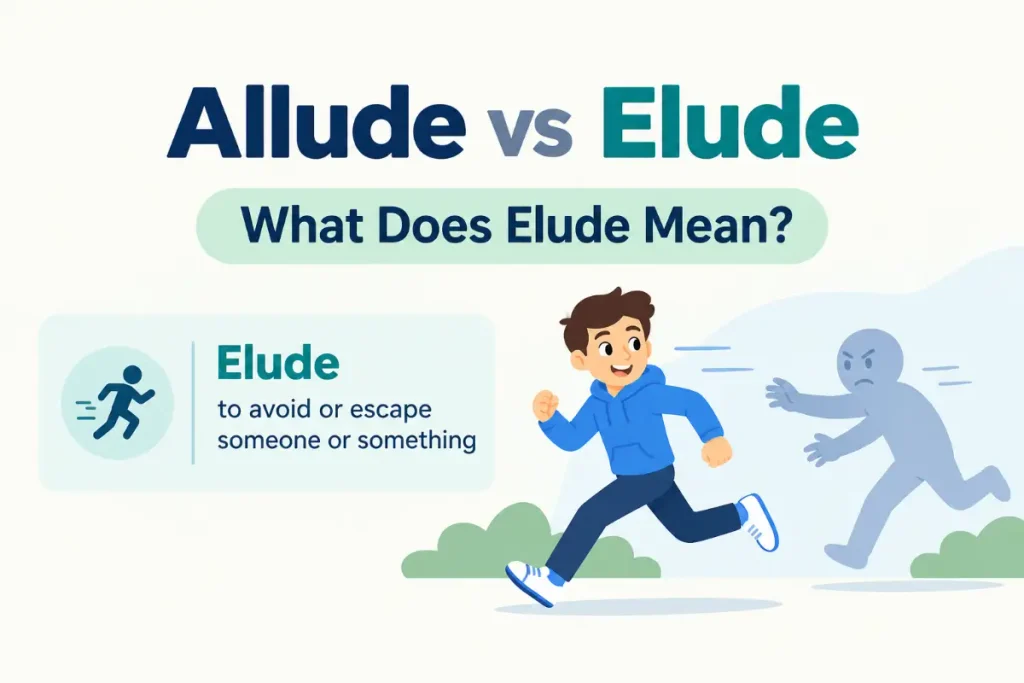
Elude has a completely different meaning. It means to avoid or escape someone or something, often by staying out of reach or avoiding capture.
It can also describe something that remains beyond someone’s ability to understand, remember, obtain, or achieve.
For example:
- The suspect eluded the police.
- The answer eluded me.
- Sleep eluded him all night.
- The solution continued to elude the researchers.
The first example describes physical escape. The other examples use elude figuratively.
This is the central idea behind elude:
Elude means to escape, avoid, or remain beyond reach.
The thing being eluded does not have to be a person. An answer, memory, solution, opportunity, goal, or feeling can also elude someone.
For example:
- The name of the actor completely eluded me.
- A clear explanation seemed to elude the committee.
- The reason for the error still eludes us.
- A championship has eluded the team for years.
Nobody is necessarily running away in these examples. Instead, something remains difficult to remember, understand, identify, or achieve.
How Elude Works In A Sentence
There are two especially useful sentence patterns.
elude + person or thing
- The driver eluded the police.
- The runner eluded his competitors.
something + elude + person
- The answer eluded the student.
- The meaning of the passage eluded me.
- The source of the problem eluded investigators.
The second pattern is particularly common in figurative writing.
Allude vs Elude At A Glance
| Feature | Allude | Elude |
|---|---|---|
| Part of speech | Verb | Verb |
| Core meaning | Refer to indirectly | Escape, avoid, or remain beyond reach |
| Common pattern | Allude to something | Elude someone or something |
| Main idea | Indirect reference | Escape or difficulty |
| Can involve a person | Yes | Yes |
| Can involve an idea | Yes | Yes |
| Can describe physical escape | No | Yes |
| Can describe difficulty remembering | No | Yes |
| Can describe difficulty achieving | No | Yes |
| Related noun | Allusion | Elusion |
| Related adjective | Allusive | Elusive |
| Pronunciation | /əˈluːd/ | /ɪˈluːd/ |
| Typical tone | Often formal | Neutral to formal |
The quickest distinction is simple:
Allude points toward a reference. Elude points away from capture or understanding.
The Key Difference Between The Two Words
The words are not synonyms, opposites, or alternate spellings. They belong to different semantic groups.
Allude belongs to the language of reference and communication. Related words include:
- mention
- refer
- hint
- suggest
- imply
- evoke
- reference
Elude belongs to the language of escape and difficulty. Related words include:
- escape
- evade
- avoid
- dodge
- remain out of reach
- remain difficult to understand
Compare these sentences:
The speaker alluded to the scandal.
This means the speaker referred indirectly to the scandal.
The suspect eluded the police.
This means the suspect escaped or avoided the police.
The answer eluded me.
This means I could not remember or figure out the answer.
These examples show why the two words cannot be substituted for each other.
Allude And Imply Are Not The Same
Allude is sometimes confused with imply because both can involve indirect communication. Still, they focus on different parts of the communication.
To allude to something means to make an indirect reference to it. To imply something means to communicate an idea without stating it directly, often allowing another person to infer the intended meaning.
Compare these examples:
- The reporter alluded to the investigation.
- The reporter implied that the company had violated the rules.
In the first sentence, the reporter indirectly referred to the investigation. In the second, the reporter suggested a particular idea without directly stating it.
A person can allude to something without implying a specific conclusion. Likewise, a person can imply something without referring to a particular subject.
For clear professional writing, use allude to when you mean refer indirectly. Use imply when you mean suggest a meaning without directly stating it.
English has many examples of another confusing word pair, where two similar-looking forms have different meanings and grammatical uses.
Allude And Refer Are Related But Different
Refer is broader than allude.
To refer to something can simply mean to mention it or direct attention to it. The reference can be direct or indirect.
For example:
The report refers to last year’s sales figures.
This does not tell us that the sales figures are hidden or indirectly mentioned.
Now compare:
The report alludes to problems with last year’s sales figures.
This suggests that the report hints at the problems without fully discussing them.
The distinction is useful:
Refer can be direct or indirect.
Allude specifically emphasizes indirect reference.
That makes allude a more precise choice when you want to show that someone hinted at a subject rather than openly discussing it.
Examples Of Allude In Sentences
These examples show how allude works across different contexts.
- The professor alluded to a major discovery during the lecture.
- The email alluded to changes that would be announced later.
- The author alludes to several classic novels in the final chapter.
- She alluded to the disagreement but avoided discussing the details.
- The advertisement alludes to a familiar childhood memory.
- His speech alluded to the company’s difficult financial year.
- The comedian alluded to a celebrity without mentioning the person’s name.
- The student alluded to the answer without giving it away.
- The article alludes to concerns about privacy.
- During the meeting, the manager alluded to a possible change in policy.
Every example involves an indirect reference. None means escape or avoidance.
Allude In Professional Writing
The verb can work well in professional contexts when an indirect reference is important.
For example:
The report alludes to several unresolved issues.
This sentence suggests that the report mentions the issues indirectly or without fully explaining them.
Still, do not use allude simply to make writing sound more sophisticated. If the writer directly names the subject, mention or refer to may be clearer.
Good editing is often about choosing the clearest word rather than the most formal one.
Examples Of Elude In Sentences
The following examples show both the literal and figurative meanings of elude.
- The suspect managed to elude the officers.
- The runner eluded his competitors during the final lap.
- The escaped dog eluded its owner for several hours.
- The answer continued to elude the student.
- The meaning of the passage eluded me at first.
- Sleep eluded her despite the long day.
- The team has been chasing a championship that has eluded it for years.
- The source of the error continues to elude investigators.
- The name of the actor completely eluded me.
- A clear explanation seemed to elude the committee.
The first three examples involve avoiding or escaping someone. The remaining examples use elude figuratively to describe something that cannot be remembered, understood, identified, or achieved.
Common Mistakes With Allude And Elude
Because the spelling differs by only one letter, these verbs are easy to mix up. The most reliable solution is to focus on meaning instead of spelling.
Mistake One: Using Elude For An Indirect Reference
Incorrect: The speaker eluded to the controversy.
Correct: The speaker alluded to the controversy.
The speaker is making an indirect reference, so alluded to is the correct expression.
Mistake Two: Using Allude For Escape
Incorrect: The suspect alluded the police.
Correct: The suspect eluded the police.
The suspect escaped or avoided the police, so eluded is the appropriate verb.
Mistake Three: Using Allude When You Mean Direct Mention
Incorrect: The writer alluded the problem directly.
Correct: The writer referred to the problem directly.
Allude already carries the idea of indirect reference. If the subject is stated directly, mention or refer to may be more natural.
Mistake Four: Forgetting To Use To With Allude
Incorrect: She alluded the issue.
Correct: She alluded to the issue.
This is one of the most useful grammar rules to remember. The common construction is allude to.
Mistake Five: Assuming Elude Only Means Physical Escape
Incorrect assumption: Elude can only describe someone running away.
That is not how modern English works. Elude can describe something that remains beyond a person’s understanding, memory, success, or reach.
For example:
The solution eluded the engineer.
The solution did not physically escape. The engineer simply could not find it.
Pronunciation Of Allude And Elude
The two words sound similar, but their opening vowels are different.
Allude: /əˈluːd/
A simple pronunciation guide is uh LOOD.
Elude: /ɪˈluːd/
A simple pronunciation guide is ih LOOD.
The main stress falls on the second syllable in both words.
The most noticeable difference is the first sound:
- allude begins with the unstressed /ə/ sound.
- elude begins with the /ɪ/ sound.
The ending sounds essentially the same.
Because the pronunciation is close, context often helps listeners identify which word someone means. When writing, the spelling and meaning make the distinction much clearer.
Word Origin And Etymology
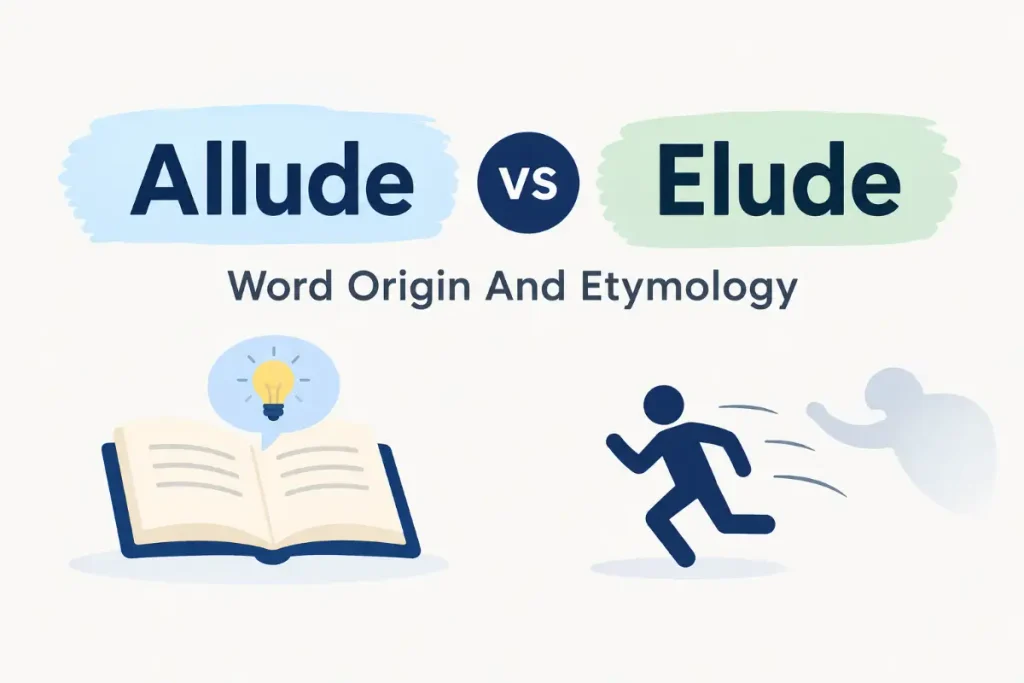
The similarity between these words has a historical explanation. Both ultimately connect to the Latin verb ludere, meaning to play.
Allude developed from Latin alludere, involving ad, meaning toward, and ludere, meaning to play. English later developed the modern sense of making an indirect reference.
Elude comes from Latin eludere, involving a form related to ex, meaning out or away, along with ludere. Its historical development produced meanings connected with escaping, avoiding, or frustrating an attempt to grasp something.
The shared history helps explain their similar appearance, but their modern meanings are separate.
Their related word families make the distinction even clearer:
- allude means to refer indirectly.
- allusion means an indirect reference.
- allusive describes something containing indirect references.
- elude means to escape or remain beyond reach.
- elusion relates to escape or avoidance.
- elusive describes something difficult to capture, understand, find, or achieve.
For example:
The answer remained elusive.
This means the answer was difficult to find or understand.
Allusion And Elusion
The nouns deserve special attention because they reinforce the difference between the verbs.
An allusion is an indirect reference.
Examples:
- The poem contains an allusion to Shakespeare.
- The speech includes an allusion to American history.
- The advertisement makes an allusion to a famous movie.
Elusion relates to escape or avoidance, but it is much less common in ordinary American English than allusion.
For example:
The suspect’s elusion of capture delayed the investigation.
In everyday writing, however, people are more likely to use a simpler expression such as escape from capture.
Do not confuse allusion with illusion either.
| Word | Meaning |
|---|---|
| Allude | Refer indirectly |
| Allusion | An indirect reference |
| Elude | Escape or remain beyond reach |
| Elusive | Difficult to capture, understand, find, or achieve |
| Illusion | A false or misleading appearance |
These words look similar, but their meanings are unrelated in modern English.
Which Word Should You Use
Use allude when the sentence is about communication or reference.
Ask yourself:
Am I referring to something indirectly?
If yes, use allude.
Example:
The speaker alluded to the earlier disagreement.
Use elude when the sentence is about escape, avoidance, or something remaining beyond reach.
Ask yourself:
Is something escaping, avoiding capture, or remaining difficult to understand, remember, find, or achieve?
If yes, use elude.
Example:
The answer eluded me.
A simple memory trick can also help:
- Allude points toward a reference.
- Elude suggests escape or staying out of reach.
The trick is not a grammar rule, but it can help you remember the difference when writing quickly.
Formal And Casual Usage
Both words are standard English and can appear in professional writing. Allude tends to sound somewhat formal because indirect reference is often discussed in academic, literary, journalistic, and professional contexts.
In casual conversation, speakers may be more likely to use mention, hint at, or refer to.
For example:
Casual: She hinted at a problem with the schedule.
More formal: She alluded to a problem with the schedule.
Neither choice is inherently better. The clearest option depends on the context and the intended meaning.
Elude works comfortably in both formal and everyday English.
Casual: I cannot remember his name. It completely eludes me.
Professional: The underlying cause of the decline continues to elude researchers.
The verb is particularly useful when describing a problem that remains difficult to identify, understand, solve, or achieve.
A Simple Editing Test
If you are proofreading a sentence and cannot decide between the two verbs, replace the word mentally with a simpler expression.
Choose allude if you could replace it with:
- refer to
- hint at
- mention indirectly
- make an indirect reference to
Choose elude if you could replace it with:
- escape
- evade
- avoid
- remain beyond reach
- remain difficult to understand
- remain difficult to remember
- remain difficult to achieve
Consider these examples:
The article ___ to an earlier study.
Try refer to. The meaning works, so alludes to is correct.
The answer ___ the student.
Try remained beyond the student’s understanding. The meaning works, so eluded is correct.
This substitution test works because the two verbs describe completely different kinds of actions.
You may also encounter regional spelling variations in English, particularly when comparing American and British spelling conventions.
Frequently Asked Questions
Which is correct, allude or elude?
Both words are correct, but they have different meanings. Allude means to refer to something indirectly and is commonly followed by to. Elude means to escape, avoid, or remain beyond someone’s ability to understand, remember, or achieve. The correct choice depends on what the sentence means.
What does allude mean?
Allude means to refer to someone or something indirectly rather than naming or explaining it directly. The usual construction is allude to. For example, “The speaker alluded to the earlier dispute” means the speaker referred to the dispute without discussing it directly.
What does elude mean?
Elude means to escape or avoid someone or something. It can also describe an idea, answer, memory, success, or solution that remains beyond someone’s ability to find, understand, remember, or achieve. For example, “The answer eluded me” means I could not remember or figure out the answer.
Is it allude to or elude to?
The standard expression is allude to. You allude to a person, subject, event, or idea when you refer to it indirectly. Elude normally does not take to in this meaning. You can say “The suspect eluded the police” or “The answer eluded me.”
Are allude and elude synonyms?
No. They are not synonyms. Allude concerns indirect reference, while elude concerns escape, avoidance, or something remaining beyond reach. Their similar spelling and pronunciation make them easy to confuse, but their meanings and grammatical patterns are clearly different.
What is the difference between allude and imply?
Allude means to make an indirect reference to a particular subject. Imply means to communicate or suggest a meaning without stating it directly. A writer can allude to an event without implying a specific conclusion, so the two verbs can overlap in some contexts but are not interchangeable.
What is the difference between allusion and illusion?
An allusion is an indirect reference to a person, event, idea, or work. An illusion is a false or misleading appearance or perception. For example, a poem can contain an allusion to Greek mythology, while a magician can create an illusion that makes something appear different from reality.
Is allude formal English?
Yes. Allude is standard English and is especially common in formal, academic, literary, journalistic, and professional writing. In casual conversation, speakers often use phrases such as hint at, refer to, or mention indirectly instead. The word is perfectly acceptable, but it can sound more formal than everyday alternatives.
Conclusion
The key to allude vs elude is the difference between reference and escape. Allude means to refer to something indirectly, normally with the construction allude to. Elude means to escape or avoid someone or something, or to remain beyond a person’s ability to remember, understand, find, or achieve.
When editing, focus on what the sentence actually describes. If someone is making an indirect reference, use allude. If something is escaping capture or remaining out of reach, use elude. That simple distinction will prevent the most common errors and make your writing clearer.