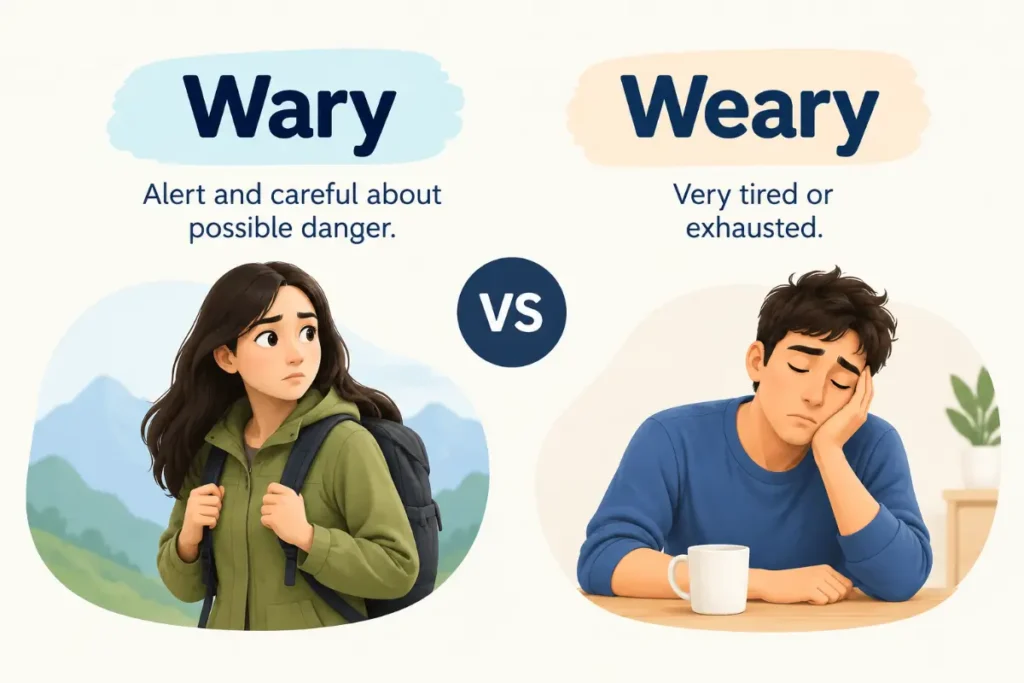
Wary vs weary are easy to mix up. They look almost alike and sound similar enough to cause mistakes in conversation and writing. Yet they describe two completely different ideas. Wary means cautious or suspicious about a possible problem. Weary means tired or worn out from effort, stress, repetition, or a long experience.
That difference matters in everyday American English. You might be wary of a suspicious email because you do not trust the link. After spending hours dealing with the problem, you might feel weary. One word describes your attitude toward something that could go wrong. The other describes your physical or mental condition.
The confusion also extends to pronunciation. Wary and weary are not standard homophones in American English, although many speakers hear them as very similar. Wary has a first vowel sound like air, while weary has a first vowel sound closer to ear.
This guide explains the meanings, pronunciation, grammar, examples, synonyms, common mistakes, related words such as leery and vary, and practical ways to remember the difference. By the end, choosing the right word should feel much more natural.
Quick Answer
Wary means cautious because you suspect danger, trouble, or deception. Weary means tired, exhausted, or mentally worn out. You can be wary of a suspicious offer, but you can feel weary after a long day. They are different words with different meanings and are not standard homophones in American English.
What Wary Means
Wary is an adjective that describes caution. Someone who is wary does not completely trust a person, situation, claim, offer, or plan because they think there could be a problem.
The important idea behind wary is caution before action. A wary person is paying attention because something does not feel completely safe or trustworthy. The danger does not have to be confirmed. Suspicion or reasonable concern can be enough.
For example, consider this sentence.
- I was wary of clicking the link in the email.
The person is not tired. They are cautious because the link might be unsafe.
Now consider another example.
- Maria was wary of accepting the job offer.
Maria is hesitant because she has some concern about the offer. Perhaps the company has given unclear information or the terms seem unusual. The sentence says nothing about Maria being tired.
Wary commonly appears with of.
- Be wary of unfamiliar websites.
- He was wary of the stranger.
- She was wary of making a quick decision.
- The manager was wary of approving the proposal.
- Consumers should be wary of offers that seem unusually generous.
You can also use wary directly before a noun.
- The customer gave the salesperson a wary look.
- The dog took a wary step toward the unfamiliar visitor.
- She kept a wary eye on the situation.
The expression keep a wary eye on means to watch something carefully because you think a problem could develop.
Wary can describe mild caution or stronger suspicion. Context determines the intensity. If someone is wary of a new restaurant, they may simply want to research it first. If someone is wary of giving a stranger their bank information, the concern is much more serious.
Like “wary” and “weary,” another easily confused word trio can cause mistakes because the words sound similar while having completely different meanings.
What Weary Means
Weary is mainly associated with tiredness. It can describe physical exhaustion, mental fatigue, emotional strain, or a loss of patience after something has continued for a long time.
The simplest synonym is tired, although weary often carries a slightly more expressive or literary tone.
For example:
- After the long flight, I felt weary.
- The hikers looked weary after climbing the mountain.
- She sounded weary after a long day of meetings.
- The workers were weary after finishing the project.
In each sentence, weary refers to fatigue.
Weary can also describe mental or emotional tiredness. This is especially common in the pattern weary of.
- She grew weary of hearing the same complaint.
- The students became weary of repeating the same exercise.
- He was weary of arguing about the issue.
- The team grew weary of waiting for an answer.
Here, the person may not be physically exhausted. Instead, they have become tired of something through repetition or prolonged frustration.
Weary can also work as a verb. As a verb, it means to make someone tired or to become tired.
- The constant delays wearied the travelers.
- The repeated arguments wearied everyone involved.
- She was wearied by the long process.
The adjective is much more common in everyday usage, but knowing the verb form helps explain the word’s broader grammatical behavior.
Wary vs Weary Difference
The simplest distinction is this: wary relates to caution while weary relates to tiredness.
| Feature | Wary | Weary |
|---|---|---|
| Main meaning | Cautious or suspicious | Tired or exhausted |
| Part of speech | Adjective | Adjective and verb |
| Main idea | Possible danger or trouble | Physical or mental fatigue |
| Common pattern | Wary of | Weary after or weary of |
| Emotional sense | Caution or distrust | Frustration or loss of patience |
| Common synonyms | Cautious, careful, guarded | Tired, exhausted, fatigued |
| Typical context | Risk, safety, trust, uncertainty | Work, travel, effort, repetition |
| US pronunciation | /ˈwer.i/ | /ˈwɪr.i/ |
| Example | I am wary of that offer. | I am weary after the trip. |
A quick substitution test can help.
If you can replace the word with cautious, use wary.
If you can replace it with tired, use weary.
For example:
- I am cautious about the website.
I am wary of the website. - I am tired after the journey.
I am weary after the journey.
The substitution will not work perfectly in every sentence, but it gives you a reliable starting point.
How To Use Wary In A Sentence
Wary usually appears when someone has a reason to proceed carefully. The reason can be obvious or implied.
The word works naturally in conversations about money, safety, relationships, business, technology, travel, and unfamiliar situations.
Here are varied examples.
- I am wary of buying expensive electronics from an unknown seller.
- The dog was wary of the unfamiliar visitor.
- She was wary of sharing personal information online.
- The manager remained wary of making promises before reviewing the contract.
- Parents should be wary of suspicious messages asking for money.
- He gave the offer a wary glance.
- The customer was wary of paying before seeing the product.
- We were wary of taking a shortcut through an unfamiliar area.
- She became wary when the caller asked for her account password.
- The company was wary of expanding before reviewing its financial results.
Notice the common thread. Every example involves caution, uncertainty, or suspicion.
Wary does not necessarily mean that something is dangerous. It means the person believes there is enough uncertainty to justify caution.
That distinction matters in professional writing. Saying that a manager is wary of a proposal does not automatically accuse the proposal’s author of doing something wrong. It simply says the manager is cautious about it.
How To Use Weary In A Sentence
Weary works when someone has become tired through effort, time, stress, repetition, or difficulty.
Here are examples across different situations.
- After the overnight flight, the passengers looked weary.
- She felt weary after spending all afternoon moving furniture.
- The weary runner finally reached the finish line.
- He sounded weary after a long day of meetings.
- The workers were weary but satisfied with their progress.
- After months of delays, the residents grew weary of waiting.
- I became weary of hearing the same excuse every morning.
- The long drive left us weary by the time we reached the hotel.
- She gave a weary smile and sat down.
- The team grew weary of repeating the same process.
The word can therefore describe more than physical exhaustion.
- A weary traveler is tired from traveling.
- A weary employee may be tired from demanding work.
- A weary parent may be exhausted after dealing with a difficult day.
- A person can also become weary of an argument after hearing it repeatedly.
This wider meaning makes weary useful in descriptive writing. It can communicate a deeper sense of tiredness than the everyday word tired in some contexts.
Are Wary And Weary Homophones
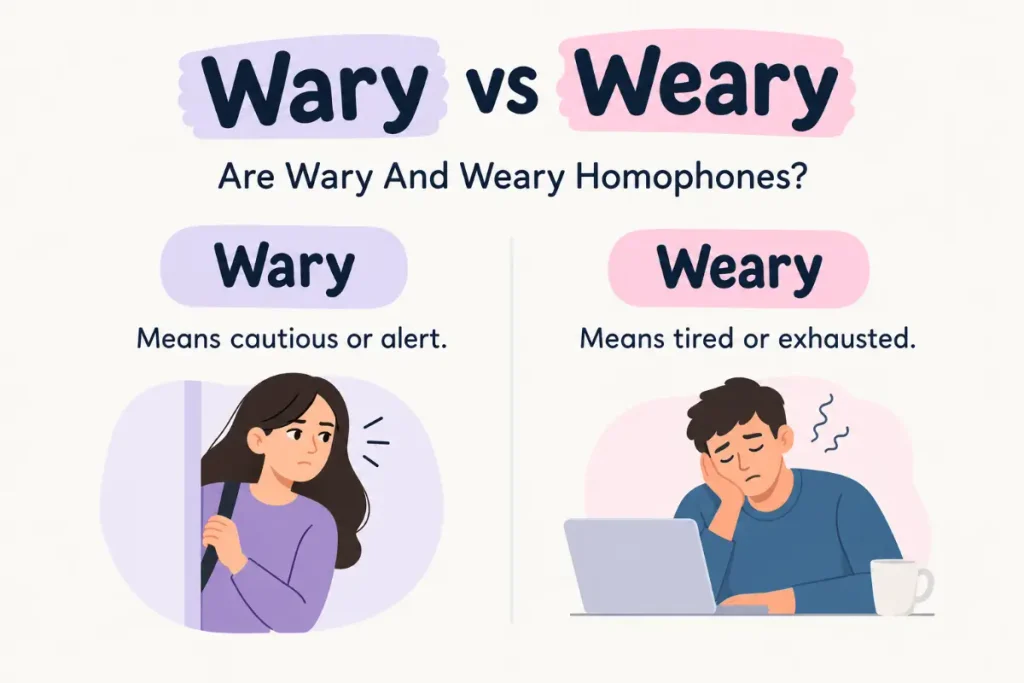
No. Wary and weary are not standard homophones in American English.
Homophones are words that have the same pronunciation but different meanings and spellings. Wary and weary have similar sounds, but their first vowel sounds are different in standard American pronunciation.
- Wary is commonly pronounced approximately like WAIR ee.
- Weary is commonly pronounced approximately like WEER ee.
The distinction can become less obvious when people speak quickly. Regional accents can also change how strongly the difference is heard. That may explain why some listeners think the two words sound identical.
Still, standard American pronunciation treats them as separate words.
The context can also help when listening. If someone says they are weary after working twelve hours, the intended meaning is clearly tiredness. If they say they are wary of a suspicious message, the intended meaning is caution.
Wary And Weary Pronunciation
The pronunciation difference is small but important.
Wary is commonly represented in American English as /ˈwer.i/. A simple pronunciation guide is WAIR ee.
Weary is commonly represented as /ˈwɪr.i/. A simple guide is WEER ee.
The first syllable is the key.
With wary, think of the vowel sound in words such as air and care.
With weary, think of the vowel sound found in words such as near and fear.
The second syllable sounds similar in both words. That is why the first syllable deserves most of your attention.
If you are learning these words for speaking practice, say the following pairs slowly.
- Wary and air.
- Weary and near.
- Wary of danger.
- Weary after work.
Then speed up naturally. The goal is not to exaggerate the difference. You want the distinction to remain clear while the words still sound natural.
Wary vs Weary vs Leery
Leery is much closer in meaning to wary than weary is.
Leery means suspicious or cautious about something. In many everyday American sentences, leery and wary can be used with little change in the basic meaning.
Compare these examples.
- I am wary of the offer.
- I am leery of the offer.
Both sentences suggest that the speaker does not fully trust the offer and wants to proceed carefully.
Weary belongs to a different meaning group.
- I am weary after the long meeting.
This sentence describes tiredness.
The easiest way to remember all three is to connect the words with their central ideas.
- Wary means cautious.
- Leery means suspicious or cautious.
- Weary means tired.
There can be a slight difference in tone between wary and leery. Leery often sounds more informal and can suggest stronger suspicion. Wary is common across both everyday and professional contexts.
For formal business writing, cautious may sometimes be the clearest alternative. In casual conversation, leery can sound perfectly natural.
English has many similar-sounding English words that are easy to mix up, especially when their spellings and meanings differ despite similar pronunciation.
Wary vs Weary vs Vary
Vary creates another common spelling and pronunciation confusion.
Vary is a verb that means to change, differ, or be different. It has no connection to caution or tiredness.
Look at these examples.
- Prices may vary by location.
- I am wary of unusually low prices.
- I am weary after comparing prices all afternoon.
The three words sound related enough to confuse a listener or writer, but their meanings are completely separate.
- Vary describes change or difference.
- Wary describes caution.
- Weary describes tiredness.
The grammar also helps distinguish vary from the other two. Wary and weary can describe a person or thing because they commonly function as adjectives. Vary functions as a verb.
For example:
- The results vary from year to year.
- She was wary of the results.
- She was weary after reviewing the results.
Once you focus on the role each word plays in the sentence, the spelling becomes easier to control.
Wary vs Weary Synonyms
Synonyms provide another useful way to separate the meanings.
Common synonyms for wary include:
- Cautious.
- Careful.
- Alert.
- Watchful.
- Guarded.
- Suspicious.
- Vigilant.
- Circumspect.
Common synonyms for weary include:
- Tired.
- Exhausted.
- Fatigued.
- Drained.
- Spent.
- Worn out.
- Bored.
- Weakened.
These synonyms are not identical in every situation.
For example, suspicious can sound stronger than wary. Someone who is wary may simply want more information. Someone who is suspicious may actively believe that something is wrong.
Likewise, exhausted can communicate stronger physical fatigue than weary. If someone has barely enough energy to continue, exhausted may be more precise.
Weary has an additional expressive quality. A phrase such as a weary smile can suggest tiredness that appears in someone’s expression. A phrase such as a tired smile is possible too, but weary can create a more descriptive tone.
Common Mistakes With These Words
The most common mistake happens when a writer uses weary to mean cautious.
Incorrect: I am weary of clicking that suspicious link.
This sentence can be grammatically valid, but it changes the intended meaning. It suggests that the writer is tired of clicking the link or tired of dealing with it.
Correct: I am wary of clicking that suspicious link.
Now the sentence clearly communicates caution.
Another mistake happens when wary is used to describe exhaustion.
Incorrect: After working twelve hours, I was wary.
Correct: After working twelve hours, I was weary.
The first sentence does not naturally communicate tiredness. The second one does.
There is another subtle point worth knowing. Weary of is a legitimate expression. So the sentence I am weary of these delays is correct. It means the delays have continued long enough to make the person tired or frustrated.
Likewise, wary of is a standard pattern. I am wary of these delays means the speaker is cautious or concerned about them.
Compare the meanings.
- I am wary of the delays.
I am concerned that the delays may signal a problem. - I am weary of the delays.
I am tired or frustrated because the delays have continued.
Both sentences are correct. The choice changes the meaning.
How Context Changes The Meaning
Sometimes wary and weary can appear in the same situation while describing different reactions.
Imagine someone receives an unexpected phone call from a company asking for payment.
At first, the person may be wary of the caller because the request seems suspicious.
After spending two hours trying to resolve the issue, the person may become weary of the entire situation.
That example shows why context matters.
Wary points toward a potential problem.
Weary points toward the effect of prolonged effort or frustration.
The same person can experience both at different moments. Being wary does not mean being tired. Being weary does not mean being suspicious.
This distinction is especially helpful in editing because the surrounding words often reveal the intended meaning.
Look for signals such as danger, risk, suspicious, careful, trust, warning, unfamiliar, and concern. These ideas usually point toward wary.
Look for signals such as tired, exhausted, long, repeated, effort, travel, stress, waiting, frustration, and boredom. These ideas usually point toward weary.
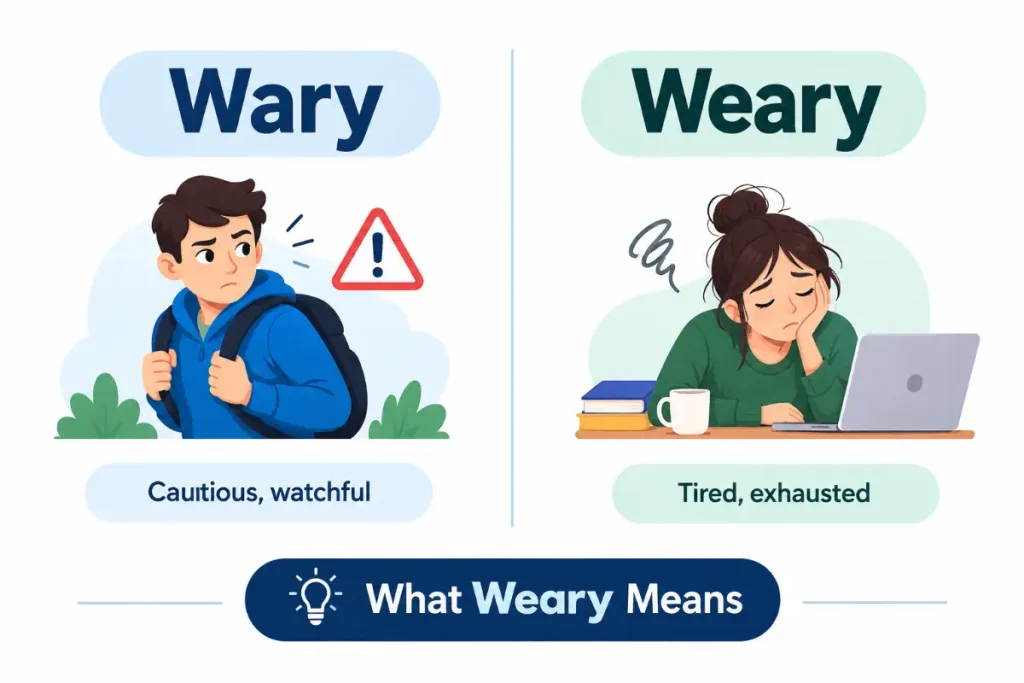
Understanding a useful word-meaning comparison can also help you distinguish between words that look or sound similar but communicate very different ideas.
Formal And Casual Usage
Both words are acceptable in American English across many settings.
Wary is neutral enough for casual conversation, workplace communication, journalism, academic writing, and professional documents.
For example:
- Casual text: Be wary of that seller.
- Workplace email: I would be wary of approving the request before reviewing the figures.
- Professional writing: Consumers may be wary of unexpected fees.
- Academic writing: Participants may be wary of sharing sensitive information.
Weary also works in formal and neutral writing, but it can sometimes sound more literary than tired.
In casual conversation, a person will often say:
- I am tired after work.
In descriptive writing, you might see:
- I was weary after a long day of travel.
Neither choice is wrong. The best word depends on the tone and the exact meaning you want.
When clarity matters most, tired is usually the most direct everyday choice for physical or mental fatigue. Weary becomes useful when you want to communicate prolonged tiredness, discouragement, or a sense of being worn down.
Word Origins Help Explain The Difference
Wary and weary have separate historical origins even though their modern spellings look closely related.
Wary developed from Old English and related Germanic forms associated with caution, awareness, and prudence. Its historical development reflects the idea of being attentive to possible danger.
Weary also comes from Old English, but its history centers on tiredness and exhaustion. Over time, the word developed broader uses connected with discouragement and becoming tired of prolonged difficulty.
The similar appearance of the modern words therefore does not mean they share the same meaning or serve the same grammatical function.
English contains many pairs that look or sound similar despite having unrelated histories. This is one reason spelling alone is not always a reliable guide to meaning.
Which Word Should You Use
- Choose wary when you want to express caution, concern, or suspicion.
- Choose weary when you want to express tiredness, exhaustion, boredom, or frustration caused by something continuing for too long.
- Choose leery when you want to express suspicion or caution in a natural informal style.
- Choose vary when you mean to change or differ.
A quick memory trick can make the choice easier.
Wary watches out. Weary wears out.
The connection is not a grammar rule. It is simply a useful memory device.
You can also use the substitution test.
- If cautious fits, choose wary.
- If tired fits, choose weary.
- If suspicious fits, choose wary or leery.
- If change or differ fits, choose vary.
Consider these four sentences.
- I was wary of the unfamiliar website.
- I was weary after working all day.
- I was leery of the unusually cheap offer.
- Prices vary by location.
Each word has a distinct job. Once you connect the spelling with the meaning, the confusion becomes much easier to avoid.
Frequently Asked Questions
Which is correct wary or weary
Both wary and weary are correct English words, but they have different meanings. Wary means cautious or suspicious about a possible problem. Weary means tired, exhausted, or mentally worn out. The correct choice depends on the meaning of your sentence rather than on spelling preference.
What does wary mean
Wary means cautious, careful, or suspicious because you think something could cause trouble or danger. It commonly appears in the pattern wary of. You can be wary of a stranger, website, offer, decision, message, or unfamiliar situation. The word focuses on caution rather than tiredness.
What does weary mean
Weary means very tired or worn out. It can describe physical fatigue after work or travel, as well as mental or emotional fatigue caused by stress or repetition. The phrase weary of means tired of something because it has continued for too long or become frustrating.
Are wary and weary homophones
No. Wary and weary are not standard homophones in American English. Their pronunciation is similar, but the first vowel sound is different. Wary is commonly pronounced like WAIR ee, while weary is commonly pronounced like WEER ee.
How do you pronounce weary
In American English, weary is commonly pronounced /ˈwɪr.i/. A simple pronunciation guide is WEER ee. The first syllable has a vowel sound similar to the sound in near or fear. The word has two syllables, with the stress placed on the first syllable.
How do you pronounce wary
In American English, wary is commonly pronounced /ˈwer.i/. A simple pronunciation guide is WAIR ee. The first syllable has a sound similar to air or care for many American speakers. The stress falls on the first syllable.
Is leery the same as wary
Leery and wary have closely related meanings because both can describe caution or suspicion. They are not identical in every context, but they can often replace one another. Weary is different because it describes tiredness or becoming tired of something that has continued for too long.
Is weary of grammatically correct
Yes. Weary of is a standard and grammatical expression. It means tired of something, often because it has continued for too long. For example, someone can be weary of repeated delays, constant complaints, or endless arguments. This meaning differs from wary of, which expresses caution or suspicion.
Conclusion
The difference between wary and weary becomes simple once you connect each word with its central idea. Wary means cautious, careful, or suspicious because you think a person, situation, or action could cause trouble. Weary means tired, exhausted, or worn down by effort, repetition, stress, or time.
They may look similar and sound similar, but they are not interchangeable. If you can replace the word with cautious, choose wary. If tired fits better, choose weary. Keep leery in the caution group and vary in the change group. One short memory trick can help too: wary watches out while weary wears out. Once that distinction becomes familiar, choosing the right word should feel almost automatic.