Have you ever written a sentence, paused for a second, and wondered if it should be dreamed or dreamt? It’s a common question because both forms appear in books, movies, songs, and everyday conversations. One writer uses dreamed, another chooses dreamt, and both seem perfectly natural.
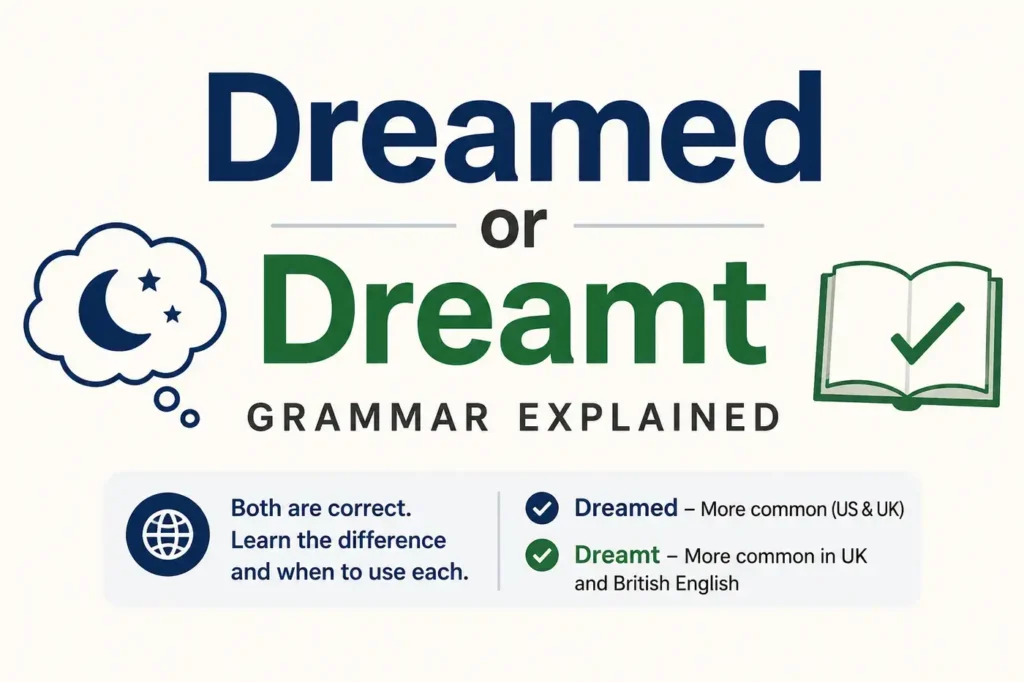
The simple answer is that both words are correct. They’re accepted past tense and past participle forms of the verb dream. The difference comes down to the variety of English you’re using, your audience, and sometimes your personal writing style. American English generally favors dreamed, while dreamt is more common in British English and several other regions.
That doesn’t mean one form is wrong or more formal than the other. Native speakers understand both without hesitation. The key is knowing when each one feels more natural and keeping your choice consistent throughout your writing.
This guide explains everything you need to know. You’ll learn the difference between the two forms, how they’re used in different countries, their pronunciation, grammar rules, real world examples, common mistakes, and practical writing tips from an editor’s perspective.
Quick Definition
Both dreamed and dreamt are correct past tense and past participle forms of the verb dream. Dreamed is the preferred form in American English, while dreamt appears more often in British English. They share the same meaning, pronunciation is nearly identical, and the choice mainly depends on regional preference and writing style.
Quick Answer
If you’re writing for an American audience, dreamed is usually the better choice because it’s the standard form in American English. If you’re writing for readers in the United Kingdom or countries that follow British English, dreamt is equally correct and often sounds more natural.
To make the rule easy to remember:
- Use dreamed for most American writing.
- Use dreamt for most British writing.
- Both forms mean exactly the same thing.
- Stay consistent throughout the same piece of writing.
Comparison Table
| Feature | Dreamed | Dreamt |
|---|---|---|
| Part of speech | Verb | Verb |
| Verb form | Past tense and past participle | Past tense and past participle |
| Meaning | Experienced a dream or imagined something | Experienced a dream or imagined something |
| Origin | Modern regular verb form | Traditional irregular verb form |
| Preferred usage | American English | British English |
| Formality | Standard | Standard |
| Common contexts | Everyday conversation, education, journalism, business writing | Literature, conversation, journalism, creative writing |
| Usage frequency | More common worldwide | Less common globally but common in British English |
| Example | I dreamed about my childhood. | I dreamt about my childhood. |
Meaning of Each Word
Although the spellings differ, both words express the same idea. They describe having a dream while sleeping or imagining something you hope will happen in the future.
What Does Dreamed Mean
Dreamed is the regular past tense and past participle form of dream. It’s the version most Americans learn in school and use in everyday writing.
You’ll commonly see it in:
- School assignments.
- News articles.
- Business communication.
- Academic writing.
- Everyday conversation.
Examples include:
- I dreamed about visiting Italy.
- She dreamed of becoming a doctor.
- We dreamed that everything would work out.
- He dreamed about his childhood home.
- They had dreamed of opening their own restaurant for years.
What Does Dreamt Mean
Dreamt has the same meaning but follows an irregular verb pattern that remains popular in British English. Many readers also feel it has a slightly more literary or traditional sound, especially in novels and poetry, although it’s perfectly natural in everyday British conversation as well.
You’ll often find it in:
- British novels.
- Newspapers in the United Kingdom.
- Australian publications.
- Irish writing.
- Everyday conversations across many English speaking countries outside the United States.
Examples include:
- I dreamt about the ocean last night.
- She dreamt of traveling around the world.
- They dreamt their hard work would pay off.
- He dreamt about his grandparents.
- We had dreamt of this moment for years.
Key Differences
The biggest difference isn’t grammar or meaning. It’s regional preference.
Here’s what sets them apart.
- Meaning. Both words mean exactly the same thing.
- Grammar. Both are correct past tense and past participle forms of dream.
- Pronunciation. The pronunciation is almost identical, with only a slight difference in the ending sound.
- Regional preference. American English strongly favors dreamed, while British English uses both forms but prefers dreamt more often.
- Writing style. Some writers feel dreamt has a more classic or poetic tone, but modern style guides accept both forms.
Think of these words the same way you think about learned and learnt or burned and burnt. The meaning stays the same even though regional preferences differ.
Which One Is Correct
Both forms are grammatically correct, so you don’t need to worry about choosing a wrong answer. The better question is which one matches your audience.
If your readers are in the United States, dreamed will usually sound more familiar because it’s the standard form taught in schools and used by most American publishers. If your audience is in the United Kingdom, dreamt often feels more natural since it’s widely accepted and frequently used alongside dreamed.
Professional editors rarely replace one with the other unless they’re adapting content for a specific audience. Their main concern is consistency. Switching between the two forms in the same article can distract readers and make the writing feel less polished.
A simple approach is to follow these guidelines.
- Choose dreamed for American English.
- Choose dreamt for British English when it suits the publication’s style.
- Follow your organization’s style guide if one exists.
- Use the same form consistently throughout your document.
Pronunciation Guide
Many learners wonder if the pronunciation changes along with the spelling. The answer is yes, but only slightly.
Dreamed Pronunciation
IPA pronunciation:
/driːmd/
Syllable breakdown:
Dreamed
One syllable.
The word ends with a soft d sound because ed is pronounced as d after the voiced consonant m.
Dreamt Pronunciation
IPA pronunciation:
/drɛmt/ or /driːmt/ depending on regional accent.
Syllable breakdown:
Dreamt
One syllable.
The ending has a crisp t sound, which makes the word feel slightly shorter and sharper when spoken.
Common Pronunciation Mistakes
Learners sometimes make these mistakes.
- Pronouncing dreamed as two syllables.
- Adding an extra vowel before the final t in dreamt.
- Confusing the ending with the present tense dream.
Listening to native speakers from both American and British English is a great way to become comfortable with each pronunciation. After a little practice, you’ll recognize both forms immediately in conversation.
Expert Language Insight
Many English learners assume that dreamt is old fashioned or that dreamed is the only modern option. That’s a common misconception.
In reality, both forms are alive and well. The difference comes from regional language preferences rather than grammar rules. American writers naturally lean toward dreamed, while British writers often use dreamt without giving it a second thought.
As an editor, I recommend matching your audience instead of worrying about which form sounds better. Readers notice consistency far more than the choice between these two perfectly acceptable verb forms.
Examples in Sentences
The easiest way to remember the difference is to see both forms in everyday writing. Since dreamed and dreamt have the same meaning, the context stays the same. Only the preferred spelling changes depending on the variety of English.
Dreamed Examples
These examples follow the style most commonly used in American English.
- I dreamed about my childhood home last night.
- She dreamed of becoming a successful architect.
- We dreamed that our vacation would never end.
- He dreamed about flying over the mountains.
- They dreamed of starting a family business together.
- I have always dreamed of visiting Japan.
- She dreamed she was walking along a quiet beach.
- The little boy dreamed about becoming an astronaut.
- We never dreamed the project would become so successful.
- They had dreamed of buying a house for many years.
Dreamt Examples
These examples reflect the spelling commonly seen in British English.
- I dreamt about my grandparents yesterday.
- She dreamt of living by the sea.
- We dreamt that we were exploring an ancient castle.
- He dreamt about winning the championship.
- They dreamt of opening their own café.
- I have always dreamt of seeing the Northern Lights.
- She dreamt she could speak every language in the world.
- The child dreamt about friendly dragons.
- We never dreamt life would change so quickly.
- They had dreamt of this opportunity for years.
Notice that every sentence would still be correct if you swapped dreamed with dreamt. The meaning never changes. Only the regional preference does.
Common Mistakes
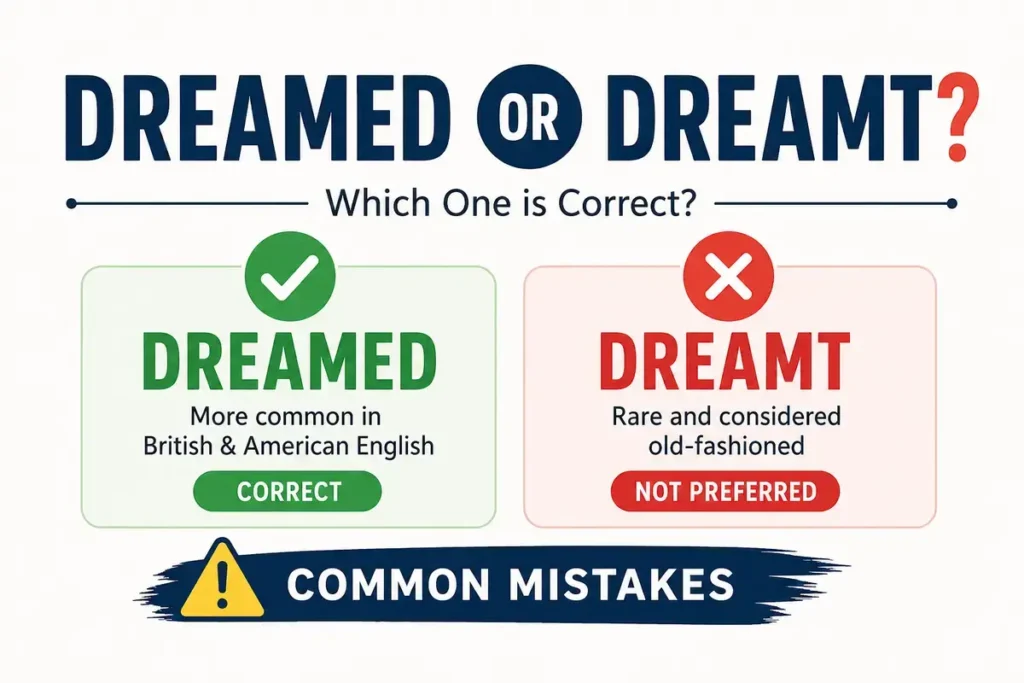
Many English learners think they have to memorize complicated grammar rules for these two forms. In reality, most mistakes come from misunderstanding regional usage rather than grammar.
Here are the errors editors see most often.
Thinking One Form Is Wrong
The biggest misconception is believing that only one word is correct.
Both dreamed and dreamt are accepted past tense and past participle forms of dream. Dictionaries and major style guides recognize both spellings.
Mixing Regional Styles
Writers sometimes begin an article with dreamed and later switch to dreamt without realizing it.
That inconsistency can distract readers, especially in educational or professional writing. Once you choose one form, keep using it throughout the document.
Assuming Dreamt Is Old Fashioned
Some people think dreamt disappeared years ago. It hasn’t.
Although dreamed is more common in American English, dreamt remains widely used in the United Kingdom, Australia, Ireland, and several other English speaking countries.
Using The Wrong Verb Form
Another mistake is confusing the past tense with the present tense.
Correct examples include:
- I dream every night.
- I dreamed about my family.
- I dreamt about my family.
- I have dreamed of traveling abroad.
- I have dreamt of traveling abroad.
Each sentence follows standard English grammar.
Etymology And Word Origin
The verb dream has a long history that stretches back to Old English. Early forms of the word referred to joy, music, or pleasant thoughts before gradually becoming associated with the dreams people experience while sleeping.
As English evolved, many verbs developed both regular and irregular past tense forms. The regular pattern added ed, creating dreamed, while the irregular pattern produced dreamt, much like learned and learnt or burned and burnt.
Over time, American English gradually favored the regular form because it matched the spelling pattern used by most English verbs. British English continued using both forms, allowing dreamt to remain a natural part of everyday language.
Today, neither form is newer or more correct. They simply represent different paths in the evolution of English.
Regional Usage
Regional preference is the biggest reason both forms continue to exist.
American English
American English strongly favors dreamed in everyday conversation, education, journalism, business writing, and publishing.
You’ll see it in:
- Newspapers.
- School textbooks.
- University writing.
- Business communication.
- Most American novels.
Although Americans recognize dreamt, they don’t use it nearly as often.
British English
British English accepts both forms, but dreamt appears more frequently than it does in American English.
You’ll commonly find it in:
- Newspapers.
- Books.
- Television scripts.
- Everyday conversation.
- Creative writing.
Many British writers choose dreamt because it feels familiar rather than formal.
Australian English
Australian English follows British conventions in many spelling and grammar choices. As a result, dreamt appears quite naturally, although dreamed is also understood.
Canadian English
Canadian English blends American and British influences.
Both forms appear in Canadian writing, but the preferred choice often depends on the publication, school, or organization’s style guide.
For international audiences, consistency matters far more than choosing one form over the other.
Grammar Rules
Understanding the grammar is much simpler than many learners expect because both words function exactly the same way.
Part Of Speech
Both dreamed and dreamt are verb forms.
They serve as:
- The past tense of dream.
- The past participle of dream.
Past Tense
Use either form to describe something that happened in the past.
Examples:
- I dreamed about college last night.
- I dreamt about college last night.
Both sentences are grammatically correct.
Present Perfect
The same rule applies after have, has, or had.
Examples:
- I have dreamed of becoming a pilot.
- I have dreamt of becoming a pilot.
- She had dreamed of this day for years.
- She had dreamt of this day for years.
The grammar doesn’t change. Only the preferred regional form does.
Common Sentence Patterns
You’ll often see these natural combinations.
- Dreamed of becoming.
- Dreamed about someone.
- Dreamed that.
- Dreamt of traveling.
- Dreamt about childhood.
- Dreamt that everything was possible.
These patterns appear regularly in both spoken and written English.
Real Life Usage Examples
The verb dream appears in almost every type of writing because people often talk about hopes, memories, ambitions, and sleep.
Daily Conversation
People naturally use both forms when talking about their dreams or future goals.
Examples include:
- I dreamed about you last night.
- She dreamt about her old school.
Academic Writing
American universities usually prefer dreamed, while British institutions may use either form depending on their editorial style.
Professional Communication
Business writing generally follows the regional standard.
An American company is more likely to write dreamed, while a British organization may naturally choose dreamt.
Literature
Novelists have more freedom than technical writers.
Some authors choose dreamt because they like its rhythm or traditional feel. Others prefer dreamed because it matches modern American usage. Neither choice is more literary by definition.
Media
News organizations usually follow their internal style guide. Once a publication chooses one form, editors use it consistently across every article.
That consistency helps readers focus on the story instead of noticing spelling differences.
Editor’s Tip
If you’re writing for yourself, choose the form that feels natural. If you’re writing for someone else, match the audience’s variety of English.
That’s exactly how experienced editors make the decision. They don’t ask which form is better. They ask which form best fits the readers.
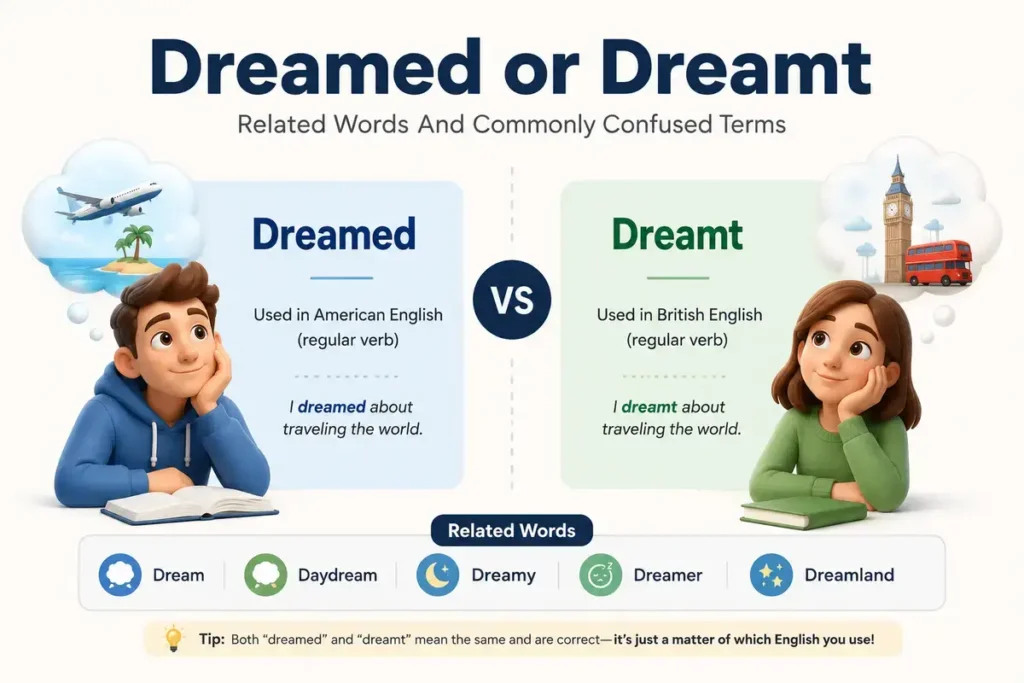
Related Words And Commonly Confused Terms
Learning one pair of verb forms often helps you understand several others. English has many verbs that follow a similar pattern, with one regular past tense ending in ed and another traditional form ending in t. Both versions are accepted, but regional preferences often influence which one people use.
Here are some similar verb pairs.
| American English | British English |
|---|---|
| Learned | Learnt |
| Burned | Burnt |
| Spoiled | Spoilt |
| Spelled | Spelt |
| Smelled | Smelt |
| Leaned | Leant |
These pairs don’t change the meaning of the verb. Like dreamed and dreamt, the main difference is the variety of English and, in some cases, personal writing style.
You may also come across related language terms while learning this topic.
- Regular verb.
- Irregular verb.
- Past tense.
- Past participle.
- American English.
- British English.
- Regional spelling.
- Verb conjugation.
- Standard English.
- Language variation.
Understanding these concepts will make it easier to recognize why English sometimes allows more than one correct form.
Expert Language Insight
One of the biggest myths about English is that every verb has only one correct past tense form. That’s true for many verbs, but not all of them.
Language evolves naturally, and some verbs preserve older forms alongside newer ones. Dreamed and dreamt are excellent examples. Both have existed for centuries, and both continue to appear in modern English. The difference isn’t about correctness. It’s about convention.
Professional editors usually don’t replace one form simply because they prefer it. Instead, they consider three things before making a change.
- Who is the audience?
- Which variety of English does the publication follow?
- Is the usage consistent from beginning to end?
If an article targets American readers, editors generally choose dreamed because that’s the form readers expect. If it’s written for a British audience, dreamt often feels more natural. Neither choice improves or weakens the writing on its own.
Native speakers rarely stop to think about the difference. They simply use the form they’ve grown up hearing. That’s why you’ll find both words in books, newspapers, television shows, and conversations around the world.
Frequently Asked Questions
Is dreamt a word?
Yes. Dreamt is a real English word and a correct past tense and past participle form of dream. It’s widely used in British English and appears in dictionaries, books, newspapers, and everyday conversation.
Which is correct, dreamed or dreamt?
Both are correct. Dreamed is the preferred form in American English, while dreamt is more common in British English. The meaning and grammar are identical, so the best choice depends on your audience.
Is dreamt used in the United States?
Yes, but it’s much less common than dreamed. Most Americans naturally use dreamed in both speech and writing, although they immediately recognize and understand dreamt.
Why do British people say dreamt?
British English has preserved many traditional verb forms that remain part of everyday language. Dreamt is one of those forms, much like learnt and burnt. It sounds completely natural to British speakers.
How do you use dreamed or dreamt in a sentence?
Both forms fit into the same sentence structure.
Examples include:
- I dreamed about my family last night.
- I dreamt about my family last night.
The only difference is the preferred regional form.
Is I have always dreamed correct?
Yes. I have always dreamed is grammatically correct and is the preferred wording in American English. In British English, many speakers naturally say I have always dreamt, and that is equally correct.
Do dreamed and dreamt have different meanings?
No. They describe the same action and follow the same grammar rules. Neither word changes the meaning of a sentence. The distinction comes from regional preference rather than definition.
Which form should I use in formal writing?
Use the form that matches your audience or your organization’s style guide. American publications generally prefer dreamed, while British publications often use dreamt. The most important rule is to stay consistent throughout the document.
Conclusion
Choosing between dreamed and dreamt is much easier once you know the basic rule. Both forms are correct, both share the same meaning, and both work as the past tense and past participle of dream. The main difference is regional preference, not grammar.
If you’re writing for an American audience, dreamed is usually the safest choice because it’s the form readers see most often. If your audience follows British English, dreamt is equally natural and widely accepted. Neither word is more accurate than the other, and neither changes the meaning of your sentence.
Instead of worrying about which form sounds better, think about who will read your writing. Match their variety of English, stay consistent from beginning to end, and you’ll make the same decision professional editors make every day.
English includes many word pairs like this, and they don’t make the language harder. They simply reflect its rich history and the way it has developed in different parts of the world. Once you understand that idea, choosing the right form becomes straightforward.