If you have ever paused while writing because you were unsure about choosing or chosing, you are in good company. This spelling mistake is surprisingly common because both words look believable at first glance. Many English learners and even native speakers wonder if both forms are correct or if one is simply a typo.
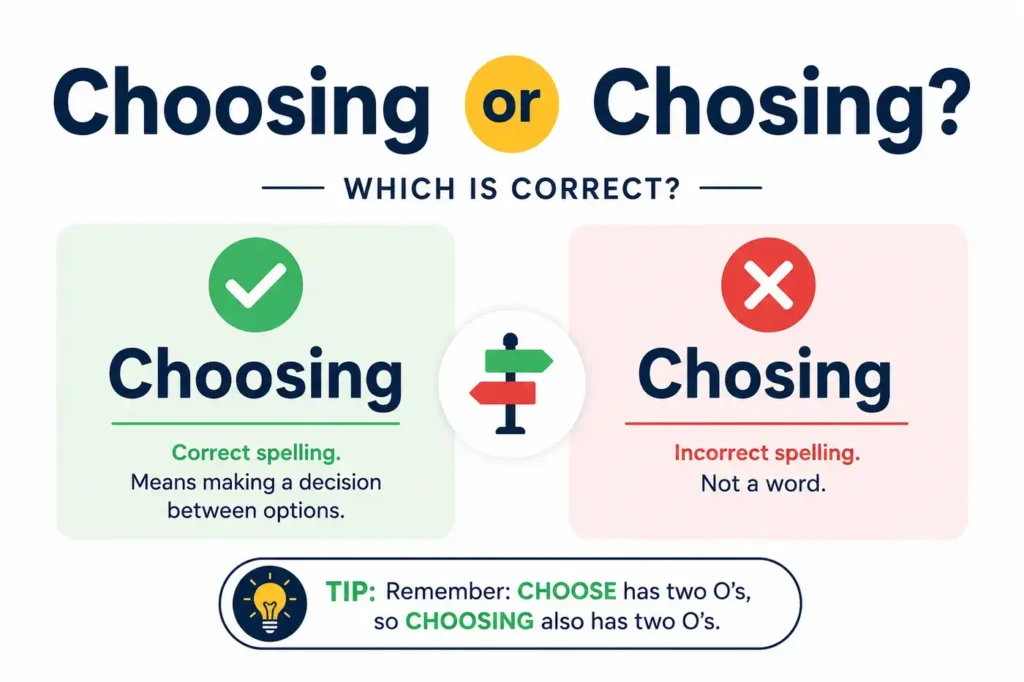
The short answer is easy. Choosing is the correct spelling. Chosing is a misspelling and is not accepted in standard English. The confusion usually happens because English spelling rules can feel inconsistent, especially when verbs change form. Words like choose, chosen, and choosing are closely related, which makes it easy to leave out a letter by accident.
This guide explains everything you need to know in clear, everyday language. You will learn the meaning of the word, why the spelling changes, how pronunciation affects the mistake, common grammar rules, real sentence examples, and practical tips that make the correct spelling easy to remember. By the end, you will know exactly which form to use and why.
Quick Definition
Choosing is the correct present participle and gerund form of the verb choose. It means selecting or deciding between two or more options. Chosing is an incorrect spelling and should not be used in formal or informal writing.
Quick Answer
If you are deciding between these two spellings, the answer is straightforward.
- Choosing is the correct spelling.
- Chosing is a spelling mistake.
- Use choosing whenever you mean selecting, picking, or making a decision.
- The spelling stays the same in American English, British English, Australian English, and Canadian English.
A simple way to remember it is this. The verb choose keeps the double o when it becomes choosing.
Comparison Table
| Feature | Choosing | Chosing |
|---|---|---|
| Spelling Status | Correct | Incorrect |
| Part of Speech | Present participle and gerund | Misspelling |
| Meaning | Selecting or making a decision | No accepted meaning |
| Origin | From the verb choose | Spelling error based on choose |
| Formality | Standard in all writing | Never appropriate |
| Common Contexts | Everyday conversation, education, business, literature | Typing mistakes and learner errors |
| Usage Frequency | Very common | Rare except as an error |
| Pronunciation | /ˈtʃuːzɪŋ/ | Not recognized as a standard word |
| Example | She is choosing a new laptop. | She is chosing a new laptop. ❌ |
If you’re interested in other commonly confused spellings, understanding the correct spelling of written can help you avoid another frequent writing mistake.
Meaning Of Choosing
The word choosing comes from the verb choose. It describes the action of selecting one option from two or more possibilities. Depending on the sentence, it can function as a verb or as a noun known as a gerund.
Here is the basic definition.
Choosing means making a decision after considering different options.
You will see it in many situations.
- Choosing a college.
- Choosing healthy food.
- Choosing a career.
- Choosing the right software.
- Choosing between two offers.
The word often suggests that someone has carefully considered the available options before making a decision.
Choosing As A Verb
When used as a verb, it describes an action happening now or around the present time.
Examples include:
- She is choosing a birthday gift for her friend.
- They are choosing new furniture for their home.
- We are choosing the best route for our trip.
Choosing As A Gerund
A gerund functions as a noun while keeping the form of a verb.
Examples include:
- Choosing the right words can improve your writing.
- Choosing healthy habits takes commitment.
- Choosing wisely often saves time and money.
In each example, choosing acts as the subject of the sentence rather than the action itself.
Meaning Of Chosing
The word chosing has no accepted meaning in modern English because it is not a correctly spelled word.
Most dictionaries do not list it as a valid entry. Instead, it appears when someone accidentally removes one of the two o letters from choose before adding ing.
This mistake is understandable because English contains many irregular spelling patterns. Still, professional writers, editors, teachers, and grammar checkers all recognize chosing as an error.
If you write chosing, readers may assume it is simply a typing mistake.
Key Differences
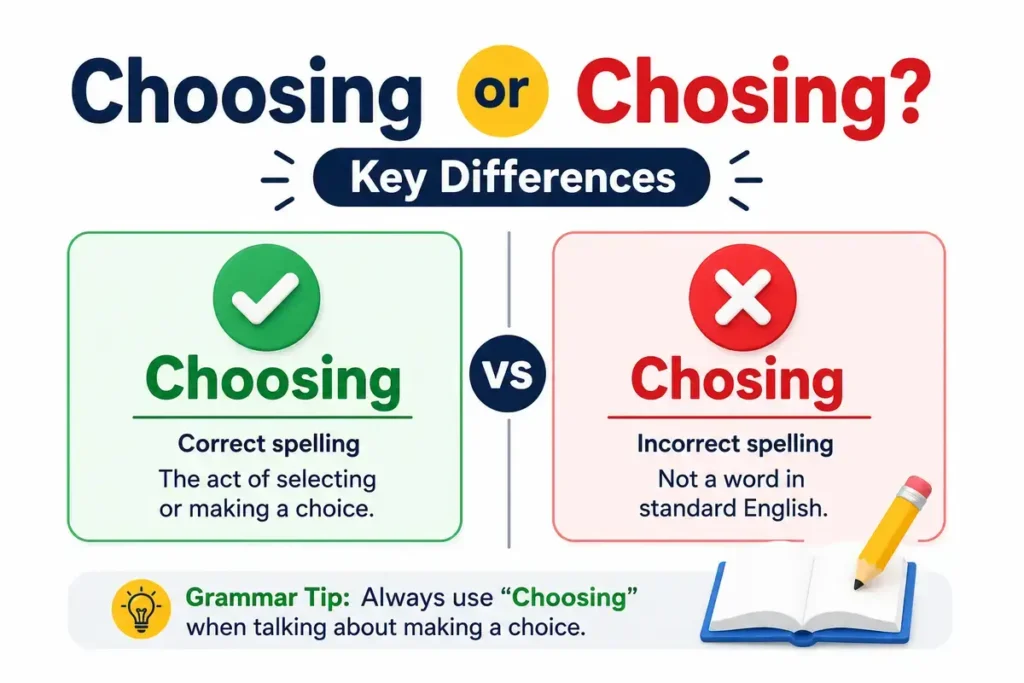
Although the two spellings look similar, only one belongs in standard English.
The biggest difference is that choosing is a correctly formed English word, while chosing is not. The extra o is not optional. It is part of the original verb choose, and it remains when the ing ending is added.
Here is a quick comparison.
- Choosing follows standard English spelling rules for the verb choose.
- Chosing breaks the spelling pattern and is considered incorrect.
- Choosing appears in dictionaries, books, newspapers, and academic writing.
- Chosing appears mainly in typing mistakes, spelling errors, or informal online posts that have not been edited.
- Grammar checkers and professional editors always replace chosing with choosing.
Remember one simple rule. If the base verb contains a double o, that double o stays when you add ing.
Which Spelling Is Correct
The correct spelling is choosing.
English spelling rules support this because the base verb is choose. When a verb ends with a silent e, the e is usually dropped before adding ing.
Here is what happens.
- Choose → Choosing.
- Make → Making.
- Drive → Driving.
- Smile → Smiling.
- Write → Writing.
Notice that only the silent e disappears. The double o remains because it is part of the original word.
Many spelling mistakes happen because people remove both the e and one o at the same time. That creates chosing, which is not recognized as a correct English word.
If you are unsure while writing, think of the base word first. If you can spell choose, you can easily spell choosing.
Pronunciation Guide
One reason people make this spelling mistake is that pronunciation does not clearly reveal the double o.
IPA Pronunciation
Choosing
/ˈtʃuːzɪŋ/
Syllable Breakdown
Choos.
Ing.
The word has two syllables.
How To Say It Naturally
Say it as:
CHOO zing
The first syllable rhymes with shoe and blue. The second syllable sounds like zing.
Common Pronunciation Mistakes
Although the pronunciation is usually correct, learners sometimes make these mistakes.
- Saying a short u sound instead of a long oo sound.
- Stressing the second syllable instead of the first.
- Assuming the spelling has only one o because the sound is heard only once.
A helpful memory trick is to connect the spelling with the sound. The long oo sound in choose carries over to choosing, so the double o stays in the spelling as well.
Expert Language Insight
Professional editors rarely confuse choosing with chosing because they focus on the base verb before checking the ending. This approach works for many English verbs. Instead of memorizing every verb form separately, identify the original word and then apply the spelling rule.
This habit not only improves spelling but also builds confidence when writing emails, essays, reports, or everyday messages. Once you recognize that choose always keeps its double o, the correct form becomes much easier to remember.
Examples In Sentences
Reading natural examples is one of the fastest ways to remember the correct spelling. Notice how choosing fits naturally into different situations. Every example below uses the word in a way that native English speakers commonly do.
Examples Using Choosing
- She is choosing a dress for the wedding.
- We spent hours choosing the perfect vacation destination.
- He is choosing a new laptop for college.
- They are choosing fresh vegetables for dinner.
- Choosing the right words can make your message clearer.
- The committee is choosing a new team leader this week.
- I enjoy choosing books at the local library.
- Parents play an important role in choosing a good school for their children.
- She is choosing between two excellent job offers.
- Choosing quality over quantity often leads to better results.
These examples show that the word works naturally in everyday conversation, academic writing, and professional communication.
Examples Showing The Incorrect Form
The following sentences contain a common spelling mistake. Each example also shows the correct version.
- ❌ She is chosing a birthday cake.
✅ She is choosing a birthday cake. - ❌ We are chosing new office furniture.
✅ We are choosing new office furniture. - ❌ He kept chosing the easiest option.
✅ He kept choosing the easiest option. - ❌ They are chosing a hotel near the beach.
✅ They are choosing a hotel near the beach. - ❌ I enjoy chosing gifts for my family.
✅ I enjoy choosing gifts for my family. - ❌ She was chosing a college major.
✅ She was choosing a college major. - ❌ The manager is chosing new employees.
✅ The manager is choosing new employees. - ❌ We finished chosing the paint colors.
✅ We finished choosing the paint colors. - ❌ Are you chosing a new phone today?
✅ Are you choosing a new phone today? - ❌ They spent the afternoon chosing wallpaper.
✅ They spent the afternoon choosing wallpaper.
Looking at both versions side by side helps you recognize the mistake immediately.
This confusion is similar to other spelling issues involving ordinal numbers, so reviewing ordinal number spelling rules can make these patterns much easier to remember.
Common Mistakes
Most spelling errors involving this word happen for predictable reasons. Understanding them makes it much easier to avoid repeating them.
Dropping One Letter Too Many
The most common mistake is removing both the silent e and one of the o letters.
Correct transformation:
Choose → Choosing
Incorrect transformation:
Choose → Chosing
Only the silent e disappears. The double o always remains.
Confusing Similar Verb Forms
Many learners mix these related words together.
- Choose.
- Chose.
- Chosen.
- Choosing.
Each word has a different grammatical role.
- Choose is the base form.
- Chose is the simple past tense.
- Chosen is the past participle.
- Choosing is the present participle and gerund.
Learning these forms together helps you understand how the verb changes across different tenses.
Trusting Autocorrect Too Much
Modern spell checkers catch most mistakes, but they are not perfect. Writers should still proofread their work because typing errors sometimes remain unnoticed, especially in informal messages or online posts.
Writing Too Quickly
Many spelling mistakes happen because people type faster than they think. Slowing down for a quick review often catches errors before anyone else sees them.
Forgetting The Base Word
Instead of memorizing the word on its own, remember the original verb.
Choose.
Once you know the base spelling, adding ing becomes much easier.
Etymology And Word Origin
The history of this word goes back much further than modern English.
The verb choose comes from Old English ċēosan, which meant to select, decide, test, or approve. It belongs to a family of Germanic words that expressed the idea of making a deliberate choice after considering different possibilities.
As English developed through the Middle English period, pronunciation and spelling gradually changed. The modern form choose became standard, while related forms such as chose, chosen, and choosing followed regular patterns used in English verb conjugation.
Although spelling has evolved over hundreds of years, the core meaning has remained remarkably consistent. Today, the word still describes the act of selecting one option from several possibilities.
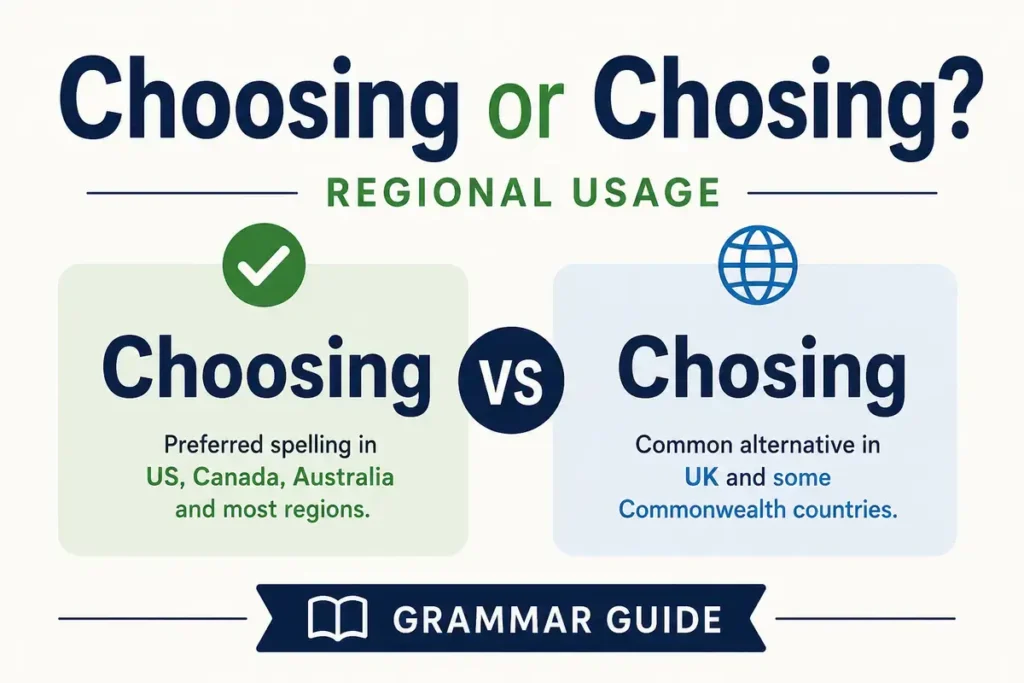
Regional Usage
Unlike some English words that have different spellings in different countries, this word follows the same spelling across the major varieties of English.
American English
American writers use choosing in schools, newspapers, books, business communication, and everyday conversation. The spelling is identical in formal and informal writing.
British English
British English also uses choosing. There is no alternative British spelling for this word, so readers expect to see exactly the same form.
Australian English
Australian English follows the same standard spelling. Teachers, publishers, and editors all use choosing.
Canadian English
Canadian English also recognizes choosing as the only correct spelling. Although Canadian English sometimes combines American and British spelling conventions, this word remains unchanged.
No matter where English is spoken, choosing is the accepted spelling.
Grammar Rules
Understanding the grammar behind the word makes it easier to use correctly in every sentence.
Part Of Speech
The word can perform two different grammatical functions.
- Present participle.
- Gerund.
Present Participle
When used with helping verbs such as is, are, or was, it becomes part of a continuous verb tense.
Examples include:
- She is choosing a new apartment.
- They were choosing gifts for the children.
- We are choosing the best solution.
Gerund
A gerund behaves like a noun while keeping the form of a verb.
Examples include:
- Choosing wisely takes patience.
- Choosing healthy meals benefits your body.
- Choosing honesty builds trust.
In these sentences, the word acts as the subject rather than the action.
Verb Pattern
The spelling follows a common English rule.
- Start with the base verb.
- Remove the silent e.
- Add ing.
Examples:
- Choose → Choosing.
- Make → Making.
- Bake → Baking.
- Arrive → Arriving.
- Save → Saving.
Knowing this pattern helps you spell many English verbs correctly.
Real Life Usage
This word appears in almost every type of communication because people make decisions every day.
Daily Conversation
People regularly use it while talking about ordinary decisions.
Examples include:
- Choosing what to cook.
- Choosing a movie.
- Choosing clothes.
- Choosing a restaurant.
- Choosing a gift.
Academic Writing
Students and teachers often use the word when discussing research, education, or critical thinking.
Examples include:
- Choosing reliable sources.
- Choosing an essay topic.
- Choosing the best research method.
Professional Communication
Businesses frequently use the word when discussing planning and decision making.
Common examples include:
- Choosing a supplier.
- Choosing a marketing strategy.
- Choosing the right candidate.
- Choosing software.
- Choosing investment options.
Literature
Authors use the word to describe important decisions that shape characters and plot development. A character may struggle with choosing between loyalty and ambition, family and career, or safety and adventure.
Media
Journalists and content creators often write about people choosing products, political candidates, travel destinations, healthcare plans, or financial services. The word naturally appears anywhere decisions are being discussed.
These examples show why choosing is such a common and useful English word. It fits naturally into everyday speech as well as formal writing.
Related Words And Commonly Confused Terms
Learning related words makes it easier to remember the correct spelling and use the verb accurately in different situations. Since these words come from the same root, they often appear together in writing and conversation.
Here are the most closely related forms.
| Word | Part of Speech | Meaning |
|---|---|---|
| Choose | Verb | To select or decide. |
| Chose | Past tense verb | Selected in the past. |
| Chosen | Past participle | Selected or picked. |
| Choice | Noun | The act of selecting or the option selected. |
| Choosy | Adjective | Hard to satisfy or selective. |
| Choosing | Present participle and gerund | Selecting or making a decision. |
You may also come across words with similar meanings. These are useful alternatives that can make your writing more varied and natural.
- Selecting.
- Picking.
- Deciding.
- Opting.
- Determining.
- Preferring.
- Electing.
- Identifying.
- Settling on.
- Making a decision.
Each synonym carries a slightly different meaning, so choose the one that best matches your sentence. For example, selecting often sounds more formal, while picking is common in everyday conversation.
Expert Language Insight
Experienced editors rarely think about this word in isolation. Instead, they focus on the complete verb family. Once you understand how choose, chose, chosen, and choosing relate to one another, the correct spelling becomes much easier to remember.
Another habit professional writers develop is proofreading slowly after finishing a draft. Spelling mistakes like chosing often happen because the brain reads the word you intended to write instead of the one actually on the page. Reading your work aloud or using a spelling checker helps, but neither replaces a careful review.
If you are learning English, avoid memorizing individual words without context. Study complete sentences instead. Seeing the word used naturally improves both your spelling and your grammar because you learn how it functions in real communication.
Learning the rules for forming plural words correctly will also help you avoid mistakes like confusing similar word endings in everyday writing.
Frequently Asked Questions
Is choosing or chosing correct?
Choosing is the correct spelling. It is the present participle and gerund form of the verb choose. Chosing is a misspelling and should not be used in formal or informal writing.
Why is chosing incorrect?
The mistake happens because some writers accidentally remove both the silent e and one o from the base verb. English spelling rules only require dropping the final e before adding ing, so the correct form is choosing.
What does choosing mean?
The word means selecting or deciding between two or more options. It can describe an action happening now or act as a noun that refers to the process of making a decision.
How do you use choosing in a sentence?
The word fits naturally into many situations. For example, She is choosing a new apartment near her office. You can also write, Choosing the right tool made the project much easier.
Is choosing a verb or a noun?
It can be both. It functions as a present participle when used with a helping verb, and it acts as a gerund when it works as a noun. The meaning depends on how it is used in the sentence.
Do British and American English spell it differently?
No. American English, British English, Australian English, and Canadian English all use the same spelling. There is no regional variation for this word.
How can I remember the correct spelling?
Start with the base verb choose. Remove the final e and add ing. Since the double o is part of the original word, it stays in the new form. Practicing this pattern with similar verbs also helps reinforce the rule.
What are some synonyms for choosing?
Common alternatives include selecting, picking, deciding, opting, electing, and making a decision. The best choice depends on the tone and context of your sentence.
Conclusion
If you have been wondering which spelling to use, the answer is simple. Choosing is the only correct form, while chosing is a spelling mistake that should be corrected before publishing or sharing your writing.
The confusion usually comes from the way English verbs change form. The base verb choose loses its final e before ing is added, but the double o remains. Remembering that single rule will help you spell this word correctly every time.
As you continue improving your English, focus on understanding spelling patterns instead of memorizing isolated words. Reading regularly, writing often, and reviewing your work carefully will strengthen both your vocabulary and your confidence. Small improvements like correcting common spelling mistakes can make your writing clearer, more professional, and easier for readers to trust.