Have you ever paused while writing because you could not decide between shakey or shaky? It is a common question, especially since both spellings appear online. Some websites, social media posts, and even published content use shakey, making it easy to assume that both forms are equally correct. That uncertainty often leaves writers wondering which spelling belongs in professional writing and which one should be avoided.
The short answer is simple. Shaky is the standard and widely accepted spelling in modern English. It appears in major dictionaries, style guides, newspapers, books, and academic writing. Shakey is usually treated as a variant spelling, a proper name, or an informal alternative rather than the standard adjective.
Understanding the difference is useful beyond passing a spelling test. Choosing the correct form helps your writing look polished, improves clarity, and builds credibility. This guide explains the meaning of each spelling, how native speakers use the word, its pronunciation, grammar, history, real life examples, and the situations where one spelling is clearly the better choice. By the end, you will know exactly which form to use with confidence.
Quick Definition
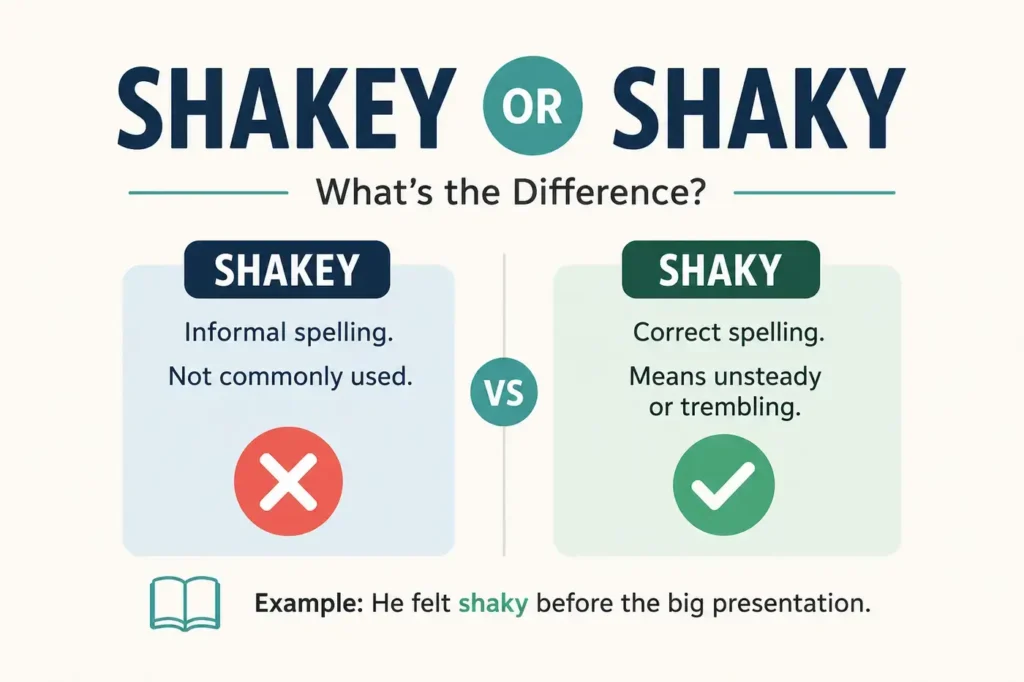
Shaky is the correct and standard spelling in modern English. It describes something that shakes, feels unstable, lacks strength, or appears uncertain. Shakey is much less common and is generally considered a nonstandard variant, although it may appear in names, informal writing, or older sources.
Quick Answer
If you only need the answer, here it is.
- Shaky is the correct spelling in American English and British English.
- Shakey is not the preferred spelling in standard dictionaries.
- Use shaky in essays, emails, business writing, articles, and professional communication.
- You may still see shakey in personal names, nicknames, brand names, or informal online content.
When in doubt, choose shaky. It is the spelling that readers, editors, and publishers expect.
Comparison Table
| Feature | Shaky | Shakey |
|---|---|---|
| Part of speech | Adjective | Usually a variant spelling or proper noun |
| Standard spelling | Yes | No in standard English |
| Meaning | Shaking, unstable, weak, uncertain | Usually intended to mean shaky |
| Dictionary recognition | Included in major dictionaries | Rarely listed as the standard form |
| Formality | Suitable for formal and informal writing | Generally avoided in formal writing |
| Common contexts | Everyday English, journalism, education, business | Names, nicknames, brands, informal writing |
| Usage frequency | Very common | Much less common |
| Example | The table felt shaky after the repair. | Shakey was the name of the old robot. |
If you’re editing formal documents, it’s also worth understanding the punctuation rules for footnotes to avoid common citation and formatting mistakes.
Meaning of Each Word
Although these spellings look almost identical, they do not carry the same level of acceptance in modern English. Knowing how each one is used helps you choose the right word in every situation.
What Does Shaky Mean
Shaky is an adjective that describes someone or something that moves unsteadily, lacks stability, or is not completely reliable. The word can describe physical movement, emotional states, financial conditions, relationships, health, confidence, and many other situations.
For example, a chair can be shaky because one leg is loose. A person’s hands can be shaky because they are nervous or cold. A business can have a shaky future if it faces financial problems.
Common meanings include:
- Physically unsteady.
- Weak or unstable.
- Nervous or trembling.
- Uncertain or unreliable.
- Lacking confidence or strength.
Because the word has both literal and figurative meanings, it appears in many different types of writing.
What Does Shakey Mean
Shakey usually represents an alternative spelling of shaky, but it is not considered the standard form in modern English. In most cases, editors replace it with shaky unless it is part of a specific name or title.
You may come across Shakey in situations such as:
- Personal nicknames.
- Company or brand names.
- Song titles.
- Historical references.
- Informal internet posts.
Outside these situations, professional writers almost always choose shaky.
Key Differences
At first glance, these spellings seem interchangeable, but there is an important difference. The difference is not in meaning. It is in acceptance and standard usage.
Here are the main distinctions.
| Shaky | Shakey |
|---|---|
| Standard English spelling | Nonstandard spelling in most contexts |
| Found in major dictionaries | Usually absent as the preferred form |
| Recommended by editors | Rarely recommended in formal writing |
| Used in education and publishing | Mostly limited to names or informal use |
| Suitable for professional writing | Better avoided unless required by a name |
If your goal is clear, professional communication, shaky is almost always the right choice.
Which Spelling Is Correct
The correct spelling is shaky.
Modern dictionaries, educational resources, publishers, and style guides consistently recognize shaky as the accepted adjective. It works in every type of writing, from school assignments and business reports to novels and newspaper articles.
That does not mean shakey never appears. English contains many proper nouns and creative spellings that do not follow standard dictionary forms. For example, a restaurant, musician, or fictional character may intentionally use Shakey as a name. In those cases, the spelling should remain exactly as it appears because names are not corrected to match dictionary spelling.
A simple way to decide is to ask yourself one question.
Are you describing something that is unsteady or unstable?
If the answer is yes, write shaky.
If you are referring to a person’s name, a brand, or a title that officially uses Shakey, keep the original spelling.
Pronunciation Guide
One reason people wonder about the spelling is that both forms sound exactly the same when spoken.
IPA Pronunciation
/ˈʃeɪ.ki/
Syllable Breakdown
Shay plus kee
The word has two syllables, with the stress on the first syllable.
How To Pronounce It Naturally
Say shay first, then add kee.
The pronunciation does not change because of the spelling. Native speakers pronounce shaky and shakey in exactly the same way.
Common Pronunciation Mistakes
Most learners pronounce the word correctly, but a few mistakes appear from time to time.
- Placing the stress on the second syllable.
- Shortening the first vowel sound.
- Pronouncing the ending like the word key with too much emphasis.
Listening to native speakers and reading the word aloud in complete sentences will help you develop a more natural pronunciation.
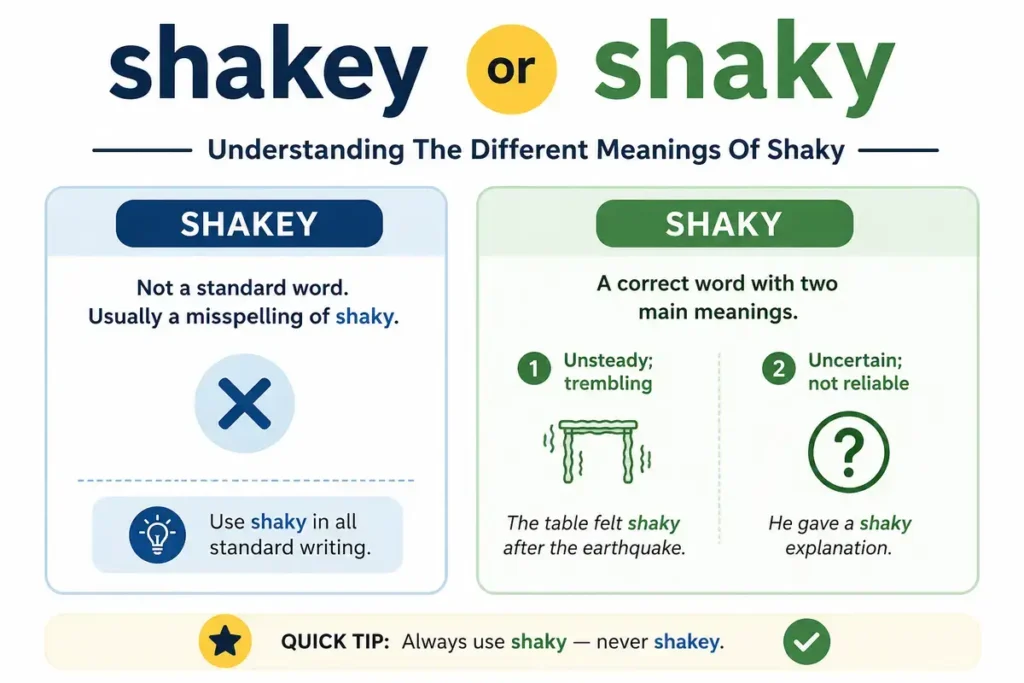
Understanding The Different Meanings Of Shaky
One reason this adjective appears so often is that it can describe both physical movement and abstract ideas. Native speakers use it in everyday conversations without giving it much thought because the intended meaning usually becomes clear from the context.
For example, if someone says their hands feel shaky, they are talking about physical movement. If they mention a shaky relationship, they are describing emotional uncertainty. A shaky argument suggests weak evidence, while a shaky economy refers to financial instability.
Here are some of the most common ways the word is used.
- Shaky hands describe hands that tremble because of nervousness, illness, cold weather, medication, or excitement.
- A shaky relationship describes one that lacks trust, stability, or long term confidence.
- A shaky person may refer to someone who is physically trembling or emotionally uncertain, depending on the situation.
- A shaky explanation suggests that the reasoning is weak or unsupported.
- A shaky future describes an uncertain outcome.
Learning these different meanings helps you understand why the word appears in news reports, books, conversations, and professional writing.
Much like the difference between putty and its common misspelling, the confusion between shakey and shaky comes from a spelling that looks plausible but isn’t the standard form.
Expert Language Insight
Experienced editors rarely question the choice between these spellings because standard English has already settled on shaky. The real decision is not about meaning but about context.
If you are writing an article, email, report, assignment, or business document, shaky is the spelling your readers expect. Choosing the standard form improves clarity and avoids distracting readers who may assume shakey is a spelling mistake.
The only time an editor leaves Shakey unchanged is when it belongs to an official name or title. In those situations, accuracy matters more than standard spelling because names should always appear exactly as their owners intend.
Examples In Sentences
Reading words in context is one of the fastest ways to understand how they are used. The examples below show the standard spelling in everyday situations and also explain why the alternative spelling appears from time to time.
Examples Using Shaky
These examples show the correct spelling in natural English.
- My hands felt shaky before the job interview.
- The old bridge looked shaky after the heavy storm.
- She gave a shaky smile as she walked onto the stage.
- The table became shaky after one of its legs came loose.
- His voice sounded shaky during the emotional speech.
- The company is in a shaky financial position this year.
- Their friendship became shaky after months of disagreement.
- I wrote my name in shaky handwriting because I was nervous.
- The evidence was too shaky to support the final decision.
- The athlete felt shaky after running the marathon in extreme heat.
Notice that the same adjective can describe physical movement, emotions, confidence, health, relationships, and ideas. Native speakers use it in all of these situations without changing its meaning.
Examples Using Shakey
The spelling Shakey is uncommon as a regular adjective, but you may still see it in names or informal writing.
- Shakey was the nickname everyone used for the old mechanic.
- The band released a song with Shakey in the title.
- The restaurant kept Shakey as part of its brand name.
- We visited a museum with an exhibit about Shakey the Robot.
- His online username includes the word Shakey.
- The author kept the original spelling because it was the character’s name.
- The company registered Shakey as its trademark.
- Some older websites still use the spelling Shakey.
- A few social media posts spell the word as Shakey instead of the standard form.
- Editors usually keep Shakey unchanged when it is part of an official name.
These examples show why both spellings appear online even though only one is considered standard English.
Common Mistakes
Many spelling mistakes happen because people rely on what looks familiar instead of checking a dictionary or style guide. Here are the mistakes editors notice most often.
Using Shakey In Formal Writing
This is the most common mistake.
Because Shakey appears in online searches and brand names, some writers assume it is an accepted alternative in every situation.
It is not.
For formal writing, school assignments, business communication, and professional articles, shaky is the correct choice.
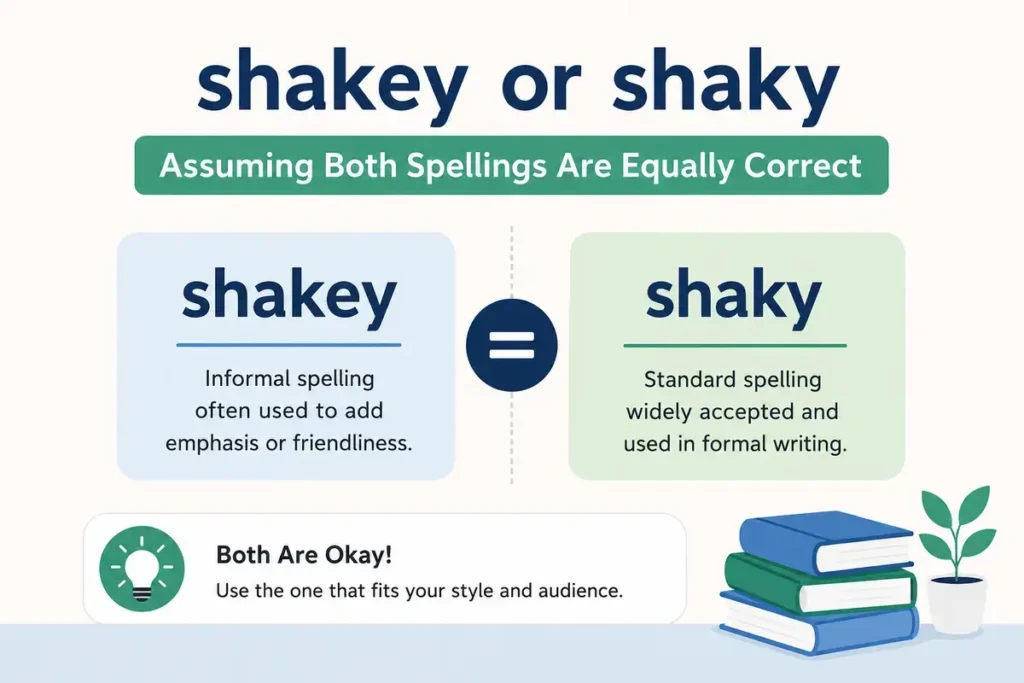
Assuming Both Spellings Are Equally Correct
Both spellings exist, but they are not equally accepted.
Professional dictionaries recognize shaky as the standard adjective. The other spelling survives mainly through names, titles, and informal use.
Correcting Proper Names
Sometimes writers make the opposite mistake by changing Shakey to shaky everywhere.
Names should never be corrected simply because they do not match dictionary spelling.
For example:
- A business name should remain exactly as registered.
- A book title should keep its original spelling.
- A person’s nickname should not be altered.
Confusing Meaning With Spelling
Some learners think the different spelling changes the meaning.
It does not.
Both forms usually refer to the same idea. The difference is that one spelling follows modern English standards while the other generally does not.
Using The Word Too Often
Another common writing mistake is repeating the adjective several times in the same paragraph.
Instead, choose a synonym when it fits naturally.
For example:
- Unsteady.
- Unstable.
- Trembling.
- Wobbly.
- Weak.
- Insecure.
- Uncertain.
- Fragile.
Using related words improves readability and prevents repetitive writing.
Etymology And Word Origin
The word shaky comes from the verb shake, which has existed in English for centuries. The verb developed from Old English and belongs to a large family of Germanic words connected with movement, trembling, and vibration.
As English evolved, speakers began adding the ending y to describe something that had the quality of shaking. This pattern appears in many English adjectives. For example, words such as cloudy, rainy, and dusty describe something that contains or resembles the noun they come from. In the same way, shaky describes something that shakes or lacks stability.
The spelling shakey appeared occasionally in informal writing and personal names, but it never became the accepted dictionary form. Over time, publishers, educators, and editors settled on shaky, making it the standard spelling used today.
Regional Usage
Unlike some English words that change spelling from one country to another, shaky remains the preferred form across major English speaking regions.
American English
American dictionaries, newspapers, schools, and businesses consistently use shaky.
Examples include:
- Shaky economy.
- Shaky hands.
- Shaky evidence.
- Shaky performance.
The spelling shakey is generally limited to names or informal writing.
British English
British English also prefers shaky.
Readers in the United Kingdom expect this spelling in books, newspapers, academic writing, and everyday communication.
Australian English
Australian publications follow the same pattern.
The standard adjective is shaky, while Shakey may appear only as part of a proper name or title.
Canadian English
Canadian English agrees with both American and British usage in this case.
The accepted spelling is shaky, making it one of the few words that does not differ across these major varieties of English.
This consistency makes the word easier to learn because you do not need to remember different spellings for different countries.
Grammar Rules
Understanding how the word functions in a sentence helps you use it more naturally.
Part Of Speech
Shaky is primarily an adjective.
It describes nouns by giving more information about their condition or quality.
Examples include:
- A shaky ladder.
- A shaky voice.
- A shaky agreement.
- A shaky bridge.
Predicate Adjective
The word often appears after linking verbs such as is, was, seems, and became.
Examples include:
- The chair is shaky.
- His hands became shaky.
- Their relationship seems shaky.
Comparative And Superlative Forms
Like many two syllable adjectives ending in y, the word changes naturally.
- Shakier.
- Shakiest.
Examples:
- This ladder is shakier than the old one.
- That bridge is the shakiest structure in the village.
Common Word Partnerships
Native speakers frequently combine the adjective with certain nouns.
Examples include:
- Shaky hands.
- Shaky voice.
- Shaky argument.
- Shaky relationship.
- Shaky economy.
- Shaky confidence.
- Shaky evidence.
- Shaky start.
- Shaky foundation.
- Shaky performance.
Learning these common combinations makes your English sound much more natural.
Real Life Usage Examples
This adjective appears in many types of communication because it describes both physical and abstract situations.
Daily Conversation
People often use it when talking about health, emotions, or objects.
Examples include:
- My hands are still shaky after drinking too much coffee.
- That old chair feels shaky.
- I was so nervous that my voice sounded shaky.
Academic Writing
Teachers and researchers may use the adjective to describe weak reasoning or unsupported conclusions.
For example:
- The study was based on shaky evidence.
- The conclusion rests on shaky assumptions.
Professional Communication
Business professionals often describe uncertain situations with this adjective.
Examples include:
- The company remains in a shaky financial position.
- Investor confidence looks shaky this quarter.
Literature And Media
Authors and journalists frequently use the word to create vivid descriptions.
Examples include:
- She crossed the shaky bridge without looking down.
- The witness gave a shaky account of the incident.
- The team’s shaky defense cost them the match.
Across all of these examples, the central idea remains the same. The word suggests instability, uncertainty, weakness, or trembling, depending on the context.
This is similar to why double letters cause spelling mistakes, where words like offered are often confused with incorrect variants despite having straightforward spelling rules.
Related Words And Confused Terms
As your vocabulary grows, you’ll notice several words that express ideas similar to shaky. Some are close synonyms, while others describe different kinds of instability. Knowing the difference helps you choose the most accurate word for the situation instead of repeating the same adjective.
Common Synonyms
Although these words share a similar meaning, each has its own nuance.
- Unsteady suggests a lack of balance or firm support.
- Unstable describes something that is likely to change, fail, or collapse.
- Wobbly usually refers to physical movement caused by poor balance.
- Trembling describes small, repeated movements, often caused by fear, cold, or illness.
- Quivering often refers to slight shaking caused by strong emotions.
- Fragile emphasizes weakness or the possibility of breaking.
- Weak describes a lack of physical strength, support, or effectiveness.
- Insecure often refers to emotional uncertainty or an unreliable situation.
- Precarious suggests that something could easily become dangerous or fail.
- Uncertain describes a situation that lacks confidence or predictability.
Choosing the right synonym makes your writing more precise. For example, a wobbly chair sounds more natural than an unstable chair, while an unstable economy usually sounds stronger than a wobbly economy.
Words That Are Often Confused
Some learners confuse shaky with words that have related meanings but different uses.
- Shaking describes the action of moving back and forth.
- Trembling usually refers to rapid, small movements caused by emotion or illness.
- Quaking often suggests stronger or more noticeable shaking.
- Rocking describes movement from side to side.
- Vibrating refers to very fast repeated movement.
Understanding these differences helps you choose words that sound natural in different contexts.
Expert Language Insight
Professional editors rarely spend time deciding between the spellings because the answer is already established in modern English. Their focus is on choosing the word that best matches the intended meaning and fits naturally within the sentence.
Native speakers use shaky in both literal and figurative ways. It can describe trembling hands, an unsteady ladder, uncertain evidence, weak arguments, or a relationship going through a difficult period. The context tells readers exactly which meaning is intended, so there is rarely any confusion.
Editors also avoid repeating the adjective too often. If several nearby sentences describe instability, they introduce alternatives such as unsteady, uncertain, fragile, or unstable. This creates smoother writing and keeps the text engaging without changing the meaning.
Another important habit is checking context before correcting a spelling. If Shakey appears as the official name of a person, business, product, or creative work, it should remain unchanged. Standard spelling rules do not override proper names.
Frequently Asked Questions
Is shaky a real word?
Yes. Shaky is a standard English adjective recognized by major dictionaries. It describes something that shakes, lacks stability, feels weak, or seems uncertain. The word is appropriate for both formal and informal writing.
Is shakey a correct spelling?
In standard English, shakey is not the preferred spelling. It usually appears as a personal name, nickname, business name, or informal variation. When you are describing something that is unsteady or uncertain, shaky is the recommended choice.
What does shaky mean?
The word describes something that is unstable, trembling, weak, or uncertain. It can refer to physical movement, emotional confidence, financial conditions, health, relationships, arguments, or any situation that lacks strength or stability.
What does shaky hands mean?
Shaky hands refers to hands that tremble or shake. This can happen because of nervousness, excitement, cold weather, fatigue, medication, medical conditions, or too much caffeine. The exact cause depends on the situation.
What does shaky relationship mean?
A shaky relationship is one that feels uncertain or unstable. It may involve trust issues, poor communication, frequent disagreements, or concerns about the future. The phrase does not always mean the relationship will end, but it suggests that it needs attention.
How do you pronounce shaky?
The word is pronounced /ˈʃeɪ.ki/. It has two syllables, with the stress on the first syllable. It sounds like SHAY kee.
Does British English use shaky?
Yes. British English, American English, Australian English, and Canadian English all use shaky as the standard spelling. Unlike many other English words, this spelling does not change across these major varieties of English.
What are some good synonyms for shaky?
Depending on the context, you can use unsteady, unstable, wobbly, trembling, fragile, uncertain, weak, precarious, insecure, or quivering. Each synonym carries a slightly different meaning, so choose the one that best matches your sentence.
Conclusion
If you have been wondering which spelling to use, the answer is straightforward. Shaky is the standard spelling accepted in modern English, while shakey is generally limited to names, nicknames, brands, and other specific titles.
The adjective shaky describes much more than physical movement. It can refer to trembling hands, uncertain relationships, weak arguments, unstable finances, or anything that lacks strength or confidence. Because it works in both literal and figurative contexts, it has become a common part of everyday English.
When writing for school, work, publishing, or professional communication, choose shaky with confidence. If you encounter Shakey as part of an official name, leave the spelling unchanged. Following this simple guideline will help your writing remain accurate, natural, and consistent.