Have you ever typed suit when you meant suite or paused before sending an email because both words sounded identical? You are not alone. These two words (suit vs suite) are among the most commonly confused pairs in English because they share the same pronunciation but have completely different meanings. A single misplaced letter can change the meaning of a sentence and make your writing look less polished.
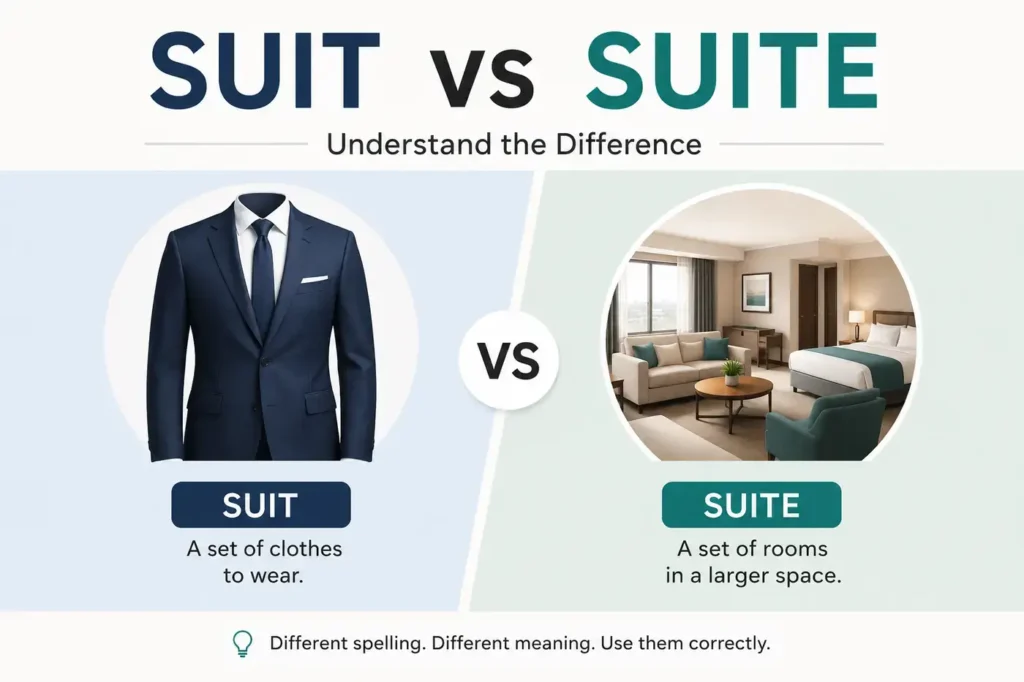
The simple answer is that suit usually refers to clothing, legal actions, card categories, or something that fits a person or purpose. Suite refers to a connected set of rooms, a collection of related items, or a group of software programs designed to work together. Although they sound exactly alike, they are never interchangeable.
This guide explains the difference in clear, everyday language. You will learn the meaning of each word, their pronunciation, origins, grammar rules, and real world usage. You will also discover common mistakes, memory tricks, and expert writing tips that help you choose the right word every time.
Quick Definition
Suit and suite are homophones, which means they sound the same but have different meanings and spellings. Suit commonly refers to clothing, legal proceedings, card suits, or something that matches a need. Suite refers to a connected group of rooms, a set of related items, or a software package. Choosing the correct word depends entirely on the context.
Quick Answer
The easiest way to remember the difference is to think about what you’re describing.
- Use suit when talking about clothing, legal cases, playing cards, or something that fits or satisfies a need.
- Use suite when referring to hotel accommodations, office spaces, collections of furniture, musical compositions, or software packages.
- If the word could mean a group or collection, suite is usually the correct choice.
- If the word describes something that fits, matches, or is worn, suit is almost always correct.
Understanding the context is much more useful than memorizing the spelling.
Suit And Suite Comparison Table
| Feature | Suit | Suite |
|---|---|---|
| Part of speech | Noun Verb | Noun |
| Meaning | Clothing legal case card category something appropriate | Connected rooms collection of related items software package |
| Origin | Old French and Latin | Old French from a word meaning sequence or following |
| Correct use | Clothing law cards suitable actions | Hotels offices music software furniture |
| Formality | Used in both formal and informal English | Used in both formal and informal English |
| Common contexts | Business fashion legal writing conversations | Travel hospitality technology business |
| Usage frequency | Very common | Common but more context specific |
| Pronunciation | Same as suite | Same as suit |
| Example | He wore a navy suit. | They booked a luxury suite. |
If you’re interested in other commonly confused spellings, our guide on the correct spelling of shaky explains why one version is standard English while the other is considered incorrect.
Meaning Of Suit
The word suit has several meanings, but they all relate to the idea of matching, fitting, or belonging in a particular situation. It can function as both a noun and a verb, making it one of the more flexible words in English.
Suit As A Noun
As a noun, suit most often refers to a matching set of clothes.
Examples include:
- He bought a new suit for the wedding.
- She wore a tailored business suit to the interview.
- His black suit looked elegant at the formal dinner.
The word also appears in card games.
Examples include:
- Hearts is my favorite suit.
- The queen belonged to the diamond suit.
- Every suit contains thirteen cards in a standard deck.
Another common meaning appears in legal writing.
Examples include:
- The company filed a civil suit.
- The court dismissed the suit after reviewing the evidence.
- She decided not to pursue the lawsuit after reaching an agreement.
Suit As A Verb
When used as a verb, suit means to be appropriate, convenient, or flattering.
Examples include:
- Friday afternoon suits my schedule.
- That color really suits you.
- This job suits his experience.
- The quiet neighborhood suits their lifestyle.
- Casual clothes suit the relaxed atmosphere.
This verb is extremely common in everyday conversation because people often talk about preferences, schedules, and compatibility.
Meaning Of Suite
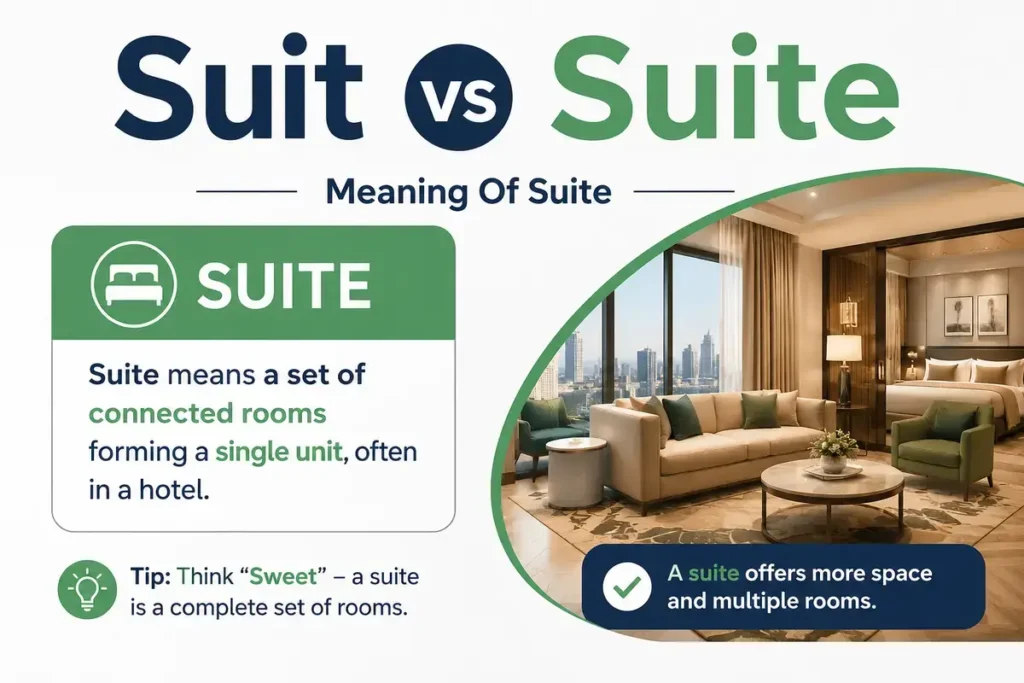
Unlike suit, the word suite functions only as a noun. It always refers to a connected group, collection, or set.
One of the most familiar meanings is a group of connected hotel rooms.
Examples include:
- They reserved a family suite for the vacation.
- The presidential suite overlooks the ocean.
- Every suite includes a private living area.
The word also appears in business settings.
Examples include:
- Her office is located in Suite 400.
- The law firm occupies an entire office suite.
- Visitors should report to the executive suite.
In technology, suite describes a collection of related software programs that work together.
Examples include:
- The company purchased a productivity suite.
- The design suite includes several creative applications.
- Students receive access to an educational software suite.
Music provides another important meaning.
A musical suite is a collection of short pieces designed to be performed as one composition.
Although this meaning is less common in everyday conversation, you’ll often encounter it in classical music and music education.
Key Differences Between Suit Vs Suite
Since both words sound exactly alike, context is the key to choosing the correct spelling. Looking at the purpose of each word makes the distinction much easier.
The most obvious difference is that suit can function as both a noun and a verb, while suite is always a noun. Their meanings also belong to completely different categories, so there is very little overlap.
Here are the main differences.
| Suit | Suite |
|---|---|
| Clothing or matching | Collection or connected group |
| Noun and verb | Noun only |
| Used in law | Not used in legal actions |
| Used in card games | Not used in card games |
| Describes something appropriate | Describes rooms software or grouped items |
Another simple way to remember them is this.
- Think of suit as something that fits, matches, or is worn.
- Think of suite as a collection or connected space.
- If you can replace the word with set or group, suite is often the correct choice.
These simple associations are much easier to remember than spelling rules alone.
Which Word Is Correct
Neither word is more correct than the other. The right choice depends entirely on what you want to say.
If you’re referring to clothing, a legal action, playing cards, or something that matches a person’s needs, suit is correct.
If you’re describing connected hotel rooms, office spaces, a collection of software programs, or another related group of items, suite is the correct spelling.
Before choosing between the two, ask yourself these questions.
- Am I talking about something that fits, matches, or is worn?
- Am I describing a connected group or collection?
- Could replacing the word with set still make sense?
Answering those questions usually leads you to the correct spelling in just a few seconds.
Pronunciation Guide
One reason people confuse these words is that they are pronounced exactly the same.
Suit Pronunciation
IPA pronunciation:
/suːt/
Syllable breakdown:
Suit
One syllable.
Suite Pronunciation
IPA pronunciation:
/suːt/
Syllable breakdown:
Suite
One syllable.
There is no pronunciation difference between the two words. Native speakers rely on context instead of sound to understand which word is intended.
Common Pronunciation Mistakes
Although the pronunciation is straightforward, some learners make these mistakes.
- Pronouncing suite as two syllables.
- Saying suite like sweet.
- Assuming the spelling changes the pronunciation.
In standard English, both words share exactly the same pronunciation.
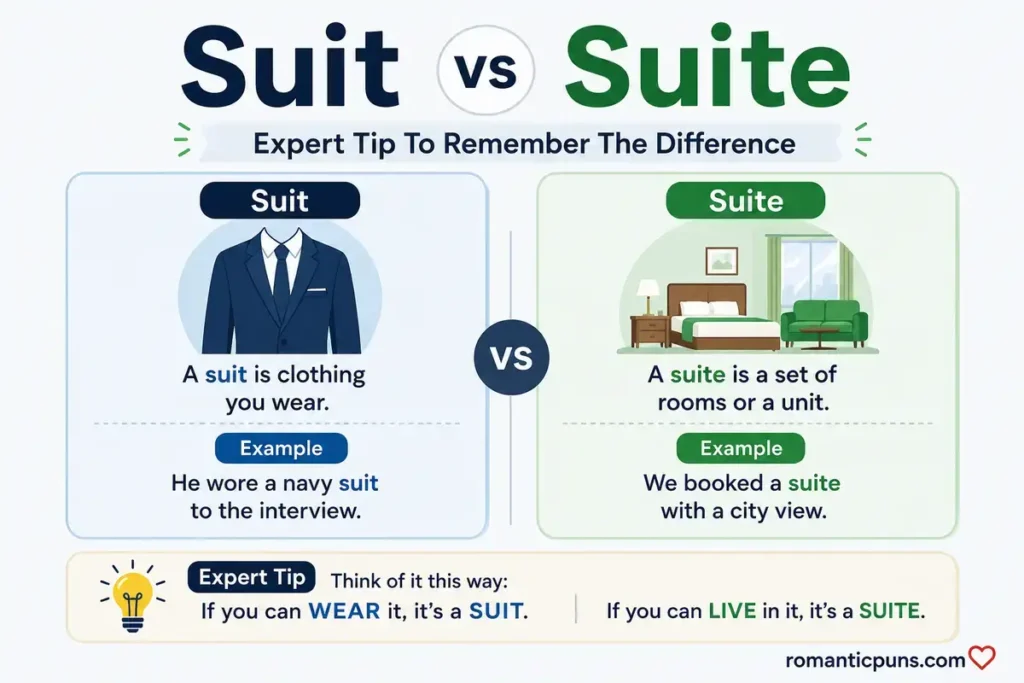
Expert Tip To Remember The Difference
Many learners focus only on the extra e in suite, but there’s a much better way to remember the spelling.
Think about the meaning first.
If the word refers to something that fits your needs, your clothing, a legal matter, or a card game, choose suit.
If it describes several related things working together, connected rooms, or a collection, choose suite.
This approach works in every context because you’re connecting the spelling to the meaning instead of relying on memorization.
Similar spelling mistakes often happen with plural nouns, so it’s worth learning how to form the plural of belly to avoid another common writing error.
Examples Using Suit Vs Suite
Reading real examples is one of the fastest ways to understand the difference between these two words. Notice how the meaning changes depending on the context. Although the pronunciation stays the same, the spelling always reflects what the sentence is describing.
Examples Using Suit
The word suit appears in many everyday situations because it has several meanings. It can describe clothing, legal actions, playing cards, or something that fits a person or purpose.
- He bought a new suit for his graduation ceremony.
- That navy suit looks professional and stylish.
- The lawyer filed a civil suit against the company.
- Hearts is my favorite suit in a deck of cards.
- This work schedule suits my lifestyle perfectly.
- The bright blue shirt does not suit the formal event.
- Her calm personality suits the role of a teacher.
- A lightweight suit is more comfortable during the summer.
- The meeting time suits everyone on the team.
- His experience makes him well suited for the position.
These examples show that suit often relates to clothing, compatibility, or legal and card game terminology.
Examples Using Suite
The word suite always refers to a connected group, collection, or set. The context usually makes the meaning clear.
- They reserved a luxury suite for their honeymoon.
- Our office is located in Suite 305.
- The hotel suite includes a living room and a private balcony.
- She installed a photo editing suite on her laptop.
- The company invested in a business software suite.
- The executive suite occupies the top floor of the building.
- The orchestra performed a beautiful orchestral suite.
- The family stayed in a spacious two bedroom suite.
- The creative suite includes tools for graphic design and video editing.
- Visitors should check in at the reception desk before entering the office suite.
As these examples show, suite usually refers to rooms, software, offices, or related collections.
Common Mistakes
People confuse these words because they are perfect homophones. They sound identical in conversation, so the listener usually understands the meaning from context. The confusion happens mainly in writing.
Here are the mistakes that appear most often.
Using Suite Instead Of Suit
Some writers accidentally add an extra e because they remember the pronunciation but not the meaning.
Incorrect:
- He wore a black suite to the wedding.
- That color really suites you.
Correct:
- He wore a black suit to the wedding.
- That color really suits you.
Remember that clothing and the verb meaning belong to suit, not suite.
Using Suit Instead Of Suite
The opposite mistake is also common.
Incorrect:
- They booked a hotel suit.
- The software suit includes several applications.
Correct:
- They booked a hotel suite.
- The software suite includes several applications.
If the word describes a group of rooms or a collection of related products, suite is the correct spelling.
Confusing Suit You And Suite You
One of the most searched questions is suit you or suite you.
The correct phrase is always suit you.
Examples include:
- Does Monday suit you?
- That hairstyle suits you.
- This opportunity suits your goals.
The phrase suite you is incorrect because suite cannot function as a verb.
Confusing Suit Or Suite Of Cards
When talking about playing cards, the correct word is always suit.
Examples include:
- Every suit contains thirteen cards.
- Clubs is one of the four suits.
- He collected every card in the same suit.
The spelling suite of cards is incorrect.
Confusing Suit Or Suite In Law
Legal writing uses suit, not suite.
Examples include:
- The company filed a civil suit.
- She settled the suit before the trial began.
- The judge dismissed the suit.
The word suite has no legal meaning in this context.
Etymology And Word Origin
Although these words sound exactly alike today, they developed along different paths and gradually took on separate meanings.
Origin Of Suit
The word suit comes from Old French siute, meaning a following or pursuit. It later entered Middle English and gradually expanded into several meanings.
Over time, English speakers used the word to describe:
- A legal proceeding.
- A set of matching clothes.
- A category of playing cards.
- Something appropriate or fitting.
These meanings may seem unrelated at first, but they all share the historical idea of following, matching, or belonging together.
Origin Of Suite
The word suite also comes from Old French and shares the same linguistic ancestor. English borrowed the French spelling later to describe a connected sequence or collection.
As the language evolved, suite became associated with:
- Connected hotel rooms.
- A group of offices.
- Musical compositions made up of several movements.
- Related software programs.
Although both words have a common historical root, modern English gives each one a distinct meaning.
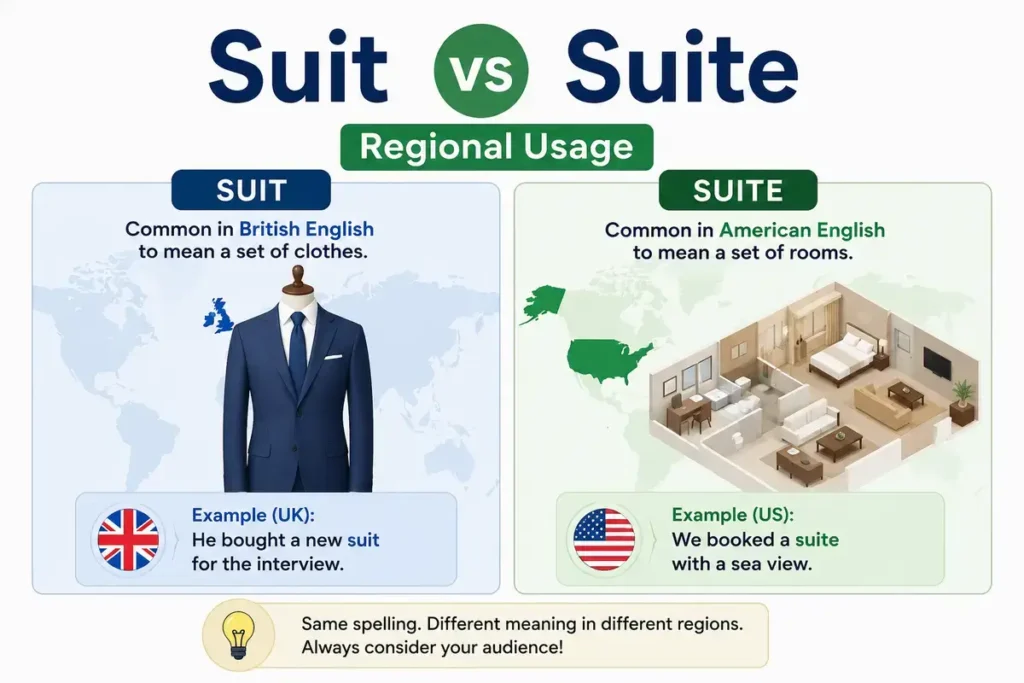
Regional Usage
One interesting fact about these words is that there is almost no regional difference in their meaning. English speakers around the world use suit and suite in the same way.
American English
American English uses suit for clothing, legal actions, playing cards, and the verb meaning to fit or satisfy.
The word suite commonly appears in:
- Hotels.
- Office addresses.
- Technology.
- Business communication.
British English
British English follows the same usage.
You’ll find suit in everyday conversation, legal documents, and clothing descriptions, while suite appears in hotels, business addresses, and music.
Australian English
Australian English also follows these meanings without significant differences.
Hotels advertise suites, businesses list office suites, and people wear suits to formal occasions.
Canadian English
Canadian English matches both American and British usage.
Because the meanings are stable across English speaking countries, writers rarely need to adjust these words for a regional audience.
Grammar Rules
Understanding how each word functions in a sentence makes choosing the correct spelling much easier.
Parts Of Speech
Suit can be:
- A noun.
- A verb.
Suite functions only as:
- A noun.
This is one of the easiest ways to tell them apart.
Verb Forms
Only suit changes form because it can be a verb.
Examples include:
- Suit.
- Suits.
- Suited.
- Suiting.
Examples in sentences:
- This schedule suits me.
- The proposal suited everyone.
- They are suiting the design to modern needs.
The word suite has no verb forms.
Plural Forms
Both nouns have regular plurals.
- Suit becomes suits.
- Suite becomes suites.
Examples include:
- The store sells business suits.
- The hotel offers several luxury suites.
Common Sentence Patterns
You’ll often see these natural patterns.
Using suit:
- Suit someone.
- Suit your needs.
- File a suit.
- Wear a suit.
- Card suit.
Using suite:
- Hotel suite.
- Office suite.
- Software suite.
- Executive suite.
- Musical suite.
Learning these common combinations helps you recognize the correct spelling almost instantly.
Real Life Usage
These words appear in many different fields, so understanding them improves both speaking and writing.
Daily Conversation
People often use suit when discussing clothing, schedules, or preferences.
Examples include:
- Does Friday suit you?
- That jacket suits you well.
Travel conversations often include suite.
Examples include:
- We booked a family suite.
- The honeymoon suite has an ocean view.
Academic Writing
In educational materials, suit appears in discussions about law, language, and literature.
Suite frequently appears in music education, architecture, hospitality, and information technology.
Professional Communication
Businesses use both words regularly.
Examples include:
- Please visit our office in Suite 220.
- A dark business suit is recommended for the interview.
- The software suite improves team productivity.
- The legal team prepared the civil suit.
Literature And Media
Novelists often describe characters wearing suits or staying in luxury suites.
Technology articles frequently discuss software suites, while legal reporting regularly mentions civil suits.
Understanding these contexts makes it much easier to choose the correct spelling naturally instead of stopping to think every time you write.
If silent-e words sometimes trip you up, you’ll also find it helpful to learn why “using” has no extra e, a mistake that follows a similar spelling pattern.
Related Words And Commonly Confused Terms
Once you understand the difference between suit and suite, it becomes much easier to recognize other words that people often confuse. Most of these pairs either sound alike or have similar spellings, which makes them easy to mix up during writing.
Here are some common examples.
- Affect and effect.
- Advice and advise.
- Accept and except.
- Compliment and complement.
- Principal and principle.
- Stationary and stationery.
- Then and than.
- Farther and further.
- Lose and loose.
- Quiet and quite.
These word pairs have different meanings even though they may look or sound similar. The safest approach is to think about the meaning of the sentence before choosing a spelling.
You should also become familiar with these related terms because they often appear alongside suit and suite.
- Business attire.
- Formal wear.
- Lawsuit.
- Playing cards.
- Hotel accommodation.
- Executive office.
- Software package.
- Productivity tools.
- Musical composition.
- Compatibility.
Building your vocabulary around these related terms helps you recognize the correct word naturally instead of relying on memorization.
Expert Language Insight
Professional editors rarely confuse suit vs suite because they read for meaning rather than spelling alone. That’s a useful habit for every writer.
When you come across one of these words, pause for a moment and ask yourself what the sentence is actually describing. Is it talking about clothing, a legal action, playing cards, or something that fits a person or situation? If the answer is yes, suit is almost certainly the correct choice.
If the sentence describes a collection of related things, connected hotel rooms, office spaces, or software applications that work together, suite is the word you need.
Another helpful observation is that native speakers rarely stop to think about these spellings while speaking because both words sound exactly alike. The decision happens only during writing. That’s why proofreading is so important. Reading your sentence one more time gives you a chance to check that the spelling matches the meaning.
Many editors also recommend learning common word combinations instead of isolated definitions. Phrases like business suit, civil suit, hotel suite, and software suite become familiar through repeated exposure. Once those combinations feel natural, choosing the correct spelling becomes almost automatic.
Frequently Asked Questions
What is the difference between suit and suite?
The main difference is their meaning. Suit refers to clothing, legal actions, playing cards, or something that matches a person or purpose. Suite refers to a connected set of rooms, a collection of related items, or a group of software programs. Although they sound identical, they are used in completely different contexts.
Which spelling should I use for a hotel room?
Use suite when referring to a hotel room with separate living or sleeping areas. Hotels often offer family suites, executive suites, and presidential suites. The spelling suit is incorrect in this context.
Is it suit you or suite you?
The correct phrase is suit you because suit functions as a verb meaning to be suitable or appropriate.
For example:
- Does this time suit you?
- That hairstyle really suits you.
The phrase suite you is always incorrect.
How do you pronounce suit and suite?
Both words have the same pronunciation.
IPA pronunciation:
/suːt/
Each word has one syllable, and native speakers rely on context rather than pronunciation to tell them apart.
Is it suit or suite of cards?
The correct expression is suit of cards or simply card suit. A standard deck contains four suits: hearts, diamonds, clubs, and spades.
The spelling suite of cards is incorrect.
Is it suit or suite in law?
Legal writing always uses suit.
Examples include:
- Civil suit.
- Class action suit.
- File a suit.
- Dismiss a suit.
The word suite has no legal meaning.
What is a software suite?
A software suite is a collection of related programs designed to work together. Office applications, graphic design tools, and security products are often sold as software suites because they share features and integrate with one another.
Why do people confuse these words?
People confuse them because they are homophones. They sound exactly the same in spoken English, but their spellings and meanings are completely different. Understanding the context is the easiest way to choose the correct word.
Conclusion
Although suit vs suite sound exactly alike, they serve very different purposes in English. Suit refers to clothing, legal matters, playing cards, or something that fits a person or situation. Suite describes a connected set of rooms, a collection of related items, or a group of software programs.
The easiest way to choose the correct spelling is to think about the meaning before you write. If the sentence is about something that matches, fits, or is worn, use suit. If it describes a group, collection, or connected space, use suite.
You do not need to memorize complicated grammar rules to avoid this mistake. Learning the most common contexts and word combinations will help you recognize the correct spelling naturally. With a little practice, choosing between these two words becomes quick, accurate, and effortless.