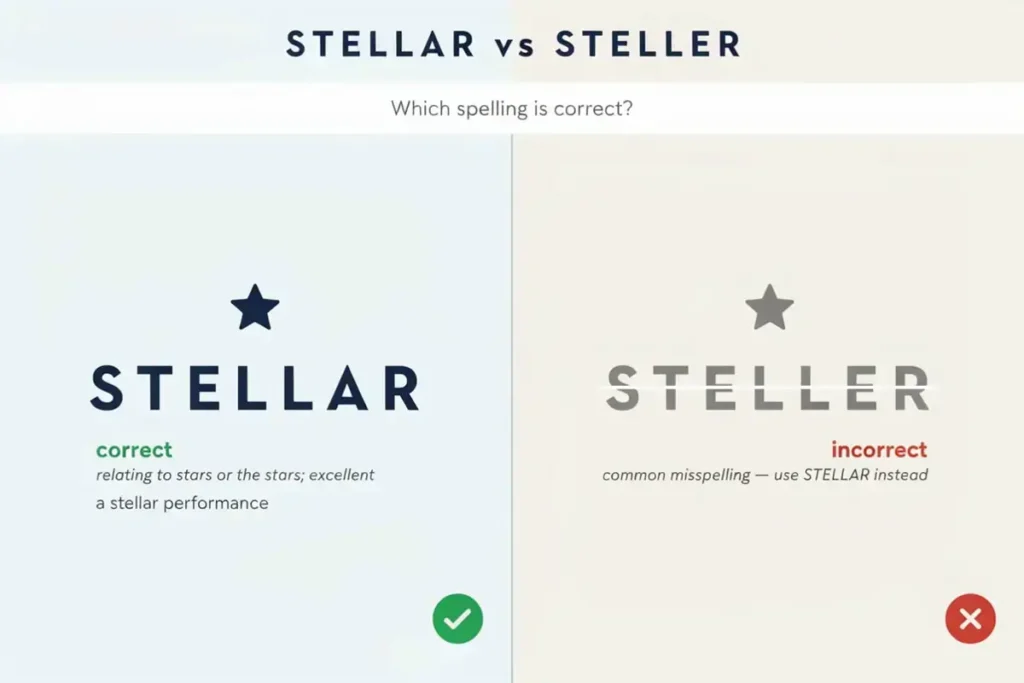
If you’ve searched for stellar vs steller, chances are you’ve seen both spellings online and wondered if they mean the same thing. It is a common point of confusion because the words differ by only one letter, and many people accidentally type the wrong version. Spell checkers do not always catch the mistake, especially when a name or brand is involved.
The short answer is simple. Stellar is the correct English word in almost every situation. It describes something related to stars or something that is exceptionally good. Steller is not an alternative spelling of stellar. Instead, it is a proper noun that appears in names, most famously in Steller’s sea eagle and Steller sea lion, both named after the eighteenth century German naturalist Georg Wilhelm Steller.
Understanding the difference is important because using the wrong spelling can change the meaning of your sentence and make your writing look less polished. This guide explains the meaning of both words, their origins, pronunciation, grammar, regional usage, real world examples, and common mistakes. By the end, you will know exactly when to use each term and avoid one of the most frequent spelling mix ups in English.
Quick Definition
Stellar is the correct English adjective meaning related to stars or exceptionally good. Steller is a proper noun that usually appears in names honoring the naturalist Georg Wilhelm Steller. The two words are not interchangeable, even though they look similar and sound almost the same.
Quick Answer
If you only need the answer, here it is.
- Stellar is the correct spelling in standard English when describing stars, outstanding performance, or exceptional quality.
- Steller is used mainly in proper names, such as Steller sea lion and Steller’s jay.
- Do not replace stellar with steller in ordinary writing.
- If you are praising something, stellar is almost always the word you need.
A simple way to remember the difference is to connect stellar with stars. Both words begin with the same letters, making the association easier to recall.
Comparison Table
| Feature | Stellar | Steller |
|---|---|---|
| Part of speech | Adjective | Proper noun and surname |
| Meaning | Related to stars or exceptionally good | A surname used in scientific names |
| Origin | Latin stellaris meaning relating to stars | Named after Georg Wilhelm Steller |
| Correct form | Standard English word | Proper name only |
| Formality | Standard in both formal and informal writing | Used in scientific and historical contexts |
| Common contexts | Astronomy education business reviews everyday conversation | Wildlife biology zoology history |
| Usage frequency | Very common | Rare outside proper names |
| Example | She gave a stellar presentation. | The Steller sea lion lives in the North Pacific. |
Just as the difference between naive and nieve often trips up writers because one is a common misspelling, stellar and steller are frequently confused due to their similar appearance.
Meaning Of Stellar
The word stellar has two closely related meanings, and both are widely accepted in modern English.
The original meaning describes something connected with stars or outer space. Scientists, astronomers, and science writers regularly use the word when discussing galaxies, constellations, stellar evolution, or stellar explosions.
Over time, the word developed a second meaning that people now use in everyday conversation. Today, calling something stellar usually means it is outstanding, impressive, or exceptionally good. You might hear someone describe a student’s performance, a restaurant review, or a business achievement as stellar because it exceeded expectations.
Here are the most common ways the word is used.
- In astronomy to describe objects or events related to stars.
- In everyday conversation to praise outstanding performance.
- In business writing to highlight exceptional results.
- In education to recognize excellent academic achievement.
- In entertainment reviews to compliment remarkable acting, music, or storytelling.
The meaning changes slightly depending on the context, but the idea of excellence or connection to stars remains consistent.
Meaning Of Steller
Unlike stellar, Steller is not a descriptive English adjective. It is a surname that became part of scientific naming after the work of Georg Wilhelm Steller, an eighteenth century explorer, physician, and naturalist.
During his expeditions across northern Asia and the North Pacific, Steller documented numerous plants and animals that were unknown to European science at the time. Many species were later named in his honor.
Some well known examples include:
- Steller sea lion.
- Steller’s jay.
- Steller’s sea eagle.
- Steller’s eider.
In these cases, Steller functions as part of a proper name rather than a regular vocabulary word. Outside scientific, historical, or geographical references, most English speakers rarely encounter it.
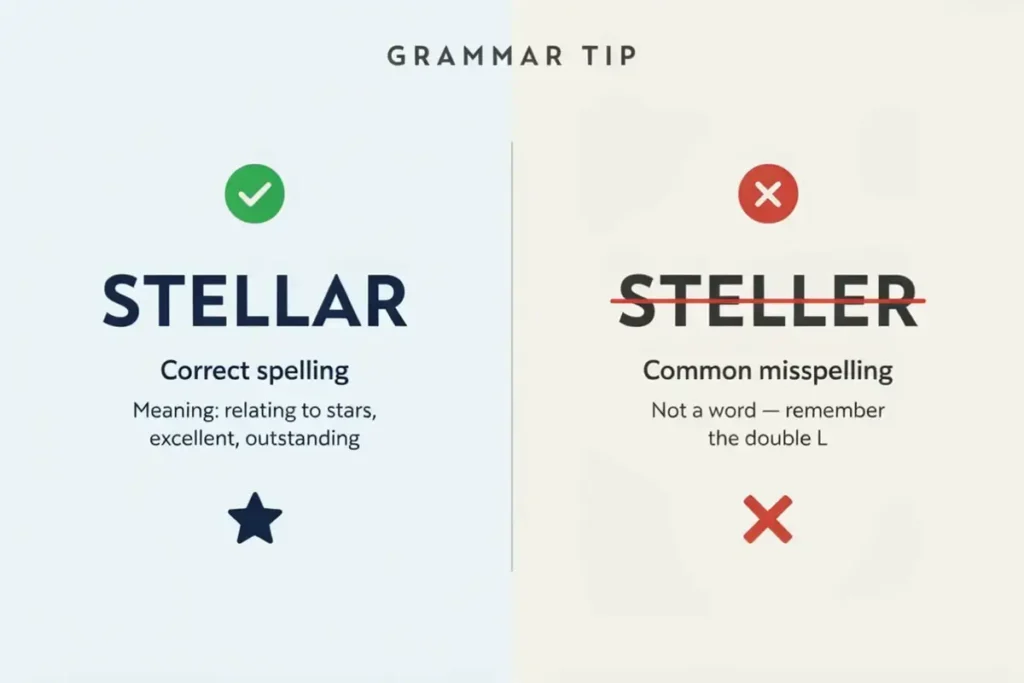
Understanding this distinction prevents a very common spelling mistake. If you are describing excellent work, impressive quality, or something related to stars, the correct word is stellar, not Steller.
Key Differences
Although the two words differ by just one letter, they have completely different purposes in English.
The easiest way to remember the distinction is to think about what each word represents. One is a standard adjective used every day. The other is a proper name connected with history and biology.
Here are the biggest differences.
- Stellar is an adjective, while Steller is primarily a surname.
- Stellar describes excellence or something related to stars, while Steller appears in scientific names.
- Stellar is common in everyday English, while Steller is uncommon outside zoology and history.
- Stellar belongs in general writing, while Steller usually belongs in proper nouns.
- Confusing the two creates a spelling error in most situations.
Keeping these differences in mind makes it much easier to choose the correct word every time.
Which One Is Correct
For almost every piece of everyday writing, stellar is the correct choice.
If you are talking about an excellent performance, an impressive achievement, a beautiful night sky, or anything related to stars, use stellar. It is the accepted spelling in dictionaries, style guides, newspapers, books, and academic writing.
Use Steller only when referring to a person named Steller or to a species, place, or object officially named after Georg Wilhelm Steller.
Before choosing between the two, ask yourself one question.
Are you describing excellence or something connected with stars, or are you referring to a specific scientific name?
If the answer is excellence or stars, write stellar. If you are referring to the naturalist or a species named after him, Steller is appropriate.
Stellar and Steller Pronunciation Guide
One reason people confuse these words is that they sound very similar when spoken.
Stellar
IPA pronunciation:
/ˈstɛlər/
Syllable breakdown:
Stel lar
Steller
IPA pronunciation:
/ˈstɛlər/
Syllable breakdown:
Stel ler
In everyday speech, most native English speakers pronounce both words almost identically. The difference exists mainly in spelling and meaning rather than pronunciation. That is why writers often make the mistake when typing instead of speaking.
If you enjoy learning about commonly confused word pairs, our guide on when to use reins or reigns explains another mistake that frequently appears in everyday writing.
Expert Learning Tip
Do not rely on pronunciation to choose the correct spelling because it will not help you. Instead, think about the meaning first.
If the sentence is about stars, outstanding quality, or exceptional performance, stellar is the word you need. If the sentence names an animal, bird, or another scientific term honoring Georg Wilhelm Steller, then Steller is correct.
Professional editors rarely confuse these words because they always check the context before checking the spelling. Developing the same habit will make your writing more accurate and much more confident.
Examples In Sentences
Reading words in context is one of the fastest ways to remember the correct spelling. Since these terms serve completely different purposes, the examples below highlight how each one is naturally used.
Stellar Examples
The adjective stellar appears in everyday conversations, professional writing, academic work, and astronomy. In most situations, it describes something connected with stars or something exceptionally good.
- The team delivered a stellar performance during the championship game.
- Her stellar presentation impressed everyone in the meeting.
- The scientist published a paper on stellar evolution.
- We enjoyed a stellar view of the night sky from the mountains.
- His stellar customer service earned him Employee of the Month.
- The restaurant received stellar reviews from local food critics.
- She has built a stellar reputation through years of honest work.
- The telescope captured stunning images of stellar formations.
- Their company reported stellar growth this quarter.
- The actor gave another stellar performance that critics praised.
Notice how the same word works naturally in both scientific and everyday contexts. The meaning changes slightly with the situation, but it always suggests either a connection to stars or a very high level of quality.
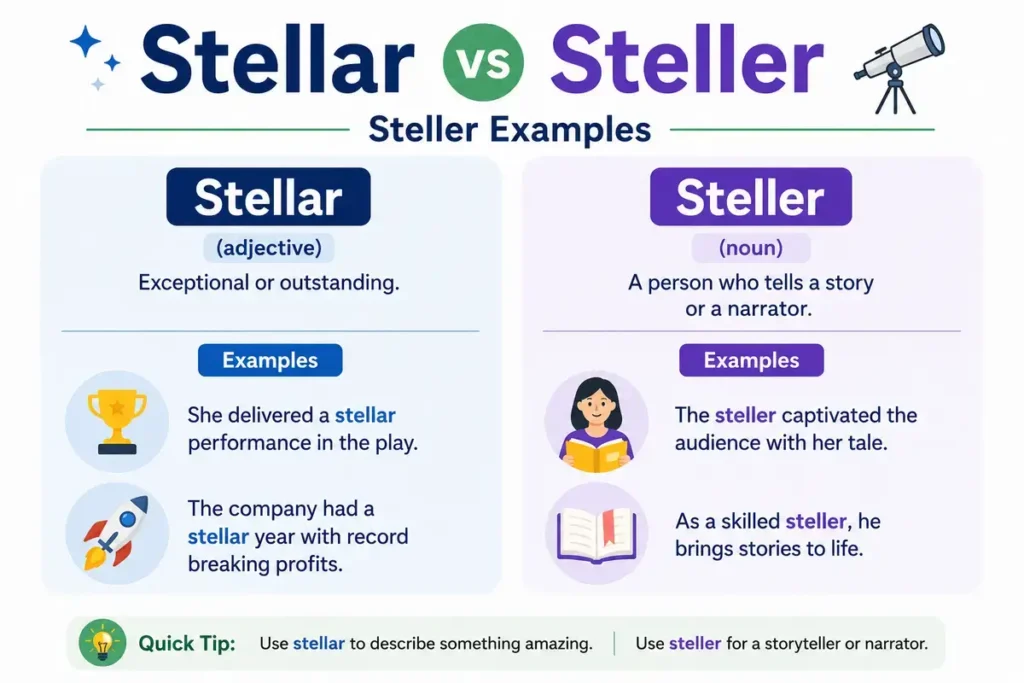
Steller Examples
Steller appears almost exclusively in proper names. Since it honors the naturalist Georg Wilhelm Steller, the word is always capitalized.
- We saw a Steller sea lion during our trip to Alaska.
- The zoo recently welcomed a rescued Steller sea eagle.
- Birdwatchers hoped to spot a Steller’s jay in the forest.
- The documentary featured the habitat of the Steller sea lion.
- Scientists continue studying the behavior of the Steller’s eider.
- Georg Wilhelm Steller joined the historic expedition across the North Pacific.
- The museum displayed artifacts connected to Steller’s scientific discoveries.
- Researchers discussed the conservation of the Steller sea eagle.
- The wildlife guide explained why the Steller’s jay is easy to recognize.
- Several marine conservation programs focus on protecting the Steller sea lion.
These examples show that Steller functions as part of a name rather than as a descriptive adjective.
Stellar vs Steller Common Mistakes
The confusion between these words usually begins with spelling. Since they differ by only one letter and sound nearly identical, many writers accidentally choose the wrong one.
Here are the mistakes editors encounter most often.
Using Steller Instead Of Stellar
This is by far the most common error.
Incorrect:
The company delivered a steller performance.
Correct:
The company delivered a stellar performance.
Whenever you’re describing excellent quality, outstanding results, or something related to stars, the correct spelling is stellar.
Assuming Stellar vs Steller Mean The Same Thing
Some people think these words are regional spelling variations like color and colour.
They are not.
The meanings are completely different, and neither word replaces the other.
Forgetting That Steller Is A Proper Name
The word Steller is usually part of a proper noun. That means it should remain capitalized when it refers to a person, place, or species named after Georg Wilhelm Steller.
Writing it in lowercase often creates another error.
Relying Only On Pronunciation
Because both words are pronounced almost the same way, pronunciation offers very little help.
Instead, focus on the meaning of the sentence. Context tells you which spelling belongs there.
Trusting Autocorrect Too Much
Some spell checkers accept Steller because it is a legitimate surname. That means they may not flag the mistake if you accidentally type it instead of stellar.
Always proofread carefully instead of depending entirely on software.
Etymology And Word Origin
Knowing where these words came from makes the difference much easier to remember.
The adjective stellar comes from the Latin word stellaris, which means “of the stars.” The Latin noun stella means “star.” English adopted the word during the seventeenth century, primarily in scientific writing. As the language evolved, writers began using it figuratively to describe exceptional performance, remarkable talent, or outstanding quality.
The word Steller has a completely different history. It comes from the surname of Georg Wilhelm Steller, a German naturalist, physician, and explorer born in the early eighteenth century. His work documenting wildlife in Alaska and the North Pacific earned him lasting recognition in biology.
Several animals discovered or documented during his expeditions were later named in his honor, including the Steller sea lion, Steller’s jay, and Steller’s sea eagle.
Although the spellings look similar, their origins have no direct connection.
Regional Usage
Unlike many English word pairs, these two terms do not change based on regional spelling preferences.
American English
American English uses stellar as the standard adjective. The spelling appears in dictionaries, newspapers, educational materials, business communication, and everyday conversation.
The surname Steller appears only in proper names and scientific references.
British English
British English follows exactly the same pattern.
Writers use stellar to describe outstanding quality or something related to stars. Steller remains limited to names honoring Georg Wilhelm Steller.
Australian English
Australian publications also use stellar as the standard adjective.
Wildlife articles and scientific resources continue using Steller only where it forms part of an official name.
Canadian English
Canadian English follows the same convention.
There is no regional spelling difference between these two words. Dictionaries across major English speaking countries recognize stellar as the adjective and Steller as a proper noun.
Grammar Rules
Although these words look alike, they belong to different grammatical categories. Understanding their roles makes it much easier to use them correctly.
Stellar As An Adjective
Most often, stellar functions as an adjective that describes a noun.
Examples include:
- A stellar performance.
- Stellar customer service.
- Stellar research.
- Stellar results.
- Stellar winds.
In every example, the adjective adds information about the noun that follows.
Steller As A Proper Noun
Steller is normally part of a proper noun.
Examples include:
- Steller sea lion.
- Steller’s jay.
- Georg Wilhelm Steller.
Since proper nouns identify specific people or officially named species, they begin with a capital letter.
Capitalization Rules
Remember these simple guidelines.
- Write stellar in lowercase unless it begins a sentence.
- Capitalize Steller because it is part of a proper name.
- Keep the official spelling unchanged when referring to species or historical figures.
Following these rules helps your writing stay accurate and professional.
Real Life Usage Examples
These words appear in very different situations.
Daily Conversation
People frequently use stellar when praising someone’s work or describing excellent quality.
Examples include:
- That was a stellar idea.
- She did a stellar job on the project.
- We received stellar customer support.
Academic Writing
Researchers may use stellar in astronomy or physics to describe stars and related phenomena.
Biology papers may use Steller only when discussing species named after the explorer.
Professional Communication
Business reports, recommendation letters, and performance reviews regularly include stellar because it expresses excellence in a concise and professional way.
Literature
Novelists often use stellar both literally and figuratively. It can describe the beauty of the night sky or symbolize extraordinary success.
Science And Media
Scientific documentaries, wildlife magazines, and conservation reports frequently mention Steller’s sea eagle, Steller sea lion, or Steller’s jay when discussing biodiversity and environmental research.
Seeing both words in authentic contexts makes the distinction much easier to remember than simply memorizing definitions.
Improving your spelling becomes much easier when you understand patterns behind similar word pairs, such as choosing between eying and eyeing alongside stellar vs. steller.
Related Words And Commonly Confused Terms
Many spelling mistakes happen because English contains words that look or sound alike. Learning related terms helps you recognize patterns and avoid confusion in your own writing.
Here are some words people often confuse with stellar.
- Astral refers to stars, outer space, or spiritual concepts connected with the heavens.
- Celestial describes anything relating to the sky, planets, stars, or the universe.
- Astronomical relates to astronomy or extremely large amounts.
- Cosmic refers to the universe or outer space.
- Galactic describes something connected with galaxies.
- Exceptional means unusually good or impressive.
- Outstanding refers to someone or something that performs at a very high level.
- Remarkable describes something worthy of attention or admiration.
- Excellent expresses a very high standard of quality.
- Superb means exceptionally good.
These words can often replace stellar depending on the sentence. Using natural variations also makes your writing smoother and more engaging.
You may also confuse stellar with other similar looking words.
- Steller, which is a proper noun used in scientific names.
- Stellar’s, which is usually a grammatical mistake unless referring to possession.
- Stellate, a scientific adjective meaning star shaped.
- Stella, a Latin word meaning star and also a common given name.
Although these words share similar letters, each has its own meaning and should be used only in the appropriate context.
Expert Language Insight
From an editor’s perspective, this spelling mistake is easy to understand. Both words are pronounced almost the same, and only one letter separates them. Writers often rely on sound instead of meaning, which leads to errors that spell checkers may not catch.
Professional editors approach the problem differently. Before checking the spelling, they identify the purpose of the word in the sentence.
If the word describes quality, achievement, performance, or something connected with stars, the correct choice is stellar. If the sentence refers to a species, historical figure, or scientific name honoring Georg Wilhelm Steller, then Steller belongs there.
Another useful habit is reading the entire sentence after proofreading. Context often reveals mistakes that individual words do not. For example, “She gave a Steller presentation” may pass through a spell checker, but it immediately sounds incorrect once you understand the meaning of Steller.
Strong writing is not just about correct spelling. It is about choosing the word that communicates your intended meaning with precision. That habit separates careful writers from casual ones.
Frequently Asked Questions
Is stellar or Steller the correct spelling?
In almost every everyday situation, stellar is the correct spelling. Use it when describing something related to stars or something exceptionally good. Steller is mainly reserved for proper names, especially species named after the naturalist Georg Wilhelm Steller.
Is Steller a real English word?
Yes. Steller is a legitimate surname and appears in several scientific names, including Steller sea lion, Steller’s jay, and Steller’s sea eagle. It is not an alternative spelling of stellar.
Why do people confuse these words?
The confusion happens because the words differ by only one letter and are pronounced almost the same way. Many writers choose the spelling based on sound instead of meaning, which leads to mistakes.
Does stellar always relate to stars?
No. The original meaning relates to stars and astronomy, but modern English also uses stellar figuratively to describe outstanding quality, excellent performance, or remarkable achievement.
Is there a difference in American and British English?
No. American English, British English, Australian English, and Canadian English all use the same spelling rules. Stellar remains the standard adjective, while Steller is used only in proper names.
Can I use Steller to describe excellent work?
No. That is one of the most common spelling mistakes. When praising a performance, presentation, product, or achievement, always use stellar.
How can I remember the correct spelling?
Connect stellar with star. Both words share the same origin and relate to stars or excellence. Reserve Steller for official names connected with Georg Wilhelm Steller and the species named in his honor.
Why does spell check not always catch this mistake?
Many spelling tools recognize both words because both exist in English. Since Steller is a valid surname, the software may not identify it as an error. Reading the sentence carefully and checking the meaning is the safest way to avoid mistakes.
Conclusion
Although the words look almost identical, they serve completely different purposes. Stellar is the standard English adjective used to describe something related to stars or something exceptionally good. It appears in everyday conversations, business writing, education, science, and countless other contexts.
Steller, on the other hand, is a proper noun connected with the naturalist Georg Wilhelm Steller. You will usually encounter it in the names of animals, birds, or historical references rather than in general writing.
The easiest way to avoid confusion is to focus on meaning instead of pronunciation. If you are complimenting someone’s work, describing remarkable quality, or writing about astronomy, stellar is almost certainly the correct choice. If you are referring to a species named after Georg Wilhelm Steller, then Steller is the appropriate spelling.
A single letter can completely change the meaning of a sentence, which is why understanding stellar vs steller matters. Once you know that stellar describes something related to stars or something exceptionally good, and Steller is mainly used in proper names, choosing the correct spelling becomes easy. Keep the context in mind before you write, and your work will always look polished, accurate, and professional.