If you searched for stich vs stitch, you are probably wondering if both spellings are correct or if one is simply a typo. It is an easy mistake to make because the two words look almost identical, and they sound very similar when spoken quickly. A single missing letter can completely change the result, leaving many writers unsure which version belongs in an email, school assignment, sewing guide, or medical document.
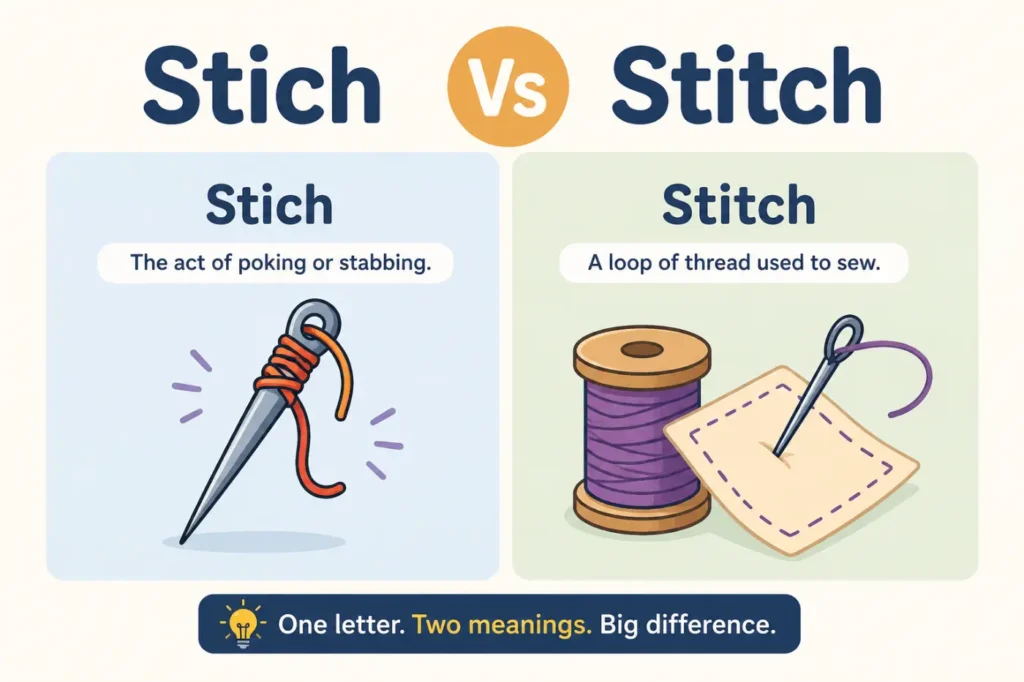
The direct answer is simple. Stitch is the correct English word. It refers to a loop of thread used in sewing, a method of joining fabric, or a medical suture used to close a wound. Stich is generally a misspelling and is not recognized as a standard English word. The main exception is when Stich appears as a surname, a brand name, or another proper noun chosen intentionally.
The confusion usually comes from fast typing, autocorrect errors, and pronunciation. Since the extra t is easy to overlook, many people accidentally write stich instead of stitch.
This guide explains the difference in plain English. You will learn the correct spelling, pronunciation, meaning, grammar, word origin, real life examples, common mistakes, and practical tips that will help you remember the right form every time.
Quick Definition
Stitch is the correct spelling in standard English. It can describe a single loop of thread, the act of sewing fabric together, or a medical suture used to close a wound. Stich is usually a spelling mistake unless it is part of a person’s name, a company name, or another official proper noun.
Quick Answer
If you only need the answer, remember these points.
- Stitch is the correct English spelling.
- Stich is generally a misspelling.
- Use stitch in writing about sewing, embroidery, knitting, crochet, medicine, and everyday English.
- Keep Stich only when it is an official name or title.
Comparison Table
| Feature | Stitch | Stich |
|---|---|---|
| Part of speech | Noun Verb | Usually proper noun or misspelling |
| Correct spelling | Yes | No in standard English |
| Meaning | A loop of thread or the act of sewing | No standard English meaning |
| Origin | Old English and Germanic roots | Derived from a typing error or used as a surname |
| Formality | Standard in all writing | Only appropriate as an official name |
| Common contexts | Sewing medicine embroidery knitting crochet clothing | Personal names company names internet typos |
| Usage frequency | Very common | Rare |
| Dictionary status | Recognized by major dictionaries | Not recognized as a standard English word |
| Example | She repaired the shirt with one stitch. | Stich appears as a family name in some countries. |
If you’re interested in other commonly confused word pairs, understanding the difference between nonresponsive and unresponsive can help you choose the most accurate term in both everyday writing and professional communication.
Meaning Of Both Terms
Although the spellings differ by only one letter, they do not carry the same status in English.
What Does Stitch Mean
Stitch is a common English word used in several related ways. In sewing, it refers to a single loop of thread that joins pieces of fabric. It can also describe the action of sewing something together.
The word appears in many everyday situations, including:
- Sewing clothes.
- Embroidery.
- Knitting.
- Crochet.
- Quilting.
- Tailoring.
- Medical treatment.
You will also hear expressions such as a stitch in time saves nine, side stitch, and stitch together, showing that the word has both literal and figurative meanings.
What Does Stich Mean
Stich is not a standard English word.
Most of the time, it appears because someone accidentally leaves out the second t while typing. Spell checkers often flag it immediately because it is not accepted as the correct spelling.
There are a few exceptions.
- It can be a surname in some countries.
- It may appear in company or product names.
- It can be part of a username or online profile.
Outside these situations, professional editors replace stich with stitch.
Key Differences
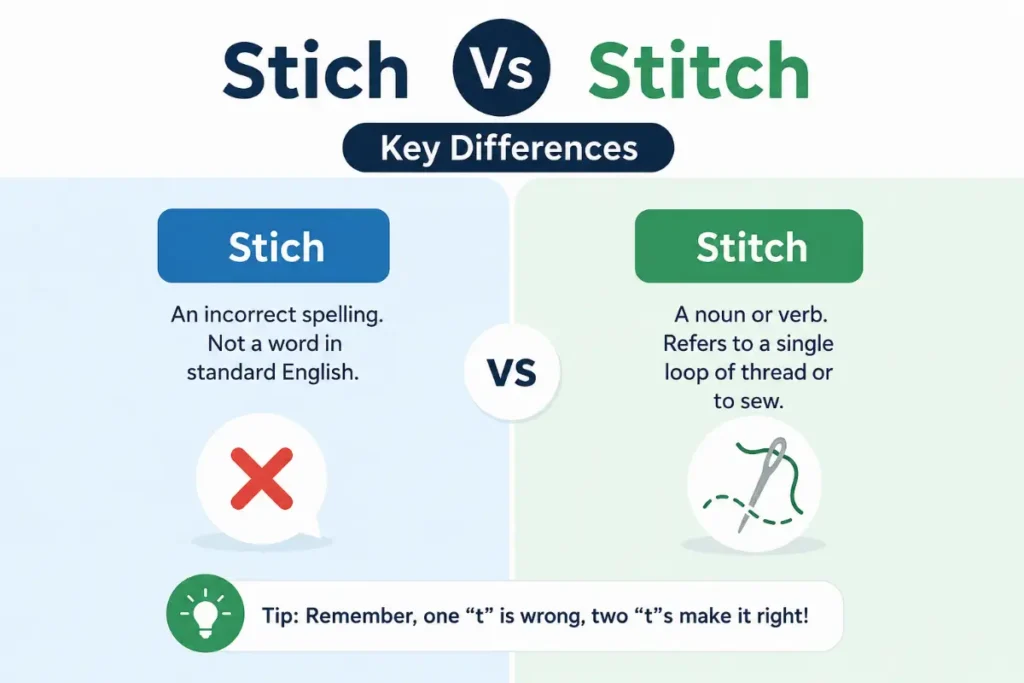
The difference between these spellings is more than a single letter. One belongs to standard English, while the other does not.
Here are the main differences.
- Stitch is the accepted spelling in dictionaries and style guides.
- Stich is usually a typing mistake.
- Stitch has several meanings related to sewing and medicine.
- Stich has no standard dictionary definition.
- Stitch is appropriate in formal, academic, and professional writing.
- Stich should only remain when it is part of an official name.
Because both words look so similar, proofreading is especially important. Missing one letter can make otherwise polished writing appear careless.
Which One Is Correct
The correct spelling is stitch.
If you are writing about sewing, clothing, fabric, embroidery, medicine, or repairing a wound, this is the form you should always use. It is recognized by dictionaries, publishers, educational institutions, and professional editors.
The spelling stich is generally incorrect in ordinary English. Although it may appear in names or trademarks, it should not replace the standard word in normal writing.
A simple question can help you decide.
Are you referring to sewing, fabric, thread, or medical sutures?
If the answer is yes, choose stitch every time.
Pronunciation Guide
One reason this spelling mistake happens so often is that the missing letter is not easy to notice when the word is spoken.
IPA Pronunciation
Stitch
/stɪtʃ/
Stich
If used as a proper name, it is usually pronounced the same way.
/stɪtʃ/
Syllable Breakdown
Both forms have one syllable.
Stitch
Common Pronunciation Mistakes
Pronunciation is rarely the problem. The mistake almost always happens while writing.
Still, learners sometimes make these errors.
- Pronouncing the vowel as steech instead of stitch.
- Softening the final ch sound.
- Confusing the pronunciation with similar sounding words such as switch or stretch.
Listening to native speakers quickly makes the correct pronunciation feel natural.
How To Remember The Correct Spelling
The easiest way to remember the correct spelling is to connect the extra t with the thread itself.
Think of the second t as another piece of thread helping hold the fabric together. If you remove that letter, the word is no longer complete, just like a seam with a missing stitch.
Another useful habit is to picture familiar phrases you’ve seen many times.
- Cross stitch.
- Running stitch.
- Back stitch.
- Stitch marker.
- Stitch pattern.
Every one of these uses the same standard spelling.
If you work with fabric, read sewing instructions, or write about medicine, seeing the correct form repeatedly will make it become second nature. After a while, the incorrect version will immediately look out of place.
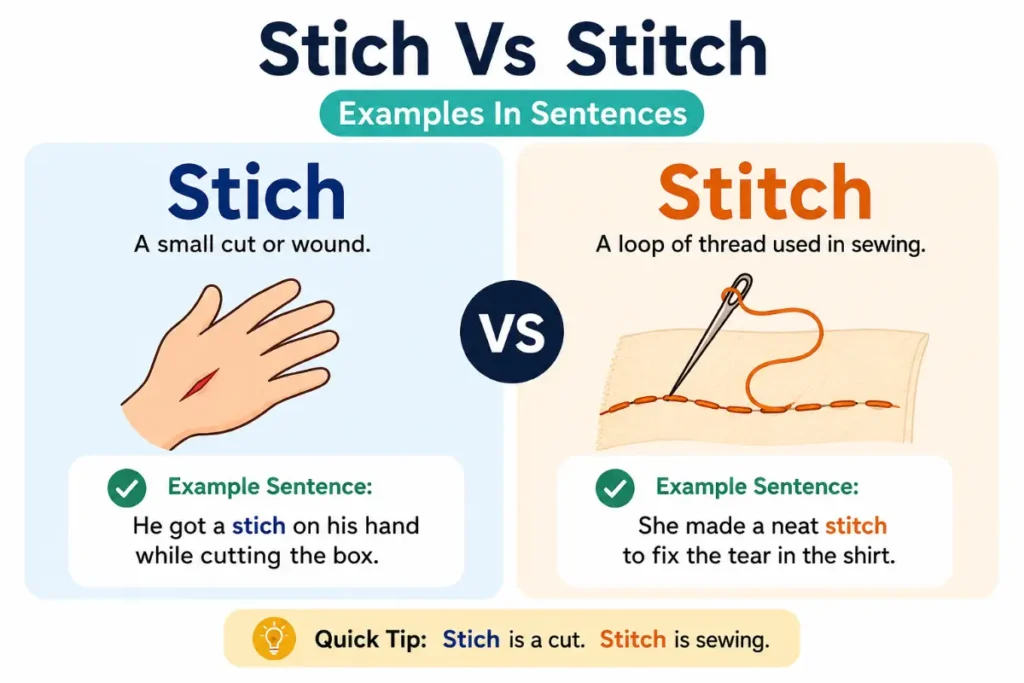
Stich Vs Stitch Examples In Sentences
The easiest way to remember the correct spelling is to see it in real situations. The first group of examples shows the standard English word. The second group explains how the incorrect spelling usually appears.
Examples Using Stitch
These examples use the correct spelling in natural contexts.
- The tailor added one stitch to strengthen the seam.
- My grandmother taught me how to stitch a button onto a shirt.
- The doctor placed several stitches to close the cut.
- She chose a decorative stitch for the embroidery project.
- The torn backpack only needed one small stitch to repair it.
- Learning to stitch by hand is a useful life skill.
- The sewing machine produced neat and even stitches.
- The pattern explained each stitch step by step.
- He felt a sharp side stitch while running uphill.
- The artist used colorful thread to stitch flowers onto the fabric.
These examples show that the word appears in sewing, medicine, sports, and everyday conversation.
Examples Using Stich
Since stich is not the standard spelling, natural sentence examples mainly involve names or spelling mistakes.
- The conference featured a speaker whose last name was Stich.
- The company registered Stich as its official brand name.
- My friend accidentally typed stich instead of stitch.
- The spell checker highlighted stich as an error.
- Several online searches ask if stich is a real word.
- A username included the word Stich because the preferred name was unavailable.
- The document contained multiple instances of the misspelling stich.
- The editor corrected every occurrence of stich before publication.
- Some websites use Stich as part of a product name.
- Writers often notice the missing letter only during proofreading.
These examples reflect the situations where you are most likely to encounter the spelling.
Common Mistakes
Because the two spellings differ by only one letter, the mistake is surprisingly common. Fortunately, it is also easy to avoid once you know what to look for.
Leaving Out The Second Letter T
This is by far the most common error.
Incorrect:
Stich
Correct:
Stitch
The missing letter usually happens because people type quickly or rely on muscle memory instead of checking the finished word.
Assuming Both Spellings Are Correct
Some writers think both versions are accepted because they have seen them online.
That is not the case.
Standard dictionaries recognize stitch. The shorter spelling is normally treated as a typo unless it is part of an official name.
Trusting Internet Results
Search engines display thousands of pages containing stich. Many of those pages include typing mistakes, usernames, forum posts, or discussions about the spelling itself.
Seeing a word online does not automatically make it correct.
Forgetting The Different Meanings
The word stitch has several accepted meanings.
It can refer to:
- Sewing thread.
- A sewing technique.
- A medical suture.
- A sharp pain in the side during exercise.
The incorrect spelling has none of these meanings in standard English.
Ignoring Spell Check Warnings
Modern writing tools usually identify stich as a spelling error.
If your editor or browser suggests changing it to stitch, it is usually the right correction unless you are writing someone’s official name.
Just as stich vs stitch often causes spelling confusion, knowing when to say rug or rag can prevent another common English vocabulary mistake.
Etymology And Word Origin
The history of stitch stretches back hundreds of years. The word comes from Old English stice, which referred to a puncture or a stab. It developed from older Germanic roots connected with piercing, pricking, and sewing materials together.
As English evolved, the meaning expanded. Instead of describing only the action of piercing, it also referred to the small loops of thread used to join fabric. Later, the word became part of medical vocabulary because closing a wound involves a similar action.
Over time, stitch also gained figurative meanings. Today, people use it in expressions about repairing relationships, creating something carefully, or experiencing a sudden pain while exercising.
The spelling stich followed a very different path. It did not develop as an accepted English word. Instead, it usually appears because one letter is accidentally omitted during typing. In some countries, however, Stich exists as a family name with its own separate history.
Stich Vs Stitch Regional Usage
Unlike words such as color and colour, the spelling of stitch stays the same across major English speaking countries.
American English
American English uses stitch in sewing, medicine, crafting, sports, and everyday conversation. The shorter spelling appears only in proper names or accidental misspellings.
British English
British English follows the same rule. Newspapers, universities, dictionaries, and publishing houses consistently use stitch.
Australian English
Australian writers also use the standard spelling in both formal and informal communication. Craft guides, educational materials, and medical publications all follow the same convention.
Canadian English
Canadian English does not treat this word differently. Although Canada sometimes combines American and British spelling traditions, stitch remains unchanged. Across these major varieties of English, the accepted spelling is exactly the same.
Grammar Rules
The word functions in several ways, making it useful in both everyday conversation and professional writing.
As A Noun
Most often, the word refers to a loop of thread or a medical suture.
Examples include:
- One stitch came loose.
- The doctor removed the stitches after two weeks.
- Every stitch must be even.
As A Verb
The word also describes the action of sewing.
Examples include:
- Please stitch the pocket before washing the jacket.
- She learned to stitch by hand when she was young.
- They stitched the quilt together over the weekend.
Singular And Plural Forms
- The singular form is stitch.
- The plural form is stitches.
Examples include:
- The shirt needs one stitch.
- The patient received five stitches.
- Decorative stitches can improve the appearance of handmade clothing.
Common Word Combinations
Native speakers often use the word in combinations such as:
- Running stitch.
- Back stitch.
- Cross stitch.
- Blanket stitch.
- Stitch marker.
- Stitch pattern.
- Stitch together.
- Surgical stitch.
Learning these combinations helps the correct spelling become more familiar.
Real Life Usage Examples
The word appears in many parts of daily life, not just sewing.
Daily Conversation
People commonly use the word when talking about clothing repairs, crafts, or minor injuries.
Examples include:
- Can you stitch this button back onto my shirt?
- I think this seam needs another stitch.
- The doctor said my stitches can come out next week.
Academic Writing
Students studying fashion design, textiles, medicine, or art regularly encounter the word in textbooks and assignments.
Using the correct spelling is especially important in these subjects because precision matters.
Professional Communication
Many careers use the word every day.
Examples include:
- Tailors describe stitching techniques.
- Surgeons discuss stitches after procedures.
- Designers explain embroidery patterns.
- Manufacturers write instructions for industrial sewing machines.
Literature And Media
Writers often use the word both literally and figuratively.
For example, someone might stitch together a story from different memories or describe repairing a friendship one small step at a time. These figurative uses build on the original idea of joining separate pieces into something complete.
The word also appears in popular culture through the well known Disney character named Stitch from Lilo & Stitch. In this case, Stitch is a proper name rather than a reference to sewing, but it still uses the standard spelling.
Related Words And Confused Terms
Many English words are connected to sewing, repairing, or fabric work. Learning these related terms makes it easier to understand the correct spelling and avoid similar mistakes.
The table below explains several words that are often associated with this topic.
| Word | Meaning | Standard English |
|---|---|---|
| Stitch | A loop of thread or the act of sewing | Yes |
| Seam | The line where two pieces of fabric are joined | Yes |
| Suture | A medical stitch used to close a wound | Yes |
| Embroidery | Decorative needlework using thread | Yes |
| Hem | The finished edge of a piece of fabric | Yes |
| Needle | A tool used for sewing | Yes |
| Thread | Fine material used to create stitches | Yes |
| Patch | A piece of fabric used to repair another item | Yes |
You may also come across these related terms.
- Running stitch.
- Back stitch.
- Cross stitch.
- Blanket stitch.
- Chain stitch.
- Slip stitch.
- Overcast stitch.
- Sewing pattern.
- Needlework.
- Textile repair.
Knowing these terms helps you build a stronger vocabulary, especially if you enjoy sewing, crafting, quilting, fashion design, or embroidery.
Expert Language Insight
Professional editors look for more than grammar. They also check spelling consistency, word choice, and accuracy. The difference between stitch and stich is a good example of why careful proofreading matters.
The missing t is easy to overlook, especially when typing quickly. Even experienced writers make this mistake from time to time. The difference is that skilled editors slow down during the final review and catch these small errors before publication.
Native speakers almost always expect to see stitch in books, newspapers, medical documents, sewing instructions, and educational materials. If they notice stich, they usually assume it is a typing mistake unless it clearly refers to a person’s name or another proper noun.
A helpful editing habit is to pay extra attention to words that lose or gain a single letter. These small spelling changes often escape a quick scan but stand out immediately when you read the sentence aloud or use a spelling checker.
If your goal is clear and professional writing, the safest approach is simple.
- Use stitch whenever you mean sewing, thread, fabric, or medical sutures.
- Keep Stich only when it is someone’s official name or part of a registered brand.
- Proofread carefully because one missing letter can change how readers judge the quality of your writing.
If you enjoy clearing up frequent spelling errors, you’ll also find it useful to learn why “greatly” is the correct spelling and avoid a mistake many writers still make.
Frequently Asked Questions
Is stitch or stich correct?
Stitch is the correct spelling in standard English. It is recognized by dictionaries and used in sewing, medicine, crafts, and everyday writing. Stich is generally a misspelling unless it appears as an official surname, company name, or another proper noun.
Why do people write stich instead of stitch?
Most people simply leave out the second t while typing. Since the word has only one syllable, the missing letter is easy to overlook. Fast typing and lack of proofreading are the most common reasons for this mistake.
Is stich a real English word?
No. Stich is not recognized as a standard English word with the same meaning as stitch. You may see it used as a family name or a brand name, but it should not replace the correct spelling in normal writing.
What does stitch mean?
The word has several meanings. It can refer to a loop of thread used in sewing, the act of joining fabric with thread, a medical suture used to close a wound, or a sharp pain in the side that sometimes occurs during exercise.
How do you pronounce stitch?
The standard pronunciation is /stɪtʃ/. It has one syllable and rhymes with words such as witch, pitch, and switch.
Is stitch a noun or a verb?
It can be both. As a noun, it refers to a loop of thread or a medical suture. As a verb, it means to sew or join pieces of fabric together using thread.
Does the spelling change in British and American English?
No. Both American English and British English use stitch. The spelling stays the same in Australian and Canadian English as well, making it one of the many words shared across major English varieties.
How can I remember the correct spelling?
Think about the extra t as another strand helping hold the fabric together. Reading sewing guides, craft instructions, and medical information also reinforces the correct spelling because every reliable source uses stitch.
Conclusion
The answer is clear. Stitch is the correct spelling in standard English, while stich is usually a typing mistake. The standard form appears in dictionaries, style guides, classrooms, sewing manuals, medical documents, and professional writing around the world.
Although Stich may exist as a surname or brand name, those situations are exceptions rather than the rule. In everyday communication, choosing stitch ensures your writing looks accurate, polished, and trustworthy.
If you are ever unsure, think about the context. Are you talking about sewing, fabric, embroidery, knitting, crochet, or closing a wound? If the answer is yes, stitch is the spelling you need.
Building the habit of proofreading carefully will help you catch this and many other small spelling mistakes before they reach your readers. Those extra few seconds can make a noticeable difference in the quality and professionalism of your writing.