If you have ever paused over uncollectible vs uncollectable while writing an email, report, or accounting document, you are not alone. The two forms look almost identical and carry essentially the same basic idea. That small spelling difference can still make you wonder if one is wrong.
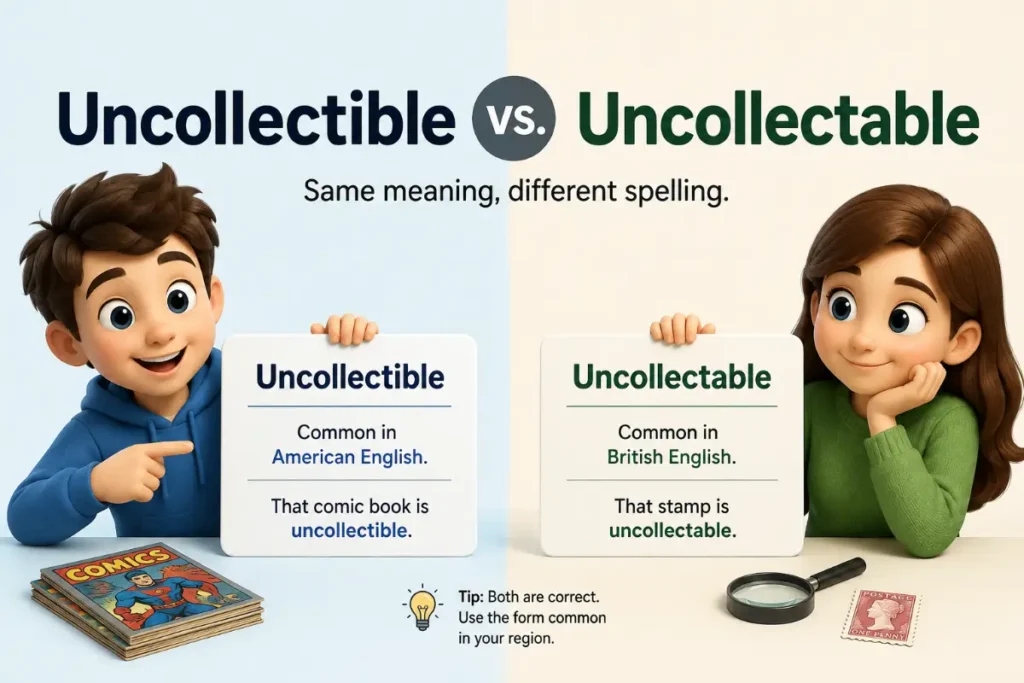
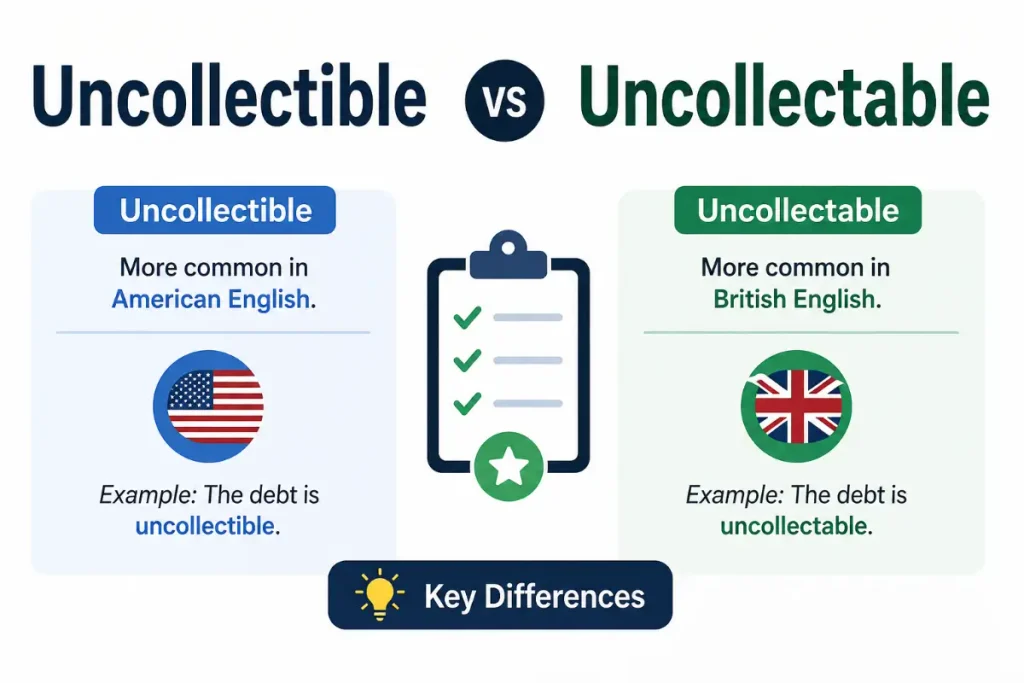
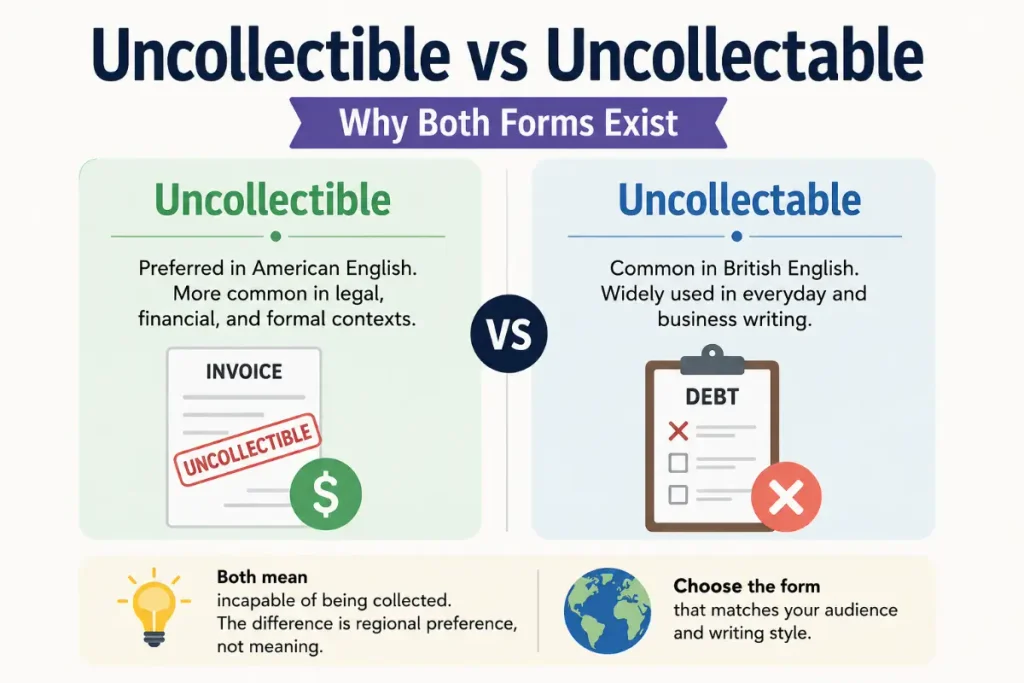
Both forms are legitimate English words. Uncollectible is more common in American English and is especially familiar in accounting and finance. Uncollectable is also correct and appears in British English and other varieties of English. In many contexts, the choice comes down to regional spelling preference rather than a difference in meaning.
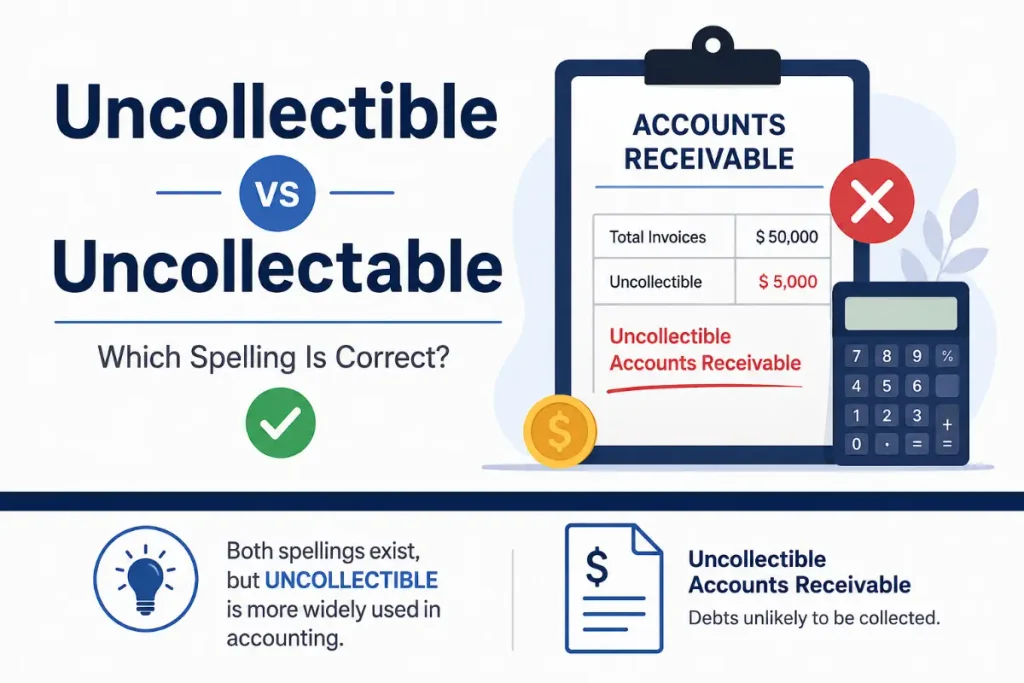
The confusion becomes more interesting in financial writing. Accountants often use uncollectible when discussing debts or accounts receivable that are unlikely to be recovered. Someone reading British financial material may encounter uncollectable instead.
This guide explains the distinction without turning a simple spelling question into a linguistic maze. You will learn what each form means, how the words developed, how native speakers use them, which spelling fits American English, how accounting professionals use the term, and how to avoid common mistakes. By the end, choosing the appropriate form should feel straightforward rather than like a coin toss.
Quick Definition
Uncollectible and uncollectable both describe something that cannot be collected or is unlikely to be collected. The meaning is essentially the same. Uncollectible is the more common form in American English, especially in accounting, while uncollectable is also standard and is more common in British English and some other varieties.
Quick Answer
Both spellings are correct, but they have different levels of regional popularity.
- Uncollectible is the preferred form in American English.
- Uncollectable is also a valid English spelling.
- British English commonly uses uncollectable, although uncollectible also occurs.
- American accounting commonly uses uncollectible for debts that are not expected to be recovered.
- The two forms generally have the same meaning and pronunciation.
- Your best choice depends mainly on your audience and the style used throughout your document.
For American readers, uncollectible is usually the safest choice.
Comparison Table
| Feature | Uncollectible | Uncollectable |
|---|---|---|
| Part of speech | Adjective | Adjective |
| Basic meaning | Unable or unlikely to be collected | Unable or unlikely to be collected |
| Word formation | un + collectible | un + collectable |
| Root word | Collect | Collect |
| Standard English | Yes | Yes |
| American English | More common | Less common |
| British English | Used | Commonly used |
| Accounting | Very common | Also understood and used |
| Formality | Formal and standard | Formal and standard |
| Common contexts | Accounting debt recovery finance receivables | Debt recovery finance receivables general writing |
| Meaning difference | Generally none | Generally none |
| Pronunciation | Usually the same | Usually the same |
| Example | The company wrote off the uncollectible account. | The company wrote off the uncollectable debt. |
The important point is that this is not normally a meaning contrast. You are not choosing between two words that describe different financial situations. You are choosing between two accepted formations of the same adjective.
Some confusing word pairs can be difficult because their meanings overlap only slightly, so understanding how gradual and insidious differ can help you choose more precise language.
Meaning Of Both Terms
The easiest way to understand the pair is to start with the word collect.
To collect something means to gather it, receive it, or obtain it. Depending on context, you might collect money, collect a payment, collect a debt, or collect information.
The suffix able then creates an adjective describing something that can be done.
For example:
collect + able = collectable
The prefix un reverses the idea.
un + collectable = uncollectable
The same basic process gives us:
collect + ible = collectible
and then:
un + collectible = uncollectible
Both formations communicate the idea that collection is not possible, practical, or expected.
Uncollectible Meaning
Uncollectible means not capable of being collected or not expected to be collected.
The word appears especially often when the object being collected is money.
For example, a business may have sold products to a customer on credit. The customer now owes the business money, but there is little realistic chance that the business will receive the payment. The amount may then be described as an uncollectible account or uncollectible debt.
In accounting, the term has a more specific practical role. Businesses must estimate how much of their accounts receivable they expect to collect. Amounts that are considered unlikely to be recovered may be treated as uncollectible for financial reporting purposes.
The word can also appear outside finance.
For example:
- The debt became uncollectible after years of unsuccessful recovery efforts.
- The agency determined that the outstanding amount was uncollectible.
- The company removed several uncollectible balances from its active receivables.
So although accounting is one of its strongest contexts, the adjective is not limited to financial language.
Uncollectable Meaning
Uncollectable has essentially the same meaning. It describes something that cannot be collected or is not likely to be collected.
The word can refer to money, debts, payments, objects, or other things that someone is attempting to gather or recover.
For example:
- The old debt was considered uncollectable.
- The charity discovered that several promised donations were uncollectable.
- The agency classified the outstanding balance as uncollectable.
The distinction is therefore not normally semantic. You should not assume that one form describes a debt that is completely impossible to recover while the other describes a debt that is merely unlikely to be recovered. Standard usage does not establish that difference.
The real distinction is primarily regional preference and word formation.
Key Differences
The most useful way to compare these adjectives is to separate spelling, meaning, pronunciation, and usage. Once you do that, the apparent mystery disappears.
Meaning Difference
There is generally no meaningful difference in definition.
Both forms can describe something that cannot be collected or is not expected to be collected.
For example, these sentences communicate essentially the same idea:
The account is uncollectible.
The account is uncollectable.
The wording changes, but the underlying message remains the same.
Spelling Difference
The difference is the ending.
Uncollectible uses ible.
Uncollectable uses able.
This reflects two different English suffixes that can create adjectives.
The distinction can feel confusing because collect appears to support both forms. English contains many words whose endings do not follow a perfectly predictable pattern. Native speakers usually learn these forms through exposure rather than constructing them from a strict mathematical rule.
Regional Difference
Regional usage is one of the strongest reasons both spellings exist.
American English strongly favors uncollectible. It is particularly established in American accounting terminology.
British English uses uncollectable more readily, although uncollectible is not incomprehensible or necessarily wrong in British usage.
Australian and Canadian English can show variation because their spelling conventions have influences from both British and American English. The important point is that neither spelling creates a different concept.
Accounting Difference
Accounting is where the choice becomes especially noticeable.
In American financial writing, uncollectible accounts, uncollectible accounts receivable, uncollectible debt, and allowance for uncollectible accounts are familiar expressions.
You will encounter the related phrase bad debt as well. However, the terms are not always interchangeable in every accounting discussion because financial reporting systems use specific concepts for estimating credit losses and recognizing amounts that are not expected to be collected.
If you are writing for an American accounting audience, uncollectible is the natural choice.
Tone Difference
Neither spelling is inherently more formal than the other.
Both can appear in professional writing. The difference is primarily convention.
A British financial report can use uncollectable without sounding informal. An American accounting report can use uncollectible without sounding more formal than its British counterpart.
Grammar Difference
There is also no important grammatical difference.
Both forms function primarily as adjectives.
They can appear before nouns:
uncollectible debt
uncollectable debt
They can also appear after linking verbs:
The debt is uncollectible.
The debt is uncollectable.
The sentence structure remains unchanged.
Which One Is Correct
Both are correct.
That answer is important because this is not a case where one spelling should simply be labeled wrong. Uncollectible and uncollectable are both established English forms.
However, if you are writing for a United States audience, uncollectible is usually the better choice because it is the more familiar form in American English.
For British readers, uncollectable may feel more natural.
A practical editorial rule is simple: match the spelling to your audience and remain consistent.
If an American accounting firm uses uncollectible accounts receivable throughout a report, suddenly changing to uncollectable halfway through the document serves no useful purpose. Consistency matters more than trying to make every individual occurrence sound different.
The same principle applies when editing international content. Do not change an established regional spelling simply because another form exists. First identify the intended audience, then follow the appropriate language convention.
Pronunciation Guide
One reason the two spellings cause confusion is that their pronunciation is usually very similar and may be identical for many speakers.
Uncollectible Pronunciation
A common pronunciation is approximately:
/ˌʌn.kəˈlɛk.tə.bəl/
You can break it into syllables like this:
un col lect i ble
The strongest stress generally falls around the lect portion.
Uncollectable Pronunciation
A common pronunciation is approximately:
/ˌʌn.kəˈlɛk.tə.bəl/
The syllable pattern is essentially the same:
un col lect a ble
In ordinary speech, the difference between the written endings is usually not something listeners notice.
Common Pronunciation Mistakes
Learners sometimes try to pronounce every written letter very strongly. That can make the word sound unnatural.
A better approach is to listen to native speakers and pay attention to the rhythm rather than attempting to pronounce each letter separately.
Another mistake is assuming that the able and ible endings must produce noticeably different sounds here. In normal speech, they generally do not create a useful pronunciation distinction between these two forms.
How To Remember The Correct Usage
If you regularly write about finance, accounting, or debt collection, choosing between these forms can become much easier with one simple rule.
Think about your audience first.
For American English:
Uncollectible is the natural default.
For British English:
Uncollectable is often the natural choice.
For an international document, look at the existing style. If the document consistently follows American spelling, use uncollectible. If it follows British spelling, use uncollectable.
You can also remember the common American accounting phrase:
uncollectible accounts
That phrase appears so frequently in American financial writing that it is worth learning as a complete expression rather than memorizing the spelling in isolation.
The bigger lesson is that English spelling often depends on established usage. Trying to derive every word from a single suffix rule can lead you down the wrong path. Exposure to reputable writing is usually the better teacher.
Why Both Forms Exist
The existence of two spellings is not unusual in English. The language has accumulated words from many sources and developed multiple patterns for forming adjectives.
The suffix able is productive and often attaches to verbs to describe something that can be done.
Examples include:
- readable.
- washable.
- manageable.
- acceptable.
- collectable.
The suffix ible also appears in many established adjectives.
Examples include:
- visible.
- flexible.
- possible.
- credible.
- collectible.
English does not always give learners an easy rule for deciding which suffix belongs to a particular word. Historical development plays a major role.
That is why the existence of both collectible and collectable is not surprising. The same variation carries into the negative forms.
For practical writing, usage matters more than trying to force the word into a single suffix rule.
A Note On Collectible And Collectable
Understanding the positive forms makes the negative forms much easier.
Both collectible and collectable can be found in English, but they have developed different patterns of use.
In American English, collectible is especially familiar when referring to an item valued by collectors.
For example:
The store sells collectible baseball cards.
Collectable is also used, particularly in British English, and can describe something worth collecting.
The negative forms follow the same general pattern:
uncollectible
uncollectable
This is another reason context matters. In financial writing, uncollectible is particularly well established in American usage. In general writing, the regional preference remains relevant.
Examples In Sentences
The clearest way to understand the difference is to see both forms working in natural sentences. In most examples the meaning stays the same. What changes is the spelling preference and the context in which the word appears.
Uncollectible Examples
These examples reflect standard American usage. They also work naturally in international writing that follows American English conventions.
- The company determined that the outstanding balance was uncollectible after several unsuccessful collection attempts.
- The accountant recorded an allowance for uncollectible accounts at the end of the reporting period.
- The business reviewed its accounts receivable to identify balances that might become uncollectible.
- Several customers failed to pay their invoices, leaving the company with a significant amount of uncollectible debt.
- The manager asked the accounting team to review the oldest uncollectible accounts.
- The lender wrote off the balance after determining that the loan was unlikely to be recovered.
- The financial report includes an estimate for uncollectible receivables.
- The company strengthened its credit policies after experiencing a rise in uncollectible balances.
- An account does not automatically become uncollectible simply because a payment is late.
- The auditor examined the company’s estimate of uncollectible amounts before completing the review.
These examples also show an important point. Uncollectible often appears alongside accounting vocabulary such as accounts receivable, allowance, debt, balance, receivables, write off, and credit loss.
Uncollectable Examples
The second form communicates the same basic idea and is especially useful when following British spelling conventions.
- The company classified the overdue balance as uncollectable.
- The accountant reviewed several uncollectable debts before preparing the annual report.
- The agency decided that the remaining amount was uncollectable.
- Some of the older invoices were considered uncollectable after repeated attempts to obtain payment.
- The business created a provision for debts that might become uncollectable.
- The charity discovered that several pledged donations were ultimately uncollectable.
- The finance department investigated the reasons behind the increase in uncollectable accounts.
- The lender removed the uncollectable balance from its active recovery records.
- The report identified several customer accounts as potentially uncollectable.
- The company improved its credit checks to reduce the number of uncollectable debts.
The important lesson is not to assign a different meaning to each spelling. If you replace one form with the other in most ordinary sentences, the underlying message remains intact.
Common Mistakes
The biggest mistake is assuming that one spelling is always wrong. This pair is different from a true correct versus incorrect spelling problem because both forms have established usage.
Still, writers make several predictable errors.
Treating Uncollectable As A Misspelling
American readers may be more accustomed to uncollectible, so they sometimes assume that uncollectable is an error.
That conclusion is too broad. The second form is used in British English and other varieties of English. It is also found in formal financial and general writing.
If you are editing an American document, changing it to uncollectible may improve regional consistency. That does not mean the original spelling was universally incorrect.
Treating Uncollectible As An American Only Error
The opposite mistake can happen with British English.
Some writers see the American form and assume it should never appear in British publications. In reality, uncollectible is recognizable and does occur in British usage.
Regional preference does not create a hard grammatical boundary.
Assuming The Two Words Have Different Financial Meanings
There is no standard accounting rule that assigns one meaning to uncollectible and another to uncollectable.
Both can describe amounts that are not expected to be collected.
The accounting treatment depends on the financial reporting framework, the facts surrounding the receivable, and the company’s policies. The spelling does not determine the accounting treatment.
Using The Word For Any Late Payment
A late payment is not automatically an uncollectible payment.
A customer might pay several weeks late because of a temporary cash flow problem. Another customer might have stopped responding and have no realistic ability to pay.
Those situations are not necessarily equivalent.
In accounting and credit management, the assessment involves evidence and reasonable expectations about recovery. Writers should avoid using the adjective casually when the financial facts do not support it.
Confusing Uncollectible With Uncollected
These words are related but not identical.
Uncollected simply means something has not been collected.
Uncollectible means that collection is not possible or is not reasonably expected.
Consider the difference:
The invoice is uncollected.
This tells us that payment has not arrived.
The invoice is uncollectible.
This suggests that recovering the amount is unlikely or not feasible.
That distinction matters in professional and accounting writing.
Changing The Spelling Throughout A Document
Switching between uncollectible and uncollectable without a reason can make a document look poorly edited.
Pick the form that fits your chosen variety of English and use it consistently.
Etymology And Word Origin
The history of these words begins with the verb collect, which entered English through Old French and ultimately traces to Latin.
The Latin verb colligere meant to gather together. It was formed from elements associated with gathering or bringing things together.
English developed collect from this broader idea of gathering. Over time, the word acquired many related meanings, including receiving money that someone owes.
The adjective collectible developed from this verb with the suffix ible, creating the sense of something that can be collected. Collectable developed through the related able pattern.
Adding the prefix un creates a negative meaning.
This gives us two parallel formations:
un + collectible = uncollectible
un + collectable = uncollectable
Neither spelling is the result of a recent internet invention. Both reflect established English word formation.
The variation exists because English has multiple adjective forming suffixes and does not always impose a single spelling pattern. Historical development, regional usage, and conventional vocabulary all influence which form becomes more common.
Similar spelling uncertainties appear in other word pairs too, including the platform spelling question, where knowing the standard form prevents a common writing mistake.
Regional Usage
Regional spelling is one of the most useful ways to understand this pair.
American English
Uncollectible is the dominant choice in American English.
It is particularly common in accounting, finance, banking, credit management, and business reporting. Expressions such as uncollectible accounts, uncollectible debt, and allowance for uncollectible accounts are familiar to American readers.
If your website, report, or educational material targets readers in the United States, this is generally the form to use.
British English
British English commonly uses uncollectable.
For example, a British financial publication may refer to uncollectable debts or uncollectable amounts.
However, uncollectible is not incomprehensible or forbidden in British English. Readers will understand it easily, particularly because financial terminology is increasingly shared across international markets.
Australian English
Australian English often follows British spelling traditions, so uncollectable can feel natural.
At the same time, professional terminology can vary between organizations. Financial institutions and international companies may use terminology influenced by American accounting literature.
The safest approach is to follow the organization’s established style.
Canadian English
Canadian English occupies an interesting middle ground because it contains both British and American influences.
Both forms can be encountered, but the preferred choice may depend on the publication, institution, industry, and editorial style.
For Canadian content, consistency matters more than pretending that one spelling completely excludes the other.
Grammar Rules
There is no major grammatical difference between the two forms. Both function primarily as adjectives.
Part Of Speech
Both words are adjectives because they describe a noun.
Examples include:
- An uncollectible debt.
- An uncollectable account.
- An uncollectible balance.
- An uncollectable receivable.
They can also appear after linking verbs.
For example:
The account is uncollectible.
The debt became uncollectable.
Comparative And Superlative Forms
You generally should not form ordinary comparative or superlative versions such as more uncollectible or most uncollectible unless the context genuinely calls for comparison.
In technical writing, it is usually clearer to describe the degree directly.
For example:
This account has a higher risk of becoming uncollectible.
That sounds more natural than trying to rank several debts using awkward adjective forms.
Noun Forms
The related noun is usually expressed through phrases such as:
- Uncollectibility.
- Uncollectible debt.
- Uncollectible accounts.
- Uncollectible receivables.
Uncollectibility refers to the condition or likelihood that something cannot be collected.
For example:
The company increased its estimate because of rising uncollectibility among older receivables.
Verb Forms
The adjective itself does not change to show tense.
Instead, the verb in the sentence carries the tense.
Examples include:
- The account became uncollectible.
- The account has become uncollectible.
- The account may become uncollectible.
- The account was considered uncollectible.
This is standard English grammar and applies equally to the alternative spelling.
Uncollectible Accounts Receivable
This is one of the most important real world contexts for the word.
Accounts receivable refers to money customers owe a business for goods or services that have already been provided, usually when the customer is allowed to pay later.
Not every receivable will necessarily be collected in full. Businesses therefore assess the risk associated with outstanding balances and estimate potential credit losses.
An uncollectible account is an account receivable that the business does not expect to recover.
For example, imagine a company has $100,000 in outstanding customer invoices. Based on its historical experience and current customer information, management expects that some portion will not be collected.
That expected loss affects financial reporting.
The exact accounting treatment depends on the applicable accounting framework. In the United States, companies may use concepts such as an allowance for credit losses under applicable financial reporting requirements. Older educational materials may discuss the allowance for doubtful accounts or the allowance method in detail.
The spelling itself does not determine the accounting method. Uncollectible is simply the standard American adjective used to describe the expected collection problem.
Uncollectible And Accounting
Accounting provides one of the strongest examples of why regional vocabulary matters.
American textbooks and financial professionals commonly use expressions such as:
- Uncollectible accounts.
- Uncollectible accounts receivable.
- Allowance for uncollectible accounts.
- Estimated uncollectible amounts.
- Uncollectible debt.
- Write off of an uncollectible account.
A beginner may see these phrases and assume that uncollectible is the only legitimate spelling. That is understandable because American accounting materials strongly favor it.
The broader English picture is different. Uncollectable remains a legitimate variant, especially in British usage.
When writing an accounting article for an American audience, however, uncollectible will usually sound more natural and familiar.
Real Life Usage
The adjective appears in several settings beyond formal accounting.
Daily Conversation
People may use the term when discussing money someone owes.
For example:
After years of trying to recover the money, the debt was considered uncollectible.
In ordinary conversation, though, people may choose simpler language such as unlikely to be paid, impossible to collect, or a debt we cannot recover.
That is worth remembering. Technical vocabulary is useful when precision matters, but plain language is often better when speaking to a general audience.
Academic Writing
Academic writers may use the term in research involving finance, economics, business, banking, or credit risk.
A research paper might discuss patterns in overdue accounts and the factors that make receivables harder to recover.
Here, the technical adjective can communicate the concept efficiently because the audience already understands the surrounding terminology.
Professional Communication
Business documents frequently use these forms in financial reports, accounting policies, collection procedures, and internal communications.
For example:
The finance department reviewed the company’s aging schedule to identify receivables with an increased risk of becoming uncollectible.
That sentence is more precise than simply saying some customers might not pay.
Literature And Media
Outside technical writing, the term appears less frequently. General readers are more likely to encounter simpler expressions such as unpaid debt, money that could not be recovered, or a debt that was never repaid.
This difference in frequency reflects an important language principle. The best word is not always the most technical one. Good writing chooses vocabulary according to audience, purpose, and context.
Related Words And Confused Terms
Understanding this pair becomes much easier when you place it beside related financial and general English terms. Some words are close in meaning but should not be treated as exact substitutes.
Uncollected
Uncollected means something has not been collected yet. It does not necessarily suggest that collection will fail.
For example:
The invoice remains uncollected because the customer has not paid it yet.
The customer could still pay tomorrow. The word simply describes the current state.
Uncollectible
This form suggests that collection is not possible or is not reasonably expected.
For example:
The invoice was classified as uncollectible after the customer ceased operations and could not be contacted.
The important idea is expected recovery rather than simply the passage of time.
Doubtful
In accounting language, doubtful can describe an amount whose collection is uncertain.
A doubtful account is not necessarily hopeless. There may still be a reasonable chance of recovery.
That makes doubtful useful when the outcome remains uncertain, while uncollectible communicates a stronger expectation that the amount will not be recovered.
Bad Debt
Bad debt is a common financial term for money owed to a business that is not expected to be collected.
The phrase is familiar to both professionals and general readers, but its precise accounting treatment depends on the relevant accounting framework and circumstances.
Collectible
Collectible is the positive counterpart. It describes something that can be collected or is considered suitable for collection.
It can also describe an item that people collect because of its value or interest.
For example:
The museum purchased a collectible baseball card.
This second meaning shows why context matters. The word can relate to debt collection or collecting objects.
Collectable
Collectable is another established form of the positive adjective. It is especially common in British English.
The negative form follows naturally as uncollectable.
These related forms demonstrate why English spelling cannot always be reduced to one simple suffix rule.
Expert Language Insight
From an editorial perspective, the most important point is that this is a variant spelling question rather than a true vocabulary contrast. Writers sometimes spend too much time searching for a hidden difference between the two forms when standard usage does not require one.
If I were editing an American business article, I would normally choose uncollectible and use it consistently. If I were editing material written for a British audience, I would consider uncollectable a natural choice. I would not change one to the other simply to make the document appear more sophisticated.
There is also a useful distinction between correctness and preference. A spelling can be less common in a particular variety of English without being universally incorrect. That distinction matters when editing international content.
Context matters even more in accounting. Writers should not label an account uncollectible merely because it is overdue. An overdue receivable can still be recovered. The stronger label should reflect the financial facts and the organization’s accounting policy.
For general readers, plain English may sometimes be preferable. Instead of saying the receivable is uncollectible, a customer facing communication might say we do not expect to recover this amount. The first is concise and technical. The second is immediately understandable.
Good editors make that decision based on the reader rather than choosing technical vocabulary simply because it sounds authoritative.
Uncollectible Or Uncollectable Spelling
If you are specifically wondering which spelling to put in your document, use this practical guide.
- American English: Choose uncollectible as the default.
- British English: Uncollectable is a common choice.
- Australian English: Uncollectable may fit British based spelling conventions.
- Canadian English: Both can occur, so follow the established style of the publication or organization.
- International business writing: Choose one regional convention and use it consistently.
- Quoted material: Preserve the original spelling when accuracy requires an exact quotation.
- Company terminology: Follow the organization’s official terminology when it has a documented style guide.
There is no need to alternate between the two forms simply to target different searches. That can make an article look unnatural.
English also contains confusing terms outside spelling, and learning the difference between these settlement terms can make it easier to describe communities and places accurately.
Uncollectible Vs Uncollectable In Accounting
Accounting is one area where the American preference becomes particularly noticeable.
A business that sells goods or services on credit records the amount owed by customers as accounts receivable. As time passes, the business assesses how much of those receivables it expects to recover.
If certain amounts are not expected to be recovered, they may be described as uncollectible.
Common phrases include:
- Uncollectible accounts.
- Uncollectible accounts receivable.
- Uncollectible receivables.
- Uncollectible debt.
- Allowance for uncollectible accounts.
- Estimated uncollectible amounts.
American accounting education has traditionally used uncollectible heavily. That is why someone searching financial textbooks may encounter it far more often than uncollectable.
The underlying financial concept is more important than the spelling. Accounting professionals must consider evidence about expected losses, customer payment behavior, aging information, credit conditions, and the applicable reporting requirements.
A writer should therefore avoid presenting the spelling choice as an accounting rule. It is a language convention. The accounting treatment is a separate issue.
Uncollectible Vs Uncollectable Meaning
The two forms have essentially the same meaning.
Both describe something that cannot be collected or is not expected to be collected.
Consider these sentences:
The debt is uncollectible.
The debt is uncollectable.
For most readers, the practical meaning is identical.
The difference becomes noticeable mainly when you consider regional preference. American readers are more likely to expect the first form. British readers may be more accustomed to the second.
That is why an effective comparison should focus on usage, not invent a difference in definition that native speakers generally do not recognize.
Uncollectible Vs Uncollectable Synonym
Several words and phrases can express related ideas, but they are not always exact substitutes.
Depending on context, useful alternatives include:
- Impossible to collect.
- Unable to be recovered.
- Unrecoverable.
- Unpaid.
- Uncollected.
- Doubtful.
- Bad debt.
- Irrecoverable.
- Outstanding.
- Written off.
Be careful with these choices.
Outstanding means an amount remains unpaid. It does not necessarily mean the amount will never be recovered.
Uncollected also does not automatically indicate failure.
Doubtful indicates uncertainty.
Unrecoverable suggests that recovery is not possible.
Choosing the right term therefore depends on the exact situation.
Uncollectible Vs Uncollectable Pronunciation
Both forms are generally pronounced the same way.
A common pronunciation is:
/ˌʌn.kəˈlɛk.tə.bəl/
A simple syllable guide is:
un col lect i ble
and:
un col lect a ble
The spelling difference does not normally create a meaningful difference in spoken English.
This is one reason the words are easy to confuse. A listener cannot usually identify the spelling from pronunciation alone. The distinction becomes visible when the word is written.
For language learners, this is a useful reminder that English spelling and pronunciation do not always map neatly onto each other.
Eight Frequently Asked Questions
Is uncollectible or uncollectable more common in American English?
Uncollectible is the more common choice in American English. It is especially established in accounting, banking, finance, and business writing. Uncollectable is understandable to American readers but is less common. If you are preparing content specifically for a United States audience, using the first form will usually sound more natural.
Is uncollectable correct in British English?
Yes. Uncollectable is an established spelling in British English and is commonly used to describe debts or amounts that cannot be collected. Uncollectible also appears in British usage, particularly in international financial contexts. The two forms generally carry the same meaning, so the choice is mainly a matter of regional convention.
What is the difference between uncollectible and uncollectable?
There is usually no meaningful difference in definition. Both adjectives describe something that cannot be collected or is not expected to be collected. The main distinction is spelling preference. American English tends to favor uncollectible, while British English commonly uses uncollectable.
Which spelling should accountants use?
Accountants should follow the terminology and style appropriate to their reporting framework, organization, and audience. In American accounting writing, uncollectible is the familiar form. The spelling itself does not determine the accounting treatment. Financial professionals must instead follow the applicable accounting requirements when evaluating expected losses and receivables.
What does uncollectible mean in accounts receivable?
In accounts receivable, uncollectible describes an amount owed by a customer that the business does not expect to recover. An overdue invoice is not automatically uncollectible. Businesses evaluate factors such as payment history, customer circumstances, aging information, and expected recovery when assessing the likelihood of collection.
Can I use uncollectable in an American English article?
You can, but uncollectible will generally be the more natural choice for an American audience. If uncollectable appears as part of a company name, product name, quotation, or other official wording, preserve that spelling. Otherwise, consistency with American English makes uncollectible the better default.
Are uncollectible and uncollected the same?
No. Uncollected means an amount has not been collected yet, while uncollectible indicates that collection is not possible or is not reasonably expected. An invoice can remain uncollected for a period of time and later be paid. Calling it uncollectible communicates a much stronger expectation about recovery.
How do you pronounce uncollectible?
A common pronunciation is /ˌʌn.kəˈlɛk.tə.bəl/. It has several syllables and is commonly spoken approximately as un col lect i ble. Uncollectable normally has essentially the same pronunciation. The difference between the spellings is therefore much easier to notice in writing than in speech.
Conclusion
Both uncollectible and uncollectable are legitimate English forms. They generally communicate the same idea: something cannot be collected or is not expected to be collected.
The practical choice comes down mainly to regional convention. Uncollectible is the stronger default for American English and is especially common in accounting and financial writing. Uncollectable is well established in British English and can also appear in Australian, Canadian, and international contexts.
The most important distinction is not between the two spellings themselves. It is between an amount that is simply uncollected and one that is considered uncollectible. An unpaid invoice may still be recovered. An uncollectible balance carries a much stronger expectation that recovery will not happen.
For professional writing, choose the form that matches your audience and stay consistent. If you are writing for readers in the United States, uncollectible is usually the safest choice. If you are following British spelling conventions, uncollectable may be the better fit.
Once you understand that the difference is primarily regional rather than semantic, the choice becomes easy. Good language is not about finding the fanciest word. It is about choosing the clearest established form for the people who will read it.