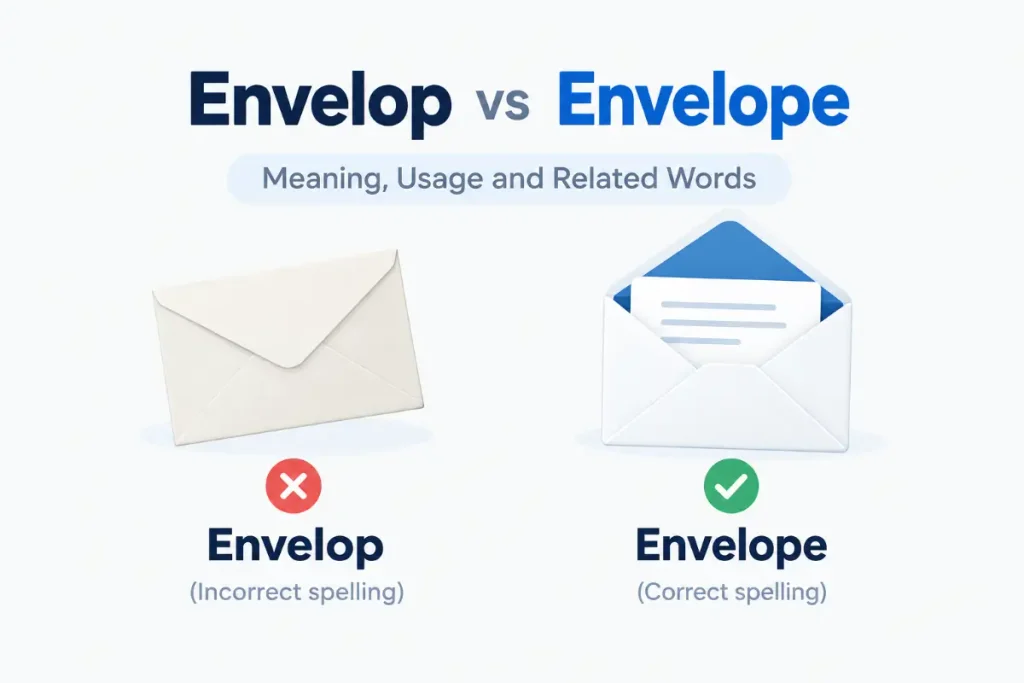
If you are unsure about envelop vs envelope, the answer depends on what you are trying to say. Envelop is a verb meaning to completely cover or surround something. Envelope is usually a noun for the paper container used to hold a letter or document. The two words look almost identical, sound somewhat related, and come from the same historical source, which makes them easy to mix up.
The distinction becomes much easier once you connect each spelling with its grammatical role. You envelop something when you surround or cover it. You put a letter inside an envelope. The verb can also appear in literary, descriptive, scientific, and professional writing, while the noun is common in everyday communication.
This guide explains the difference clearly, including pronunciation, meanings, grammar, examples, common mistakes, word origins, professional usage, and related expressions such as building envelope and push the envelope.
Quick Answer
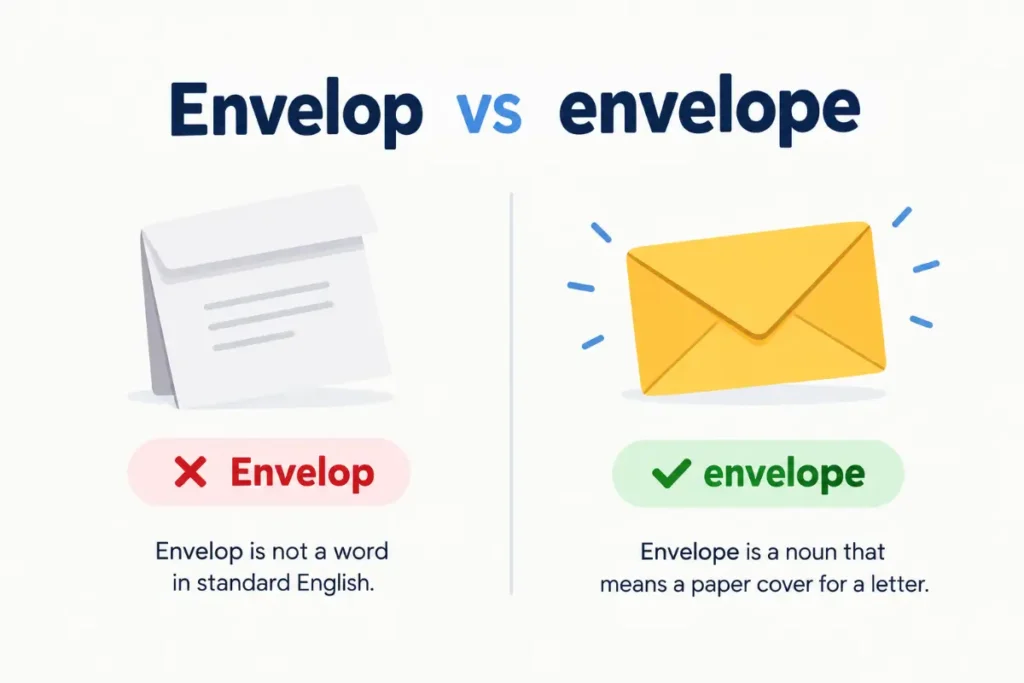
Envelop is a verb meaning to cover or surround something completely. Envelope is usually a noun meaning a paper container for a letter or document. For example, fog can envelop a city, while you can place a letter inside an envelope. They are related words, but they do different grammatical jobs.
Envelop vs Envelope at a Glance
The easiest way to distinguish the two words is to focus on their parts of speech.
| Feature | Envelop | Envelope |
|---|---|---|
| Part of speech | Verb | Usually a noun |
| Core meaning | To cover or surround completely | A container or covering |
| Typical use | Describes an action | Names an object or boundary |
| Example | Fog began to envelop the town. | She put the letter in an envelope. |
| Common contexts | Weather, literature, science, descriptive writing | Mail, documents, packaging, business |
| US pronunciation | /ɪnˈvel.əp/ | /ˈɑːn.və.loʊp/ or /ˈen.və.loʊp/ |
| Related forms | enveloped, enveloping, envelopment | envelopes |
| Common confusion | Mistaken for the noun | Mistaken for the verb |
The most useful memory trick is simple:
Envelop is an action. Envelope is usually a thing.
If something surrounds something else, you can use the verb envelop. If you are talking about the paper container that holds a letter, use envelope. Cambridge defines envelop as a verb meaning to cover or surround something completely, while envelope is defined as a noun for a flat paper container used for a letter.

When choosing between commonly confused words, it helps to check both their spelling and meaning before using them in formal writing.
What Does Envelop Mean?
Envelop is a verb that means to cover, surround, or completely enclose something.
It often describes something spreading around another object, person, place, or area. Fog, smoke, darkness, silence, heat, and crowds are common subjects because they can surround something from many directions.
For example:
- Thick fog began to envelop the highway.
- Darkness enveloped the neighborhood after the power went out.
- Smoke quickly enveloped the building.
- A warm blanket enveloped the sleeping child.
- The crowd began to envelop the small group of protesters.
- Silence seemed to envelop the room.
- The mountain was enveloped in clouds.
- A strange calm enveloped the classroom after the announcement.
The word often has a descriptive or somewhat formal tone. Cambridge labels the verb as literary, although it is also used in ordinary nonfiction and specialized writing.
The basic grammatical pattern is:
Subject + envelop + object
For example:
- Fog enveloped the valley.
- The darkness enveloped the street.
- Smoke enveloped the house.
You can also use the passive form be enveloped in:
- The town was enveloped in fog.
- The mountains were enveloped in mist.
- She was enveloped in a warm blanket.
The past tense and past participle are enveloped, while the present participle is enveloping.
What Does Envelope Mean?
Envelope is most commonly a noun. It refers to a flat paper container designed to hold a letter, card, document, check, or similar item.
For example:
- I put the check in an envelope.
- She sealed the envelope before leaving.
- The letter arrived in a plain white envelope.
- Please write your return address on the envelope.
- He opened the envelope carefully.
- The invitation came in a large envelope.
- The secretary placed the documents in an envelope.
- I forgot to put a stamp on the envelope.
This is the meaning most people encounter in everyday American English.
The noun is countable, so you can say:
- an envelope
- one envelope
- two envelopes
- several envelopes
The plural is envelopes.
For example:
I bought three envelopes at the office supply store.
The word also has broader meanings. In technical contexts, an envelope can refer to an outer covering, boundary, or range. For example, scientists, engineers, mathematicians, and other specialists may use envelope in ways that have nothing to do with paper mail.
That broader meaning is connected to the basic idea of something surrounding or containing something else.
The Main Difference in Meaning
The two words are closely connected, but they describe different things.
Envelop describes the act of surrounding or covering.
Envelope usually describes the thing that contains or covers.
Compare these sentences:
- Fog enveloped the city.
- The letter was inside an envelope.
In the first sentence, enveloped tells us what the fog did. It surrounded the city.
In the second sentence, envelope names an object. It is the container holding the letter.
This distinction explains many of the mistakes people make. The spelling differs by only one letter, but the grammatical function changes completely.
Another useful comparison is:
- The darkness enveloped the room.
- The document was placed in an envelope.
You would not normally replace one with the other because the sentence requires a different kind of word.
When Should You Use Envelop?
Use envelop when you need a verb that means to surround or cover completely.
It works particularly well when something physically or figuratively spreads around another thing.
Physical surroundings
You can use it for physical substances or objects:
- Clouds enveloped the mountain.
- Smoke enveloped the cabin.
- The blanket enveloped the baby.
- Thick mist enveloped the road.
Emotional or figurative surroundings
The word can also describe abstract conditions:
- Fear enveloped the community.
- A sense of uncertainty enveloped the organization.
- Silence enveloped the audience.
- Relief enveloped her after the announcement.
These uses are more figurative. The idea is still the same: something surrounds or covers the subject.
Descriptive and literary writing
Because the verb can sound more formal than simpler alternatives such as surround or cover, writers sometimes choose it for vivid description.
Compare:
Fog surrounded the village.
and
Fog enveloped the village.
Both are grammatical. The second emphasizes the sense of the fog covering the village completely and can sound more atmospheric.
When Should You Use Envelope?
Use envelope when you are referring to a physical container or another type of outer covering or boundary.
The most familiar use involves mail:
- Put the card in an envelope.
- Seal the envelope.
- Address the envelope.
- Open the envelope.
- Mail the envelope.
The word is also common in business communication.
For example:
Please include the signed form in the enclosed envelope.
You may see it in administrative instructions, banking correspondence, school communications, legal documents, and traditional postal communication.
The noun also appears in established expressions.
Push the envelope
Push the envelope is an idiomatic expression meaning to go beyond the usual limits or boundaries, especially by trying something new or unconventional. Cambridge gives this expression as an example of a broader meaning associated with envelope.
Examples include:
- The new design pushes the envelope in terms of efficiency.
- The filmmaker is known for pushing the envelope.
- The company wants to push the envelope with its next product.
Here, envelope does not mean a paper container. It refers figuratively to a boundary or limit.
Examples of Envelop in Sentences
Seeing the verb in several contexts makes its function easier to recognize.
Everyday situations
- A thick fog began to envelop the neighborhood before sunrise.
The fog surrounds the neighborhood.
- Warm sunlight enveloped the room through the open windows.
The sunlight spreads throughout the room.
- Smoke quickly enveloped the kitchen.
The smoke surrounded or filled the kitchen.
Workplace writing
- A sense of uncertainty began to envelop the team after the announcement.
The uncertainty affects and surrounds the team figuratively.
- The building was enveloped in dust during the renovation.
The dust covered the building.
Academic or technical writing
- The surrounding atmosphere can envelop the surface in a thin layer of gas.
The verb describes complete surrounding or coverage.
- The membrane envelops the structure beneath it.
The membrane surrounds the structure.
Descriptive writing
- Dark clouds enveloped the valley by late afternoon.
The clouds covered the valley.
- A strange silence enveloped the theater after the lights went out.
The silence is presented figuratively as surrounding the space.
- The child was enveloped in a thick winter coat.
The coat surrounded and covered the child.
Notice that all ten examples involve an action. Something is doing the surrounding or covering.
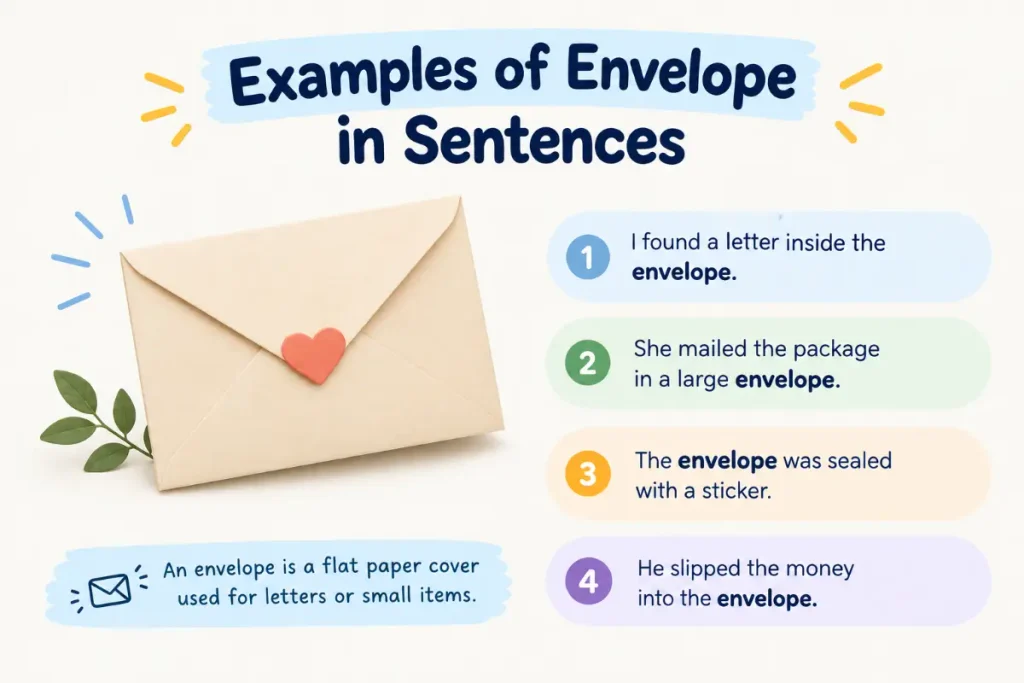
Examples of Envelope in Sentences
Now compare the noun.
Mail and letters
- I put the letter in a blue envelope.
- Please write the recipient’s address on the envelope.
- She opened the envelope and read the note.
- The invitation arrived in a decorated envelope.
Business communication
- The signed contract was returned in a sealed envelope.
- Please place the completed form in the envelope provided.
- The accounting department mailed the documents in a large envelope.
School and everyday life
- The teacher handed each student an envelope containing the exam materials.
- He slipped the birthday card into an envelope.
- I need to buy a few envelopes before sending these invitations.
Here, envelope names a thing. That is the key difference.
Common Mistakes With These Words
The most common problem is using the noun when the sentence requires a verb, or using the verb when the sentence requires a noun.
Mistake 1: Using envelope as a verb
Incorrect:
The fog enveloped the town.
This sentence is actually correct.
A common mistake would be:
The fog enveloped the town in a paper container.
That changes the intended meaning and can create confusion.
The important point is that envelop is the verb used for surrounding.
Correct:
The fog enveloped the town.
Mistake 2: Using envelop for a paper container
Incorrect:
I put the check inside an envelop.
Correct:
I put the check inside an envelope.
The paper container is the noun envelope.
Mistake 3: Treating the two words as spelling variants
They are not simply alternate spellings of the same word.
They are related words with different grammatical roles.
- envelop = verb
- envelope = noun in its most common use
This is similar to other word pairs in English where a small spelling difference signals a change in meaning or function.
Mistake 4: Assuming the final e is silent in both words
Pronunciation helps distinguish them.
Envelop ends with the sound of lep.
Envelope ends with the sound of lope in common US pronunciations.
That difference can help you remember the spelling.
Envelop vs Envelope Pronunciation
Pronunciation is one of the easiest ways to separate these words.
Cambridge gives the US pronunciation of envelop as /ɪnˈvel.əp/. The stress falls on the second syllable.
A simple pronunciation guide is:
envelop: in VEL up
The final syllable sounds like a relaxed uhp, not like lope.
For envelope, Cambridge lists US pronunciations including /ˈɑːn.və.loʊp/ and /ˈen.və.loʊp/.
A simple pronunciation guide is:
envelope: EN vuh lope
or, in another common US pronunciation:
AHN vuh lope
The first syllable can vary in American English, but the important distinction is the ending.
Compare:
- envelop: in VEL up
- envelope: EN vuh lope
The different stress patterns and endings make the distinction much clearer when spoken aloud.
Just as envelop and envelope differ in both form and function, continual and continuous have distinct meanings that can change the accuracy of a sentence.
Envelop Past Tense and Other Verb Forms
Because envelop is a regular verb, its main forms are straightforward.
| Form | Word |
|---|---|
| Base form | envelop |
| Third person singular | envelops |
| Past tense | enveloped |
| Past participle | enveloped |
| Present participle | enveloping |
Examples:
Present:
The fog envelops the valley every morning.
Past:
The fog enveloped the valley yesterday.
Perfect:
The fog has enveloped the valley.
Progressive:
The fog is enveloping the valley.
The past tense is enveloped, not envelopped.
The present participle is enveloping, not envelopeing.
These forms follow standard English spelling patterns for verbs ending in a silent final e.
Building Envelope or Building Envelop?
In architecture and construction, the correct term is building envelope.
A building envelope refers to the parts of a building that separate its interior from the exterior environment. Depending on the context, this can include walls, roofs, windows, doors, and other elements that form the outer boundary.
For example:
The building envelope must provide adequate protection from weather.
Here, envelope is a noun.
You would not normally write:
The building envelop must provide adequate protection from weather.
That spelling is wrong for this technical noun.
The confusion happens because the concept itself involves surrounding a building. Still, the established term is building envelope.
Envelop or Envelope in Professional Writing
Both words can appear in professional writing, but they serve different purposes.
Use envelop when you need to describe something being completely surrounded or covered:
- The new material can envelop the internal structure.
- The smoke began to envelop the facility.
- The coating envelops the surface.
Use envelope when naming a physical container or technical boundary:
- Please return the form in the enclosed envelope.
- The building envelope requires additional insulation.
- The design operates within a defined performance envelope.
For most business emails involving physical mail, envelope will be the word you need.
For descriptive reports, technical documents, research papers, and formal prose, envelop may appear when the meaning involves surrounding or covering.
Is Envelop Formal or Casual?
Envelop is grammatical and standard, but it often sounds more formal or literary than everyday alternatives such as surround, cover, or wrap around. Cambridge specifically labels the verb as literary.
That does not make it inappropriate for professional writing. It simply means that context matters.
For example:
Formal or descriptive:
A dense fog enveloped the aircraft.
Plain and direct:
A dense fog surrounded the aircraft.
Both communicate the basic idea. The first has a more descriptive quality.
In casual conversation, people may prefer surround because it is more familiar:
The trees surrounded the house.
In a literary passage, enveloped may sound more natural:
The house was enveloped by towering trees.
The best choice depends on the tone you want.
Is Envelope Always a Physical Paper Container?
No. The paper container is the most familiar meaning, but envelope has several specialized uses.
In mathematics, geometry, engineering, physics, architecture, aviation, and other fields, the word can describe an outer boundary, range, or surrounding form.
For example:
The aircraft remained within its operating envelope.
Here, envelope refers to a defined range of operating conditions rather than a piece of paper.
Similarly, building envelope refers to the outer boundary of a building.
These technical uses are not unrelated to the everyday noun. They share the broader idea of something that contains, surrounds, or defines an outer limit.
Envelop and Envelope Word Origin
The two words are historically connected.
Envelop entered English in the late fourteenth century through forms derived from Old French envoleper and envoluper, meaning to cover, wrap, or fold up. The literal sense developed later in English.
Envelope developed from French enveloppe and entered English as a noun around 1705. Historical sources describe it as a wrapper or covering, specifically including a prepared wrapper for a letter or other paper.
This history explains why the words look so similar. They are not unrelated spelling accidents. The noun developed from the same family of ideas represented by the verb.
The basic concept is still visible today:
- envelop means to surround or cover.
- envelope names something that surrounds, contains, or covers.
Understanding that connection makes the pair easier to remember.
Envelop vs Envelope and Related Words
Several related forms can create additional confusion.
Enveloped
Enveloped is the past tense and past participle of envelop.
Example:
The valley was enveloped in mist.
Enveloping
Enveloping is the present participle or gerund form.
Example:
The enveloping fog reduced visibility.
Envelopment
Envelopment is a noun referring to the act or process of enveloping.
Example:
The rapid envelopment of the area made evacuation difficult.
The noun envelope is different even though it belongs to the same word family.
Enclose
Enclose is a useful synonym for some contexts. It can mean to surround something or put something inside a container.
For example:
Please enclose a copy of your receipt.
This means to include the receipt with something else, such as a letter.
Surround
Surround is one of the simplest everyday alternatives to envelop.
For example:
Trees surrounded the house.
You could also say:
Trees enveloped the house.
The second version is more vivid and suggests complete coverage or immersion.
A Simple Memory Trick
If you regularly confuse these spellings, connect each one to its grammatical role.
Think:
Envelop = enveloping action.
Something envelops something else.
Then:
Envelope = object.
A letter goes inside an envelope.
You can also remember the pronunciation:
- envelop ends like up.
- envelope ends like lope.
Try these pairs aloud:
- Fog enveloped the city.
- The letter went into an envelope.
- Darkness enveloped the room.
- She sealed the envelope.
- Clouds enveloped the mountain.
- The document was inside the envelope.
The meaning becomes obvious when the words appear in context.
Which Word Should You Use?
Choose envelop when the sentence describes an action of completely covering or surrounding something.
Choose envelope when you are naming a paper container or another type of outer boundary, range, or covering.
A quick decision process can help:
- Are you describing an action?
Use envelop. - Are you naming a paper container?
Use envelope. - Are you describing a building’s outer boundary?
Use building envelope. - Are you talking about going beyond a limit?
The expression push the envelope may be appropriate. - Are you describing something surrounded by fog, smoke, darkness, or another substance?
Envelop or enveloped may fit.
This approach is more reliable than trying to remember the spelling by appearance alone.
These small differences in word choice can be easy to overlook, much like the distinction between disinterested and uninterested, but understanding them makes your writing more precise.
Frequently Asked Questions
Which is correct, envelop or envelope?
Both are correct words, but they are used differently. Envelop is a verb meaning to cover or surround completely. Envelope is usually a noun referring to a paper container for a letter or document. The sentence determines which word you need.
Is envelop a real word?
Yes. Envelop is a standard English verb. It means to cover or surround something completely. It can describe physical surroundings, such as fog enveloping a town, as well as figurative situations, such as fear enveloping a community. Cambridge lists it as a verb and gives the US pronunciation /ɪnˈvel.əp/.
Is envelope a verb?
Envelope is primarily used as a noun in standard modern English. It names a paper container for a letter and has broader technical meanings involving an outer boundary or range. If you mean to surround or cover something, use the verb envelop.
How do you pronounce envelop?
In American English, envelop is pronounced /ɪnˈvel.əp/. A simple approximation is in VEL up. The stress falls on the second syllable, and the final sound is different from the lope ending in envelope.
How do you pronounce envelope?
In American English, envelope has pronunciations including /ˈɑːn.və.loʊp/ and /ˈen.və.loʊp/. A simple guide is AHN vuh lope or EN vuh lope. The final syllable rhymes with hope or lope.
Is building envelope or building envelop correct?
Building envelope is the correct term. In architecture and construction, it refers to the outer parts or boundary of a building that separate the interior from the outside environment. The word is a noun in this phrase, so envelope is required.
What is the past tense of envelop?
The past tense is enveloped. For example: A thick fog enveloped the city. The same form is used as the past participle, as in The city was enveloped in fog. The present participle is enveloping.
What is the easiest way to remember the difference?
Remember that envelop is an action and envelope is usually a thing. You can envelop a city in fog, but you put a letter inside an envelope. Pronunciation provides another clue: envelop ends with an uhp sound, while envelope ends with lope.
Conclusion
The difference between envelop vs envelope becomes simple once you focus on grammar. Envelop is a verb that means to cover or surround something completely. Envelope is usually a noun for a paper container, although it also has broader meanings involving outer boundaries, limits, and coverings.
Use envelop in sentences such as Darkness enveloped the town. Use envelope in sentences such as She placed the letter in an envelope. The words share a historical connection, so their similar spelling makes sense, but they are not interchangeable. If you remember envelop = action and envelope = thing, you will usually choose the right form quickly and confidently.