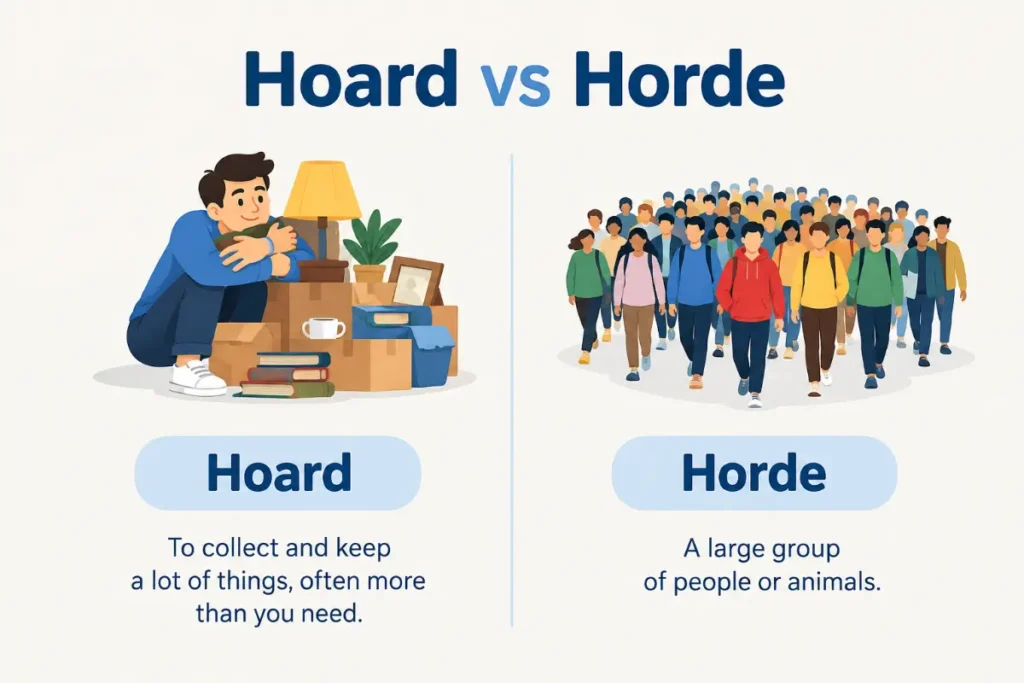
Hoard vs horde is a common spelling confusion because these two words sound exactly alike in American English. However, they have very different meanings. Hoard refers to a collection of things someone stores or keeps, often in large quantities. Horde refers to a large group of people or animals, usually moving together or gathering in one place.
For example, you might hoard canned food before a major storm, but a horde of shoppers might rush into a store during a holiday sale. The first word describes collecting or storing things, while the second describes a crowd. Although the words share the same pronunciation, you cannot use them interchangeably without changing your sentence’s meaning.
The confusion becomes easier to manage when you understand how each word functions as a noun or verb. You will also learn how to use both words naturally in everyday American English, recognize common mistakes, understand their origins, and choose the correct spelling in professional writing, school assignments, emails, and social media posts.
Quick Answer
Hoard means a supply or collection of things kept for future use, or the act of storing those things. Horde means a large group of people or animals. You can hoard emergency supplies, but you cannot hoard a horde of people. Remember that hoard involves keeping things, while horde involves a crowd.
What Does Hoard Mean
Hoard can function as both a noun and a verb. As a noun, it refers to a collection of items stored or kept, often secretly or for future use. As a verb, it means to accumulate or hold on to things instead of sharing, using, or getting rid of them.
The word often suggests that someone is keeping more than they need. For example, a person who buys dozens of canned goods and refuses to share them during an emergency might be accused of hoarding supplies. However, hoarding is not always negative. Someone who carefully saves money or collects valuable items may simply be building a reserve.
Hoard as a Noun
When hoard is a noun, it identifies the things someone has accumulated. The collection might include money, food, supplies, documents, collectibles, or other possessions. A hoard can be valuable, useful, excessive, or unnecessary, depending on the context.
For example, a family might discover a hoard of old coins in an attic. Archaeologists might uncover a hoard of gold objects buried centuries ago. In both cases, hoard refers to a stored collection rather than a group of people.
The noun is commonly used in historical, financial, and everyday contexts. It can describe anything from an emergency food reserve to a valuable collection hidden away for years.
Hoard as a Verb
As a verb, hoard describes the act of gathering and keeping things, often in large quantities. It can suggest secrecy, excessive accumulation, reluctance to share, or preparation for a future need. The surrounding sentence helps readers understand the reason behind the behavior.
Consider the sentence, “Residents began to hoard bottled water before the hurricane.” Here, hoard means they accumulated water supplies, possibly because they expected shortages. In another context, “He hoards old newspapers” suggests that he keeps far more newspapers than he needs.
The main verb forms are hoard, hoards, hoarded, and hoarding. For example, “She hoards books,” “She hoarded supplies,” and “She is hoarding food” all use the same basic meaning in different grammatical forms.
Once the distinction between “hoard” and “horde” is clear, it becomes easier to avoid confusion with other expressions, including a point that no longer matters in a discussion.
What Does Horde Mean
Horde is a noun that describes a large group of people or animals. It often suggests that the group is moving together, gathering in a particular place, or arriving in overwhelming numbers. The word can create an image of a crowd that is difficult to manage or control.
For example, you might describe a horde of fans waiting outside a concert venue. You could also refer to a horde of tourists crowding a popular attraction during the summer. In both examples, horde refers to a large group rather than a collection of stored objects.
The word can sound dramatic or slightly negative, particularly when the writer wants to emphasize a crowd’s size, noise, or movement. However, it can also be playful, especially in humorous descriptions of shoppers, children, fans, or excited pets.
Horde in Everyday English
Horde is often paired with a phrase that identifies the group. Common examples include a horde of people, a horde of fans, a horde of tourists, a horde of shoppers, and a horde of wild animals.
For instance, “A horde of fans gathered outside the stadium before the championship game.” The sentence emphasizes the large number of fans gathered in one place. It does not mean the fans were collecting or storing anything.
Similarly, “A horde of geese crossed the parking lot” describes a large group of birds. The word gives the reader a sense of numbers and movement without identifying an exact count.
Although horde often carries a negative or exaggerated tone, it does not automatically mean the group is dangerous. Writers frequently use it for humorous effect or to emphasize an unusually large crowd.
Hoard vs Horde Meaning
The most important difference is that hoard describes accumulated things, while horde describes a large group. Hoard can be a noun or a verb, but horde is a noun in standard contemporary English.
| Feature | Hoard | Horde |
|---|---|---|
| Part of speech | Noun and verb | Noun |
| Main meaning | A stored collection or the act of accumulating things | A large group of people or animals |
| Common examples | Hoard of coins, hoard supplies | Horde of fans, horde of tourists |
| Typical action | Saving, collecting, storing, keeping | Gathering, arriving, moving together |
| Tone | Can suggest excessive accumulation or careful saving | Can suggest a large or overwhelming crowd |
| Verb form | Hoard, hoards, hoarded, hoarding | No standard verb form with this meaning |
| Example | They hoarded emergency supplies. | A horde of shoppers entered the store. |
A simple way to remember the difference is to ask what the sentence describes. If someone is keeping objects or building a supply, hoard is probably correct. If the sentence describes a crowd of people or animals, horde is the right choice.
Hoard and Horde in a Sentence
Using both words in the same sentence makes the contrast easy to see. Consider this example: “The shoppers hoarded bottled water while a horde of customers waited outside the store.” The verb hoarded describes the act of accumulating water, while horde identifies the large group waiting outside.
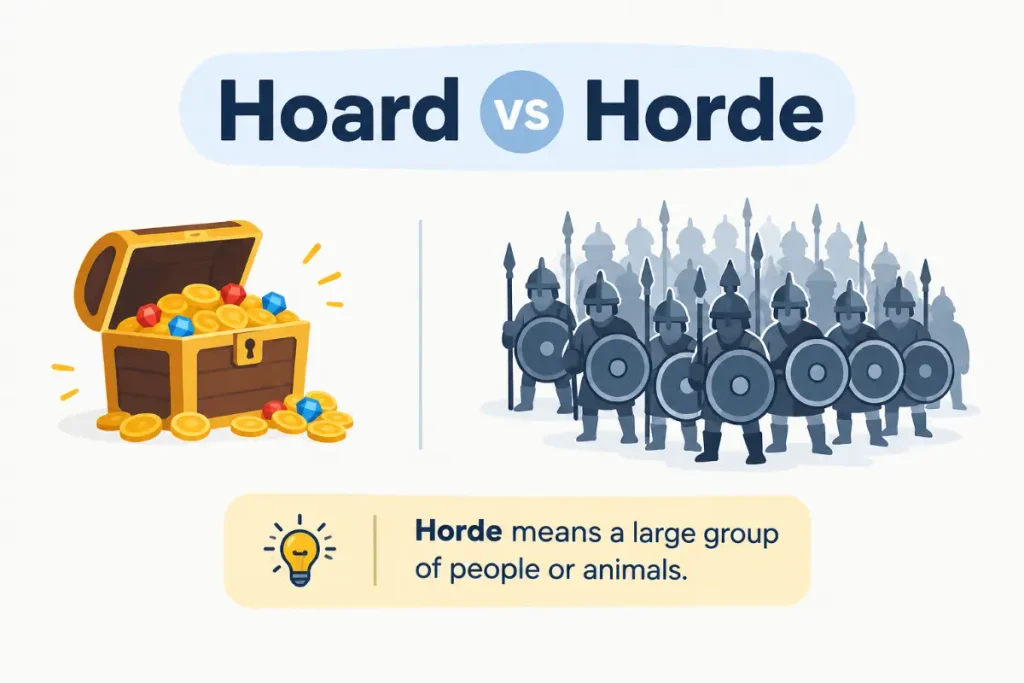
Here is another example: “The dragon guarded its hoard of gold as a horde of warriors approached the cave.” The hoard is the stored treasure, and the horde is the group of warriors. The words serve different grammatical roles and describe different things.
You can use this pattern in stories, news reports, everyday conversation, and creative writing. Once you recognize the difference between a collection and a crowd, choosing the correct spelling becomes much easier.
Examples of Hoard in Sentences
These examples show how hoard works as both a noun and a verb in everyday American English.
1. The family kept a hoard of emergency supplies in the basement.
2. She tends to hoard old magazines instead of recycling them.
3. Archaeologists discovered a hoard of ancient coins beneath the ruins.
4. Some shoppers began to hoard toilet paper when the shortage was announced.
5. He has a hoard of baseball cards collected over several decades.
6. The squirrel continued to hoard nuts before winter arrived.
7. The company was accused of hoarding essential materials during the supply shortage.
8. My grandfather kept a small hoard of letters and photographs in a wooden box.
9. You should not hoard information that your teammates need to complete the project.
10. The fantasy novel describes a dragon protecting its enormous hoard of treasure.
Notice that the word does not always describe selfish behavior. A collection of historical objects can be called a hoard, while hoarding supplies can suggest excessive accumulation or preparation. The context determines the tone.
Examples of Horde in Sentences
These examples show how horde describes large groups of people or animals.
1. A horde of fans waited outside the arena before the concert.
2. A horde of tourists filled the narrow streets near the waterfront.
3. The hikers watched a horde of ants moving across the forest floor.
4. A horde of shoppers rushed into the mall on Black Friday.
5. The teacher greeted a horde of excited children at the school entrance.
6. A horde of geese gathered near the pond.
7. The video game requires players to defend their village against a horde of monsters.
8. A horde of reporters gathered outside the courthouse.
9. The restaurant struggled to serve the horde of customers who arrived during lunch.
10. In the fantasy story, a horde of warriors marched toward the castle.
In every example, horde identifies a group. It does not describe collecting, saving, or storing anything.
“Hoard” and “horde” are another commonly confused word pair where similar-looking words have distinctly different meanings and uses.
Why People Confuse Hoard and Horde
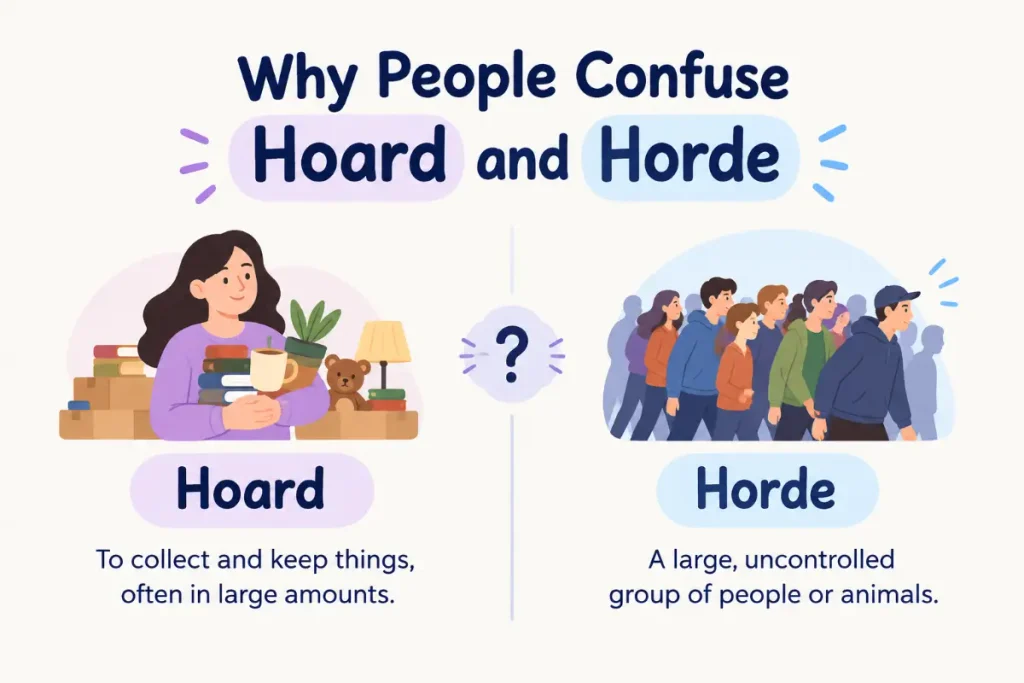
The main reason for the confusion is pronunciation. In standard American English, hoard and horde are homophones, meaning they sound alike even though they have different spellings and meanings. When someone says either word aloud, listeners must rely on context to understand which one the speaker intends.
The spelling difference is small, so it is easy to choose the wrong word while typing quickly. Autocorrect may not catch the mistake because both spellings are legitimate English words. A sentence can therefore look grammatically correct while communicating an unintended meaning.
The words also appear in similar contexts involving large quantities. Someone might write about a hoard of supplies or a horde of shoppers, and both phrases describe something large in number. However, one refers to stored objects and the other refers to a crowd.
The best solution is to remember the noun each word describes. A hoard is a collection of things. A horde is a crowd of living creatures, especially people or animals.
Hoard as a Verb and Common Grammar Rules
Hoard is especially useful to understand because it can function as both a noun and a verb. As a noun, it refers to the collection itself. As a verb, it describes the act of collecting and keeping items.
The verb follows the usual pattern for regular English verbs. Its present forms include hoard and hoards, its past tense is hoarded, and its present participle is hoarding. These forms work in ordinary sentences without any unusual grammatical rules.
For example, “I hoard old books” uses the simple present. “She hoarded supplies last winter” uses the simple past. “They are hoarding food” uses the present progressive to describe an action in progress.
Horde does not have a standard verb form meaning to gather into a crowd. You can say that people gathered, crowded together, or arrived in large numbers, but horde itself is normally a noun in contemporary English.
Hoard vs Horde Etymology
The histories of these words help explain why their spellings differ even though their pronunciations are alike.
Hoard comes from Old English hord, which referred to a treasure, store, or valuable collection. Its meaning developed around the idea of keeping possessions or supplies in reserve. That connection remains clear in modern phrases such as a hoard of coins and to hoard food.
Horde entered English through European languages and is ultimately associated with Turkic words referring to a camp, encampment, or group. It became associated with large groups of people, particularly in historical descriptions of nomadic communities and invading forces. Modern English uses it more broadly for large crowds of people or animals.
Although the words have different histories, their similar pronunciation explains much of the confusion. Learning their origins can help you remember the difference, but the practical distinction is even simpler: hoard concerns stored things, while horde concerns a group.
Is Horde Always Negative
No. Horde can carry a negative tone, but it does not always describe a dangerous, hostile, or unwelcome crowd. Writers often use it to emphasize the sheer size of a group, sometimes with humor or exaggeration.
For example, “A horde of children raced toward the playground” sounds lively rather than threatening. “A horde of fans surrounded the celebrity’s car” may suggest an overwhelming crowd. The surrounding details determine the emotional effect.
The word can also appear in fantasy, gaming, and adventure writing. A horde of monsters or warriors often suggests a large force that presents a challenge to the main characters. In those settings, the word adds drama and conveys scale.
If you want a more neutral tone in professional writing, crowd, group, gathering, or audience may be better choices. Horde is appropriate when the size or overwhelming nature of the group matters to the description.
Is Hoarding Always a Bad Thing
No. The verb hoard can describe sensible preparation as well as excessive accumulation. Its tone depends on the quantity of items, the reason for keeping them, and the effect on other people.
For example, keeping a reasonable supply of canned food before hurricane season may be practical preparation. Buying far more than a household needs and leaving other residents without essentials may be described as hoarding in a negative sense. The same basic action of accumulating supplies can therefore receive different judgments depending on the circumstances.
Hoard also appears in collecting and historical contexts without suggesting wrongdoing. A hoard of ancient coins might be an important archaeological discovery. A person who has a hoard of vintage comic books may simply have an extensive collection.
When writing about someone’s behavior, consider the intended meaning. If you only mean that a person collects things, collect or save may be more neutral. If you want to emphasize keeping large quantities, particularly excessively or secretly, hoard may be more accurate.
Hoard vs Horde in Everyday American English
Both words are standard in American English, and neither is a regional spelling variant of the other. Their meanings remain distinct across American, British, Canadian, and Australian English. The main issue is choosing the right word for the situation rather than following a regional spelling convention.
In everyday conversation, hoard often appears when people talk about money, food, household items, collectibles, or information. For example, someone might say, “Stop hoarding all the snacks and share with everyone.” Here the verb means keeping more than a fair share for yourself.
Horde commonly appears when describing crowds at concerts, sporting events, shopping centers, tourist attractions, or public gatherings. For example, a news report might describe a horde of fans waiting for tickets. In casual speech, people may choose crowd instead because it sounds more neutral.
In professional writing, precision matters more than formality. Use hoard for stored items or the act of accumulating them, and use horde for a large group. If horde sounds too dramatic for the situation, crowd or group may communicate the idea more naturally.
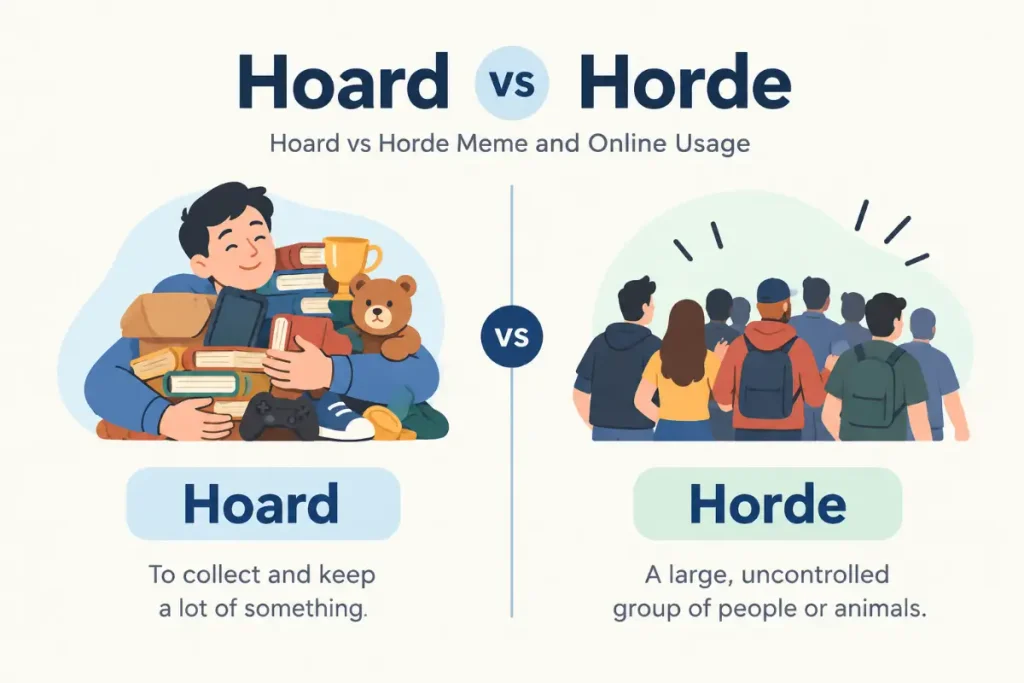
Hoard vs Horde Meme and Online Usage
The difference between hoard and horde can also appear in memes, gaming discussions, and social media posts. These settings often use the words humorously because a single letter changes the meaning while the pronunciation stays the same.
For example, a meme might show someone buying every roll of toilet paper in a store with the caption, “When you hoard supplies before a storm.” The joke relies on the idea of one person accumulating far too much. A different meme might show a crowd of people rushing toward a sale with the caption, “A horde of shoppers has arrived.”
Gaming communities also use horde to describe waves of enemies attacking a player or team. Hoard, by contrast, may refer to accumulated loot, gold, equipment, or other resources. A player might hoard rare items while fighting off a horde of monsters.
These examples are informal, but the distinction is the same in professional writing. Hoard means to accumulate or a collection of stored things. Horde means a large group. Humor does not change the underlying meanings.
Related Words That Can Help You Remember
Several related words can make the distinction easier to understand. For hoard, useful alternatives include stash, stockpile, reserve, store, accumulate, and save. These words relate to keeping or collecting things, although each has its own tone and context.
For horde, useful alternatives include crowd, throng, mass, multitude, and large group. These words describe people or other living creatures gathered in numbers. Throngs and hordes can sound dramatic, while crowd is generally more neutral.
The alternatives are not perfect substitutes in every sentence. A stash often suggests a hidden supply, while a stockpile suggests a large quantity stored for future use. A multitude emphasizes number, while a horde may suggest a crowd that is overwhelming or moving together.
Choose the word that communicates the right image. If you are describing objects collected in one place, consider hoard, stash, or stockpile. If you are describing people or animals gathered together, consider horde, crowd, or throng.
Understanding subtle differences in word meaning can help you choose the right word and make your writing more precise.
Frequently Asked Questions
What is the difference between hoard and horde
Hoard refers to a stored collection of things or the act of accumulating items. Horde refers to a large group of people or animals. You might hoard emergency supplies before a hurricane, while a horde of residents gathers at a community shelter. The words sound alike but have different meanings and grammatical functions.
Is hoard a noun or a verb
Hoard can be both a noun and a verb. As a noun, it means a collection of stored or accumulated things. As a verb, it means to gather and keep items, often in large quantities. For example, “The family discovered a hoard of coins” uses the noun, while “They hoard supplies” uses the verb.
Is horde a noun or a verb
Horde is a noun in standard contemporary English. It describes a large group of people or animals, as in a horde of tourists or a horde of geese. It is not normally used as a verb to mean gathering into a crowd. Use gather, crowd, or assemble when you need a verb for that action.
How do you use hoard and horde in a sentence
You can use both words in one sentence to show their different meanings. For example, “The dragon protected its hoard of gold while a horde of warriors approached the cave.” Hoard identifies the stored treasure, while horde identifies the large group of warriors. The sentence makes the spelling distinction clear through context.
What does a horde of people mean
A horde of people means a large crowd or group of people. The expression can suggest that the group is arriving in large numbers, moving together, or overwhelming a particular place. It may sound dramatic or negative, but it can also be used humorously. A neutral alternative is a crowd of people.
Why do hoard and horde sound the same
Hoard and horde are homophones in standard American English, so they share the same pronunciation despite their different spellings and meanings. The first word concerns stored items or accumulation, while the second describes a large group. Because pronunciation cannot distinguish them, writers need to rely on meaning and context when choosing the correct spelling.
What is the origin of hoard and horde
Hoard comes from Old English hord, meaning a store or treasure. Horde entered English through European languages and is ultimately associated with Turkic words for a camp or group. Their separate histories reflect their different meanings. Hoard developed around stored possessions, while horde became associated with large groups of people and animals.
Is hoard always a negative word
No. Hoard can describe excessive or selfish accumulation, but it can also refer neutrally to a collection of valuable objects or stored supplies. A hoard of ancient coins may be an important historical discovery, while hoarding essential goods during a shortage may be criticized. Context determines whether the word sounds neutral or negative.
Conclusion
The difference between hoard vs horde comes down to one simple distinction. A hoard is a collection of things kept or accumulated, and hoard can also describe the act of keeping those things. A horde is a large group of people or animals, often gathered or moving together.
When you are unsure which spelling to use, identify what your sentence describes. If it involves saving food, collecting coins, storing supplies, or keeping possessions, choose hoard. If it involves a crowd of shoppers, fans, tourists, or animals, choose horde. Both words are correct in American English, but they are not interchangeable. Remembering the difference will help you write more clearly in everyday conversation, professional communication, academic work, and online posts.