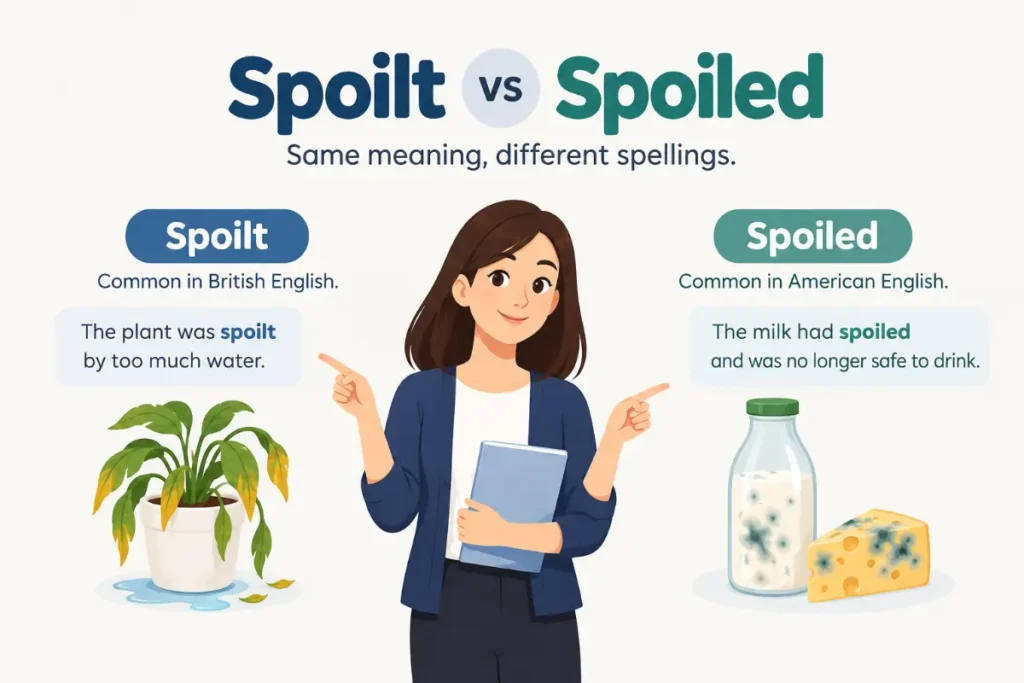
The difference between spoilt vs spoiled comes down to spelling preference and regional usage rather than a difference in meaning. Both words are correct forms of the past tense and past participle of spoil. However, spoiled is the standard choice in American English, while spoilt is more common in British English and other varieties of English outside the United States.
You might write that your parents spoiled you on your birthday, that the milk spoiled in the refrigerator, or that a surprise party spoiled the ending of a movie. In each case, spoiled works naturally for an American audience. In British English, you may encounter spoilt in the same situations without any change in meaning.
The choice becomes slightly more interesting when you describe a child who receives too many gifts or expects to get everything they want. Both a spoiled child and a spoilt child are grammatically correct, but the spelling you choose may signal a regional preference. Understanding the difference helps you write naturally without treating a valid British form as a spelling mistake. The following sections explain the meanings, grammar rules, birthday expressions, common phrases, and sentence examples so you can confidently choose the right form for your audience.
Quick Answer
Spoiled is the preferred spelling in American English, while spoilt is a valid alternative used more often in British English. Both are forms of the verb spoil and have the same meaning. Use spoiled for US schoolwork, professional writing, emails, and everyday communication unless you are following a style guide that prefers spoilt.
What Does Spoiled Mean
Spoiled is the past tense and past participle of the verb spoil. It can mean that something has become bad or unusable, that someone has damaged or ruined something, or that a person has received so much attention or indulgence that they behave as though they are entitled to special treatment.
The exact meaning depends on the context. If food has spoiled, it has gone bad. If someone spoiled a movie ending, they revealed an important detail that another person wanted to discover while watching. If parents spoiled their child, they may have given the child too many treats, gifts, or privileges.
Here are some examples of the word in everyday American English.
- The milk spoiled because we left it outside the refrigerator.
- My parents spoiled me with thoughtful gifts on my birthday.
- Please do not spoil the ending of the movie.
- The unexpected rain spoiled our picnic.
- The company spoiled its customers with discounts and free upgrades.
Although the meanings differ, the spelling stays the same. American writers generally use spoiled in all these situations.
Just as “spoilt” and “spoiled” can raise questions about spelling and usage, common singular and plural mistakes can also make everyday English writing less precise.
What Does Spoilt Mean
Spoilt is another past tense and past participle form of spoil. It carries the same meanings as spoiled, but it is more closely associated with British English and is also used in other varieties of English around the world.
For example, a British writer might say, “The milk has spoilt,” while an American writer would usually write, “The milk has spoiled.” Both sentences communicate that the milk has gone bad.
The same pattern applies when describing a person or an event. A writer might refer to a spoilt child, a spoilt surprise, or a spoilt vacation. These expressions are understandable and grammatically valid, although spoiled is generally the more natural choice for a US audience.
The important point is that spoilt is not an incorrect word. It is a recognized variant of spoiled. If you are writing for American readers, however, using spoiled consistently will make your writing sound more familiar and align with standard American usage.
Spoilt vs Spoiled Meaning and Differences
The main difference between the two forms is regional preference. Both come from the same verb, both function as past tense and past participle forms, and both can describe food that has gone bad, plans that have been ruined, or people who have received excessive indulgence.
| Feature | Spoiled | Spoilt |
|---|---|---|
| Base verb | Spoil | Spoil |
| Part of speech | Past tense and past participle | Past tense and past participle |
| Meaning | Ruined, gone bad, or excessively indulged | Ruined, gone bad, or excessively indulged |
| American English | Preferred standard form | Less common alternative |
| British English | Correct and widely understood | Common alternative |
| Food | The food spoiled | The food spoilt |
| Behavior | A spoiled child | A spoilt child |
| Plans | The weather spoiled our trip | The weather spoilt our trip |
| Birthday | I was spoiled on my birthday | I was spoilt on my birthday |
Neither spelling changes the meaning of the sentence. The difference is mainly a matter of regional convention and writing style.
For American readers, spoiled is the safest choice. For British readers, spoilt may sound more familiar in some contexts. If you are writing for an international audience, either form can be understood, but consistency matters more than switching between them without a reason.
Which Spelling Is Correct in American English
Spoiled is the standard and preferred spelling in American English. You should generally use it in school assignments, workplace communication, blog posts, news writing, and other content intended for readers in the United States.
For example, an American writer would normally write, “My parents spoiled me on my birthday.” The same writer would usually say, “The food spoiled before we could eat it.” These sentences follow familiar American spelling conventions.
Spoilt is still a valid English word, so calling it universally wrong would be inaccurate. It simply has a stronger association with British English and is less common in ordinary American writing.
If you are editing a document for a US audience, consistency is the best approach. Choose spoiled and use it throughout the document. If you are quoting a British source or writing for a publication that follows British English conventions, retaining spoilt may be appropriate.
Spoiled vs Spoilt for Your Birthday
Both expressions spoiled for your birthday and spoilt for your birthday can be grammatically correct. The right spelling depends on the regional variety of English you are using.
In American English, you would naturally say, “My family spoiled me on my birthday.” This usually means your family gave you gifts, treated you to a special meal, or made you feel extra loved and appreciated.
A British English speaker might say, “My family spoilt me on my birthday.” The meaning is the same. The difference is simply the preferred spelling in that variety of English.
There is also a small distinction in how people use the phrase. Saying that someone spoiled you on your birthday usually communicates affection or generosity. It does not necessarily suggest that you have become selfish or demanding. However, saying that someone is a spoiled child often carries a negative judgment about their behavior.
For example, “My parents spoiled me with a weekend trip for my birthday” sounds appreciative. By contrast, “He is a spoiled child who refuses to share his toys” suggests that excessive indulgence has affected his behavior.
Spoiled vs Spoilt Brat
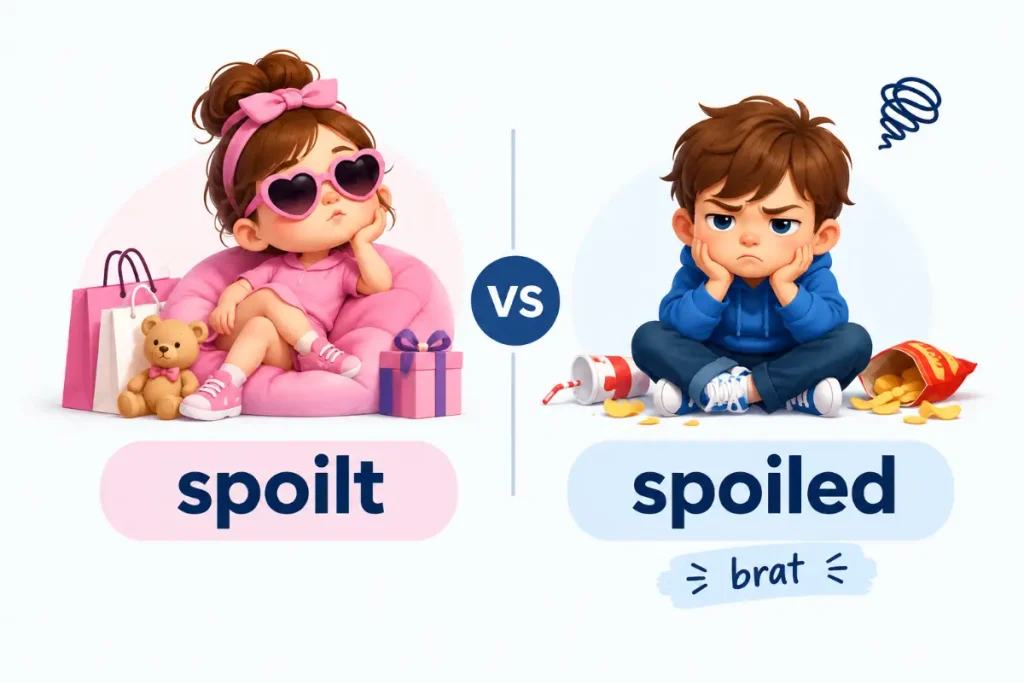
A spoiled brat is a child or sometimes an adult who behaves selfishly, demands special treatment, or reacts badly when they do not get what they want. The expression is informal and usually negative.
In American English, spoiled brat is the standard spelling. In British English, spoilt brat is also common. Neither expression has a different meaning because of the spelling.
Consider these examples.
- The spoiled brat threw a tantrum when his parents said no.
- Everyone complained that the spoiled child expected to receive every new toy.
- His behavior made him sound like a spoiled brat.
- She did not want her son to grow into a spoiled child who never appreciated anything.
- The spoiled teenager expected everyone else to clean up after him.
The word spoiled does not always describe a child’s personality. It can also describe an adult who expects special treatment because they have grown accustomed to getting their way.
Be careful when using spoiled brat in professional or sensitive situations. It is a harsh expression that can sound insulting. If you want a more neutral description, you could say demanding, entitled, or accustomed to getting their way.
Grammar Rules for Spoiled and Spoilt
The verb spoil follows a pattern that allows two accepted past forms. Spoiled is the regular form, created by adding the ending ed. Spoilt is an alternative form that follows a different historical pattern.
The three main forms are:
| Verb form | Example |
|---|---|
| Base form | I do not want to spoil the surprise. |
| Simple past | I spoiled the surprise yesterday. |
| Past participle | I have spoiled the surprise. |
The alternative forms work in the same positions.
| Verb form | Example |
|---|---|
| Base form | I do not want to spoil the surprise. |
| Simple past | I spoilt the surprise yesterday. |
| Past participle | I have spoilt the surprise. |
Both patterns are grammatically acceptable. The choice between spoiled and spoilt is not a difference in tense or grammatical function.
When to Use Spoiled
Use spoiled when you need the regular past tense or past participle in American English. The word works with common sentence patterns involving actions that happened in the past or events that have already occurred.
For example, “The children spoiled the surprise by opening the gifts early.” This sentence uses spoiled as the simple past tense. You could also write, “The surprise has been spoiled,” where spoiled functions as a past participle in a passive construction.
When to Use Spoilt
Use spoilt when you are following a variety of English in which that form is customary. It can appear in the simple past or as a past participle.
For example, “The children spoilt the surprise” and “The surprise has been spoilt” are valid constructions. For an American audience, however, spoiled will generally sound more familiar.
Examples of Spoiled in Sentences
The following examples show how Americans use spoiled in different contexts, including food, relationships, entertainment, work, and everyday life.
- The leftover chicken spoiled after sitting on the counter overnight.
- My grandparents spoiled me with homemade cookies whenever I visited.
- The loud construction noise spoiled our quiet afternoon.
- Please do not spoil the ending of the new mystery series.
- Heavy rain spoiled the outdoor wedding ceremony.
- The company spoiled its loyal customers with special rewards.
- My sister spoiled the surprise by mentioning the gift too early.
- The vacation was spoiled by a series of unexpected travel delays.
- He spoiled his appetite by eating too many snacks before dinner.
- The child felt spoiled after receiving so many birthday presents.
These sentences show that spoiled has several meanings. It can describe food that is no longer good, an experience that has been ruined, information that has been revealed too soon, or a person who has received excessive indulgence.
Along with choosing between “spoilt” and “spoiled,” understanding subtle grammatical differences can help you express actions and experiences more accurately in English.
Examples of Spoilt in Sentences
The following sentences use spoilt correctly. They may sound more natural to readers who are accustomed to British English, but American readers can still understand them.
- The milk had spoilt before breakfast.
- Her parents spoilt her with expensive gifts.
- The unexpected rain spoilt the garden party.
- He accidentally spoilt the ending of the film.
- The children spoilt the surprise by revealing the plan.
- The long delay spoilt their travel experience.
- She worried that her son had become a spoilt child.
- The heat spoilt the food before the guests arrived.
- The mistake spoilt an otherwise excellent presentation.
- His careless comment spoilt the mood at dinner.
The meanings remain the same as they would with spoiled. If you are adapting these sentences for a US website or American publication, simply replace spoilt with spoiled.
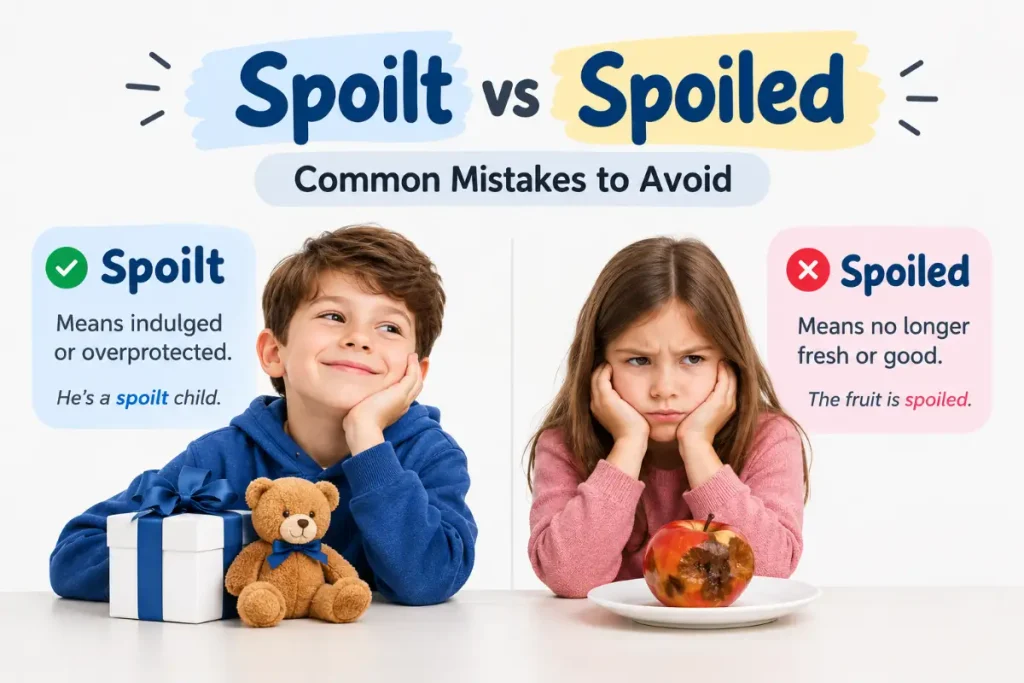
Common Mistakes to Avoid
One common mistake is assuming that spoilt is always a spelling error. It is a legitimate variant, so the correct decision depends on your audience and style guide. For standard American writing, however, spoiled is usually the better choice.
Another mistake is using the two forms inconsistently in the same piece of writing. For example, a paragraph that says “The food spoiled” and later says “The weather spoilt the picnic” may look inconsistent if both sentences follow American English conventions. Choose one form and stick with it unless you have a clear reason to preserve a regional spelling.
Writers can also confuse the verb spoil with its other meanings. A spoiled child is not the same as spoiled food, even though both expressions use the same word. The surrounding words tell readers which meaning applies.
Here are some examples of common errors and corrections.
Incorrect for standard American usage: The milk has spoilt.
Preferred American form: The milk has spoiled.
Incorrect for standard American usage: My parents spoilt me on my birthday.
Preferred American form: My parents spoiled me on my birthday.
Awkward word choice: The spoiled movie was very entertaining.
Clearer wording: The movie’s ending was spoiled by a social media post.
The last example is not a spelling error. It illustrates how a sentence can be grammatically possible but unclear about what was ruined. Good writing makes the intended meaning easy to understand.
Synonyms for Spoiled and Spoilt
The best synonym depends on the meaning you intend to convey. When describing food, spoiled can mean rotten, rancid, stale, or gone bad, although these words are not interchangeable in every situation.
When describing a ruined event or experience, useful alternatives include ruined, damaged, disrupted, undermined, or wrecked. For example, “The storm ruined our picnic” expresses a similar idea to “The storm spoiled our picnic.”
When describing a person who receives too much indulgence, possible alternatives include pampered, overindulged, entitled, demanding, or self centered. These words carry different shades of meaning. Pampered can be positive or negative, while entitled usually criticizes someone’s expectations or behavior.
Do not replace spoiled mechanically with the first synonym you find. Choose the word that matches the specific situation and tone. In professional writing, ruined or disrupted may be clearer when describing an event, while overindulged or entitled may be more precise when describing behavior.
Word Origin and the Reason for Two Forms
The verb spoil entered English through historical forms associated with taking property or plundering. Its meaning gradually expanded to include damaging something, reducing its value, or making it unusable. Modern English also uses the verb when talking about excessive indulgence, especially when someone’s behavior is affected by receiving too much attention or too many privileges.
The two past forms reflect different patterns in English verb development. Spoiled follows the regular pattern of adding ed, while spoilt preserves an alternative form that has remained common in some varieties of English.
This kind of variation is not unusual. English contains many verbs with more than one accepted past form, and regional preferences can influence which version speakers use most often. The existence of spoilt does not make spoiled incorrect, and the preference for spoiled in American English does not make spoilt invalid everywhere.
American vs British English
American and British English often differ in spelling preferences, and spoiled versus spoilt is one example. American English strongly favors spoiled in everyday writing, while British English commonly accepts both forms and often uses spoilt.
For a US audience, the practical recommendation is straightforward. Use spoiled in blog posts, educational articles, emails, school assignments, and business communication. If you are writing in British English, follow the publication’s preferred style and remain consistent.
Canadian, Australian, and other varieties of English may show different preferences depending on the speaker, publication, and context. Avoid assuming that every English speaking country follows exactly the same convention as the United Kingdom. When regional consistency matters, consult the style guide for your intended audience.
Formal vs Casual Usage
Spoiled and spoilt are both standard forms rather than slang. The difference lies mainly in regional preference, not in formality. You can use spoiled in casual conversation, professional communication, academic writing, and published content for American readers.
In a casual text, you might write, “My parents spoiled me on my birthday.” In a professional email, you might say, “The delay spoiled our original schedule, so we have moved the meeting to Friday.” Both sentences are natural American English.
The form you choose should support the reader’s expectations. If your audience is primarily American, spoiled is the more familiar option. If you are reproducing a British quotation or writing for a British publication, spoilt may be the appropriate choice.
Just as “spoilt” and “spoiled” can raise questions about spelling and usage, common singular and plural mistakes can also make everyday English writing less precise.
Frequently Asked Questions
Is spoiled or spoilt correct in American English
Spoiled is the preferred form in American English. Spoilt is also a legitimate English variant, but it is more closely associated with British English. If you are writing for a US audience, use spoiled in both formal and informal contexts to follow standard American usage.
Is spoilt a real word
Yes, spoilt is a real word and an accepted form of the past tense and past participle of spoil. It is common in British English and appears in other varieties of English as well. It has the same meaning as spoiled, so the difference is primarily regional.
Should I write spoiled or spoilt for your birthday
For an American audience, write spoiled for your birthday. For example, “My family spoiled me on my birthday with dinner and thoughtful gifts.” A British English speaker may write spoilt instead. Both forms express the same idea of receiving special attention, gifts, or treats.
Is it spoiled brat or spoilt brat
Both expressions are correct, but spoiled brat is the usual choice in American English. Spoilt brat is common in British English. The phrase describes someone who behaves selfishly or expects special treatment, and it often sounds critical or insulting.
Is spoiled the past tense of spoil
Yes, spoiled is the regular simple past tense and past participle of spoil. You can write, “The food spoiled yesterday,” or, “The food has spoiled.” Spoilt can also serve as the simple past tense and past participle, particularly in varieties of English that commonly use that form.
Is spoiled British or American English
Spoiled is used in both American and British English. It is the standard preferred form in the United States, while British English also commonly uses spoilt. The distinction is not that one form belongs exclusively to one country but that regional preferences differ.
Do spoiled and spoilt have different meanings
No, spoiled and spoilt generally have the same meanings. Both can describe food that has gone bad, plans that have been ruined, information that has been revealed prematurely, or a person who has received excessive indulgence. The spelling choice usually reflects regional convention rather than a difference in meaning.
Which spelling should I use on a US website
Use spoiled on a US focused website. It is the spelling American readers are most accustomed to seeing, and it fits standard American English usage. Keep the spelling consistent throughout your article, and use spoilt only when a quotation, source, or specific regional context makes it appropriate.
Conclusion
The difference between spoilt vs spoiled is mainly a matter of regional spelling preference. Both are correct forms of the verb spoil, and both can describe ruined food, damaged plans, revealed surprises, or people who receive excessive indulgence. The key distinction is that spoiled is the preferred spelling in American English, while spoilt is more common in British English.
If you are writing for readers in the United States, choose spoiled for birthdays, spoiled food, spoiled children, and spoiled surprises. You do not need to treat spoilt as universally incorrect, but you should recognize that it may look unfamiliar to some American readers. Follow your audience’s conventions, stay consistent, and let clarity guide your word choice.