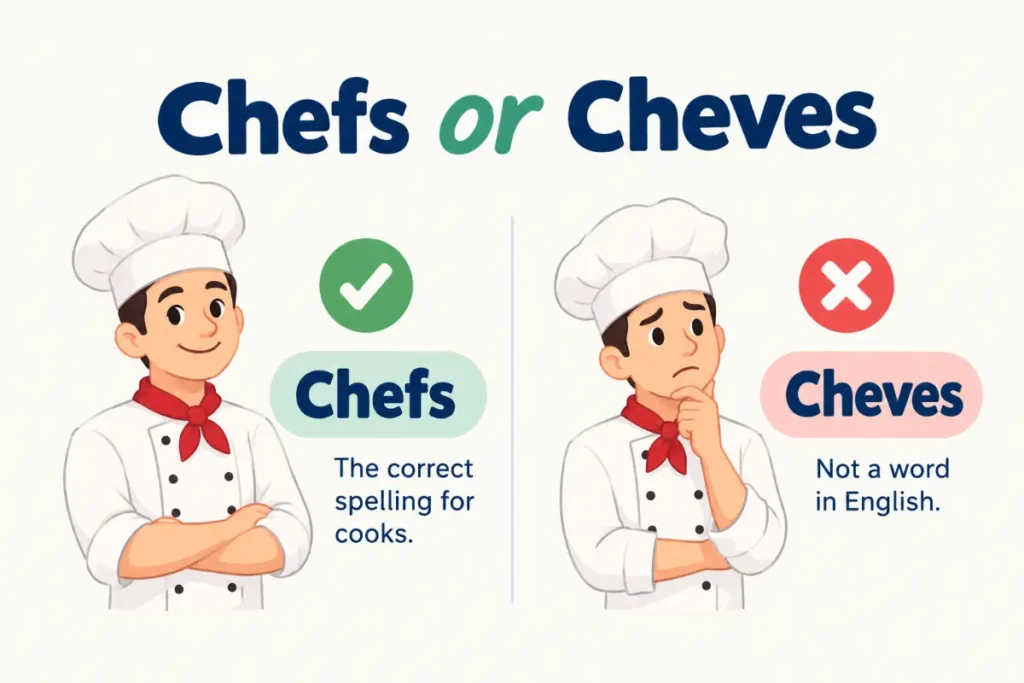
If you are unsure about chefs or cheves, the correct spelling is chefs. It is the standard plural of chef, the word for a professional cook who prepares food, often in a restaurant or commercial kitchen. Although cheves might look like a reasonable plural at first glance, it is not the standard English spelling.
The confusion comes from a familiar spelling pattern. Many English words ending in f or fe change to ves in the plural. For example, leaf becomes leaves, knife becomes knives, and wife becomes wives. However, English has plenty of exceptions, and chef follows a different rule. You simply add an s to form chefs.
Knowing this distinction helps you write correctly in restaurant reviews, recipes, school assignments, workplace communication, and everyday messages. It also makes related grammar questions easier to answer, including how to pronounce the word, how to show possession, and how to use it naturally in a sentence. This guide explains the spelling, meaning, pronunciation, plural rules, and common mistakes so you can use the word confidently in American English.
Quick Answer
Chefs is the correct plural of chef. Use chef when referring to one professional cook and chefs when referring to two or more. Cheves is not the standard English plural. Unlike leaf becoming leaves, chef forms its plural by adding s.
Chefs or Cheves Meaning
The difference between these spellings is straightforward. Chefs is a correct English word, while cheves is generally a misspelling when someone intends to refer to more than one chef.
A chef is a person trained or professionally employed to prepare food. Chefs may work in restaurants, hotels, catering companies, private homes, cruise ships, hospitals, or other food service settings. Some specialize in particular cuisines or techniques, while others manage kitchens, develop menus, supervise staff, and maintain food quality.
For example, consider this sentence: “The chefs prepared a special menu for the restaurant’s opening night.” The word chefs refers to multiple people working in professional cooking roles. If the sentence referred to just one person, it would use chef instead.
The spelling cheves does not serve as the standard plural of chef in English. If you see it in a restaurant review, social media post, recipe, or informal message, the writer probably intended to write chefs. The important point is that the plural follows the regular pattern of adding s.

When deciding whether to write chef or chefs, understanding how to form plural nouns correctly can help you avoid common spelling and grammar mistakes in everyday writing.
Why Chefs Is the Correct Plural
English uses several patterns to form plural nouns. Most regular nouns become plural by adding s or es, but some nouns ending in f or fe change their endings to ves. Since both patterns exist, it is easy to assume that every word ending in f follows the same rule.
However, English plurals depend on the individual word rather than a single rule that covers every noun. The plural of chef is chefs, just as the plural of roof is roofs and the plural of belief is beliefs. These examples show that an ending in f does not automatically change to ves.
Here are a few examples of correct plural forms.
- One chef becomes two chefs.
- One roof becomes two roofs.
- One belief becomes several beliefs.
- One leaf becomes several leaves.
- One knife becomes several knives.
- One wife becomes several wives.
Notice that leaf, knife, and wife change their endings, while chef, roof, and belief do not. You need to learn the standard plural form of each word instead of assuming that every noun ending in f behaves alike.
Chef vs Chefs vs Cheves
Comparing the singular, plural, and incorrect form makes the spelling rule easier to remember.
| Word | Correct status | Meaning | Example |
|---|---|---|---|
| Chef | Correct | One professional cook | The chef prepared dinner. |
| Chefs | Correct | Two or more professional cooks | The chefs prepared dinner. |
| Cheves | Incorrect for this meaning | Not the standard plural of chef | The restaurant hired three chefs. |
The singular form refers to one person. The plural form refers to more than one person, and the incorrect form should not appear in standard writing when you mean multiple chefs.
For example, write “The chef created a new dessert” when referring to one cook. Write “The chefs created new desserts” when referring to several cooks. You do not need to change the f to v in either case.
What Does Chef Mean
The word chef refers to a cook, particularly someone who prepares food professionally or has specialized culinary training. In many restaurant settings, a chef also takes responsibility for menu planning, kitchen organization, food presentation, ingredient selection, and supervising other kitchen workers.
The word can describe people with different specialties. An executive chef may oversee an entire kitchen operation, while a pastry chef focuses on desserts, pastries, and baked goods. A sous chef usually works under the executive chef and helps manage daily kitchen operations.
Here are some examples of the word in context.
- The chef prepared a fresh pasta dish for the guests.
- My brother wants to become a chef after culinary school.
- The pastry chef designed a beautiful wedding cake.
- The executive chef introduced a seasonal menu.
- A private chef prepared dinner for the family.
In everyday conversation, people sometimes use chef loosely to describe someone who cooks very well at home. However, the word most commonly refers to a professional cook or someone with culinary expertise. If you are describing a person who simply enjoys preparing meals at home, cook may be the more natural choice.
How to Use Chefs in a Sentence
Use chefs when you are referring to multiple people who cook professionally or hold chef roles. The word works as a regular plural noun and can appear as the subject, object, or complement of a sentence.
As a subject, chefs perform an action. For example, “The chefs prepared dinner before the guests arrived.” As an object, chefs receive an action. For example, “The restaurant owner thanked the chefs for their hard work.”
The word can also appear after a number or another expression that indicates more than one person. You might write “three chefs,” “several chefs,” “many chefs,” or “a team of chefs.” These expressions are common in restaurant descriptions, culinary articles, job advertisements, and everyday conversation.
Consider these additional examples.
- The chefs collaborated on a new tasting menu.
- Two chefs competed in the cooking competition.
- Several chefs attended the culinary conference.
- The hotel employs experienced chefs from different countries.
- The chefs prepared meals for hundreds of guests.
- Local chefs shared their favorite recipes.
- The restaurant invited guest chefs for a special event.
- The chefs discussed ways to reduce food waste.
Every sentence uses chefs to refer to more than one person. The spelling remains the same regardless of the number of chefs involved.
The Plural Rule for Words Ending in F
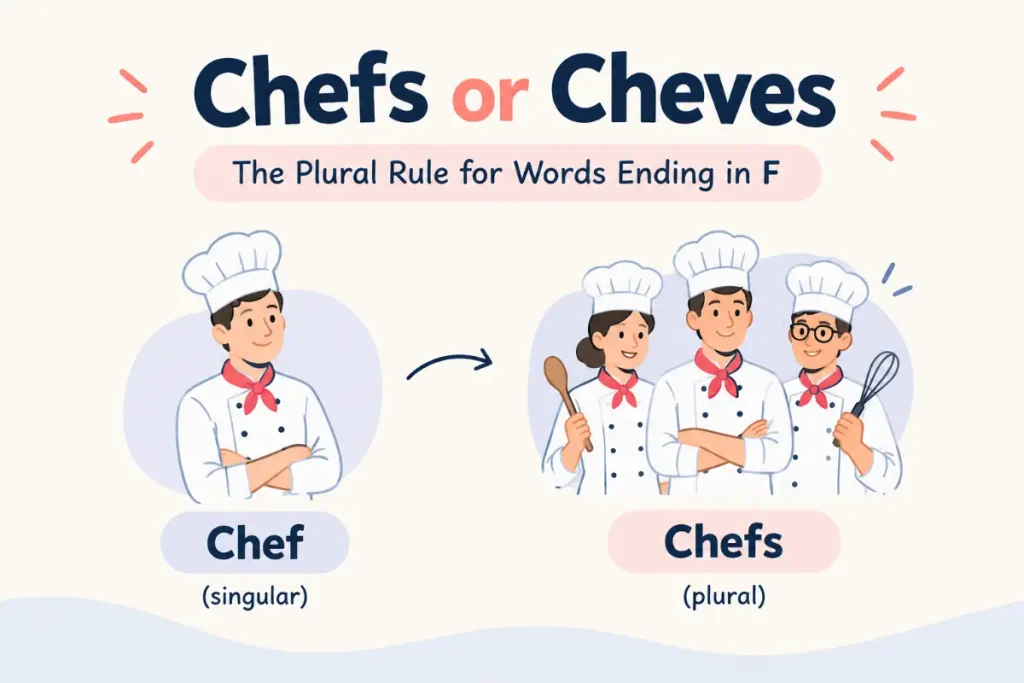
The confusion over chefs and cheves comes from a broader feature of English spelling. Some nouns ending in f or fe form their plurals by changing the ending to ves. Others simply add s or, in certain cases, es.
Words that commonly change to ves include leaf and leaves, knife and knives, wife and wives, and wolf and wolves. These familiar examples can make the pattern seem universal, but it is not. English has developed its plural forms over time, and different words have retained different patterns.
Other nouns ending in f keep the original ending when they become plural. For example, roof becomes roofs, belief becomes beliefs, chief becomes chiefs, and chef becomes chefs. These forms are standard in American English.
A practical way to avoid mistakes is to check the plural of an unfamiliar word instead of applying the ves pattern automatically. Once you know that chef becomes chefs, you can use the form consistently in recipes, restaurant reviews, articles, and professional communication.
More Words That Follow the Same Pattern as Chef
Chef is not the only English noun ending in f that forms its plural with s. Several common words follow the same pattern, which can help you remember the correct spelling.
| Singular | Correct plural | Example |
|---|---|---|
| Chef | Chefs | The chefs planned the menu. |
| Chief | Chiefs | The chiefs attended the meeting. |
| Roof | Roofs | The roofs needed repairs. |
| Belief | Beliefs | Their beliefs differed. |
| Cliff | Cliffs | The cliffs overlooked the ocean. |
| Proof | Proofs | The editor checked the proofs. |
| Safe | Safes | The bank installed two safes. |
| Handkerchief | Handkerchiefs | The store sells cotton handkerchiefs. |
These words show why it is risky to assume that an f ending always changes to ves. English has patterns, but individual words do not always follow the pattern that seems most obvious.
The best approach is to learn common plural forms through reading and practice. When writing a word that you rarely use, a reliable dictionary can help confirm the correct spelling.
Just as chefs is the correct plural of chef, learning about commonly confused English spellings can help you distinguish correctly spelled words from frequent misspellings.
Chef Plural Possessive
The plural possessive form is another common source of confusion. To form the plural possessive of chef, start with the correct plural chefs and then add an apostrophe. The result is chefs’.
Use chefs’ when something belongs to or is associated with multiple chefs. For example, “The chefs’ recommendations helped improve the menu.” The recommendations belong to several chefs, so the apostrophe comes after the final s.
Compare the three forms below.
| Form | Meaning | Example |
|---|---|---|
| Chef | One chef | The chef prepared lunch. |
| Chef’s | Belonging to one chef | The chef’s knife was sharp. |
| Chefs’ | Belonging to multiple chefs | The chefs’ knives were sharp. |
The apostrophe changes position based on the number of people involved. For a singular possessive, add apostrophe and s to chef. For a plural possessive, use the plural chefs and place the apostrophe after the final s.
Singular Possessive Examples
Use chef’s when one chef owns something or is responsible for something.
- The chef’s recipe became a customer favorite.
- The chef’s uniform was spotless.
- The chef’s knife needed sharpening.
- The chef’s special was sold out by noon.
Plural Possessive Examples
Use chefs’ when multiple chefs share ownership or responsibility.
- The chefs’ recipes appeared in the cookbook.
- The chefs’ uniforms were hanging in the locker room.
- The chefs’ meeting began at nine.
- The chefs’ opinions helped shape the new menu.
Remember that chefs is the plural, chef’s is the singular possessive, and chefs’ is the plural possessive. Cheves is not the correct plural or possessive form.
Chef Pronunciation
In American English, chef is commonly pronounced shef, with one syllable. Its IPA pronunciation is /ʃɛf/. The beginning sounds like the sh in ship, and the ending sounds like the f in food.
The plural chefs is pronounced shefs, with a final s sound. The spelling does not change the pronunciation of the main word; you simply add the plural ending.
The word comes from French, which explains the spelling and the initial sh sound. English speakers generally pronounce the word naturally as one syllable rather than trying to pronounce each letter separately.
If you are unsure how to say it, think of the word shef. Avoid pronouncing the initial ch as the sound in chair. In this word, the letters produce the sh sound.
Chefs or Cheves Pronunciation
The pronunciation question usually arises because readers want to know if the spelling changes the sound. The standard singular pronunciation is /ʃɛf/, and the plural pronunciation is /ʃɛfs/. The plural simply adds the final s sound.
Cheves is not the standard plural spelling, so it does not have a standard pronunciation as the plural of chef. If you see it in writing, the intended word is usually chefs, pronounced shefs.
The French origin of chef can make its spelling look unfamiliar to English learners. However, once you learn that the initial letters produce a sh sound, both the singular and plural forms become straightforward.
Common Mistakes to Avoid
The most common mistake is writing cheves because other words ending in f change to ves. Although that pattern is valid for words such as leaves and knives, it does not apply to chef.
Incorrect: The restaurant hired three cheves.
Correct: The restaurant hired three chefs.
Another mistake is using the singular form when the sentence refers to multiple people. For example, “The chef prepared meals for the wedding guests” refers to one chef. If several cooks prepared the meals, write “The chefs prepared meals for the wedding guests.”
Writers also sometimes confuse plural and possessive forms. The sentence “The chefs recipe won an award” is incorrect if the recipe belongs to one chef. Write “The chef’s recipe won an award” for one person or “The chefs’ recipes won awards” for multiple people.
A final mistake is assuming that every word ending in f follows the same plural rule. English contains several plural patterns, so it is better to learn common exceptions than to rely on one spelling rule for every word.
Real Life Examples of Chefs
The word chefs appears in many everyday situations, from restaurant reviews to professional biographies and cooking competitions. The following examples show how to use it naturally in American English.
- The chefs at the new restaurant specialize in Italian cuisine.
- Three chefs prepared a special dinner for the charity event.
- The hotel hired two chefs to manage its restaurant kitchens.
- Local chefs demonstrated simple cooking techniques at the food festival.
- The chefs created a menu using fresh ingredients from nearby farms.
- Several chefs appeared on the television cooking competition.
- The culinary school invited experienced chefs to mentor its students.
- The chefs worked together to prepare meals for the community.
- Guest chefs introduced dishes inspired by their home countries.
- The restaurant’s chefs received positive reviews for their seasonal menu.
These examples cover professional settings, public events, education, hospitality, and community activities. In every case, chefs refers to more than one cook.
Formal and Casual Usage
Chefs is appropriate in both formal and informal English. You can use it in a professional report, restaurant review, academic assignment, email, text message, or casual conversation. The word itself does not sound overly formal or technical.
In a professional email, you might write, “The chefs will meet with the restaurant manager on Monday.” In a casual text, you might say, “The chefs at that place make amazing pasta.” Both sentences use the plural correctly, even though their tones differ.
The spelling does not change depending on the situation. Chefs remains the standard plural in business communication, schoolwork, recipes, menus, social media posts, and everyday messages.
Whether you are writing a recipe, describing professional chefs, or discussing cooking techniques, learning to improve your everyday English writing helps you communicate clearly and avoid common spelling errors.
American and British English
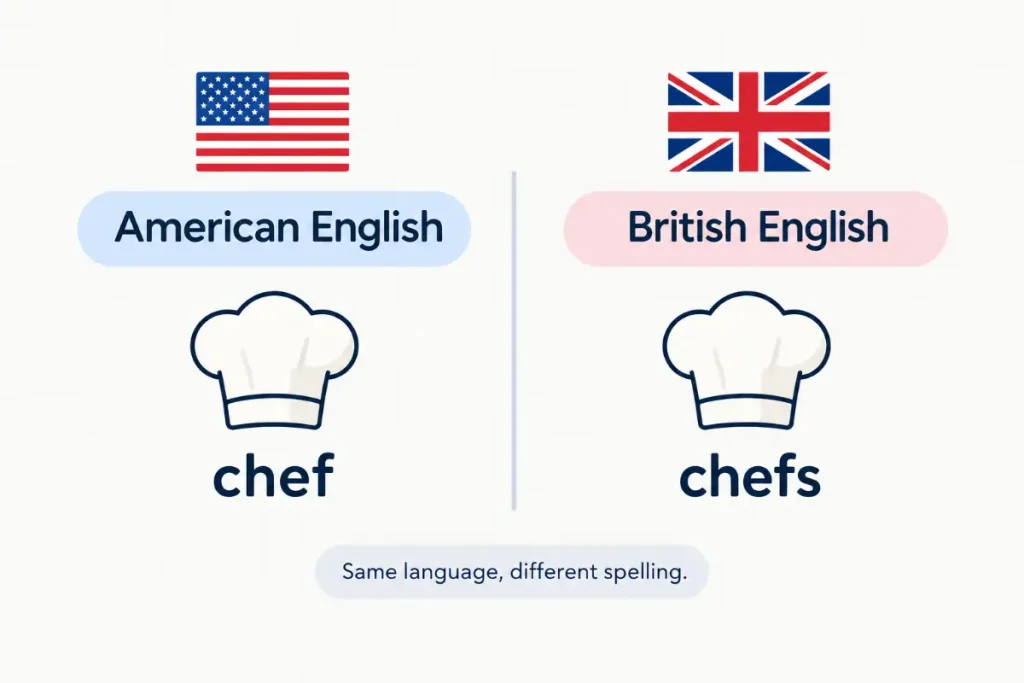
The plural of chef is chefs in both American and British English. There is no regional spelling difference for this word, so writers do not need to choose between an American form and a British form.
You may notice differences in other culinary vocabulary, food names, or restaurant terminology across English-speaking countries. However, these variations do not affect the plural spelling of chef. The correct form remains chefs regardless of the region.
For a US audience, use chef for one professional cook and chefs for multiple professional cooks. The same rule applies in Canada, Australia, and the United Kingdom.
Frequently Asked Questions
Is chefs or cheves correct
Chefs is correct when referring to more than one chef. Cheves is not the standard English plural of chef. The word follows the regular plural pattern of adding s, just like roofs and chiefs. Use chefs in formal writing, restaurant reviews, recipes, school assignments, and everyday conversation.
What is the plural of chef in English
The plural of chef is chefs. Use chef for one person and chefs for two or more people. For example, “The chef prepared dinner” refers to one cook, while “The chefs prepared dinner” refers to multiple cooks. You do not change the final f to ves.
Why is the plural of chef not cheves
The plural is chefs because English does not apply the f to ves pattern to every noun ending in f. Some words, such as leaf and knife, change to leaves and knives, but others retain the f and add s. Chef belongs to the second group.
How do you pronounce chefs
Chefs is pronounced shefs, with one syllable. The singular chef is pronounced shef. In both forms, the initial ch produces a sh sound, reflecting the word’s French origin. The plural simply adds a final s sound.
What is the plural possessive of chef
The plural possessive of chef is chefs’. Use it when something belongs to or is associated with multiple chefs. For example, “The chefs’ recipes were featured in the magazine.” For one chef, use chef’s, as in “The chef’s recipe was featured in the magazine.”
Is chef’s or chefs’ correct
Both forms are correct, but they have different meanings. Chef’s is the singular possessive and refers to something belonging to one chef. Chefs’ is the plural possessive and refers to something belonging to multiple chefs. The apostrophe position tells readers if the owner is singular or plural.
Is chefs correct in American English
Yes, chefs is the standard plural in American English. The same spelling is used in British, Canadian, and Australian English. There is no regional variation that changes the plural to cheves, so chefs is the form you should use in standard English writing.
Can I use cheves in a sentence
You should not use cheves as the plural of chef in standard English. If you are referring to multiple professional cooks, write chefs instead. For example, “The chefs prepared a meal for the guests” is correct. Cheves would be considered a spelling mistake in that context.
Conclusion
The correct spelling is chefs, not cheves. Chef refers to one professional cook, while chefs refers to two or more. Although many English nouns ending in f change to ves in the plural, chef follows the regular pattern of adding s. The same spelling applies in American and British English.
Remember the related possessive forms, too. Chef’s refers to something belonging to one chef, while chefs’ refers to something belonging to multiple chefs. If you are writing a restaurant review, preparing a recipe, completing a school assignment, or sending a professional email, use chefs whenever you mean more than one cook. That simple rule will keep your spelling and grammar accurate.