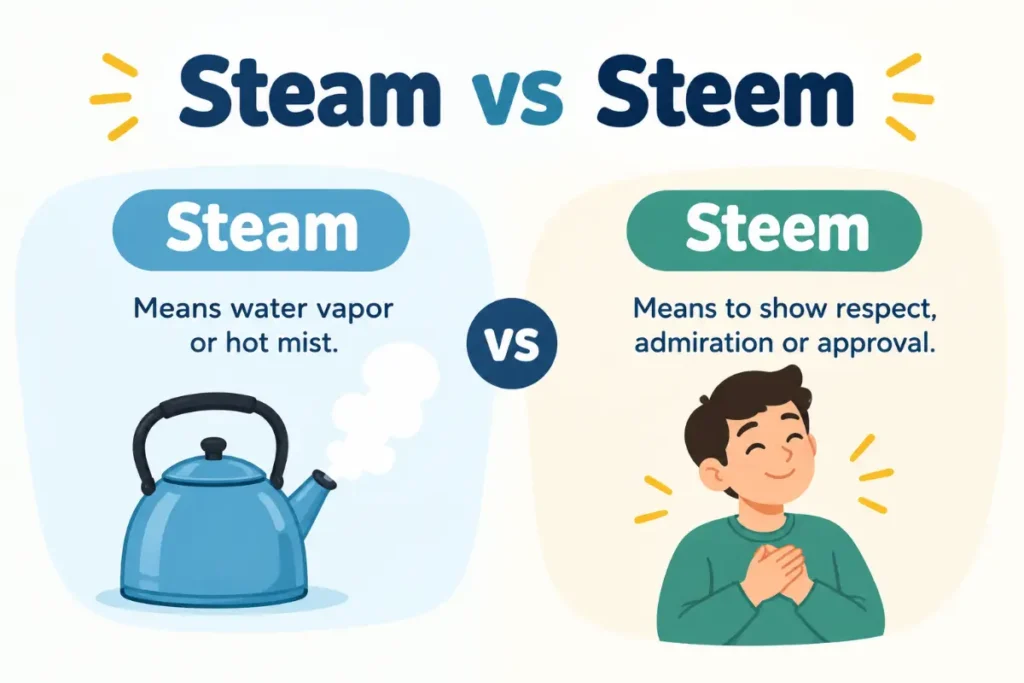
The difference between steam vs steem comes down to spelling, meaning, and context. Steam is the standard English word for the invisible water vapor that forms when water is heated. It also refers to energy, momentum, and the popular PC gaming platform. Steem, on the other hand, is not a standard English word in ordinary writing, although it appears as the name of a blockchain platform and cryptocurrency ecosystem.
The confusion often starts because steam and steem sound alike when spoken aloud. If you hear someone use either word in a conversation, you might not know which spelling they intend. The surrounding context usually provides the answer. A conversation about cooking, engines, or pressure probably involves steam, while a discussion about blockchain technology may involve Steem.
There is another possible source of confusion. In education, STEAM stands for science, technology, engineering, arts, and mathematics. It is related to STEM education, but it has nothing to do with water vapor or the Steem blockchain. Understanding these distinctions will help you choose the correct spelling, recognize specialized meanings, and avoid common mistakes in everyday writing.
Quick Answer
Steam is the correct spelling for water vapor, heat related vapor, and the familiar English expressions involving steam. Steem is a proper name associated with a blockchain platform and its digital token. In education, STEAM stands for science, technology, engineering, arts, and mathematics. The right choice depends on the context.
What Does Steam Mean
Steam is a noun that commonly refers to water in its gaseous form. It forms when water is heated, although the visible cloud above boiling water consists largely of tiny liquid droplets formed as water vapor cools. In everyday conversation, people commonly call this visible cloud steam.
You encounter steam in kitchens, bathrooms, factories, power plants, and other places where water is heated. A pot of boiling water releases steam, a steam iron uses heat and water to remove wrinkles, and a steam engine uses pressurized steam to produce mechanical motion. The word is familiar in both everyday and technical contexts.
Steam also has several figurative meanings. People use it to describe energy, enthusiasm, momentum, anger, or progress. For example, a project can gain steam when it starts making progress, and an angry person can blow off steam by doing something that helps release frustration.
Just as steam and steem are often confused because of their similar spelling, learning the correct spelling of tying can help you avoid common English spelling mistakes.

Steam as a Noun
As a noun, steam refers to vapor associated with heated water or to the energy produced by steam in a mechanical system. It can also appear in common expressions that describe someone’s emotional state or the progress of an activity.
Consider these examples.
1. Steam rose from the hot soup.
2. The bathroom mirror fogged up from the steam of the shower.
3. The old factory used steam to power its machinery.
4. The steam from the kettle disappeared into the air.
5. The train was powered by a steam engine.
In these sentences, steam refers to water vapor, a visible cloud associated with heated water, or a system powered by steam.
Steam as a Verb
Steam can also function as a verb. It can mean to cook food using steam, to emit steam, or, informally, to move quickly and forcefully.
For example, you might steam vegetables instead of frying them. A window can steam up when warm, moist air meets a cooler surface. Someone might also say that a train steamed down the track, using the verb to suggest energetic movement.
Here are more examples.
1. Steam the broccoli for five minutes.
2. The kettle began to steam.
3. My glasses steamed up when I entered the warm house.
4. The chef steamed the fish with fresh herbs.
5. The train steamed through the countryside.
The word’s grammatical role depends on how it appears in the sentence. In “The steam filled the kitchen,” it is a noun. In “Steam the vegetables,” it is a verb.
What Does Steem Mean
Steem is not a standard English spelling of the word steam. Instead, it is primarily recognized as a proper name associated with blockchain technology and a cryptocurrency ecosystem.
The Steem blockchain was developed to support applications involving online communities, content publishing, and digital rewards. Its ecosystem has included cryptocurrency tokens and systems through which users can earn or distribute rewards for online participation. In this context, Steem is a specialized name rather than an ordinary vocabulary word.
For example, someone discussing blockchain technology might write, “The project used the Steem blockchain for community publishing.” The spelling is appropriate because the sentence refers to a specific technology.
The capitalization matters when Steem is used as a proper name. Writing Steem helps distinguish the platform or related ecosystem from the ordinary word steam. In general writing, however, you should not replace steam with steem simply because the words sound alike.
Is Steem a Real Word
Yes, Steem is a real name used in a specialized technological context. However, it is not the standard spelling of the common English word for water vapor.
This distinction is important because a word can have a legitimate use as a name without being a standard dictionary alternative to another word. Brand names, project names, and cryptocurrency names often use spellings that differ from ordinary English words.
If you are writing about blockchain applications, digital assets, or the Steem ecosystem, use the proper name. If you are describing a boiling kettle, a steam iron, or a steam engine, use steam.
Steam vs Steem Meaning and Key Differences
The two spellings have different roles in English. Steam is an ordinary word with established meanings as a noun and a verb. Steem is primarily a proper name in the context of blockchain technology.
| Feature | Steam | Steem |
|---|---|---|
| Standard English word | Yes | No, not as a spelling variant of steam |
| Main meaning | Water vapor or vapor related energy | Name associated with a blockchain ecosystem |
| Part of speech | Noun and verb | Proper noun when referring to the platform |
| Common context | Cooking, heating, machinery, expressions | Blockchain, digital communities, cryptocurrency |
| Capitalization | Usually lowercase | Usually capitalized as a proper name |
| Pronunciation | /stiːm/ | Generally pronounced /stiːm/ |
| Example | Steam rose from the kettle. | The developer discussed Steem. |
The table shows why context matters. The words sound the same in common pronunciation, so listeners may not notice a difference. Readers, however, can identify the intended meaning from the spelling and the surrounding sentence.

English spelling can be tricky, especially when a word’s ending is uncertain, so understanding common English spelling mistakes can help you distinguish correctly spelled words from frequent errors.
Is Steam or Steem the Correct Spelling
For ordinary English writing, steam is the correct spelling when you mean water vapor, cooking with vapor, steam powered machinery, or figurative expressions involving energy and momentum.
Steem is appropriate when you are referring to the specific blockchain name or another proper name that uses that spelling. It is not a standard alternative that you can substitute for steam in everyday sentences.
Consider these examples.
Incorrect: The steam from the kettle filled the kitchen with steem.
Correct: The steam from the kettle filled the kitchen.
Incorrect: I used steem to cook the vegetables.
Correct: I used steam to cook the vegetables.
The first incorrect example uses two spellings for the same ordinary meaning. The second uses steem where the sentence clearly calls for the cooking method.
However, a sentence about blockchain technology can legitimately use Steem. For instance, “The developer explored applications built on Steem” uses the name correctly. The spelling is not wrong simply because it differs from the everyday word.
What Does STEAM Stand for in Education
STEAM is an educational acronym that stands for science, technology, engineering, arts, and mathematics. It expands on STEM, which stands for science, technology, engineering, and mathematics, by explicitly including the arts.
STEAM education encourages students to connect scientific and technical knowledge with creativity, design, communication, and artistic thinking. Instead of treating each subject as an isolated area of study, an integrated STEAM project may combine several disciplines to solve a practical problem.
For example, students designing a model bridge might calculate loads and measure materials while also considering the structure’s appearance and the way people will use it. A robotics project could involve programming, engineering, storytelling, and visual design.
The word is usually written in uppercase when it refers to the educational framework. This capitalization distinguishes the acronym from the ordinary word steam, although the two forms are pronounced alike.
What Is the Difference Between STEM and STEAM
STEM focuses on science, technology, engineering, and mathematics. STEAM includes the arts as an additional area of learning, often with the goal of encouraging creative thinking alongside technical problem solving.
| Feature | STEM | STEAM |
|---|---|---|
| Full form | Science, technology, engineering, mathematics | Science, technology, engineering, arts, mathematics |
| Main emphasis | Scientific and technical learning | Scientific and technical learning integrated with the arts |
| Typical activities | Coding, experiments, engineering challenges | Coding, design, experiments, creative projects |
| Role of creativity | Can be central to technical problem solving | Explicitly connects artistic and creative approaches |
| Example | Building and testing a robot | Building a robot and designing its appearance and user experience |
Neither approach automatically guarantees better learning. The value of each depends on the learning goals, teaching quality, available resources, and how well the activities connect different subjects.
STEM may suit a project focused on mathematical modeling or a technical experiment. STEAM may be useful when a project also benefits from visual communication, creative design, music, or other artistic approaches. The two approaches can overlap considerably.
Why Is STEM Sometimes Called STEAM
STEM is sometimes called STEAM because educators and schools choose to make the arts an explicit part of interdisciplinary learning. The additional letter highlights the idea that creativity and technical knowledge can support each other.
The arts can include visual art, music, design, theater, creative writing, and other disciplines, depending on the program. In many STEAM activities, students use artistic methods to communicate scientific findings, design a product, develop a prototype, or explore a problem from different perspectives.
For example, a classroom project about renewable energy might ask students to research solar panels, calculate energy output, build a model, and create an illustrated presentation explaining how the system works. The science and mathematics help students understand the technology, while the creative work helps them communicate their findings.
STEAM does not mean that STEM subjects have become less important. It reflects an educational approach that combines technical learning with creative and artistic methods. Schools may use STEM or STEAM depending on their curriculum and learning objectives.
Steam vs Steem Pros and Cons
Comparing the pros and cons of steam and Steem only makes sense after clarifying what each term refers to. Steam is a general English word and a physical phenomenon, while Steem refers to a specialized blockchain ecosystem. They are not two competing spellings or products designed to serve the same purpose.
Advantages and Disadvantages of Steam
Steam has practical uses in cooking, cleaning, heating, industrial processes, and power generation. It can transfer heat efficiently and help cook food without immersing it in water or exposing it directly to a hot cooking surface.
However, steam can also cause serious burns because hot vapor and condensed water can transfer significant heat to the skin. Pressurized steam systems require appropriate equipment, maintenance, and safety procedures. Steam is useful when handled correctly, but it is not harmless simply because it comes from water.
Advantages and Disadvantages of Steem
The Steem ecosystem has been associated with blockchain based content publishing, community participation, and digital reward mechanisms. These features may interest developers and users exploring decentralized applications or online reward systems.
At the same time, blockchain platforms and their tokens can involve technical complexity, price volatility, governance questions, and security risks. Users should understand how a particular application works before relying on it or committing money to a digital asset.
These are different categories of advantages and disadvantages. Steam is evaluated according to its physical, industrial, or household uses. Steem is evaluated according to its technology, applications, community, and associated digital assets.
Steam vs Steem on Reddit
When people search for steam vs steem on Reddit or other online communities, the intended comparison depends on the discussion. A post about cooking, household equipment, or industrial processes probably concerns steam. A post about blockchain publishing, cryptocurrency, or decentralized communities may refer to Steem.
The educational acronym STEAM can create another source of confusion. In discussions about schools, lesson plans, or science projects, STEAM usually refers to the integration of arts into STEM education rather than to water vapor or blockchain technology.
When reading an online discussion, look at the surrounding terms before deciding which meaning applies. References to science classes, engineering challenges, and creative projects point toward STEAM education. References to blockchain applications and digital tokens point toward Steem, while references to boiling water or cooking point toward steam.
Online comments may contain misspellings, informal shorthand, or jokes. A single spelling in a forum post does not establish that the spelling is a standard English alternative. For reliable writing, use the spelling that matches the intended meaning.
Common Mistakes With Steam and Steem
The most common mistake is using steem as a spelling variant of steam. Since the words sound alike, a writer may accidentally choose the wrong letters while typing quickly or relying on autocorrect.
Incorrect: The bathroom was filled with steem after the shower.
Correct: The bathroom was filled with steam after the shower.
The correct spelling is steam because the sentence describes water vapor associated with a hot shower.
Another mistake is assuming that every use of Steem is a spelling error. In a sentence about the blockchain ecosystem, Steem is a proper name and should retain its intended spelling.
Incorrect: The developer published the application on Steam, referring to the Steem blockchain.
Correct: The developer published the application on Steem, if the intended platform was the Steem blockchain.
The first sentence could be correct if the application was published on the Steam gaming platform, but it would be misleading if the writer meant Steem. Always confirm the platform or technology before choosing the spelling.
A third mistake is confusing steam with STEAM in an educational context. When discussing a school program that combines science, technology, engineering, arts, and mathematics, use STEAM. When discussing vapor from boiling water, use steam.
How to Use Steam in a Sentence
The best way to learn a word is to see how it works in different contexts. Steam can describe a physical substance, a cooking method, a mechanical system, or a figurative idea.
Here are ten examples of correct usage.
1. Steam rose from the pot as the water began to boil.
2. I used a steam iron to remove the wrinkles from my shirt.
3. The restaurant steams its vegetables to preserve their texture.
4. The old locomotive ran on steam power.
5. The bathroom mirror fogged up because of the steam from the shower.
6. The team gained steam after winning three consecutive games.
7. She went for a long walk to blow off steam after a stressful day.
8. The campaign lost steam when public interest declined.
9. Steam escaped from the damaged pipe, so workers closed the area.
10. The chef placed the dumplings in a steamer to cook them with steam.
These examples show that steam has several established uses in English. Its meaning depends on the surrounding words, but its spelling remains the same.

How to Use Steem in a Sentence
Steem should generally appear in writing when you are referring to the proper name associated with the blockchain ecosystem. Since it is a specialized name, readers may need context to understand the reference.
Here are examples that demonstrate the appropriate context.
1. The developer researched applications built on the Steem blockchain.
2. The article explained how the Steem ecosystem supported online communities.
3. The discussion focused on digital rewards within Steem based applications.
4. The team compared Steem with other blockchain platforms.
5. The researcher examined the history of the Steem project.
6. The user wanted to learn how the Steem ecosystem worked.
7. The report discussed community publishing on Steem.
8. The developer evaluated the technical features of Steem.
9. The online forum included a discussion about Steem and digital tokens.
10. The presentation introduced students to the basic concepts behind the Steem blockchain.
These examples use Steem as a proper name rather than as an alternative spelling for water vapor. When writing about a particular product, platform, or token, verify the exact name and capitalization used by that project.
Pronunciation of Steam and Steem
Steam and Steem are generally pronounced the same way in English. Both use the long ee vowel sound, as in the word “team,” followed by the final consonant sound in “seem.”
Their IPA pronunciation is commonly represented as /stiːm/. The identical pronunciation explains why a listener may not know which spelling someone intends without additional context.
The educational acronym STEAM is also pronounced like the ordinary word steam. Writers therefore rely on capitalization and context to distinguish the acronym from the physical phenomenon.
If you are proofreading a document, pay special attention to meaning rather than pronunciation. Sound alone will not tell you if the writer intended steam, the Steem blockchain, or the STEAM educational framework.
When deciding whether to use steam or steem, choosing the more natural word starts with understanding each word’s meaning and using the correct form in context.
Frequently Asked Questions
Is steem a real word
Steem is a recognized proper name associated with a blockchain ecosystem, but it is not the standard spelling of the ordinary English word steam. Use steam when referring to water vapor, cooking with vapor, or steam powered machinery. Use Steem when the context specifically refers to the blockchain or a related project.
What does STEAM stand for
STEAM stands for science, technology, engineering, arts, and mathematics. It is an educational approach that connects technical and scientific subjects with creative and artistic disciplines. Schools may use STEAM projects to help students combine research, problem solving, design, and communication in practical activities.
What does Steem stand for
Steem is primarily a proper name rather than a standard English acronym with a universally accepted expanded form. It is associated with a blockchain ecosystem used for online communities and content related applications. The exact meaning of the name depends on the project context, so it should not automatically be treated as an abbreviation.
Is steam or steem the correct spelling
Steam is correct for the ordinary English word describing water vapor and its related meanings. Steem is appropriate when referring to the specific blockchain name. The two spellings are not interchangeable, even though they sound alike when spoken aloud.
Why is STEM sometimes called STEAM
STEM stands for science, technology, engineering, and mathematics. STEAM adds arts to the acronym to highlight the role of creative disciplines in interdisciplinary learning. Schools may choose STEAM when their projects combine technical skills with artistic design, communication, or creative problem solving.
Is STEM better than STEAM
Neither STEM nor STEAM is automatically better in every situation. STEM may fit a project focused on technical or scientific learning, while STEAM explicitly incorporates artistic and creative work. The right approach depends on the educational objectives, student needs, teaching methods, and resources available.
Are steam and steem pronounced the same
Yes, they are generally pronounced the same way in English, with the long ee sound heard in team. Their pronunciation is commonly represented by the IPA form /stiːm/. Because the sound is identical, context and spelling help readers distinguish the ordinary word from the proper name.
What is the difference between steam and STEAM
Steam usually refers to water vapor or related processes and expressions. STEAM is an acronym for science, technology, engineering, arts, and mathematics, used in education. They are pronounced alike, but capitalization and context distinguish the educational framework from the ordinary English word.
Conclusion
The difference between steam vs steem is mainly a matter of spelling and context. Steam is the standard English word for water vapor and also appears in expressions about energy, progress, and frustration. Steem is a proper name associated with a blockchain ecosystem, while STEAM is an educational acronym for science, technology, engineering, arts, and mathematics.
For everyday writing, choose steam when discussing boiling water, cooking, machinery, or familiar expressions. Use Steem only when you mean the specific name, and use STEAM when referring to the educational approach. Since all three forms sound alike, the best way to avoid mistakes is to identify the subject of your sentence before choosing the spelling.