Have you ever typed deep seated vs deep seeded into a search engine because you were unsure which expression was correct? You are not alone. This is one of the most common word mix ups in English. At first glance, both expressions seem logical. After all, something that grows from a seed can become deeply rooted over time. That mental image makes deep seeded sound believable, even though it is not the standard expression in modern English.
The correct phrase is deep seated. It describes beliefs, emotions, habits, fears, or problems that have existed for a long time and are firmly established. Although deep seeded appears online and in casual conversations, most dictionaries and professional style guides treat it as a mistaken variation rather than a standard expression.
In this guide, you will learn the meaning of both expressions, why people confuse them, where the mistake comes from, how native speakers use the phrase today, and how professional editors decide which version belongs in polished writing. You will also find practical examples, grammar guidance, pronunciation tips, and real world usage that will help you remember the correct expression with confidence.
Quick Definition
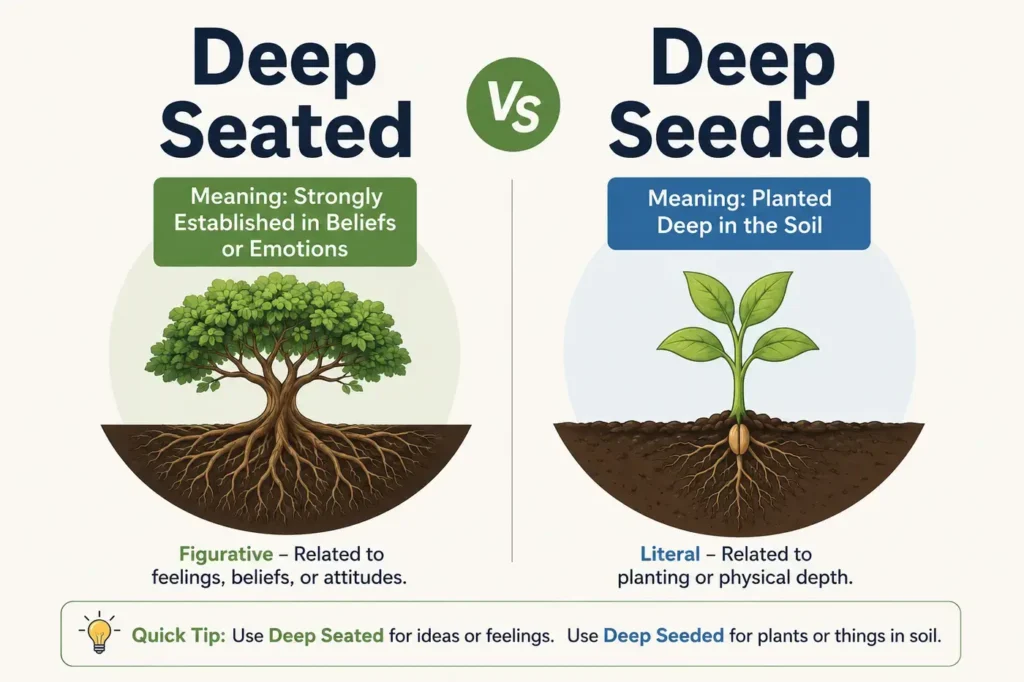
Deep seated is the correct English expression. It describes something that is firmly established, deeply rooted, or difficult to change, such as beliefs, emotions, traditions, or prejudice. Deep seeded is a common variation that developed because people associate long lasting ideas with seeds and roots, but it is generally considered incorrect in standard English.
Quick Answer
If you only remember one thing from this article, remember this.
- Deep seated is the accepted expression in standard English.
- It means firmly established or deeply rooted over time.
- Deep seeded is widely used by mistake because it sounds logical.
- Formal writing, academic work, journalism, and professional editing almost always prefer deep seated.
- Use deep seated unless you are intentionally discussing seeds or gardening.
Comparison Table
| Feature | Deep Seated | Deep Seeded |
|---|---|---|
| Part of speech | Adjectival phrase | Nonstandard variation |
| Meaning | Firmly established or deeply rooted | Often intended to mean the same thing |
| Standard English | Yes | No |
| Origin | Based on the word seated meaning fixed in place | Developed through language confusion |
| Formality | Appropriate in all writing | Best avoided in formal writing |
| Common contexts | Emotions beliefs traditions prejudice habits problems | Casual speech internet posts informal writing |
| Usage frequency | Far more common in edited publications | Common online but much less accepted |
| Example | Deep seated fears affected his decisions. | Deep seeded fears affected his decisions. |
Meaning Of Each Expression
Although these expressions look similar, they do not share the same status in modern English. Understanding the meaning behind each one makes it much easier to remember the correct choice.
Similar spelling mix-ups are common in English, and the Duchess spelling explained guide shows why one extra letter can completely change what’s considered correct.
What Does Deep Seated Mean
The expression deep seated describes something that has become firmly established over a long period. It often refers to emotions, attitudes, traditions, opinions, habits, or conflicts that are difficult to change because they have become part of someone’s thinking or behavior.
Imagine an old chair that has settled firmly into the ground after sitting in the same place for years. That image reflects the original idea behind seated. Something that is seated has settled into a fixed position. Over time, the phrase came to describe ideas and feelings that are firmly fixed in people’s minds.
You will commonly see deep seated used with words such as:
- Beliefs.
- Fears.
- Hatred.
- Bias.
- Anxiety.
- Resentment.
- Traditions.
- Values.
- Problems.
- Concerns.
Here are a few natural examples.
- She struggled with deep seated anxiety for many years.
- The community worked to overcome deep seated prejudice.
- His deep seated belief in honesty shaped every decision he made.
- The disagreement came from deep seated cultural differences.
- Their success was built on deep seated family values.
In every example, the phrase describes something that has existed for a long time and is not easily changed.
What Does Deep Seeded Mean
The expression deep seeded is easy to understand because it creates a vivid picture. Seeds are planted beneath the ground, grow roots, and remain anchored in the soil. Because of that image, many people naturally assume deep seeded is the correct phrase.
In everyday conversation, you may hear someone say:
- Deep seeded hatred.
- Deep seeded issues.
- Deep seeded fear.
- Deep seeded emotions.
Most listeners understand exactly what the speaker means. Even so, professional editors usually replace deep seeded with deep seated because the traditional expression comes from seated, not seeded.
This type of mistake is called an eggcorn. An eggcorn happens when someone replaces part of a familiar expression with another word that sounds similar and seems to make sense. Since seeds naturally grow deep roots, many English speakers assume deep seeded is the original phrase. It is understandable, but it is still considered nonstandard in edited English.
Key Differences
The difference between these expressions goes beyond spelling. It also involves history, accepted usage, and editorial standards.
Here are the most important differences.
- Deep seated is the established expression recognized by dictionaries and style guides.
- Deep seeded is a common variation that developed through misunderstanding.
- Both expressions usually communicate the same idea, but only one is considered standard English.
- Professional writers, publishers, teachers, and editors almost always choose deep seated.
- Using the accepted form makes your writing look more polished and credible.
The confusion exists because the incorrect version creates a powerful mental picture. Seeds grow beneath the ground, so many people connect long lasting emotions or beliefs with something planted deep in the soil. While that image feels natural, the history of the expression points to seated, meaning firmly fixed or settled in place.
Which Expression Is Correct
If your goal is clear, accurate, and professional writing, the answer is straightforward. Deep seated is the expression you should use.
You’ll find it in newspapers, books, academic journals, business writing, legal documents, and respected dictionaries. It has been part of English for centuries and continues to be the preferred choice in edited writing.
That does not mean people never say deep seeded. In fact, it appears regularly in conversations, social media posts, blogs, and online discussions. Language changes over time, and some expressions become more accepted through frequent use. At the moment, though, most language experts still recommend deep seated as the correct form.
A simple way to remember the rule is this.
- Think of seated as meaning settled or firmly fixed.
- Reserve seeded for situations that actually involve seeds, planting, or sports where teams are seeded in a tournament.
- If you are writing for school, work, publication, or professional communication, always choose deep seated.
Pronunciation Guide
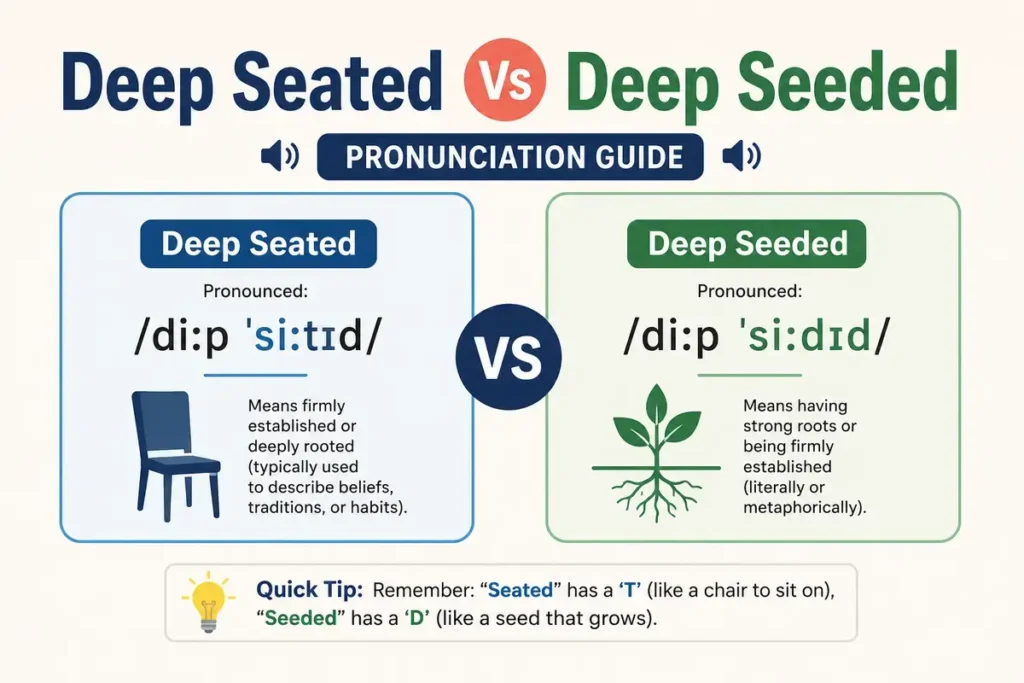
One reason this expression causes so much confusion is that both versions sound almost identical when spoken. Unless you see the words written down, it is almost impossible to tell which one a speaker intends.
Deep Seated
IPA pronunciation:
/diːp ˈsiːtɪd/
Syllable breakdown:
Deep.
Seat.
Ed.
Deep Seeded
IPA pronunciation:
/diːp ˈsiːdɪd/
Syllable breakdown:
Deep.
Seed.
Ed.
The pronunciation differs only slightly in the middle sound. In fast conversation, many native speakers pronounce them so similarly that listeners never notice the difference. That is another reason the nonstandard form has spread so widely.
Expert Language Insight
Experienced editors rarely correct deep seeded because the meaning is unclear. They correct it because published writing follows established usage. Readers expect consistency and accuracy, especially in books, newspapers, academic papers, and professional documents.
Language experts also recognize that deep seeded is becoming more common in everyday speech. Still, popularity alone does not immediately change editorial standards. Until major dictionaries and style guides consistently accept the newer form, deep seated remains the safer and more professional choice.
If you want your writing to sound polished and trustworthy, treat deep seated as your default expression. It communicates the same idea while matching the expectations of educated readers and professional editors.
If you’re interested in regional English variations, our guide to British and American spelling differences explains why some spellings are considered correct depending on where you write.
Examples In Sentences
Reading an expression in context is one of the fastest ways to remember it. The examples below show how the standard expression works in everyday writing and explain why the nonstandard variation continues to appear.
Deep Seated Examples
The following sentences use the accepted expression correctly.
- Her deep seated fear of public speaking began when she was a child.
- The company struggled to change its deep seated workplace culture.
- Their friendship survived despite deep seated political differences.
- Years of experience gave him a deep seated respect for the profession.
- The conflict grew from deep seated historical tensions.
- She recognized that her deep seated beliefs influenced many of her decisions.
- The counselor helped him understand his deep seated insecurities.
- Deep seated traditions continue to shape the community today.
- The documentary explored the country’s deep seated social issues.
- Their success came from deep seated values passed down through generations.
Notice that the phrase almost always describes something lasting, firmly established, and difficult to change. It commonly appears with words such as beliefs, fears, prejudice, hatred, values, traditions, and issues.
Deep Seeded Examples
The next examples reflect how people often use the nonstandard variation in everyday conversation and online writing.
- She believed her deep seeded fears came from childhood experiences.
- They tried to address the deep seeded problems within the organization.
- His deep seeded dislike of change affected every decision.
- Many people talk about deep seeded family traditions.
- The article mentioned deep seeded resentment between the two groups.
- They discussed deep seeded emotional wounds during therapy.
- The coach wanted players to overcome their deep seeded doubts.
- Some readers still write about deep seeded hatred in online discussions.
- Her deep seeded habits were difficult to break.
- The speech focused on deep seeded inequality.
Although these sentences sound natural, professional editors would normally replace deep seeded with deep seated before publication. The intended meaning remains the same, but the accepted expression is still deep seated.
Common Mistakes
This expression causes confusion because both versions seem reasonable. Understanding the most common mistakes will help you avoid them in your own writing.
Replacing Seated With Seeded
This is the mistake people make most often.
Because seeds grow roots beneath the ground, many writers assume seeded fits the idea of something deeply rooted. The image makes sense, but the traditional expression comes from seated, meaning firmly settled or fixed.
Assuming Popular Use Makes It Correct
A quick internet search returns thousands of examples using deep seeded. Seeing the phrase repeatedly can make it appear correct.
Popularity does not always equal correctness. Many websites publish informal or unedited content, which allows common language mistakes to spread quickly.
Ignoring The Audience
Your audience should influence your word choice.
If you are writing for school, work, academic publishing, journalism, or professional communication, use deep seated.
In casual conversation, you may hear deep seeded, but it is still likely to be corrected in formal writing.
Confusing Meaning With Origin
People often assume that because deep seeded creates a stronger visual image, it must be the original phrase.
The opposite is true.
The expression developed from seated, not seeded, even though the incorrect variation sounds logical to many modern speakers.
Using Seeded In The Wrong Context
The word seeded is perfectly correct in other situations.
For example:
- The watermelon was seeded.
- The lawn was seeded in early spring.
- The tennis player was seeded first in the tournament.
- The basketball team earned the top seeded position.
In these examples, seeded is the correct word because it refers to seeds or tournament rankings rather than the idiom.
Etymology And Word Origin
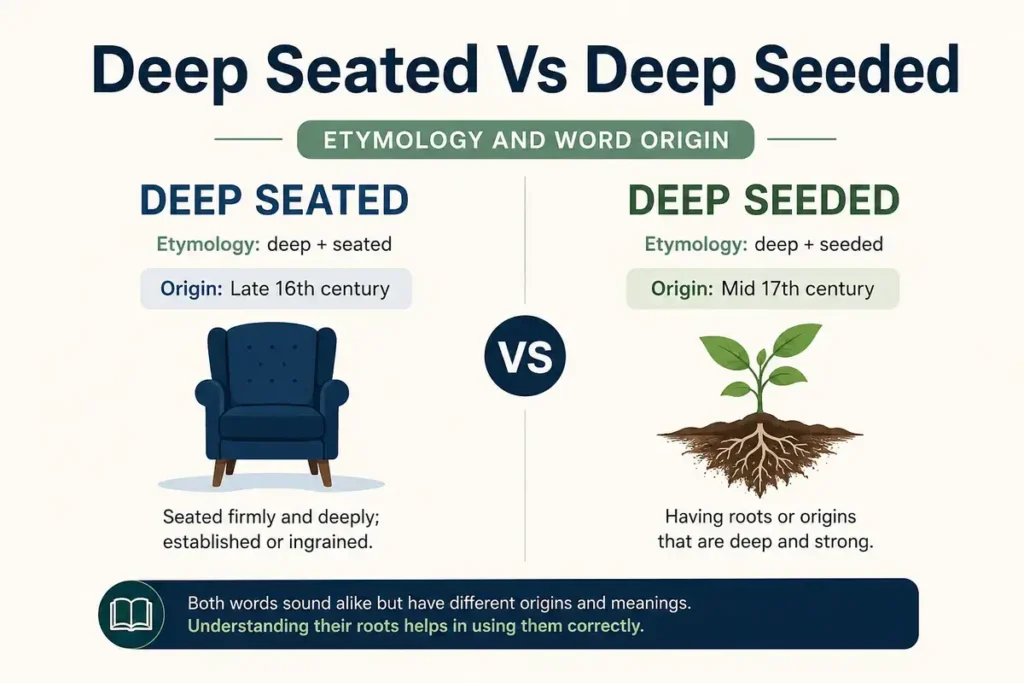
The history of this expression explains why the accepted form surprises so many people.
The adjective seated comes from the verb seat, which originally meant to place or settle something firmly in position. Over time, English speakers began using seated to describe ideas, emotions, and conditions that had become firmly established instead of physically fixed.
The expression deep seated appeared in English centuries ago to describe beliefs, habits, and feelings that were firmly settled in someone’s character or mind. It never referred to seeds or planting.
The variation deep seeded emerged much later. Linguists classify it as an eggcorn, a term used for a word or phrase that changes because people replace it with another expression that sounds similar and appears to make sense.
English contains many eggcorns.
- Free reign instead of free rein.
- Nip it in the butt instead of nip it in the bud.
- For all intensive purposes instead of for all intents and purposes.
- Deep seeded instead of deep seated.
These substitutions happen because our brains naturally search for familiar words that create a logical picture.
Regional Usage
One question many readers ask is if the preferred expression changes from one English speaking country to another.
The answer is simple. It does not.
American English
American dictionaries, newspapers, universities, and style guides overwhelmingly prefer deep seated.
Although deep seeded appears in casual speech and online discussions, it is generally treated as a nonstandard variation.
British English
British English follows the same pattern.
You’ll find deep seated in books, newspapers, academic writing, and professional publications throughout the United Kingdom.
Australian English
Australian writers also favor deep seated in edited content.
The nonstandard variation occasionally appears in informal communication but rarely survives professional editing.
Canadian English
Canadian English aligns closely with both American and British editorial standards.
Professional publications almost always use deep seated, while informal writing sometimes includes the alternative version.
Across all four major English varieties, the recommendation remains remarkably consistent. If your goal is polished writing, deep seated is the preferred expression.
Grammar Rules Deep Seated Vs Deep Seeded
Although this topic is mainly about vocabulary and usage, understanding the grammar behind the expression helps explain why it works.
Part Of Speech
Deep seated functions as a compound adjective. It describes a noun by showing that something has become firmly established over time.
Examples include:
- Deep seated fear.
- Deep seated prejudice.
- Deep seated resentment.
- Deep seated tradition.
Position In A Sentence
The expression usually appears before the noun it modifies.
Examples:
- They addressed deep seated problems within the organization.
- She overcame her deep seated anxiety.
It can also appear after a linking verb.
Examples:
- Their disagreements were deep seated.
- His concerns seemed deeply seated in past experiences.
Common Word Partners
Native speakers frequently combine the expression with certain nouns.
These include:
- Beliefs.
- Values.
- Fear.
- Hatred.
- Bias.
- Distrust.
- Anger.
- Trauma.
- Conflict.
- Issues.
Recognizing these natural combinations helps your writing sound more fluent.
Real Life Usage Examples
The expression appears in many different types of writing because it describes ideas that develop over time.
Daily Conversation
People often use it when discussing emotions, relationships, or personal experiences.
Examples include:
- They talked about deep seated family conflicts.
- She finally confronted her deep seated fears.
Academic Writing
Researchers frequently describe long standing attitudes, social patterns, and psychological behavior.
Examples include:
- The study examined deep seated cultural beliefs.
- Researchers explored deep seated economic inequality.
Professional Communication
Business leaders and consultants use the phrase when discussing organizational culture or workplace challenges.
Examples include:
- The review identified deep seated communication problems.
- Managers worked to address deep seated resistance to change.
Literature
Novelists often use the expression to reveal a character’s emotional state.
Examples include:
- His deep seated guilt influenced every decision.
- The story explored deep seated resentment between generations.
Media
Journalists commonly use the phrase while reporting on politics, society, education, and history.
Examples include:
- The report highlighted deep seated social divisions.
- Experts discussed deep seated economic concerns affecting the region.
Across all of these contexts, the expression carries the same core idea. It describes something firmly established that usually takes significant time or effort to change.
Related Words And Confused Terms
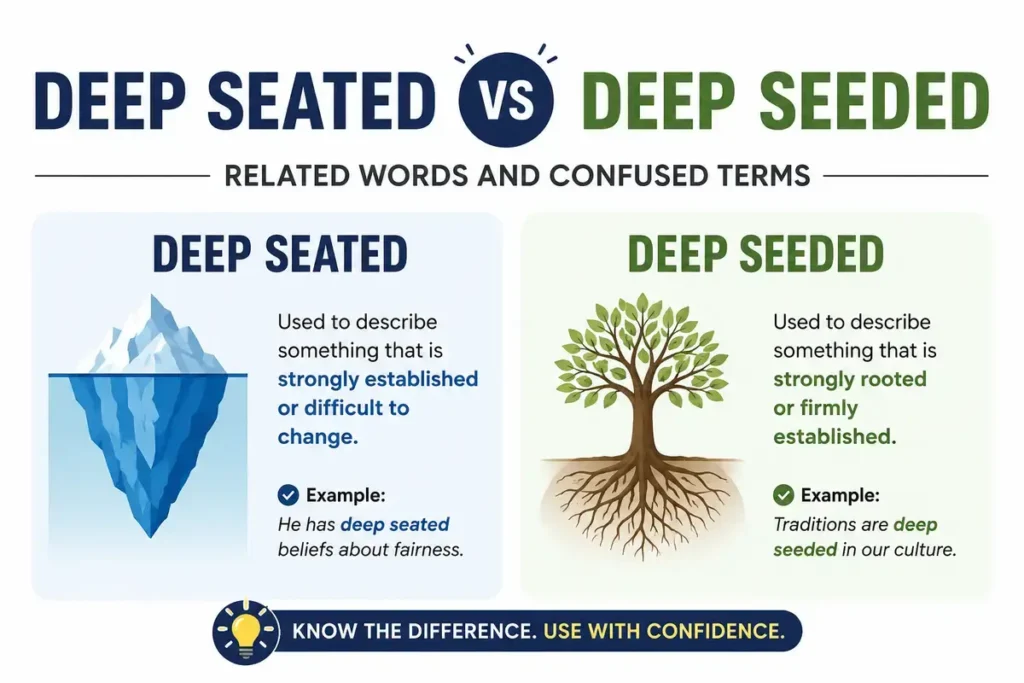
Many English expressions become confusing because they sound alike or create similar mental images. Deep seated belongs to that group. Learning a few related terms will help you understand why this particular expression causes so much uncertainty.
Here are some words and phrases closely connected to this topic.
- Deep rooted.
- Firmly established.
- Entrenched.
- Long standing.
- Embedded.
- Ingrained.
- Fixed.
- Persistent.
- Enduring.
- Well established.
These expressions often work as natural alternatives when you want to avoid repetition. Each one suggests that an idea, emotion, belief, or habit has existed for a long time and is difficult to change.
Deep Seated Meaning
The expression describes something firmly established in a person’s mind, character, culture, or society. It often refers to emotions, attitudes, traditions, fears, prejudice, habits, values, or beliefs that have developed over many years.
For example:
- Deep seated anxiety.
- Deep seated distrust.
- Deep seated cultural traditions.
- Deep seated resentment.
Just as writers often confuse deep-seated and deep-seeded, many also wonder which spelling of “pricey” is correct when describing something expensive.
Deep Seeded Meaning
Many people use deep seeded intending to express the same idea as deep seated. The wording feels logical because seeds grow beneath the soil and develop deep roots. Even so, professional dictionaries and editorial style guides continue to recommend deep seated as the standard expression.
Deep Seated Issues Meaning
When someone talks about deep seated issues, they mean problems that have existed for a long time and cannot be solved with a quick fix. These issues usually involve emotions, relationships, organizations, or social systems that require lasting change rather than temporary solutions.
Deep Seated Hatred
This phrase describes intense hostility that has developed gradually over time. It often appears in discussions about history, politics, psychology, or personal relationships where emotions have become deeply established through years of experience.
Seeded Or Seated In Sports
This question causes confusion because both words are correct, but they belong in completely different situations.
In sports competitions, seeded is the correct choice because teams or players receive rankings before a tournament begins.
Examples include:
- She was seeded first in the championship.
- The defending champion received the top seeded position.
- Only the highest seeded teams advanced to the next round.
The word seated has nothing to do with tournament rankings. It refers to someone sitting down or something being firmly positioned.
Understanding this distinction makes it much easier to remember why deep seated uses seated, while sports competitions use seeded.
Expert Language Insight
Professional editors rarely make decisions based only on popularity. They also consider history, accepted usage, reader expectations, and dictionary evidence.
This expression is a perfect example.
Most editors recognize that millions of English speakers genuinely believe deep seeded is correct. The mistake is understandable because it creates a vivid image of ideas growing like roots beneath the ground. That image is memorable, but it does not reflect the historical origin of the expression.
Experienced writers focus on established usage rather than personal interpretation. If an expression appears consistently in respected dictionaries, style guides, academic publications, and major newspapers, it becomes the safest choice for professional writing.
That is why editors continue to recommend deep seated.
If you are writing an essay, business report, blog article, research paper, or book, choosing the accepted expression strengthens your credibility. Readers may not consciously notice the wording, but they are more likely to trust writing that follows standard English conventions.
Language continues to evolve, and some nonstandard expressions eventually become accepted. Until that happens, deep seated remains the expression that professional writers and editors recommend.
Frequently Asked Questions
Is deep seated or deep seeded correct?
The accepted expression is deep seated. It describes ideas, emotions, beliefs, habits, or problems that are firmly established and difficult to change. Deep seeded appears frequently in everyday conversation and online writing, but it is still considered a nonstandard variation in formal English.
Why do people say deep seeded?
People often choose deep seeded because it creates a logical picture. Seeds grow beneath the ground and develop deep roots, so the phrase sounds believable. This type of language mistake is known as an eggcorn, where a familiar expression changes into another version that sounds reasonable.
What does deep seated mean?
Deep seated means firmly established or deeply rooted over time. It commonly describes emotions, traditions, attitudes, beliefs, fears, prejudice, and long standing problems that are not easy to change.
Is deep seeded ever correct?
The phrase appears regularly in informal speech, social media, and online discussions, so most people understand its intended meaning. However, it is not the preferred choice in edited English. If you are writing for school, work, or publication, deep seated is the better option.
What is another word for deep seated?
Several expressions have a similar meaning.
- Deep rooted.
- Ingrained.
- Entrenched.
- Firmly established.
- Embedded.
- Long standing.
- Enduring.
The best synonym depends on the sentence and the idea you want to express.
Is deep seated used in American and British English?
Yes. Both American English and British English prefer deep seated in dictionaries, newspapers, books, academic writing, and professional communication. The recommendation is consistent across other major English varieties as well.
What does deep seated issues mean?
The phrase describes long lasting problems that usually have complex causes. Deep seated issues often involve personal emotions, family relationships, workplace culture, social inequality, or historical conflict. These problems typically require thoughtful solutions instead of quick fixes.
How can I remember the correct expression?
Think about the word seated as meaning firmly settled or fixed in place. Something that is deeply seated has become established over time. Reserve seeded for situations involving gardening, agriculture, or sports tournaments where competitors are seeded according to their rankings.
Conclusion
Choosing between these two expressions becomes much easier once you understand their history. Deep seated is the traditional and accepted expression in standard English. It describes beliefs, emotions, habits, traditions, and problems that have become firmly established over time.
The variation deep seeded continues to appear because it sounds logical. Many people naturally connect long lasting ideas with seeds growing deep beneath the ground. Even though that image makes sense, it does not match the historical origin of the expression or current editorial standards.
If you are writing for school, work, publishing, or any professional setting, deep seated is the choice you can use with confidence. It is recognized by dictionaries, preferred by editors, and widely accepted across American, British, Australian, and Canadian English.
The next time you find yourself wondering about deep seated vs deep seeded, remember that deep seated is the accepted expression in standard English. It reflects something firmly established over time and is the form trusted by dictionaries, editors, and professional writers. Choosing the correct phrase will make your writing clearer, more credible, and more polished, no matter who your audience is.