Have you typed eying or eyeing into Google after seeing both spellings online? You’re not the only one. This pair confuses students, writers, editors, and native English speakers because both forms appear in books, news articles, dictionaries, and social media. At first glance, it looks like one must be a typo. In reality, the answer is a little more interesting.
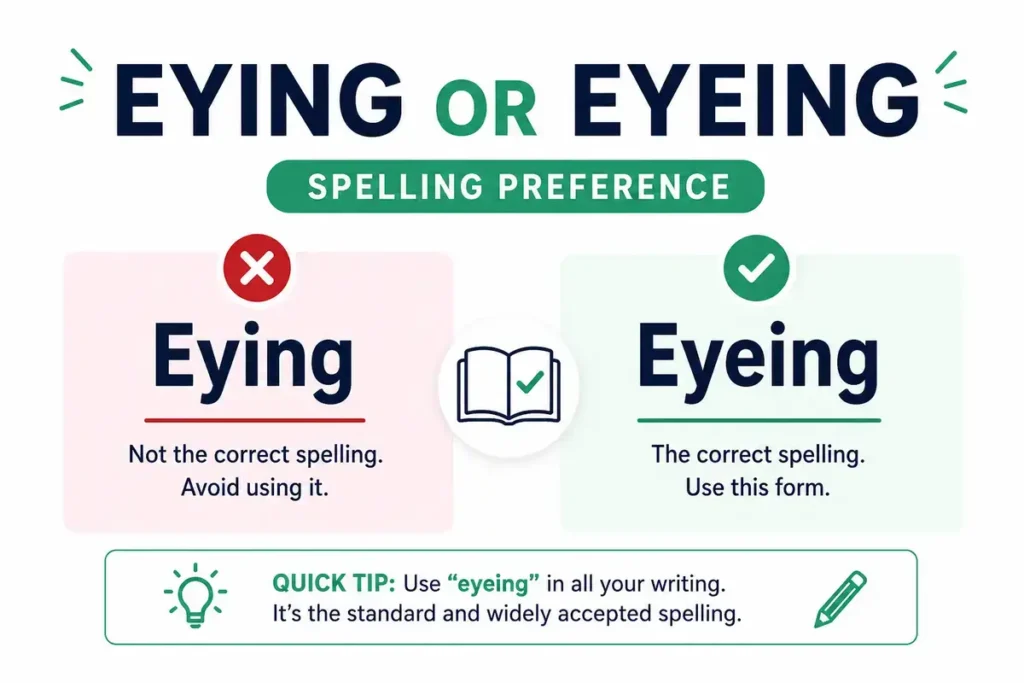
The short answer is that eyeing is the preferred spelling in modern English and is accepted by virtually every major dictionary and style guide. Eying is also a real word, but it is much less common. Some dictionaries list it as an alternative spelling, while certain publications and regional style preferences occasionally use it. Even so, most professional editors, publishers, and businesses choose eyeing because it matches current usage and meets readers’ expectations.
This guide explains the difference in plain English. You will learn which spelling is considered standard, why both forms exist, how dictionaries and style guides treat them, how to use the word correctly in sentences, and the grammar behind each form. You will also discover common mistakes, pronunciation tips, real life examples, and expert writing advice that helps you choose the right spelling with confidence.
Quick Definition
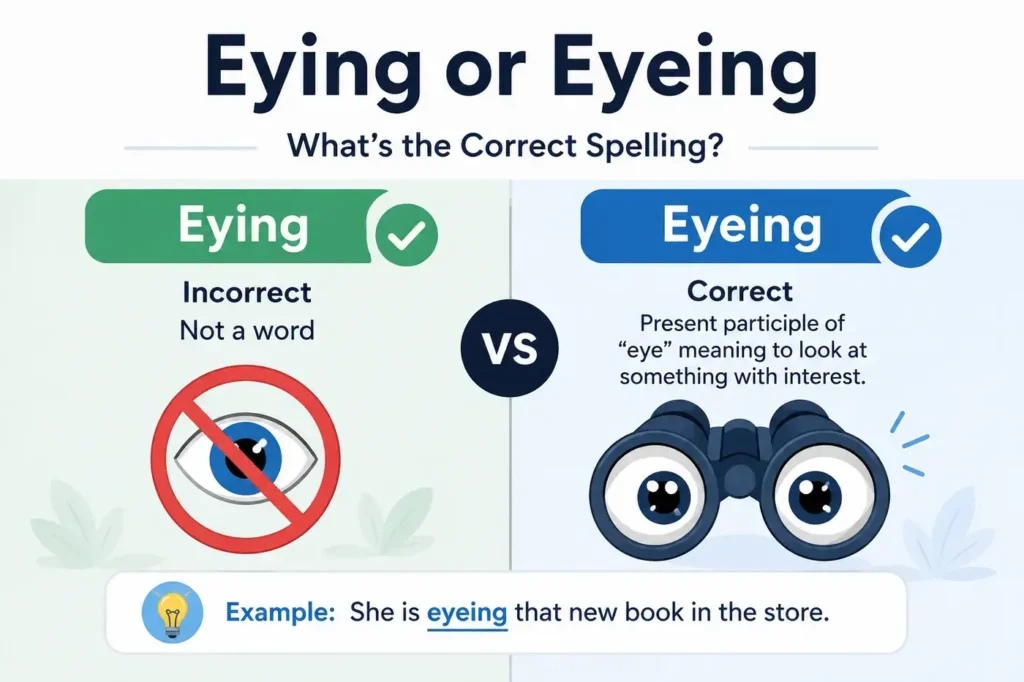
Both eyeing and eying are present participle forms of the verb eye, which means to look at someone or something carefully, closely, or with interest. Eyeing is the standard and preferred spelling in modern English, while eying is an accepted but much less common variant found in some dictionaries and publications.
Quick Answer
If you only remember one rule, make it this one.
- Use eyeing in almost every situation.
- Treat eying as an uncommon alternative spelling.
- Follow your organization’s style guide if one exists.
- Stay consistent throughout your document.
For most writers, students, bloggers, and professionals, eyeing is the safest and most natural choice. It is the spelling readers expect to see, and it appears far more often in newspapers, books, websites, and professional writing.
Comparison Table
| Feature | Eyeing | Eying |
|---|---|---|
| Part of speech | Present participle and gerund of eye | Alternative present participle and gerund of eye |
| Meaning | Looking at someone or something carefully | Same meaning |
| Correct form | Standard modern spelling | Accepted alternative spelling |
| Origin | Derived from the verb eye | Derived from the same verb |
| Formality level | Standard in formal and informal writing | Rare in formal writing |
| Common contexts | Journalism business writing fiction conversation | Limited publications older texts some dictionaries |
| Usage frequency | Very common | Much less common |
| Example | She is eyeing the last slice of pizza. | She is eying the last slice of pizza. |
If you’re unsure about spelling conventions, our guide on how to write large numbers correctly explains when to use lacs or lakhs in different forms of English.
Meaning Of Each Spelling
Although one spelling is much more common than the other, both come from the same verb and carry the same meaning. The difference is about spelling preference rather than definition.
What Does Eyeing Mean
Eyeing is the present participle of the verb eye. It describes looking at someone or something with attention, curiosity, suspicion, admiration, interest, or desire.
The word often suggests that the person is observing something carefully instead of taking a quick glance.
You might see eyeing in situations like these.
- Someone is considering buying a new car.
- A child is looking at a plate of cookies.
- A detective is watching a suspect.
- An investor is studying a business opportunity.
- A traveler is admiring a beautiful view.
The exact meaning depends on the context, but the central idea stays the same. Someone is giving something close attention.
What Does Eying Mean
Eying carries exactly the same meaning. It also functions as the present participle of eye.
The difference is that this spelling appears much less often in modern English. While some dictionaries recognize it, most publishers and professional editors prefer eyeing because it aligns with current spelling conventions.
If you come across eying in a novel, article, or online discussion, you should not assume it is incorrect. In many cases, it reflects the writer’s preferred spelling or the publication’s editorial style rather than a grammar mistake.
Key Differences
The meanings are identical, but there are several practical differences worth understanding before choosing one spelling over the other.
Spelling Preference
The biggest difference is frequency.
Eyeing is the spelling you’ll encounter in most dictionaries, newspapers, books, websites, and professional publications. Eying appears much less often and may look unfamiliar to many readers.
Reader Expectations
Modern readers generally expect to see eyeing. Using the more common spelling makes your writing feel natural and polished because it matches what people see every day.
Editorial Practice
Professional editors usually standardize spelling across an article or publication. Since eyeing is the dominant form in contemporary English, it is often selected during the editing process even when another variant is technically acceptable.
Meaning
There is no difference in meaning.
Both words describe looking at someone or something with focused attention.
Grammar
Both spellings function in exactly the same way.
They can act as:
- A present participle.
- A gerund.
- Part of a continuous verb tense.
For example:
- She is eyeing the painting.
- Eyeing the competition helped him prepare.
- They were eyeing a larger office.
The same grammar applies if a writer chooses the alternative spelling.
Which Spelling Should You Use
For nearly every situation, eyeing is the better choice.
It is the spelling recommended by most dictionaries, recognized by readers around the world, and commonly used in journalism, business communication, academic writing, and everyday English. Choosing the standard spelling also reduces the chance that readers will think you’ve made a mistake.
There are still situations where eying may appear.
- Older publications.
- Certain dictionary entries.
- Personal writing preferences.
- Publications with their own editorial conventions.
Unless a style guide specifically recommends otherwise, using eyeing is the safest decision.
Pronunciation Guide
One reason this spelling pair causes confusion is that both words sound exactly the same when spoken.
Eyeing
IPA pronunciation:
/ˈaɪɪŋ/
Syllable breakdown:
Eye ing
Eying
IPA pronunciation:
/ˈaɪɪŋ/
Syllable breakdown:
Eye ing
Because the pronunciation is identical, listeners cannot tell which spelling a writer has used. The difference exists only in written English.
Common Pronunciation Mistakes
Most learners pronounce these words correctly because they simply combine the word eye with the ing ending. Still, a few mistakes appear from time to time.
- Adding an extra syllable.
- Stressing the second syllable instead of the first.
- Pronouncing the ending too strongly.
The natural pronunciation flows smoothly as a two syllable word.
Eying and eyeing aren’t the only words that cause confusion, another commonly confused spelling is naive vs nieve, which often trips up writers.
Expert Language Insight
English spelling often follows patterns, but it also contains historical exceptions that survive long after the language changes. The verb eye is a good example. When adding ing, some writers expect the final e to disappear, while others expect it to remain because it helps preserve the appearance of the base word.
Modern usage has largely settled the question. Professional editors, publishing houses, and most major style guides overwhelmingly favor eyeing because it is instantly recognizable and aligns with current publishing standards.
As an editor, my recommendation is simple. Unless you’re following a publication that specifically prefers the alternative form, use eyeing. It is familiar to readers, widely accepted, and unlikely to distract anyone from your message.
Examples In Sentences
Seeing both spellings in real sentences makes the difference much easier to understand. As you read these examples, notice that the meaning never changes. Only the spelling does. Since eyeing is the preferred form in modern English, you’ll encounter it far more often in books, news articles, websites, and everyday writing.
Eyeing Examples
The following examples use the standard spelling that most dictionaries and style guides recommend.
- She is eyeing the last piece of cake on the table.
- The family is eyeing a larger home before the end of the year.
- Investors are eyeing new opportunities in the technology sector.
- He kept eyeing the clock during the long meeting.
- The coach was eyeing several young players for the starting lineup.
- We have been eyeing that beach resort for our next vacation.
- The child stood quietly, eyeing the colorful balloons.
- Shoppers were eyeing the biggest discounts during the holiday sale.
- The detective spent hours eyeing the security footage.
- She walked through the bookstore, eyeing every novel on the shelf.
These examples show that the word works naturally in casual conversation, journalism, business writing, and storytelling.
Eying Examples
The following sentences use the less common spelling. Although it carries the same meaning, many readers will find it unfamiliar because it appears much less frequently in modern English.
- She was eying the beautiful necklace in the display window.
- They have been eying a new office downtown.
- The teacher noticed the student eying the answer sheet.
- He kept eying the trophy throughout the ceremony.
- We spent the afternoon eying different vacation packages.
- The dog sat quietly, eying the food on the kitchen counter.
- The company is eying international expansion next year.
- Reporters were eying the latest economic data.
- The child smiled while eying the birthday presents.
- She caught him eying the antique watch at the market.
If you’re writing for a broad audience, replacing eying with eyeing will usually make your writing feel more familiar and polished.
Common Mistakes
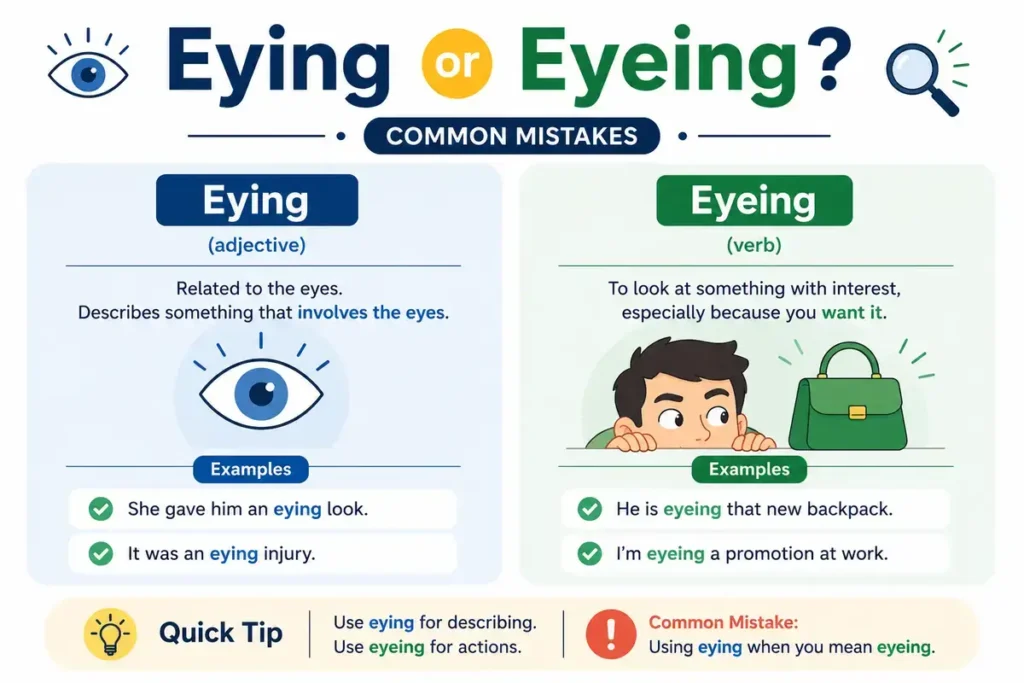
This spelling pair causes confusion because both forms exist. Most errors happen when writers rely on assumptions instead of checking a trusted dictionary or style guide.
Here are the mistakes editors see most often.
Assuming Eying Is Always Wrong
Many writers believe eying is simply a misspelling.
That is not entirely accurate. Several respected dictionaries list it as an alternative spelling. Even so, it is much less common than eyeing, which is why most editors replace it during the editing process.
Using Both Spellings In One Article
Switching between spellings makes the writing feel inconsistent.
For example, an article might begin with eyeing and later change to eying without any reason. Readers often notice this inconsistency, even if they cannot explain why it feels unusual.
Choose one spelling and use it consistently from beginning to end.
Applying General Spelling Rules Automatically
English often drops a final e before adding ing, as in these examples.
- Make becomes making.
- Bake becomes baking.
- Drive becomes driving.
Some writers expect the same rule to apply to eye, which explains why eying appears. However, modern dictionaries and editorial practice generally favor eyeing, making it the better choice for most situations.
Ignoring The Style Guide
Schools, publishers, businesses, and news organizations often have their own editorial standards.
Before changing a spelling, check the style guide you’re expected to follow. If no guide exists, choose the spelling that most readers recognize.
Etymology And Word Origin
The verb eye has a long history in English. It developed from the noun eye, which comes from Old English ēage, meaning the organ of sight.
Over time, English speakers began using the noun as a verb. Instead of referring only to the body part, eye also came to mean looking at someone or something carefully, watching with interest, or observing closely.
As the language evolved, writers needed a present participle form of the verb. Both eyeing and eying appeared in printed works, although eyeing gradually became the dominant spelling.
Today, the preferred form reflects modern publishing practice more than a difference in meaning. Both spellings share the same origin, but one has become far more common through everyday use.
Regional Usage
Unlike many spelling differences in English, this one is not strongly divided between American and British English. Writers in several English speaking countries generally prefer the same spelling.
American English
American dictionaries, newspapers, publishers, and businesses overwhelmingly use eyeing. It is the spelling most readers expect to see in professional writing.
British English
British English also favors eyeing in modern publications. Although eying occasionally appears, it is much less common.
Australian English
Australian writers typically follow the same pattern. The standard spelling appears in newspapers, educational materials, and business communication.
Canadian English
Canadian English also leans toward eyeing. Since Canadian writing blends influences from both American and British English, style guides may differ in other areas, but this spelling is generally consistent.
No matter where you write, eyeing is usually the safer choice unless a specific publication requests otherwise.
Grammar Rules
Understanding how the word functions in a sentence is just as important as choosing the correct spelling.
Part Of Speech
The word commonly functions as a present participle or a gerund.
Examples:
- She is eyeing the painting. Present participle.
- Eyeing the competition helped him prepare. Gerund.
Verb Tenses
You’ll most often see the word in continuous verb tenses.
Examples include:
- She is eyeing a promotion.
- They were eyeing a new apartment.
- We have been eyeing that restaurant for months.
Sentence Structure
The word usually follows helping verbs such as:
- Is.
- Are.
- Was.
- Were.
- Has been.
- Have been.
It can also begin a sentence when used as a gerund phrase.
Example:
Eyeing the finish line, the runner increased her speed.
Is Eying A Word
Yes.
Eying is a real word that appears in several dictionaries. However, it is an alternative spelling rather than the preferred one. Most editors, teachers, and publishers recommend eyeing because it is much more common in current English.
AP Style And Editorial Preference
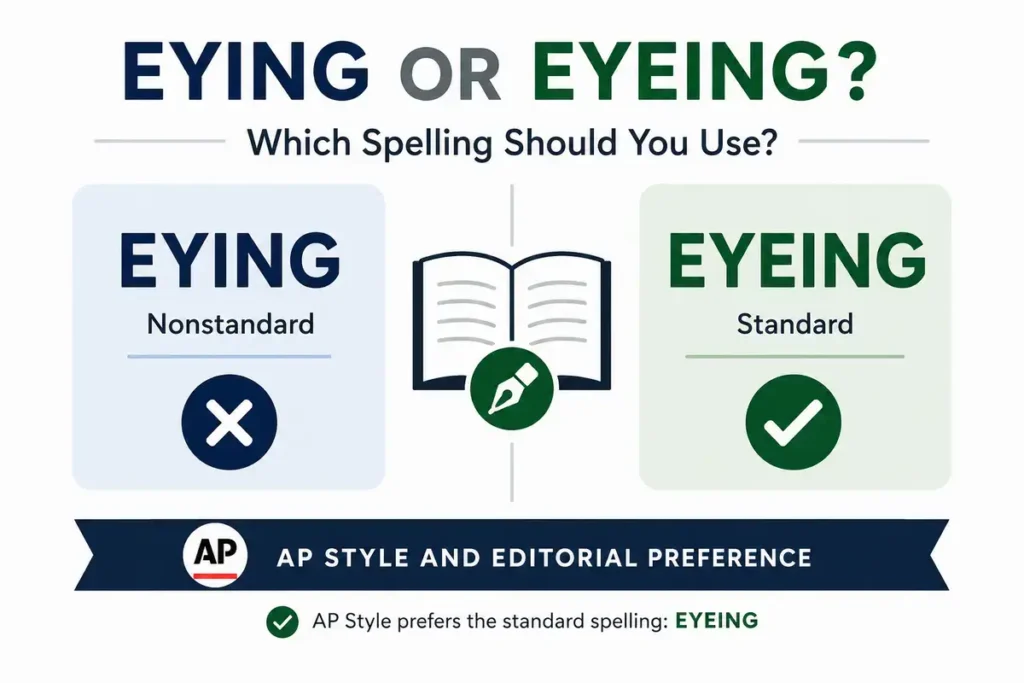
Many writers search for eyeing or eyeing AP Style because they want to match professional journalism standards.
While style guides focus on clarity and consistency, news organizations generally use the spelling found in standard dictionaries. In practice, eyeing is the form you’ll most often see in newspapers, magazines, and digital news publications that follow modern editorial conventions.
If you’re writing news articles, blog posts, marketing content, or business documents, choosing eyeing is the safest option unless your organization’s style guide says otherwise.
Real Life Usage Examples
This word appears in many different situations, not just in fiction.
Daily Conversation
People often use it when talking about something they want or find interesting.
Examples include:
- I’m eyeing those new running shoes.
- She’s eyeing a weekend trip to the mountains.
Academic Writing
Researchers and journalists may use the word when discussing trends or future plans.
Examples include:
- Universities are eyeing new research partnerships.
- Scientists are eyeing promising treatment options.
Professional Communication
Business writing frequently uses the word to describe future plans or strategic decisions.
Examples include:
- The company is eyeing expansion into new markets.
- Investors are eyeing long term growth opportunities.
Literature And Media
Novelists often use the word to describe characters observing people or objects with curiosity, suspicion, admiration, or desire. News outlets also use it when reporting on acquisitions, elections, sports transfers, and economic developments because it conveys interest without suggesting a final decision.
Related Words And Commonly Confused Terms
When people search for this topic, they often have questions that go beyond spelling. They want to know if the word is correct, how it is used, and if another word would sound better in a sentence. Learning these related terms helps you write more naturally and choose the right word for the situation.
Synonyms
The best synonym depends on the context. Sometimes the word suggests simple observation, while in other situations it implies interest, curiosity, suspicion, or even desire.
Here are some common alternatives.
- Looking at.
- Watching.
- Observing.
- Staring at.
- Glancing at.
- Inspecting.
- Examining.
- Studying.
- Considering.
- Checking out.
- Admiring.
- Viewing.
No synonym fits every situation. For example, studying suggests careful attention, while admiring adds a positive emotional tone. Watching usually describes ongoing observation, and considering often works best when someone is thinking about buying or choosing something.
Eyeing On Something
Many English learners ask if eyeing on something is correct.
In standard English, the answer is no. The verb eye does not normally take the preposition on.
Correct examples include:
- She is eyeing a new laptop.
- They are eyeing the vacant property.
- Investors are eyeing renewable energy projects.
Adding on sounds unnatural because the verb already includes the idea of directing your attention toward something.
Similar Words That Cause Confusion
Several verbs have similar meanings but slightly different uses.
- Look means to direct your eyes toward something.
- Watch suggests observing something over a period of time.
- Stare usually implies looking for longer than normal.
- Glance means taking a quick look.
- Observe often sounds more formal or scientific.
- Examine suggests careful inspection.
- Notice means becoming aware of something.
Choosing the right word depends on the situation and the level of attention involved.
Expert Language Insight
One reason this spelling question continues to appear is that English contains many verbs ending in e. Learners naturally expect all of them to follow the same spelling rule when ing is added.
Real language is rarely that predictable.
Professional editors pay close attention to actual usage instead of relying only on spelling rules. When one form becomes overwhelmingly common in books, newspapers, websites, and respected dictionaries, that version gradually becomes the editorial standard. That’s exactly what happened here.
From an editor’s perspective, the decision is straightforward.
- Use eyeing in articles, emails, reports, academic papers, marketing content, and business communication.
- Recognize eying as an alternative spelling that still appears occasionally.
- Stay consistent throughout your document instead of switching between both forms.
Readers usually judge writing by how natural it feels. Using the spelling they see most often helps your content appear polished and trustworthy without drawing attention to the spelling itself.
Improving your writing also means mastering similar-sounding words, such as knowing when to use reins instead of reigns in common expressions.
Frequently Asked Questions
Is eyeing or eying correct?
Both spellings are recognized, but eyeing is the standard choice in modern English. It appears far more often in dictionaries, newspapers, books, and professional writing. Eying is an accepted alternative, but it is much less common.
Is eying a real word?
Yes. Eying is a real word and appears in several dictionaries. However, it is considered an alternative spelling rather than the preferred one. Most writers and editors choose eyeing because it is more familiar to readers.
What does eyeing mean?
The word means looking at someone or something with attention, interest, curiosity, suspicion, or desire. The exact meaning depends on the context, but it always involves more than a quick glance.
How do you use eyeing in a sentence?
The word usually appears as part of a continuous verb tense or a gerund phrase.
Examples include:
- She is eyeing a promotion at work.
- The family has been eyeing a new house for months.
- Eyeing the finish line, the runner picked up the pace.
Does AP Style prefer eyeing or eying?
While style guides emphasize consistency, professional journalism overwhelmingly uses eyeing because it matches modern dictionary usage and reader expectations. If you’re writing news or business content, eyeing is generally the safest choice.
Are there regional differences?
Unlike many spelling differences, this one is not strongly divided by country. American, British, Australian, and Canadian publications all tend to prefer eyeing, although eying appears occasionally in some sources.
What are the best synonyms?
Some of the closest alternatives include:
- Looking at.
- Watching.
- Observing.
- Examining.
- Studying.
- Considering.
- Inspecting.
- Admiring.
Choose the synonym that best matches the level of attention and the context of your sentence.
Why do people search Reddit about this spelling?
Many writers notice both spellings online and want to know if one is wrong. Discussion forums often include personal opinions, but dictionaries and established style guides provide the most reliable guidance. Those sources consistently show that eyeing is the preferred modern spelling.
Conclusion
The answer is simpler than it first appears. Both spellings exist, but they are not used equally. Eyeing has become the standard choice in modern English because it is the form preferred by most dictionaries, publishers, editors, and professional writers. Eying is still recognized as an alternative spelling, but it appears much less often and may look unfamiliar to many readers.
If you’re writing for school, work, publishing, or the web, choosing eyeing is usually the safest decision. It communicates the same meaning, follows current editorial practice, and meets the expectations of most readers. Unless you’re following a publication that specifically prefers the alternative spelling, there is little reason to choose eying.
One final habit will improve your writing even more. Pick a spelling, use it consistently, and let the context explain the meaning. Readers rarely stop to think about the spelling when the writing is clear, natural, and easy to follow.