If you have ever typed whiny vs whiney into a search bar you have probably noticed that both spellings appear online. That creates a reasonable question. Is one a mistake? Are they different words? Or can you use either spelling in normal English?
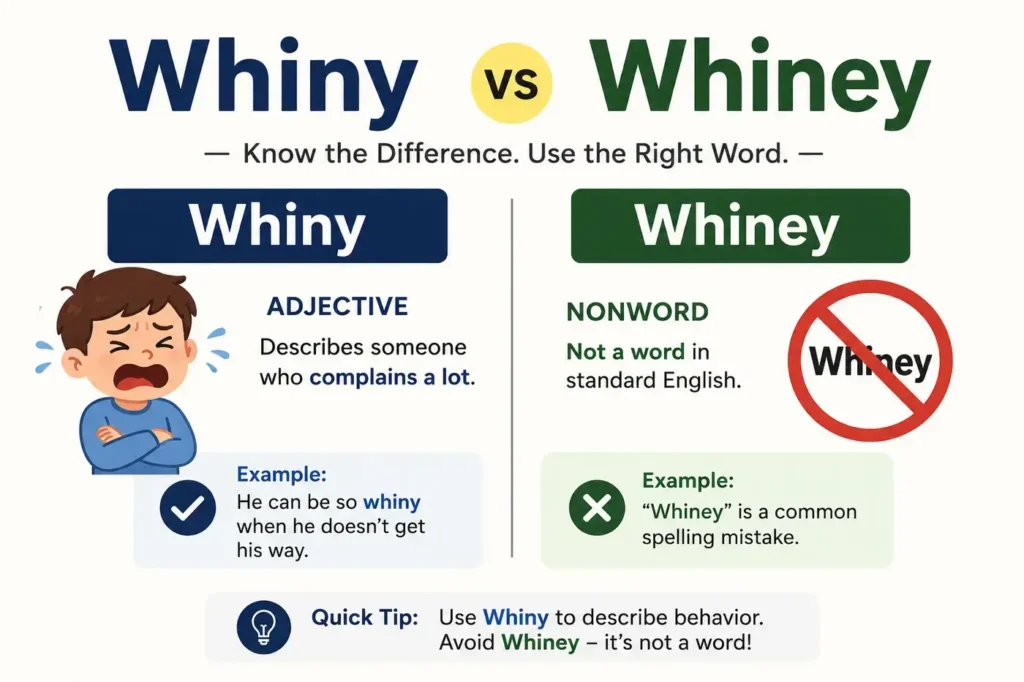
The standard answer is clear. Whiny is the preferred spelling in modern English, especially in edited American English. Whiney is also found in dictionaries and real world usage, but it is less common and is often treated as a variant spelling. Both forms describe someone or something that complains in an irritating or high pitched way.
The confusion comes from pronunciation. The word whiny sounds as though it could be spelled whiney because the base word is whine. English spelling does not always follow a perfectly predictable pattern, so that instinct is understandable. This guide explains the difference in spelling, meaning, pronunciation, grammar, usage, and tone. You will also learn how native speakers use the word, how to describe a whiny person naturally, and which form an editor would normally choose.
Just as it’s important to distinguish the difference between ballot and bullet, understanding small spelling differences like whiny and whiney helps you communicate with greater precision.
Quick Definition
Whiny is the standard and more common spelling for someone or something that complains repeatedly in an irritating or high pitched manner. Whiney is a recognized variant spelling with the same basic meaning, but it is less common in edited writing. For most school, business, and general writing, whiny is the safer choice.
Quick Answer
The preferred spelling is whiny.
Whiney is also used and can be found in dictionaries, but it is less common. The two forms generally have the same meaning and pronunciation. Both describe a person, voice, sound, or behavior that seems complaining, irritating, or excessively plaintive.
For most writing, choose whiny. Use whiney only if it fits the style of a particular publication, character, brand, or personal voice.
Comparison Table
| Feature | Whiny | Whiney |
|---|---|---|
| Part of speech | Adjective | Adjective |
| Standard status | Preferred and widely used | Accepted variant |
| Meaning | Complaining or sounding like a whine | Complaining or sounding like a whine |
| Origin | Derived from whine | Derived from whine |
| Formality level | Neutral and informal | Informal |
| Common contexts | Everyday speech, writing, reviews, descriptions | Casual writing, dialogue, informal descriptions |
| Usage frequency | More common | Less common |
| Pronunciation | Usually /ˈwaɪni/ | Usually /ˈwaɪni/ |
| Example | The child became whiny after missing lunch. | The child became whiney after missing lunch. |
The main difference is not meaning. It is spelling preference and frequency. In carefully edited writing, whiny is usually the form readers are most likely to expect.
Meaning Of Both Terms
The two spellings are closely related because they come from the same base word. Understanding that base word makes the comparison much easier.
What Does Whiny Mean
Whiny describes someone who complains in an annoying, persistent, or high pitched way. It can describe a person, a voice, a tone, behavior, or even a sound that resembles a prolonged complaint.
For example, you might describe a child as whiny after repeatedly complaining about a small problem. You might also describe an adult as whiny if they continue to complain without taking action. The word usually carries a negative tone because it suggests that the complaining feels excessive, irritating, or immature.
The meaning can change slightly depending on the noun it describes.
- A whiny child complains repeatedly.
- A whiny voice sounds high pitched or plaintive.
- A whiny tone suggests irritation or complaint.
- A whiny person complains in a way that others find irritating.
- A whiny sound resembles a long, unpleasant complaint.
The word does not always mean that the complaint is false or unimportant. Someone may have a legitimate problem and still sound whiny while talking about it. The adjective describes the manner of expression rather than proving that the underlying complaint has no merit.
What Does Whiney Mean
Whiney has essentially the same meaning. It describes a person, voice, or manner of speaking that sounds like a whine or involves repeated complaining.
The main difference is that this spelling is less common. Many writers choose it because the word comes from whine and the ending appears visually straightforward. That spelling makes sense at first glance, but whiny is the form most writers and editors normally prefer.
For example:
- The character sounded whiney during the argument.
- His whiney voice made the scene feel comic.
- The review described the song as overly whiney.
These sentences are understandable and natural in informal writing. Still, whiny would generally be the more conventional choice.
Whiny vs Whiney Key Differences
The most important point is that the two forms do not usually describe different behaviors. They are spelling variants of the same adjective. The distinction becomes clearer when you look at usage, tone, grammar, and audience.
Meaning Differences
There is no significant difference in basic meaning. Both forms can describe persistent complaining, a plaintive voice, or an irritatingly high pitched sound.
A writer might describe someone as whiny because that person keeps complaining about minor problems. The same person could be described as whiney without changing the meaning of the sentence.
Tone Differences
The spelling itself does not create a major difference in tone. However, whiney can sometimes look more informal because it is less common in edited prose. A writer may choose it intentionally in dialogue, humorous writing, or a casual online post.
Whiny tends to look more conventional and neutral. That makes it the better choice for most general writing.
Grammar Differences
Both forms function as adjectives.
They can describe:
- A person.
- A voice.
- A tone.
- A complaint.
- A sound.
- A style of behavior.
The grammar does not change simply because the spelling changes.
For example:
The child is whiny.
The child was whiny.
The child became whiny after the long trip.
The same sentence structures can use whiney.
Regional Differences
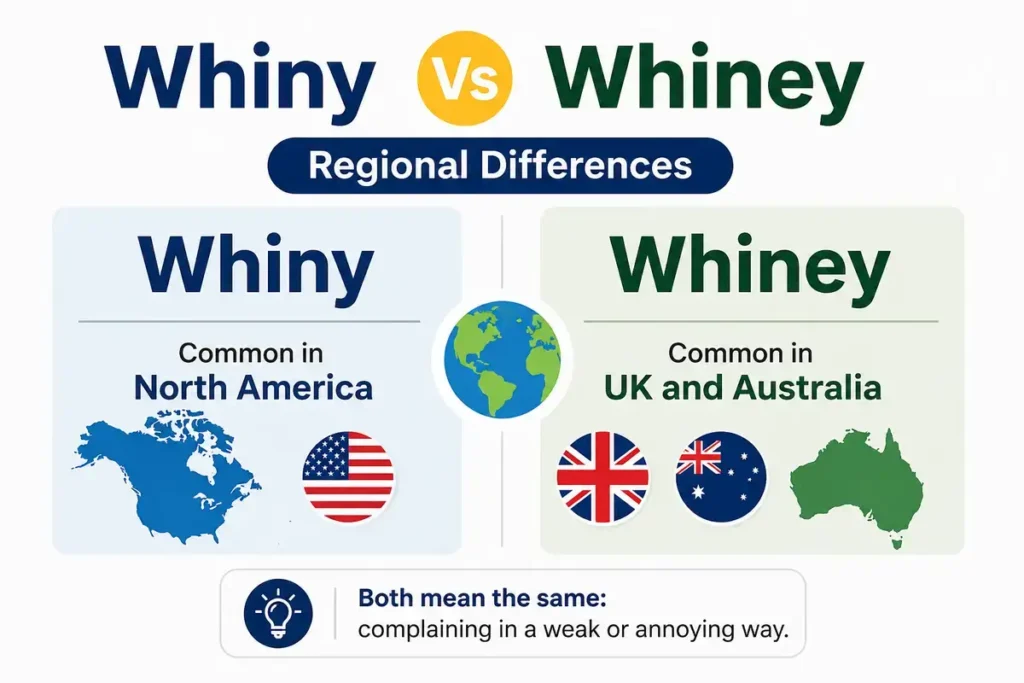
This is not a major American English versus British English spelling difference like color and colour. Both forms can appear across different English speaking regions.
The bigger distinction is frequency and editorial preference. Whiny is generally the more common form in modern English writing. Whiney appears as a variant and in informal usage.
Context Differences
Context often determines how natural the word feels.
In formal writing, a writer may choose a more precise description instead of either form. For example, persistent, complaining, plaintive, or high pitched may communicate the intended idea more professionally.
In everyday conversation, whiny is perfectly natural.
In fiction, the choice can depend on the character’s voice. A writer may deliberately choose a less common spelling in dialogue or informal narration to create a particular feel.
Which One Is Correct
Whiny is the preferred spelling for most situations.
It is the form you should normally choose in:
- School assignments.
- Blog articles.
- General nonfiction.
- Professional communication.
- Edited publications.
- Everyday writing.
Whiney is not simply meaningless or impossible. It is a variant spelling that appears in real English usage. Still, it is less common, so many readers and editors will expect whiny instead.
A practical editing rule is simple. If you are writing a sentence from scratch and do not have a specific reason to use the alternative form, choose whiny. If you are reproducing the official spelling of a title, quotation, character name, or other creative work, preserve the original form.
This is a useful distinction in English. A word can exist in real usage without being the best choice for every context. Editors do not only ask if a spelling can be found. They also consider frequency, audience expectations, clarity, and the conventions of the publication.
Pronunciation Guide
Both forms are generally pronounced the same way.
Whiny Pronunciation
The usual pronunciation is:
/ˈwaɪni/
You can think of it as:
WHY nee
The word has two syllables.
whi ny
The first syllable carries the main stress.
Whiney Pronunciation
The variant spelling is also usually pronounced:
/ˈwaɪni/
The spelling changes, but the sound remains essentially the same.
This similarity is one of the main reasons people search for the correct form. When people hear the word rather than see it written, they cannot tell which spelling the speaker has in mind.
Common Pronunciation Mistakes
Most pronunciation errors come from treating the word as though it has three syllables or from changing the vowel sound.
Common mistakes include:
- Pronouncing the word as win ee.
- Giving equal stress to both syllables.
- Adding an extra syllable after the final y.
- Pronouncing the first part like when instead of why.
The standard pronunciation begins with the same sound found in why and whine.
Whiny vs Whiney How To Remember The Correct Spelling
The easiest way to remember the preferred form is to connect it to the base word whine.
The adjective whiny keeps the recognizable whin part and adds the y ending.
Think of the pattern like this:
whine → whiny
The final e is removed before the y is added. This pattern appears in many English words formed from a base word ending in silent e.
For example:
- Noise becomes noisy.
- Taste becomes tasty.
- Ice becomes icy.
- Grease becomes greasy.
The spelling pattern is not perfectly consistent across English, but connecting the adjective to whine helps many learners remember why whiny is the more common form.
If you are writing quickly and hesitate between the two forms, choose whiny. It is the standard choice most readers will recognize immediately.
Expert Learning Tip
The best way to understand this word is to separate three ideas that people often blend together: the spelling, the sound, and the meaning.
The spelling you will usually want is whiny. The pronunciation is generally the same as whiney. The meaning is also essentially the same. Once you separate those three questions, the confusion becomes much smaller.
This approach works for many spelling comparisons in English. Two forms can sound alike and carry the same meaning while still differing in frequency and editorial preference. Experienced writers pay attention to that difference instead of assuming that every form found online is equally suitable for polished writing.
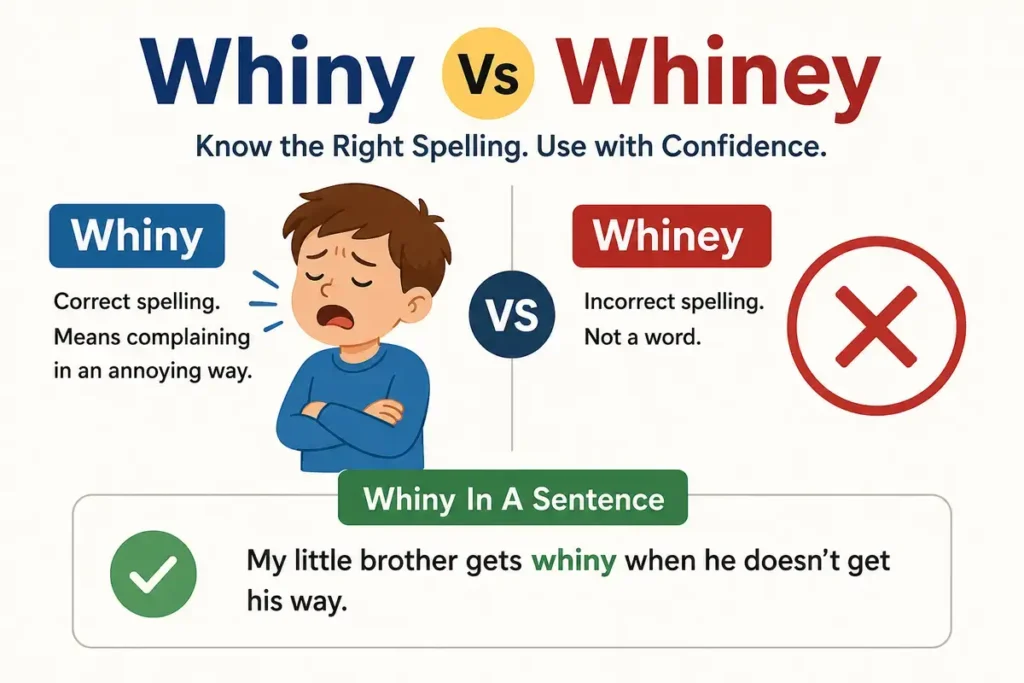
Examples In Sentences
The easiest way to understand this adjective is to see how it behaves in natural sentences. It can describe a person, a voice, a tone, a complaint, or a sound. The meaning depends on the noun it modifies and the situation surrounding it.
Whiny In A Sentence
- The child became whiny after spending all afternoon in the car.
- I understand that you are tired, but that whiny tone is not helping.
- Her whiny voice made the simple complaint sound much more dramatic.
- The puppy grew whiny when it realized that everyone had left the room.
- He sounded whiny during the meeting because the schedule had changed.
- The character’s whiny behavior made the comedy scene even funnier.
- My little brother gets whiny when he skips breakfast.
- The singer’s voice sounded unusually whiny on the final verse.
- She was not trying to be difficult, but her repeated complaints sounded whiny.
- The reviewer criticized the movie for giving its main character a constantly whiny personality.
These examples show an important point. The word can describe a temporary mood, a repeated habit, or a particular sound. It does not always describe someone’s entire personality.
Whiney In A Sentence
The less common spelling can appear in the same types of sentences.
- The child sounded whiney after the long day at the amusement park.
- His whiney complaints eventually tested everyone’s patience.
- The character has a slightly whiney voice that makes the scene memorable.
- She became whiney when the team changed the original plan.
- The puppy gave a whiney cry from the other side of the door.
- The actor used a whiney tone to make the character seem immature.
- My brother sounded whiney after losing the game.
- The song has a thin and whiney vocal quality.
- The reviewer called the dialogue whiney and repetitive.
- The child was tired and hungry, which made her unusually whiney.
In edited writing, many readers and editors would choose whiny in these examples. The meaning does not change. The difference is mainly the spelling preference.
Common Mistakes
The most common errors involve spelling rather than grammar. Because the word sounds exactly like a natural derivative of whine, people often create spellings based on what seems logical to them.
Treating Whiney As The Only Correct Form
Some writers assume that the adjective must be spelled whiney because the base word is whine.
That reasoning is understandable, but English spelling does not always preserve every letter from the base word. The more common form is whiny.
Assuming Whiny And Whiney Have Different Meanings
They generally do not.
Both forms describe complaining behavior or a sound that resembles a whine. The spelling difference does not normally signal a difference in personality, intensity, or emotion.
Confusing Whiny With Whining
These words are related but serve different grammatical roles.
Whiny is an adjective.
Whining can function as a present participle or gerund.
Compare these sentences:
The child is whiny.
The child is whining.
The first describes the child’s manner or quality. The second describes an action happening now.
Using The Word For Every Complaint
Calling someone whiny expresses judgment. It suggests that the person’s complaining is excessive, irritating, or expressed in an unpleasant way.
That means the word is not always neutral.
For example, a person who complains about a serious problem may have a legitimate reason to speak up. Describing that person as whiny focuses on how the complaint sounds rather than proving that the complaint itself is unreasonable.
In sensitive writing, more precise words may work better.
- Persistent.
- Repetitive.
- Complaining.
- Plaintive.
- Irritated.
- High pitched.
Confusing Whiny With Whiney In Formal Writing
Both forms can appear in informal communication, but whiny is usually the safer choice in edited writing.
If you are preparing an article, report, essay, or professional message, use the more common spelling unless you have a specific reason to preserve the alternative.
If you often write emails or workplace messages, you may also want to learn whether “touch base” is one or two words to avoid another common writing mistake.
Etymology And Word Origin
The history of this adjective begins with the verb whine.
The word whine has a long history in English and is connected to sounds that are high pitched, plaintive, or complaining. Over time, the verb developed both literal and figurative meanings.
A person can whine by making a prolonged complaining sound. A machine can also whine if it produces a high pitched noise. From this verb, English developed related forms describing the sound or behavior.
The adjective whiny emerged as a way to describe something that resembles a whine.
The development is straightforward:
whine → whiny
The variant whiney follows a different visual pattern by retaining more of the base word’s spelling. That form has appeared in English usage, but whiny became the more common modern spelling.
This is a useful example of how English word formation can produce competing forms. Speakers may create an adjective by adding y to a noun or verb, but the spelling changes needed before the suffix is added are not always obvious.
Regional Usage
The spelling difference does not divide neatly along national lines. English speakers in the United States, the United Kingdom, Australia, and Canada can encounter both forms.
Still, usage patterns can vary slightly depending on the publication, dictionary, community, and style tradition.
American English
American English strongly favors whiny in general writing. It appears naturally in conversations, fiction, online articles, reviews, and everyday descriptions.
The alternative form appears occasionally, especially in informal writing or personal communication.
British English
British English also uses whiny as a common spelling. Whiney can be found as a variant, but it is not the form most editors would automatically choose.
British writers may also use related words such as complaining, moany, or petulant, depending on the exact tone they want.
Australian English
Australian English generally recognizes the same two forms. The preferred choice can depend on the writer and context, but whiny remains widely understood and commonly used.
Informal speech may favor different descriptive expressions depending on the situation.
Canadian English
Canadian English also uses whiny and recognizes the broader spelling variation found across English. The standard form is widely understood in both formal and casual writing.
The important point is that this is not a major regional spelling split. You should not treat the difference like centre and center or colour and color.
Grammar Rules
Both whiny and whiney are adjectives. They describe qualities or characteristics rather than naming an action by themselves.
Attributive Use
An adjective can appear before a noun.
Examples include:
- A whiny child.
- A whiny voice.
- A whiny complaint.
- A whiny tone.
- A whiny sound.
This is called attributive use.
Predicative Use
The adjective can also appear after a linking verb.
Examples include:
- The child is whiny.
- His voice sounded whiny.
- The puppy became whiny.
- She seemed whiny after the long delay.
Here, the adjective describes the subject after a linking verb.
Comparative And Superlative Forms
In informal English, speakers may use:
- Whinier.
- Whiniest.
For example:
The younger child became whinier as the trip continued.
That was the whiniest complaint I heard all day.
The spelling changes because the final y becomes i before the comparative ending.
Related Verb Forms
The base verb is whine.
Common forms include:
- Whine.
- Whines.
- Whined.
- Whining.
The adjective is different from the present participle.
He is whining.
This describes an action.
He is whiny.
This describes a quality or manner.
That distinction matters because writers sometimes use one form when they mean the other.
Real Life Usage Examples
The word appears in many situations, but its tone can change depending on context.
Daily Conversation
People often use the adjective when describing someone’s manner of speaking.
For example:
You are starting to sound whiny.
This usually means the speaker thinks the other person’s complaints have become repetitive or irritating.
Academic Writing
Academic writers tend to avoid the word unless they are analyzing dialogue, behavior, literature, or language. The term is somewhat subjective, so a formal researcher may prefer a more specific description.
For example, instead of calling a participant whiny, an academic writer might describe the speech as:
- Repetitive.
- High pitched.
- Plaintive.
- Complaint focused.
Professional Communication
Calling a coworker whiny directly can sound rude or dismissive. In professional communication, more neutral language usually works better.
Instead of writing:
Your message sounds whiny.
A professional editor might write:
The message could sound overly negative or repetitive to some readers.
The second version communicates the concern without attacking the person.
Literature
Fiction writers use the word more freely because character voice matters. A whiny character may be intentionally irritating, immature, comic, or vulnerable.
The adjective can reveal how the narrator or another character judges someone. That makes it useful for characterization.
Media And Reviews
Reviewers sometimes use the word to criticize a character, performance, or vocal style.
For example:
The film’s protagonist becomes increasingly whiny as the story progresses.
This tells the reader that the character’s complaints have become a noticeable part of the viewing experience.
Whiny Voice Meaning
A whiny voice is a voice that sounds complaining, plaintive, nasal, or irritatingly high pitched. The phrase usually describes the sound and emotional impression of someone’s speech.
It does not necessarily mean the speaker is actually complaining about something. A person can have a naturally high pitched or nasal voice that another listener describes as whiny.
Whiny Girl Meaning
The phrase whiny girl generally means a girl who complains frequently or speaks in a way that sounds irritatingly plaintive.
However, context matters. The phrase can be playful, insulting, dismissive, or descriptive. It is usually better to describe the specific behavior when precision matters.
For example:
She kept complaining about the delay.
This is more specific than:
She was whiny.
Whiny Person
A whiny person is someone who frequently complains in a way that others find irritating. The phrase often describes a repeated pattern rather than one isolated complaint.
Someone may be called whiny because they:
- Complain about minor inconveniences.
- Repeat the same complaint.
- Use a plaintive tone.
- Expect others to solve every problem.
- Focus heavily on negative experiences.
Still, the word is subjective. A person may sound whiny to one listener and reasonably concerned to another.
Whiny Or Whiney Synonyms
The best synonym depends on the exact meaning you want.
For someone who complains frequently:
- Complaining.
- Petulant.
- Irritable.
- Fussy.
- Picky.
- Negative.
For a voice or sound:
- Plaintive.
- Nasal.
- High pitched.
- Mewling.
- Grating.
- Irritating.
For immature behavior:
- Childish.
- Petty.
- Sulky.
- Demanding.
- Self pitying.
Choosing a precise synonym often produces better writing than repeating the same adjective.
Mastering the spelling of whiny is just one step toward spelling “sentence” correctly and avoiding other frequent English spelling errors.
Related Words And Confused Terms
The word belongs to a larger group of terms connected with complaining, unpleasant sounds, irritation, and emotional expression. Understanding those relationships helps you choose a more precise word instead of using one adjective for every situation.
Whine
Whine is the base verb and noun.
As a verb:
The child began to whine about the long wait.
As a noun:
I could hear a faint whine coming from the engine.
The verb focuses on the action of complaining or producing a high pitched sound. The adjective describes something that has the quality of a whine.
Whining
Whining usually describes an action that is happening.
The children were whining about the weather.
This is different from:
The children were whiny.
The first sentence describes what they were doing. The second describes how they behaved or sounded.
Complaining
Complaining is a broader and more neutral term. A person can complain without sounding irritating or immature.
That distinction matters. Someone who reports a genuine problem is complaining. Calling that person whiny adds a judgment about the manner or tone of the complaint.
Plaintive
Plaintive describes a sound or expression that seems sad, pleading, or sorrowful.
A plaintive voice may sound emotional without being irritating. That makes this word more precise in literary, academic, or descriptive writing.
Petulant
Petulant describes someone who is irritated or impatient in a childish way.
A petulant person may complain, sulk, or react badly when things do not go as expected. The word focuses more on immature behavior than on the sound of someone’s voice.
Fussy
Fussy can describe someone who is difficult to please or easily bothered.
A fussy child may complain about food, clothing, travel, or small inconveniences. The word is often softer than whiny.
Nasal
Nasal describes a sound produced with noticeable resonance through the nose. A voice may sound nasal without being complaining.
This distinction is important because people sometimes confuse a high pitched or nasal voice with a whiny voice. The terms can overlap in perception, but they do not mean exactly the same thing.
Mewling
Mewling describes a weak, soft, plaintive cry. It is more literary and less common in everyday conversation.
A writer might use it to describe a baby, an animal, or a character making a helpless sound.
Expert Language Insight
From an editorial perspective, the most important point is that this adjective is subjective. It describes how a speaker’s behavior or voice is perceived, not an objective fact that can be measured in every situation.
That is why context matters so much.
If you write She has a whiny voice, you are making a judgment about the quality of her speech. If you write She spoke in a high pitched voice, you are describing an audible feature more objectively. If you write She repeatedly complained about the delay, you are describing observable behavior.
Experienced writers choose between these options based on their purpose.
Use the adjective when the judgment itself matters. It works well in casual conversation, character descriptions, reviews, and informal commentary. Choose a more precise description when you are writing professionally, academically, or about a sensitive subject.
Another useful editorial distinction involves whiny and whining. Writers often confuse adjectives with actions because the words are closely related.
Compare these examples:
The customer was whiny.
This describes the customer’s manner.
The customer was whining about the price.
This describes the customer’s action. The second sentence gives the reader more specific information. The first gives a broader impression.
A strong editor also considers the person being described. Calling a child whiny may sound mildly critical or even playful. Calling an adult whiny can sound sharply dismissive. Calling a colleague whiny in professional communication can damage the tone of the message.
The spelling question is therefore only one part of using the word well. The more important question is often this: does the word accurately describe the situation and suit the audience?
Frequently Asked Questions
Is whiny or whiney the correct spelling?
Whiny is the preferred and more common spelling in modern English. Whiney is also used as a variant and carries essentially the same meaning. For schoolwork, professional writing, and general edited content, whiny is usually the safest choice.
What is the whiny meaning?
The word describes someone or something that complains in an irritating, persistent, or plaintive way. It can describe a person, voice, tone, behavior, or sound. The exact meaning depends on context, but the word usually suggests that the complaining feels excessive or unpleasant to the listener.
What does whiny or whiney mean?
Both spellings generally mean complaining, plaintive, or irritatingly high pitched. The difference is mainly spelling preference. Whiny is more common and is normally preferred in edited writing, while whiney appears as a less common variant and in informal usage.
How do you use the word in a sentence?
You can use it before a noun or after a linking verb. For example, The child had a whiny voice uses it before a noun, while The child became whiny uses it after a linking verb. It can describe behavior, tone, speech, or sound.
What does whiny voice mean?
A whiny voice is a voice that sounds complaining, plaintive, irritating, or sometimes unusually high pitched. The phrase describes how the voice sounds to the listener. It does not always mean the person is actually complaining, since a natural vocal quality can create a similar impression.
What does whiny girl mean?
The phrase generally describes a girl who complains frequently or speaks in a way that sounds irritatingly plaintive. However, it can sound judgmental or insulting. In careful writing, describing the specific behavior is often clearer, such as saying that she repeatedly complained about a problem.
What is a whiny person?
A whiny person is someone who often complains in a way that others find irritating or excessive. The description is subjective because different listeners may judge the same behavior differently. Someone who sounds whiny in one situation may simply be tired, frustrated, or dealing with a genuine problem.
How do you pronounce whiny?
The usual pronunciation is /ˈwaɪni/, which sounds like WHY nee. It has two syllables with the main stress on the first syllable. The variant spelling whiney is generally pronounced the same way, so the difference is written rather than spoken.
Conclusion
The preferred spelling is whiny. It is the form most writers should choose in general English, school assignments, articles, professional communication, and other edited writing.
Whiney is a real variant that appears in informal usage, but it is less common. The two spellings generally share the same meaning and pronunciation. Both can describe someone who complains repeatedly, a voice that sounds plaintive or irritating, or a sound that resembles a prolonged complaint.
The best choice depends on more than spelling. Good writing also considers tone and precision. Calling someone whiny expresses a judgment about how that person sounds or behaves. In a casual conversation or character description, that may be exactly the right word. In a professional or sensitive context, terms such as complaining, repetitive, plaintive, or high pitched may communicate the idea more accurately.
The simplest practical rule is this: choose whiny by default and use whiney only when a particular style or context calls for it. When you understand the spelling, pronunciation, grammar, and tone together, the whiny vs whiney question becomes easy to answer.