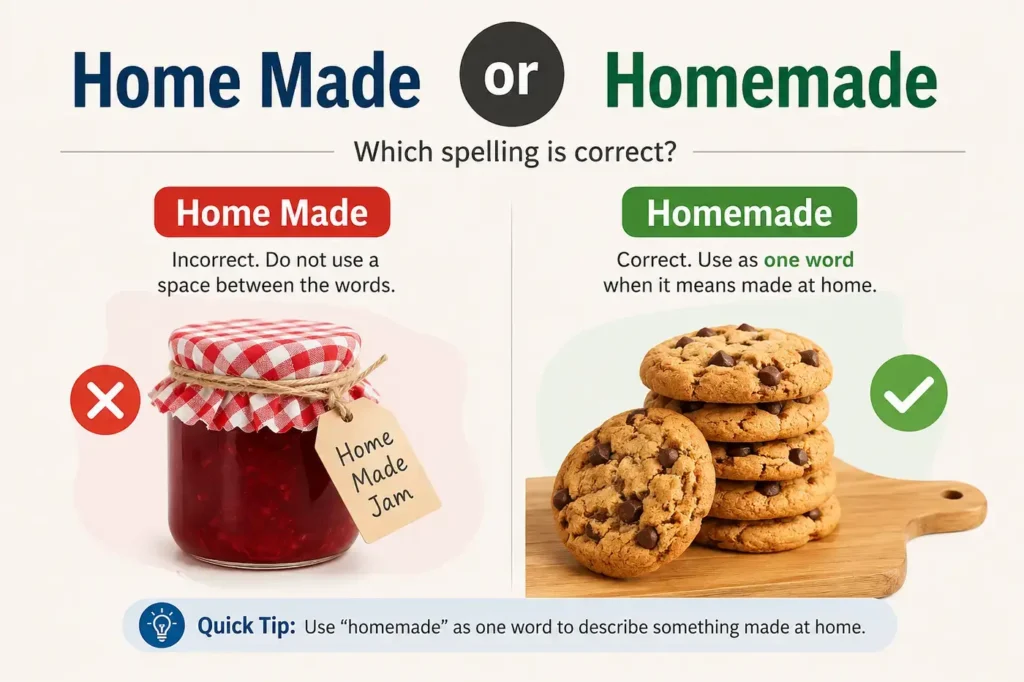
If you have ever wondered home made or homemade is the correct spelling, you have probably seen both forms in real writing. A recipe may say homemade cookies while an old sign or informal post may use home made food. That makes the difference look more complicated than it really is.
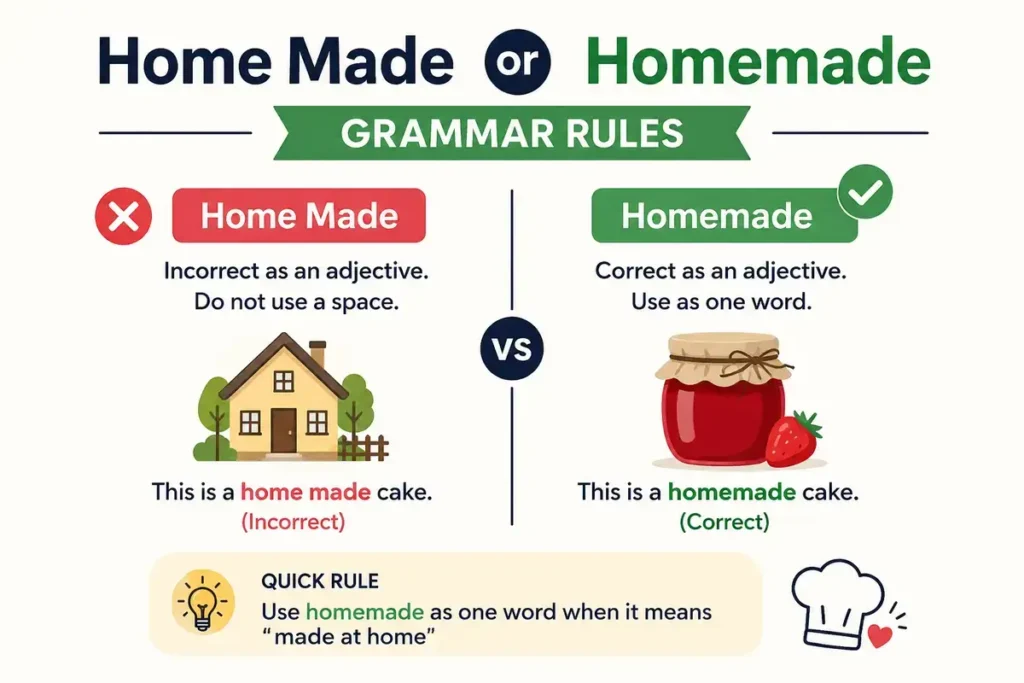
In modern standard English, homemade is usually the correct and preferred spelling when the word works as an adjective before a noun or describes something made at home. For example, homemade bread, homemade soap, and homemade gifts are standard forms. The two word form home made can still appear in some contexts when the writer wants to emphasize the separate ideas of home and made, but it is much less common in ordinary modern usage.
The confusion often comes from compound words. English frequently combines two words into one over time, and spelling conventions can change as usage develops. This guide explains the difference clearly so you can choose the right form in recipes, school writing, business content, product descriptions, and everyday conversation. You will learn the meaning, grammar, pronunciation, history, regional usage, common mistakes, and practical rules native speakers actually follow.
Quick Definition
Homemade is the standard one word form used for something made at home rather than bought ready made from a store or factory. Home made can appear as two separate words in limited contexts, but it is not the usual spelling for the common adjective. For most everyday writing, use homemade.
Quick Answer
Use homemade as one word in most situations.
- Homemade cookies is the standard form.
- Homemade food is the standard form.
- Homemade gifts is the standard form.
- Home made may appear in older writing or special constructions but is not the usual modern choice.
If you are describing something created at home, homemade is generally the form you want.
Comparison Table
| Feature | Homemade | Home made |
|---|---|---|
| Part of speech | Usually adjective | Separate adjective and verb in special contexts |
| Standard form | Yes | Limited use |
| Meaning | Made at home | Made at home when the words function separately |
| Origin | Compound form developed from home plus made | Original two word construction |
| Formality | Standard | Less common in ordinary modern usage |
| Common contexts | Food crafts gifts products recipes | Emphasis or unusual sentence structures |
| Usage frequency | Very common | Much less common |
| Example | She baked homemade bread. | The furniture was home made by the owner. |
| Preferred modern spelling | Yes | Usually no |
The table gives the practical answer, but grammar explains why the one word form has become so dominant. English compounds often begin as separate words, develop into hyphenated forms, and eventually become closed compounds written as one word. Homemade has largely followed that pattern.
If you’re trying to improve your spelling overall, understanding the rules for writing a sentence correctly can help you avoid many common writing mistakes beyond compound words.
Meaning Of Both Forms
The two forms are closely related because they come from the same basic idea. Something is made at home rather than produced commercially or bought ready made. The difference mainly concerns spelling, word formation, and sentence structure.
What Homemade Means
Homemade means made at home, usually by an individual rather than by a commercial manufacturer. It often suggests personal effort, small scale production, traditional methods, or a personal touch.
For example, homemade food is prepared in a home kitchen. Homemade decorations are created at home. Homemade gifts are made by the person giving them.
The word can describe many things.
- Homemade bread.
- Homemade soup.
- Homemade candles.
- Homemade cards.
- Homemade furniture.
- Homemade toys.
- Homemade skincare products.
- Homemade decorations.
The meaning does not always require that every stage of production happen inside a house. A person may prepare something at home using ingredients or materials bought from a store. The important idea is that the item was personally made rather than purchased as a finished commercial product.
What Home Made Means
The two word form home made expresses the same basic idea in a less common grammatical structure. In modern everyday English, most writers would replace it with homemade when they are using the phrase as a normal adjective.
For example, this is the natural modern form:
She served homemade pie.
The two word version can sometimes appear when the writer is deliberately treating home and made as separate elements. However, those situations are uncommon in ordinary writing.
This is why experienced editors usually change home made to homemade when the intended meaning is simply something made at home.
Key Differences
The main difference is not meaning. It is how English speakers normally write the compound adjective.
Homemade is a closed compound. The two original words have joined together to create one established adjective. The word now behaves like other familiar compounds such as handmade, homgrown, and household.
The two word form can still be understood, but it does not match the standard spelling most readers expect.
Here are the most important differences.
- Homemade is the standard modern spelling.
- Home made is much less common as a normal adjective.
- Both forms relate to something produced at home.
- The one word form sounds more natural in recipes, articles, product descriptions, and everyday writing.
- The difference is mainly orthographic and grammatical rather than semantic.
Meaning Difference
In ordinary use, there is little or no difference in meaning. A homemade cake and a home made cake would generally refer to the same type of cake.
The difference is similar to other compound word questions. Readers usually understand the meaning from context, but standard spelling still matters in polished writing.
Tone Difference
Homemade often sounds warm, personal, and familiar. It can suggest care, tradition, comfort, and individual effort.
Consider these examples.
Homemade apple pie filled the kitchen with a warm cinnamon smell.
The restaurant promoted its homemade pasta.
The word carries a personal feeling that commercial, factory made, or mass produced often does not.
Grammar Difference
The standard adjective is written as one word.
She sells homemade candles.
The phrase home made can be analyzed as separate words, but that structure is not the normal choice when the intended meaning is the established adjective.
Regional Difference
English speaking regions generally recognize homemade as the standard form. American English, British English, Australian English, and Canadian English all commonly use the one word spelling.
Regional differences may appear in style preferences and dictionaries, but the basic spelling is remarkably consistent.
Context Difference
The one word form works naturally in almost every common context.
You will see it in:
- Recipes.
- Food blogs.
- Product descriptions.
- Advertising.
- School assignments.
- Personal writing.
- News articles.
- Social media posts.
The two word form is far less likely to be the best choice in these contexts.
Which One Is Correct
Homemade is the correct standard form for most modern English writing. Use it when you mean something made at home.
Examples include:
- Homemade food.
- Homemade bread.
- Homemade gifts.
- Homemade decorations.
- Homemade products.
The two word spelling is not usually the best choice for the common adjective. If you are proofreading an article or writing a sentence such as I love home made cookies, an editor would normally change it to I love homemade cookies.
There is one important point to remember. English contains many compounds whose spelling depends on how the words function in a sentence. A phrase may be written as one word in one context and as separate words in another. That is why it is better to understand the grammar than to rely on a simple rule that every combination of words must always be joined.
For ordinary descriptions of things created at home, though, the practical answer is clear.
Use homemade.
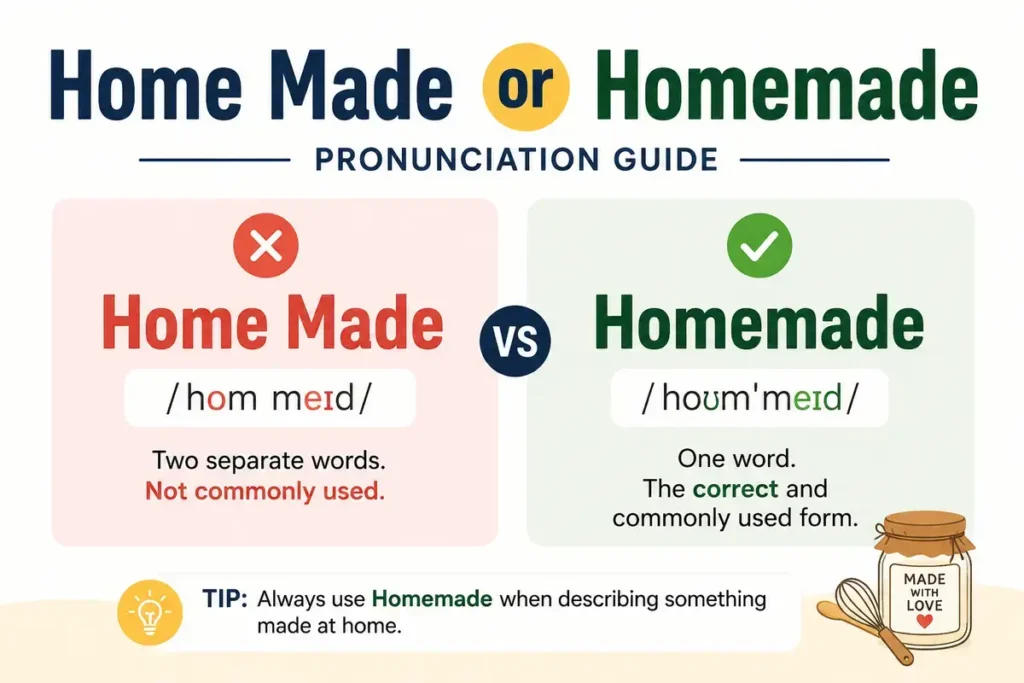
Pronunciation Guide
The standard word has two syllables.
IPA Pronunciation
Homemade
/ˌhoʊmˈmeɪd/
Syllable Breakdown
Home made
The word is pronounced as two syllables even though it is written as one word. The first part sounds like home. The second part sounds like made.
Common Pronunciation Mistakes
Most speakers pronounce the word correctly because both parts are familiar. Learners may occasionally place too much stress on the first syllable or pronounce the word as if it had three syllables.
The natural pronunciation is simple.
home made
The spelling does not change the pronunciation. The one word form and the less common two word form are generally understood in the same way when spoken.
How To Remember The Correct Spelling
The easiest memory trick is to think of homemade as an established adjective rather than as a temporary phrase.
When the word directly describes a noun, write it as one word.
- Homemade bread.
- Homemade soup.
- Homemade toys.
- Homemade candles.
- Homemade decorations.
A useful comparison is handmade. You would normally write handmade jewelry as one word because the word has become an established adjective. Homemade follows the same pattern.
Another helpful test is to ask what you are trying to say. If your meaning is simply made at home, the one word adjective is almost always the natural choice.
That rule will guide you correctly in most everyday situations.
English contains many words that cause similar spelling confusion, such as the correct spelling of whiny, making it worthwhile to learn the patterns behind these differences.
Examples In Sentences
The best way to understand a compound adjective is to see how native speakers use it naturally. In ordinary writing, the one word form appears before nouns and also after linking verbs when the writer describes something created at home.
Examples With Homemade
- We served homemade bread with dinner.
- My grandmother makes homemade jam every summer.
- The children prepared homemade cards for their parents.
- She brought homemade cookies to the office.
- The restaurant is known for its homemade pasta.
- He gave me a jar of homemade salsa.
- They decorated the house with homemade ornaments.
- I prefer homemade soup on a cold evening.
- The students sold homemade crafts at the school fair.
- She created a homemade gift for her friend.
These examples show the word functioning naturally as an adjective. It describes food, gifts, crafts, and other items made at home.
Examples With Home Made
The two word form is much less common as the ordinary adjective. You may still encounter it in older writing, unusual constructions, or situations where the writer is treating the words separately.
- The sign described the furniture as home made.
- The old catalog advertised home made goods.
- The phrase appeared as home made in the historical document.
- The article preserved the original wording home made.
- The museum displayed a sign that read home made products.
- The writer used home made as two separate words in an older passage.
- The label featured the words home made in its original design.
- The editor changed home made to homemade during revision.
- The teacher explained why homemade is now more common.
- The search results showed both home made and homemade.
In modern writing, most of these examples would sound more natural with homemade written as one word. The two word form is worth understanding mainly because readers may encounter it in older material, informal writing, or historical text.
Common Mistakes
The most frequent error is writing the phrase as two words simply because the meaning appears to contain two separate ideas. English does not always preserve the original spacing of compound expressions. Over time, commonly used combinations often become established as single words.
Writing Home Made Food
The standard modern form is:
Homemade food.
The phrase home made food is understandable, but it looks less polished and is not the usual spelling in contemporary English.
Confusing Homemade With Home Cooked
These words are related but not identical.
Homemade means made at home. It can describe food, crafts, furniture, decorations, and many other things.
Home cooked usually describes food prepared at home, often emphasizing the cooking process and the comforting quality of a meal.
For example:
I bought a homemade candle.
You would not normally say home cooked candle because cooking is not involved.
Likewise:
The restaurant serves home cooked meals.
This phrase focuses specifically on cooking rather than the broader idea of something being made at home.
Using A Hyphen Incorrectly
Some writers use home-made because they have seen older spelling conventions or British publications that once used hyphenated compounds more frequently.
Modern English generally prefers homemade as one word. However, historical texts and individual style guides may preserve older forms.
The key point is consistency. Do not switch randomly between homemade, home-made, and home made in the same piece of writing.
Assuming Home Made Is Always Wrong
The situation is slightly more nuanced than simply saying the two word form can never appear.
English compounds can vary according to context, historical period, regional style, and editorial convention. A historical document may use home made. A brand may intentionally use Home Made as part of its name. A quotation may preserve the original spelling.
However, those special cases do not change the practical rule for ordinary modern writing.
Internet Confusion
Search engines display all kinds of spelling variations. A phrase may appear online because of:
- User generated content.
- Older publications.
- Product names.
- Search queries.
- Regional preferences.
- Typographical errors.
Seeing a spelling online does not automatically make it the preferred standard form. Professional writing requires attention to established usage and context.
Etymology And Word Origin
The word developed from the combination of home and made.
Home comes from Old English hām, referring to a dwelling, household, or place where a person lives. The word has deep Germanic roots and is related to similar terms in other Germanic languages.
Made is the past participle of make, a very old English verb with Germanic origins. The verb has long carried the meaning of creating, producing, preparing, or constructing something.
When the two ideas were combined, English speakers began using the expression to describe objects created at home rather than commercially manufactured goods.
Like many English compounds, the spelling changed over time. A phrase can begin as two separate words, become hyphenated, and eventually develop into a closed compound written as one word.
The modern form homemade reflects this process.
The same pattern appears in many familiar compounds.
- Handmade.
- Homemade.
- Household.
- Homework.
- Homemade.
Not every compound follows exactly the same historical path, but frequent use often encourages shorter and more unified spellings.
Regional Usage
The standard form is remarkably consistent across major English varieties.
American English
American English strongly prefers homemade as one word.
You will see it in:
- Recipe websites.
- Food packaging.
- Newspapers.
- School materials.
- Advertising.
- Everyday conversation.
American writers also commonly use home cooked when specifically describing meals prepared at home.
British English
British English also commonly uses homemade.
Older British writing may contain home-made with a hyphen, especially in historical publications or older editorial styles. Modern usage generally favors the closed compound.
The spelling home made as two separate words is not the normal modern choice for the adjective.
Australian English
Australian English generally follows the same modern pattern.
Homemade is the usual spelling in contemporary writing, while older or specialized sources may show different compound conventions.
Canadian English
Canadian English also commonly uses homemade.
Spelling sometimes combines features associated with British and American English, but this particular compound is generally written as one word. Across all four varieties, the safest modern choice is the same.
Homemade.
Grammar Rules
Understanding how the word behaves grammatically makes the spelling easier to remember.
Part Of Speech
The word is primarily an adjective. It modifies a noun by explaining that something was made at home.
Examples include:
- Homemade bread.
- Homemade furniture.
- Homemade decorations.
- Homemade medicine.
Before A Noun
This is the most common structure.
- She brought homemade cookies.
- We bought homemade soap at the market.
The adjective appears directly before the noun it describes.
After A Linking Verb
The word can also appear after verbs such as be, seem, and look.
Examples include:
- The bread is homemade.
- The decorations look homemade.
- The sauce seems homemade.
In these sentences, the adjective describes the subject rather than appearing directly before a noun.
Plural Forms
The word does not change when the noun becomes plural.
You write:
- Homemade cookie.
- Homemade cookies.
The adjective remains exactly the same.
Comparative And Superlative Forms
Native speakers do not usually compare the word directly with more homemade or most homemade in ordinary writing. Instead, they often use a different structure.
For example:
This recipe tastes more homemade than the packaged version.
This is understandable because the word is being used as a descriptive quality. However, the naturalness of the comparison depends on context.
Common Structures
Some common phrases include:
- Homemade food.
- Homemade recipe.
- Homemade bread.
- Homemade meal.
- Homemade product.
- Homemade gift.
- Homemade solution.
- Homemade version.
These combinations are common because they clearly communicate personal creation rather than commercial production.
Real Life Usage Examples
The word appears across everyday life, education, business, food culture, and creative work.
Daily Conversation
People often use the word when talking about food and personal projects.
My aunt brought homemade pie to the family dinner.
I made a homemade birthday card for my sister.
The word often carries a warm emotional meaning. It can suggest care, effort, tradition, and personal involvement.
Homemade Food Meaning
The phrase homemade food generally means food prepared at home rather than purchased as a finished meal from a restaurant, store, or factory.
The phrase can describe:
- Bread.
- Soup.
- Cakes.
- Cookies.
- Sauces.
- Jam.
- Pasta.
- Pickles.
The ingredients do not need to be grown at home. Someone can buy flour, vegetables, spices, or other ingredients from a store and still make the finished food at home.
That distinction matters. Homemade describes where and how the finished item was prepared. It does not necessarily mean every ingredient was produced by the person who made it.
Homemade Or Home Cooked
These phrases overlap but have slightly different emphasis.
Homemade is broader. It can describe anything made at home.
Home cooked is specifically associated with food prepared through cooking.
For example:
I bought a homemade wooden table.
The phrase home cooked wooden table would make no sense.
On the other hand:
The restaurant serves home cooked meals.
This wording emphasizes the style and process of cooking.
Academic Writing
Academic writers may use the word when discussing food production, consumer behavior, economics, sociology, nutrition, or cultural traditions.
For example:
The study examined how homemade meals influenced household food habits.
In academic writing, the word should be used precisely. If the research concerns food prepared in a private kitchen, homemade may be appropriate. If the research concerns the nutritional value of meals prepared by a person at home, home cooked may communicate the idea more specifically.
Professional Communication
Businesses use the word in marketing, food services, hospitality, retail, and craft industries.
Examples include:
Our bakery specializes in homemade pies.
The company sells homemade style products.
The second example requires careful attention. Homemade style can mean something designed to resemble products made at home, even if the item was actually produced commercially.
That distinction is important in professional communication. A product description should not imply personal home production if the product was made in a factory.
Literature
Writers often use the word to create a sense of comfort and familiarity. A description of homemade bread may suggest family tradition. Homemade clothing may suggest resourcefulness. A homemade gift may reveal affection or personal effort.
The word can therefore carry emotional meaning beyond its dictionary definition.
Media And Advertising
Food shows, recipe videos, social media posts, and advertising frequently use the word because it creates an immediate association with freshness and personal care.
That does not mean every product described as homemade was literally made in a private home. In advertising, the word may sometimes be used more loosely, so readers should consider the context.
Related Words And Confused Terms
The word homemade belongs to a larger group of terms describing how something is produced, prepared, or created. Understanding these related expressions can help you choose the most precise word instead of treating every similar phrase as interchangeable.
Homemade And Handmade
Homemade means made at home. Handmade means made by hand rather than entirely by automated machinery.
The two ideas can overlap.
A person may make a handmade wooden bowl at home. That bowl could accurately be described as both handmade and homemade.
However, the words emphasize different things.
- Homemade focuses on the place or setting of production.
- Handmade focuses on the method of production.
- Handcrafted often suggests skilled artistic or traditional work.
- Hand built emphasizes construction by hand.
- Artisanal often suggests small scale production and specialized craftsmanship.
These distinctions matter in product descriptions and marketing because each word creates a slightly different image in the reader’s mind.
Homemade And Home Cooked
These expressions are closely related but not identical.
Homemade can describe food and nonfood items.
Home cooked specifically describes food that has been cooked at home.
You can have homemade candles, homemade furniture, and homemade gifts. You can also have home cooked soup, home cooked meals, and home cooked dinners.
The broader term describes the origin of an item. The narrower term focuses on cooking.
Homemade And Store Bought
These expressions represent opposite sides of a common comparison.
Homemade means prepared or created at home.
Store bought means purchased from a store as a finished product.
For example:
I prefer homemade bread to store bought bread.
The comparison is common in conversations about food, cost, quality, convenience, and personal preferences.
Homemade And Factory Made
Factory made emphasizes large scale commercial production.
The contrast is particularly useful in manufacturing and consumer discussions.
For example:
The homemade version required more time, while the factory made version was cheaper and easier to find.
This comparison does not automatically mean one option is better. It simply describes how the items were produced.
Homemade And DIY
DIY stands for do it yourself.
The term refers to making, repairing, modifying, or building something without hiring a professional to do the work.
A DIY project can be homemade, but the words are not identical.
For example, someone might complete a DIY project in a workshop rather than at home. Likewise, something homemade may not be described as DIY if the person simply prepared food or made a gift.
Semantic Relationships
From a semantic SEO perspective, the topic connects to several related concepts.
These include:
- Made at home.
- Prepared at home.
- Home cooking.
- Personal creation.
- Handmade goods.
- DIY projects.
- Fresh food.
- Traditional recipes.
- Small batch production.
- Artisan products.
- Store bought goods.
- Commercial production.
These related concepts help explain the meaning naturally without repeating the same phrase again and again.
The same spelling principles appear in other words too—for example, why suing drops the “e” follows an important rule that often surprises English learners.
Expert Language Insight
The strongest editorial advice is simple. Do not treat every two word phrase as a spelling problem. First determine how English speakers actually use the expression.
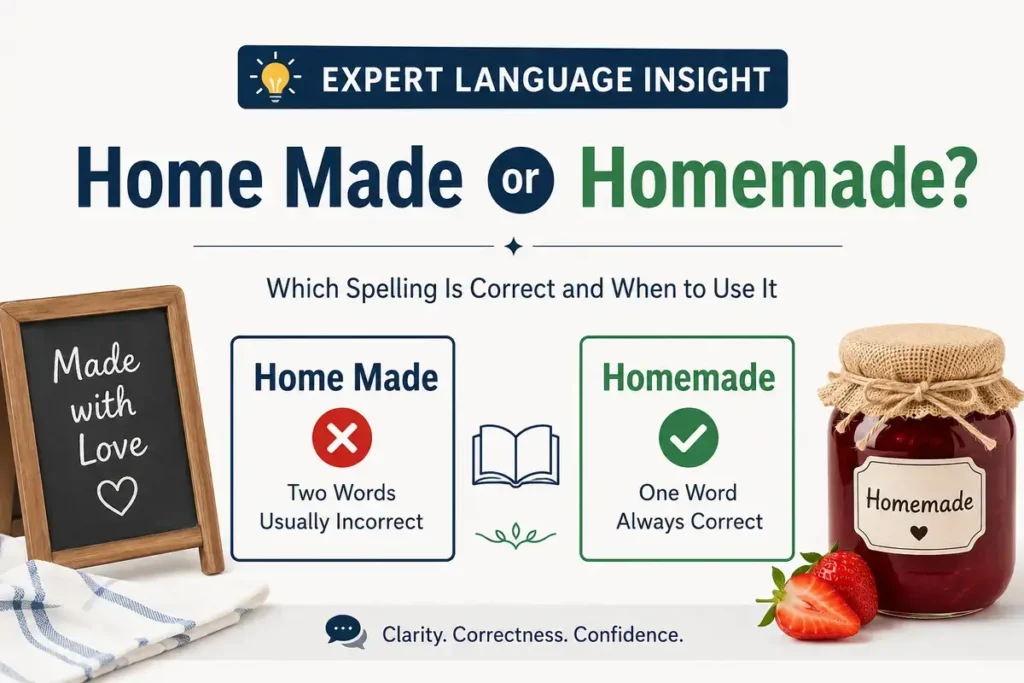
Homemade has become an established closed compound. That is why it looks and feels natural to modern readers. When a writer uses home made in an ordinary sentence such as She baked home made cookies, most editors will change it to homemade cookies.
The same principle applies to many compound words. English spelling is shaped by long term usage, dictionaries, publishing conventions, and reader expectations. A form that seems logically possible is not always the form native speakers prefer.
There is also an important distinction between standard language and names. A business may call itself Home Made Bakery. A product may be branded Home Made. A historical document may preserve the two word spelling. In those cases, the original name or source should be respected.
For normal writing, however, consistency matters more than creativity. If you are describing food, gifts, crafts, or products created at home, choose the established one word form.
A practical editor’s test is this.
- If the phrase describes something created at home, use homemade.
- If you are reproducing an official name, preserve its exact spelling.
- If you are quoting historical material, keep the original form when accuracy requires it.
- If you are unsure, check the surrounding sentence and ask if the word is functioning as a standard adjective.
This approach is more reliable than memorizing isolated spelling rules.
Frequently Asked Questions
Is home made or homemade correct?
Homemade is the standard modern spelling in most situations. Use it when describing something made at home, such as homemade bread, homemade gifts, or homemade food. The two word form may appear in older writing, historical sources, or official names, but it is not the usual choice for ordinary modern English.
What is the meaning of homemade?
Homemade means made or prepared at home rather than purchased as a finished commercial product. The word can describe food, crafts, furniture, gifts, decorations, and many other things. It often suggests personal effort, small scale production, and a connection to home preparation.
What is the meaning of homemade food?
Homemade food means food prepared at home instead of being purchased as a finished meal or commercially manufactured product. The ingredients can come from a grocery store. The important point is that the finished food was prepared in a home setting.
Is homemade the same as home cooked?
Not exactly. Homemade is a broader term that can describe food and nonfood items made at home. Home cooked specifically refers to food prepared through cooking at home. Homemade bread and homemade candles are both possible, but only the bread could normally be described as home cooked.
What is a synonym for homemade?
Depending on the context, possible synonyms include made at home, home produced, handmade, handcrafted, self made, and do it yourself. These words are not always exact replacements. Handmade focuses on the method, while homemade focuses on the place where something was made.
How do you use homemade in a sentence?
You can use the word before a noun or after a linking verb. For example, She brought homemade cookies to the party uses it before a noun. The soup is homemade uses it after a linking verb. In both sentences, the word describes something prepared at home.
Should I write home made food or homemade food?
Use homemade food in standard modern English. The one word form is the natural choice for describing food prepared at home. The two word version is understandable, but it is less common and generally looks less polished in contemporary writing.
Is homemade one word or two words?
In modern standard English, homemade is normally written as one word. It is an established compound adjective. Older sources, historical writing, and certain names may use home made or home-made, but the closed form is the preferred choice for ordinary contemporary writing.
Conclusion
The answer is clear. Homemade is the standard modern spelling when you mean something made or prepared at home. It is the natural choice for homemade food, homemade gifts, homemade crafts, homemade furniture, and countless other examples.
The two word form home made may still appear in older material, historical documents, official names, or unusual constructions. However, it is not the form most writers should choose in ordinary modern English.
The distinction between homemade and home cooked is also worth remembering. The first can describe almost anything created at home. The second specifically describes food prepared through cooking.
If you are writing a recipe, school assignment, product description, blog post, email, or everyday message, use homemade as one word. It is clear, familiar, and immediately understood by English speakers across major English speaking regions. The best rule is the simplest one. If you mean made at home, write homemade.