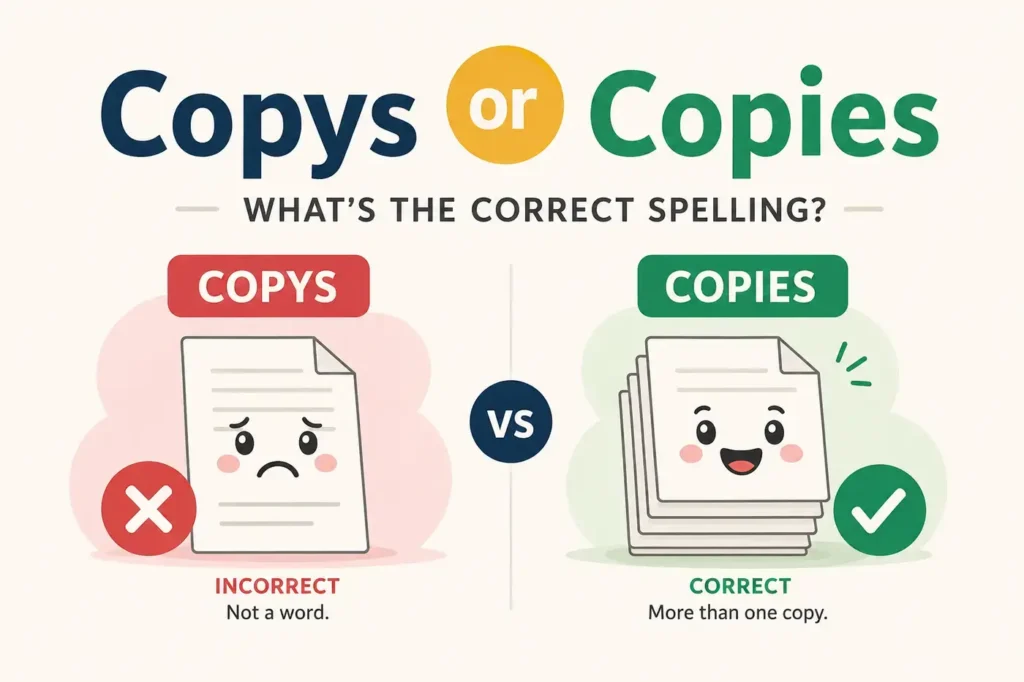
If you have ever written copys or copies and paused to check which form is correct, the answer is straightforward. Copies is the correct standard English spelling. Copys is generally incorrect when you mean more than one copy.
The confusion usually comes from a basic English spelling rule. Many nouns form their plural by adding s, but words ending in a consonant followed by y usually change the y to ies. Since copy ends in a consonant plus y, its plural becomes copies.
This small spelling difference matters in school assignments, business emails, document management, publishing, copywriting, and everyday conversation. It also creates common questions about phrases such as copy or copies of documents, copy or copies in copywriting, and how to write 2 copy or 2 copies correctly.
This guide explains the difference clearly and thoroughly. You will learn the correct plural form, the grammar rule behind it, how to use each form in a sentence, how the word functions as a noun and verb, and why the incorrect spelling appears so often online. You will also see practical examples that make the rule easy to remember.
Quick Definition
Copies is the correct plural form of copy. Use copy for one item and copies for two or more. Copys is not the standard plural spelling. The y changes to ies because copy ends in a consonant followed by y. For example, one copy becomes two copies.
Quick Answer
The correct spelling is copies.
Use:
- Copy for one item.
- Copies for more than one.
- Copied for the past tense.
- Copying for the present participle or gerund.
Examples:
- I need one copy of the report.
- I need two copies of the report.
- She copied the document yesterday.
- He is copying the files now.
The form copys is generally a spelling error. The plural follows the common English rule that changes a final consonant plus y into ies.
If you enjoy learning about commonly confused spellings, you’ll also find similar spelling mistakes in English helpful, especially words like suing and sueing that often trip up writers.
Comparison Table
| Feature | Copy | Copies | Copys |
|---|---|---|---|
| Part of speech | Noun or verb | Plural noun or verb | Nonstandard spelling |
| Meaning | One reproduction or the act of reproducing | More than one reproduction | Usually intended to mean copies |
| Correct form | Yes | Yes | No in standard English |
| Origin | From Latin and French roots | Plural form of copy | Incorrect formation |
| Formality level | Standard | Standard | Nonstandard |
| Common contexts | Documents writing advertising files | Multiple documents or reproductions | Informal mistakes and online typing |
| Usage frequency | Very common | Very common | Uncommon in edited writing |
| Example | I need a copy. | I need three copies. | Incorrect: I need three copys. |
The key difference is grammatical number. Copy refers to one item when used as a countable noun. Copies refers to more than one. The spelling does not simply add s because English spelling rules change the final y to ies in this pattern.
Meaning Of Both Terms
Understanding the meaning of the singular and plural forms makes the spelling rule easier to apply.
What Copy Means
As a noun, copy usually means an individual reproduction of something. It can refer to a document, book, file, image, recording, or another version of an original.
For example, you might ask for a copy of a contract, save a copy of a file, or buy a copy of a book. The word can also refer to written material created for advertising or marketing. In that context, copy means the words used in an advertisement, website, brochure, email, or other promotional material.
As a verb, copy means to reproduce something or make something similar to an original. You can copy a document, copy text, copy a file, or copy someone’s method.
The word therefore has several connected meanings:
- One reproduction of an original.
- Written material used in publishing or advertising.
- The act of reproducing information.
- The act of imitating something.
The exact meaning comes from the context.
What Copies Means
Copies has two main grammatical uses. First, it is the plural noun form of copy. In this use, it means more than one copy.
For example:
- I printed five copies of the contract.
- The library ordered new copies of the book.
- Please send copies of your identification documents.
Second, copies can be the third person singular present tense of the verb copy.
For example:
- She copies the information into her notebook.
- The software copies the files automatically.
- He copies the format used in the original document.
This distinction matters because the same spelling can function as either a plural noun or a verb.
Key Differences
The main difference between copy and copies is number and grammar. Copy usually refers to one item or describes the basic action of reproducing something. Copies can refer to several items or describe what one person or thing does in the present tense.
Consider these examples:
- I need a copy of the invoice.
This means one invoice reproduction.
- I need copies of the invoices.
This means more than one reproduction. Now look at the verb:
- I copy the information every morning.
The subject is I, so the base verb copy is used.
- She copies the information every morning.
The subject is she, so the verb changes to copies. The spelling looks similar in both situations, but the grammar is different.
Meaning Differences
The singular form refers to one reproduction or the base action. The plural form refers to multiple reproductions or the action performed by a singular third person subject.
Tone Differences
There is no meaningful difference in tone. Both forms are ordinary English words. The choice depends on number and sentence structure rather than formality.
Grammar Differences
Copy can be:
- A singular countable noun.
- A base form verb.
- Part of a compound noun such as copy editor or copywriter.
Copies can be:
- A plural noun.
- A third person singular present tense verb.
Context Differences
The surrounding words usually make the correct form clear. Use the plural noun when several items exist.
The office needs ten copies of the proposal.
Use the third person singular verb when one person or thing performs the action.
The printer copies both sides of the page.
Which Form Is Correct
Copies is the correct plural form of copy. The spelling copys does not follow standard English plural rules.
The reason is simple. When a singular noun ends in a consonant followed by y, the usual plural formation changes the y to ies.
Examples include:
- Baby becomes babies.
- City becomes cities.
- Story becomes stories.
- Company becomes companies.
- Copy becomes copies.
The same pattern appears in many common words. Once you recognize the spelling pattern, the correct form becomes much easier to remember.
There is one important detail. Words ending in a vowel followed by y usually add s instead.
For example:
- Boy becomes boys.
- Day becomes days.
- Key becomes keys.
- Toy becomes toys.
The difference is the letter immediately before the y.
In copy, the letter before y is p, a consonant. Therefore, the plural becomes copies.
Pronunciation Guide
The singular and plural forms have different pronunciations.
Copy
IPA pronunciation:
/ˈkɑːpi/ in many American English pronunciations.
Syllable breakdown:
cop y
The first syllable receives the main stress.
Copies
IPA pronunciation:
/ˈkɑːpiz/ in many American English pronunciations.
Syllable breakdown:
cop ies
The plural ending adds an extra syllable.
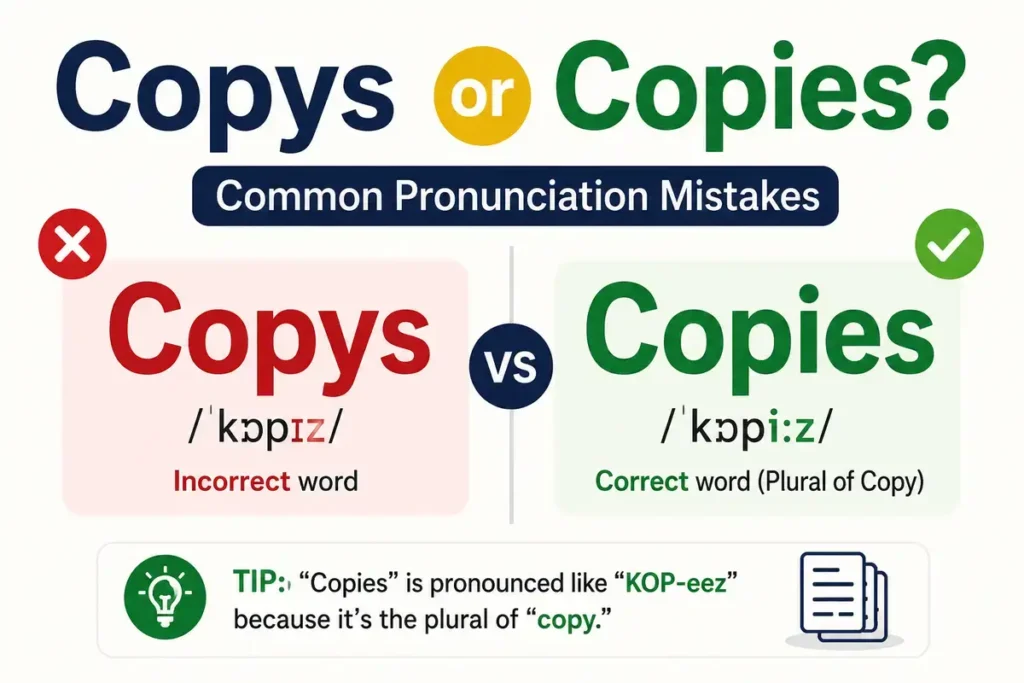
Common Pronunciation Mistakes
Learners sometimes pronounce the plural as if it were spelled copy s with a separate s sound. Native speakers generally pronounce the ending as eez.
The difference is easy to hear:
- Copy sounds like KAH pee.
- Copies sounds like KAH peez.
The spelling changes from y to ies, and the pronunciation adds the plural sound at the end.
How To Remember The Correct Spelling
The easiest memory trick is to look at the letter before the final y.
In copy, the final y comes after p, which is a consonant. When a word ends in a consonant plus y, the plural usually changes the ending to ies.
Remember this pattern:
Consonant plus y becomes ies.
Examples:
- Copy becomes copies.
- Puppy becomes puppies.
- Country becomes countries.
- Family becomes families.
- Library becomes libraries.
You can also remember the practical rule by asking how many items you mean. If you mean one, use copy. If you mean two or more, use copies.
For example:
- One copy.
- Two copies.
- Three copies.
- Several copies.
- Many copies.
This rule works in everyday writing, business communication, school assignments, publishing, and document management.
A useful editing habit is to read the entire phrase rather than focusing only on the word itself. Two copies sounds natural because the number tells you that the noun must be plural. Two copys looks wrong because the spelling does not match the standard plural pattern.
Examples In Sentences
The difference becomes much easier to understand when you see the word used in real sentences. The correct form depends on the number of items you mean and the grammatical role of the word in the sentence.
Examples With Copy
- I need a copy of the signed agreement for my records.
- Please make a copy of this page before you leave.
- She saved a copy of the presentation on her computer.
- I read a copy of the report before the meeting.
- The editor asked for a copy of the manuscript.
- Can you send me a copy of the receipt?
- I will copy the information into the new document.
- Please copy the address exactly as it appears.
- The designer created a copy of the original file.
- The writer used clear copy to explain the product.
These examples show the two main uses of the singular form. It can describe one reproduction or the action of reproducing information.
Examples With Copies
- I printed three copies of the contract for the meeting.
- The teacher handed out copies of the worksheet.
- Please send copies of the required documents.
- The library ordered several copies of the new book.
- We kept copies of all important records.
- She copies the data into the spreadsheet every morning.
- The machine copies both sides of the page automatically.
- He copies the design carefully before making changes.
- The office needs two copies of each form.
- The software copies the files to a secure location.
The first five examples use copies as a plural noun. The last five use it as a verb for a singular subject such as she, he, or the software.
The same spelling principles apply when deciding whether compound words should be joined, such as choosing between home made and homemade.
Common Mistakes
The most common mistake is writing copys as the plural of copy. This happens because many English nouns form their plural by adding s. However, words ending in a consonant followed by y usually follow a different pattern.
Writing Copys Instead Of Copies
Incorrect:
I need five copys of the report.
Correct:
I need five copies of the report.
The final y changes to ies.
Confusing Copy And Copies
The number of items determines the noun form.
Incorrect:
I need two copy of the invoice.
Correct:
I need two copies of the invoice.
Incorrect:
I need one copies of the invoice.
Correct:
I need one copy of the invoice.
The same rule applies to phrases such as copy or copies of documents. One document reproduction is a copy of a document. More than one is copies of documents or copies of a document, depending on the meaning.
Confusing The Noun And Verb
The word can function as both a noun and a verb.
- I need a copy of the file.
Here, copy is a noun.
- I will copy the file.
Copy is a verb.
- She copies the file every evening.
Here, copies is a present tense verb because the subject is she. This is one reason the same spelling can appear in different grammatical situations.
Using The Wrong Form After A Number
Numbers provide a quick clue. Use the singular form after one.
One copy.
Use the plural form after numbers greater than one.
- Two copies.
- Ten copies.
- Several copies.
- Many copies.
The phrase 2 copy is incorrect when you mean two reproductions. The correct form is 2 copies. In normal prose, however, many professional style guides prefer spelling out small numbers. Two copies usually looks more natural than 2 copies in a sentence.
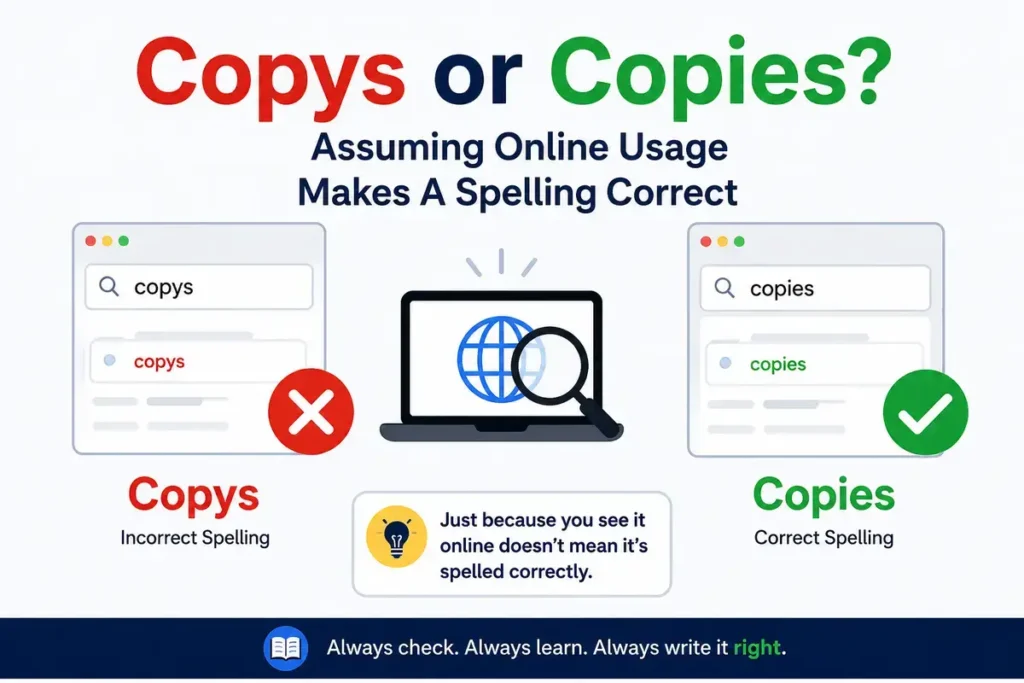
Assuming Online Usage Makes A Spelling Correct
People often see copys online and assume it must be an accepted variant. Internet writing contains many typos, rushed messages, user generated content, and informal shortcuts.
Frequency alone does not determine standard spelling.
Edited books, professional publications, academic writing, and reputable dictionaries provide stronger evidence of accepted usage.
Etymology And Word Origin
The word copy has a long history in English and is closely connected to writing, manuscripts, and reproduction.
It entered English through Anglo French and Old French from the Latin word copia, which originally meant abundance or plenty. Over time, the word developed a meaning connected to a written reproduction or transcript.
This connection makes sense in historical context. Before modern printing and digital technology, people reproduced books and documents by handwriting them. A written duplicate was therefore a copy of the original.
As printing developed, the word became increasingly associated with reproduced texts. Later, its meaning expanded further.
Today, a copy can refer to:
- A printed document.
- A digital file.
- A reproduction of an image.
- Written material for advertising.
- A duplicate of information.
- An imitation of an original.
The verb developed alongside the noun. To copy something means to reproduce it or make a similar version.
The plural spelling copies follows the normal English spelling pattern for nouns ending in a consonant plus y. The spelling change is grammatical rather than historical.
Regional Usage
The spelling is consistent across the major varieties of English. Unlike words such as color and colour, there is no significant American and British spelling difference here.
American English
American English uses copy for one item and copies for more than one.
Examples include:
- A copy of the report.
- Three copies of the report.
- The company copies the data.
The same forms appear in education, publishing, business, advertising, and technology.
British English
British English follows the same spelling rule. A British writer would use:
I need two copies of the contract.
The plural is not written as copys.
Australian English
Australian English also uses copies as the standard plural form. The grammar and spelling pattern remains the same.
Canadian English
Canadian English follows the same rule as American and British English in this case. Across these varieties, the standard form remains consistent. The difference is not regional. It is grammatical.
Grammar Rules
Understanding the grammar behind the word helps prevent mistakes in more complex sentences.
Copy As A Singular Countable Noun
When referring to one reproduction, use a singular determiner or number.
Examples:
- A copy.
- One copy.
- This copy.
- My copy.
- The copy.
Example:
I saved a copy of the file.
Copies As A Plural Countable Noun
When referring to more than one reproduction, use the plural form.
Examples:
- Two copies.
- Several copies.
- Many copies.
- These copies.
- The copies.
Example:
The manager requested copies of the invoices.
Copy As A Base Verb
The base form appears after subjects such as I, you, we, and they.
Examples:
- I copy the information.
- You copy the file.
- We copy the records.
- They copy the data.
The base form also follows modal verbs.
Examples:
- You should copy the document.
- We can copy the files.
- They might copy the design.
Copies As A Third Person Singular Verb
Use copies with he, she, it, and singular nouns in the simple present tense.
Examples:
- She copies the notes.
- He copies the files.
- The machine copies the pages.
- The program copies the data.
The spelling changes because the verb follows the same consonant plus y pattern.
Past Tense
The past tense is copied.
Examples:
- I copied the document.
- She copied the information.
- They copied the files.
The spelling changes from y to ied because the verb ends in a consonant plus y.
Present Participle
The present participle is copying.
Examples:
- I am copying the file.
- She is copying the notes.
- They are copying the records.
The final y does not change before ing.
Real Life Usage Examples
The word appears in many areas of modern life. Its meaning can shift slightly depending on the field.
Daily Conversation
People often use it when discussing documents, files, photos, and books.
- Can you send me a copy of that photo?
- I made copies for everyone at the meeting.
- I copied the address into my phone.
These uses are simple and common.
Academic Writing
Students and researchers may discuss copies of books, manuscripts, records, or research materials.
Examples include:
- A copy of the original manuscript.
- Digital copies of historical records.
- Copies of the research questionnaire.
Academic writing often requires precise distinctions between an original source and a reproduction.
Professional Communication
Business communication frequently uses the plural form when several people need the same material.
- Please provide copies of the signed agreement to the legal team.
- We need two copies of the final proposal.
- The system copies the files to a backup server.
The correct form helps make instructions clear.
Copywriting
In advertising and marketing, copy has a specialized meaning. It refers to the written words created for promotional communication.
A copywriter may write:
- Website copy.
- Email copy.
- Ad copy.
- Sales copy.
- Product copy.
- Landing page copy.
In this context, copy does not necessarily mean a duplicate. It means persuasive or informative written content.
For example:
- The copy on the landing page needs a stronger opening.
When discussing multiple pieces of written material, the context determines the wording.
- The agency created several versions of the ad copy.
Copy Or Copies Of Documents
This phrase appears frequently in offices, schools, government forms, and legal communication.
- Use a copy of a document when referring to one reproduction.
- Please provide a copy of your passport.
- Use copies of documents when referring to multiple documents or multiple reproductions.
- Please submit copies of the required documents.
- Use two copies of the document when you need two reproductions of one specific document.
- Please bring two copies of the signed agreement.
These distinctions may seem small, but they make instructions more precise.
Digital Files
The same grammar applies to digital content.
Examples include:
- Make a copy of the spreadsheet.
- Save copies of your important files.
- The program copies the folder automatically.
- I copied the text into the new document.
The word does not only refer to paper anymore. It applies equally to digital information.
Publishing
Publishers may discuss copies of books, magazines, newspapers, and manuscripts.
Examples include:
- The publisher printed thousands of copies.
- The author received copies of the finished book.
- The library ordered several copies.
The basic singular and plural distinction remains unchanged.
Media
News organizations and media companies use the word when discussing recordings, files, photographs, and published material.
A journalist might request a copy of a recording. A production team might store multiple copies of important footage. The context changes, but the grammar stays the same.
Understanding British and American spelling differences can also help with words like enrol and enroll, where the correct form depends on the variety of English you’re using.
Related Words And Confused Terms
The word copy appears in several different areas of English, so learners sometimes confuse it with related terms. Some words describe a duplicate. Others describe written content, imitation, or the act of reproducing information.
Understanding these relationships gives you a clearer picture of how the word works in real communication.
Copy And Duplicate
A duplicate is something that is exactly the same as another item or serves as an identical reproduction.
The words can often be used in similar situations.
Please make a copy of the report.
Please make a duplicate of the report.
However, copy is usually more natural in everyday conversation. Duplicate often sounds more technical or formal.
Copy And Reproduction
A reproduction is a copy made to represent or recreate an original. The word often appears in art, publishing, museums, photography, and historical discussions.
For example:
The museum displayed a reproduction of the original painting.
A reproduction may be carefully created to resemble the original, while copy is a broader everyday term.
Copy And Replica
A replica is usually a close physical recreation of an object. You might see replicas of historical buildings, weapons, vehicles, or works of art.
A copy can be a document, file, image, or piece of writing. A replica usually refers to something designed to resemble a physical original.
Copy And Imitate
Copy can also mean to imitate someone or something.
For example:
The student copied the artist’s technique.
The company copied the competitor’s design.
In this context, the word can carry a neutral or negative meaning depending on the situation.
Copy And Paste
In digital communication, copy and paste describes moving duplicated text, images, or files from one location to another.
The phrase is now part of everyday language.
Examples include:
- Copy the text and paste it into the form.
- I copied the link and pasted it into the message.
- You can copy and paste the information into the spreadsheet.
Copywriting And Copy
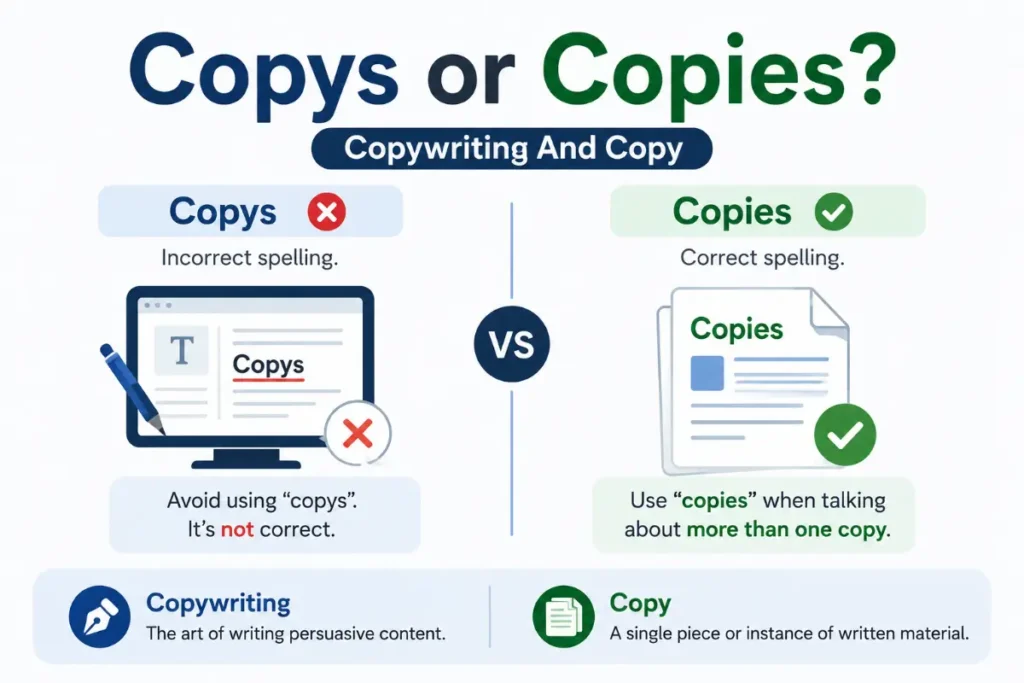
In marketing, copy refers to written content designed to communicate, persuade, inform, or sell. This meaning is different from the idea of making a duplicate. A copywriter may create:
- Website copy.
- Advertisement copy.
- Email copy.
- Product descriptions.
- Social media copy.
- Sales pages.
The word copywriting does not mean writing duplicate material. It refers to the professional craft of writing persuasive content.
Copywriter And Copyright
These words are often confused because they look similar. A copywriter creates written content for marketing or communication. Copyright is a legal protection that gives creators certain rights over original creative work. The two terms have different meanings even though both begin with copy.
Expert Language Insight
From an editor’s perspective, the most important lesson is simple. Do not choose the word based only on how it sounds. Look at the grammatical role and the number of things involved.
- If the sentence refers to one reproduction, use copy.
- If it refers to several reproductions, use copies.
- If the word describes what a singular person or thing does in the present tense, use copies as a verb.
That third use is the one many learners overlook. Compare these sentences:
- I copy the files every morning.
- She copies the files every morning.
The subject changes from I to she, so the verb changes from copy to copies.
Professional editors also pay close attention to the phrase surrounding the noun. A number, determiner, or quantifier often gives you the answer immediately.
- One copy.
- A copy.
- This copy.
- Two copies.
- Several copies.
- Many copies.
The spelling copys does not belong to standard English. It is usually an error caused by applying the basic plural rule too mechanically.
The best practical advice is to learn the spelling pattern rather than memorize this word in isolation. Once you understand that a consonant followed by y usually changes to ies, words such as copy, city, story, and company become easier to spell correctly.
Frequently Asked Questions
Is copys or copies correct?
Copies is the correct standard English spelling. It is the plural form of copy and can also be the third person singular present tense form of the verb copy. The spelling copys is generally incorrect. For example, write two copies of the report rather than two copys of the report.
What is the plural of copy?
The plural of copy is copies. The final y changes to ies because the word ends in a consonant followed by y. For example, one copy becomes two copies. This follows the same spelling pattern as baby and babies and city and cities.
How do you write two copies correctly?
The correct phrase is two copies. You can write 2 copies in many practical contexts such as forms, labels, instructions, and notes. In polished prose, spelling out the number as two copies is often preferred. The phrase two copy is incorrect when you mean two separate reproductions.
What is the difference between copy and copies?
Copy is singular and normally refers to one reproduction or the base form of the verb. Copies is plural when it refers to multiple reproductions. It can also be a verb used with a singular third person subject. For example, I copy files, but she copies files.
How do you use copy or copies of documents?
Use a copy of a document for one reproduction. Use copies of documents for multiple items or reproductions. For example, Please send a copy of the contract means one. Please send copies of the required documents means more than one document or reproduction.
Is copy or copies used in copywriting?
Copy is the standard term for written content used in advertising and marketing. You can talk about website copy, sales copy, email copy, or ad copy. When referring to multiple pieces or versions, the context may require a plural phrase such as several versions of the copy or different pieces of marketing copy.
Is 2 copy or 2 copies correct?
Two copies or 2 copies is correct. The noun must be plural because the number is greater than one. Two copy is incorrect when referring to two separate reproductions. In formal prose, two copies usually looks more polished than using the numeral.
Why is copys incorrect?
The spelling copys is incorrect because English normally changes the final y to ies when a noun ends in a consonant followed by y. Since copy ends in p plus y, its plural becomes copies. This rule also appears in words such as story and stories.
Conclusion
The correct answer is clear. Copies is the standard plural form of copy, while copys is generally a spelling error. Use copy when you mean one reproduction, one document, one file, or the base form of the verb. Use copies when you mean more than one reproduction or when a singular third person subject performs the action in the present tense.
The key spelling rule is worth remembering. When a word ends in a consonant followed by y, the plural commonly changes y to ies. That is why copy becomes copies, just as city becomes cities and story becomes stories.
The word also has several meanings beyond physical documents. In digital work, you can copy files and save copies of important data. In marketing, copy means written content created to inform or persuade an audience. Copies can refer to multiple printed books or documents in publishing,.
So when you are unsure, look at the sentence rather than guessing from sound. One item is a copy. More than one is copies. A singular person or thing copies something in the simple present tense. That small spelling rule solves the entire problem and keeps your writing clear.