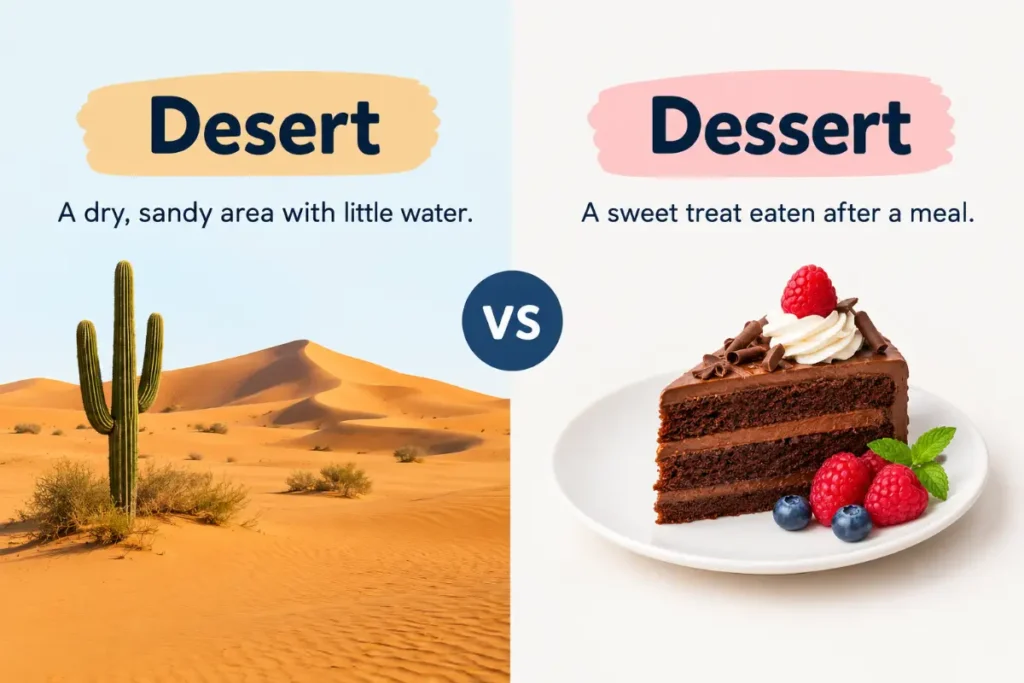
Desert vs dessert is a common English spelling and usage question because the two words look almost identical but have different meanings and pronunciations. One refers to a dry region of land, while the other refers to the sweet food usually served at the end of a meal. The extra s in dessert is small, but it changes the word completely.
The confusion becomes even more interesting because desert has two different pronunciations when it functions as a noun or a verb. As a noun, desert can mean a dry, often sandy region. As a verb, it means to leave someone or something behind. Dessert, by contrast, has one common pronunciation and refers to sweet food such as cake, pie, ice cream, or pudding.
This guide explains the difference between the two words, their meanings, pronunciation, grammar, origins, common mistakes, and practical memory tricks. You will also see how Americans use these words in everyday conversation, school writing, menus, emails, and other common situations.
Quick Answer
Desert usually means a dry region of land, such as the Mojave Desert, or it can mean to abandon someone or something. Dessert means a sweet food served after a meal. The easiest spelling trick is to remember that dessert has two s letters because you usually want seconds of dessert.
Desert vs Dessert Comparison
The quickest way to understand the difference is to compare the words by meaning, pronunciation, and grammatical function. Although they share most of their letters, they do not mean the same thing and should not be used interchangeably.
| Feature | Desert | Dessert |
|---|---|---|
| Main meaning | A dry region of land | A sweet food served after a meal |
| Other meaning | To abandon or leave | No common unrelated meaning |
| Part of speech | Noun or verb | Noun |
| Common noun pronunciation | /ˈdezərt/ | /dɪˈzɝːt/ |
| Stress | First syllable | Second syllable |
| Example | The desert is extremely dry. | We had cake for dessert. |
| Memory clue | One S for the dry land | Two S letters because you want seconds |
The biggest spelling difference is simple. Desert has one s, while dessert has two. The difference is easy to overlook when writing quickly, but the meanings are completely separate.
There is also an important pronunciation difference. When desert means a dry region, the stress falls on the first syllable. Dessert has stress on the second syllable. This difference can help you distinguish them when speaking.
Just as spelling can change the meaning of a word, choosing that or which can affect the clarity and correctness of a sentence.
What Does Desert Mean
The most familiar meaning of desert is a large area of land that receives very little precipitation and has relatively dry conditions. Deserts can contain sand, rocks, mountains, grass, shrubs, and other types of terrain. They are not all endless stretches of sand.
In American English, familiar examples include the Mojave Desert, Sonoran Desert, and Chihuahuan Desert. The word can refer to a specific geographic region or to a general type of dry environment.
- The Mojave Desert covers a large area of the American Southwest.
- We drove through the desert during our vacation.
- The desert can become extremely hot during the day.
- Some desert plants can survive with very little water.
- The landscape changed as we entered the desert.
In these sentences, desert is a noun referring to a geographical environment. Its pronunciation has stress on the first syllable.
Desert As A Place
When desert refers to a dry geographical region, it is a countable noun. You can talk about a desert, the desert, or several deserts.
For example, The Sahara is a desert identifies the Sahara as one type of dry region. The United States has several deserts uses the plural form deserts to discuss more than one such region.
The word does not require sand to be present. A desert is defined by its dry climate and limited precipitation rather than simply by the appearance of the ground. This distinction matters because people sometimes picture every desert as a landscape covered entirely in sand.
Desert As A Verb
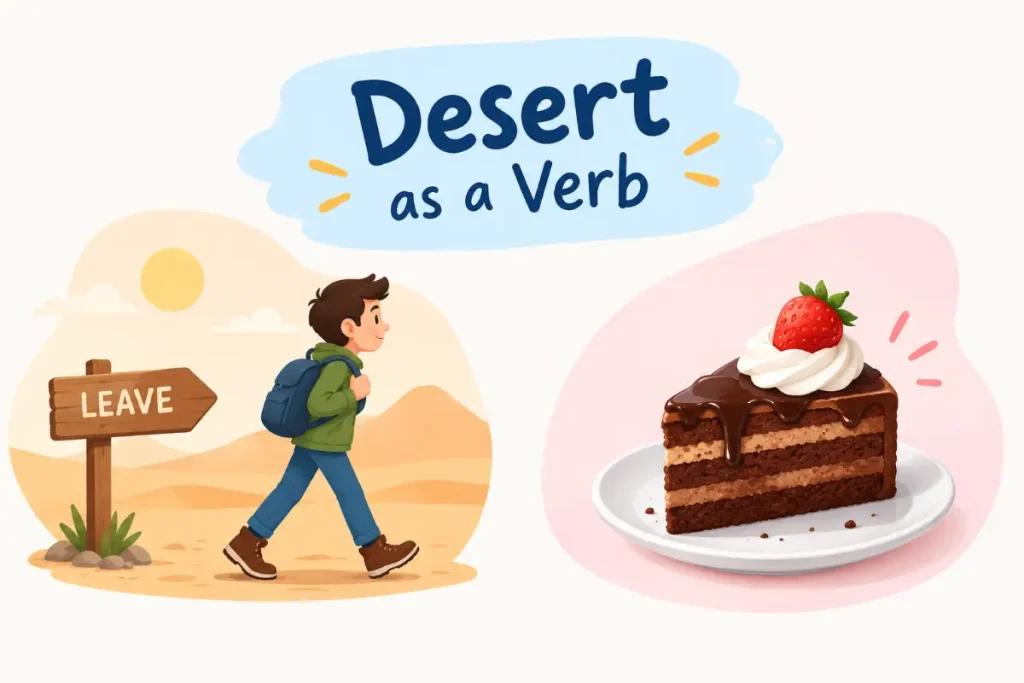
Desert also functions as a verb. In this use, it means to leave someone or something behind, especially when doing so means abandoning a responsibility, place, or person.
- The soldier was accused of deserting his post.
- He refused to desert his friends during a difficult time.
- The village was deserted after the storm.
- The animals were left when the owners deserted the property.
The verb desert has a different pronunciation from the noun meaning a dry region. As a verb, it is pronounced with the stress on the second syllable, similar to dessert.
This creates an interesting point for learners. The spelling desert can represent two different pronunciations and meanings. Context tells you which meaning is intended.
What Does Dessert Mean
Dessert is a sweet food or course typically served at the end of a meal. Common desserts include cake, pie, cookies, ice cream, pudding, cheesecake, brownies, and fruit based dishes prepared as a sweet course.
- We ordered chocolate cake for dessert.
- The restaurant serves several homemade desserts.
- Would you like ice cream for dessert?
- She made an apple pie for Sunday dessert.
- The children were excited about dessert.
Unlike desert, the noun dessert has two s letters. Its pronunciation also differs from the noun desert. The stress falls on the second syllable, making the word sound like dih ZURT in a simple American English pronunciation guide.
Dessert In Everyday Use
People commonly use dessert when talking about meals, restaurants, recipes, celebrations, and food preferences. It can describe a particular dish or the entire course that comes after the main meal.
For example, a restaurant menu might list several desserts, such as cheesecake, chocolate mousse, or ice cream. At home, someone might ask, What are we having for dessert?
The word can also appear in expressions such as dessert menu, dessert plate, dessert recipe, and dessert table. In each case, the word relates to sweet food or the course in which it is served.
Why Desert And Dessert Are Confused
The confusion is easy to understand because the two words differ by only one letter. Both contain the letters d, e, s, e, r, and t, but dessert contains an additional s.
Spelling alone can make the words look almost interchangeable, especially when someone is writing quickly. Pronunciation adds another layer because the noun desert and dessert can sound similar enough to confuse learners, especially when speaking quickly.
The verb desert makes the situation even more complicated because its pronunciation resembles dessert. As a result, understanding the meaning and grammatical role of the word is more reliable than simply listening to the sound.
How To Remember Desert And Dessert
The most popular memory trick is simple: dessert has two s letters because you want seconds.
The idea connects the extra s with the desire for another serving of something sweet. It is not a historical explanation of the spelling. It is simply a useful spelling device.
You can also remember the basic meaning this way:
- Desert has one s and refers to a dry place.
- Dessert has two s letters and refers to sweet food.
- Dessert is the one you may want seconds of.
- Desert is the one you may cross on a road trip.
Another useful clue comes from pronunciation. The noun desert has first syllable stress, while dessert has second syllable stress. Once you become familiar with the difference, hearing the words can help you choose the spelling.
Desert And Dessert Pronunciation
Pronunciation is one of the most useful parts of this comparison because the two words do not sound exactly the same in their most common forms.
In American English, the noun desert, meaning a dry region, is commonly pronounced approximately /ˈdezərt/. The first syllable receives the main stress.
Dessert is commonly pronounced approximately /dɪˈzɝːt/ in General American English. The second syllable receives the main stress.
A simple pronunciation guide is:
- Desert as a dry region: DEZ ert
- Dessert as sweet food: dih ZURT
The difference becomes especially important because desert can also be a verb. When desert means to abandon or leave someone or something, it is pronounced with second syllable stress, similar to dessert.
For example:
- The explorers crossed the DEZ ert.
- The soldier decided to dih ZURT his post.
- We ordered cake for dih ZURT.
The spelling and meaning tell you which pronunciation to use.
Why Stress Matters
English uses word stress to distinguish many words and word forms. In this case, changing the stressed syllable changes how desert is understood.
When the word is a noun referring to dry land, the first syllable receives stress. When it is a verb meaning to abandon, the second syllable receives stress. Dessert also receives stress on the second syllable.
This means that a speaker can communicate the intended meaning through pronunciation even though the spelling of desert remains unchanged in its noun and verb forms.
Desert Examples In Sentences
The following examples show the most common uses of desert as a noun and verb.
Desert As A Noun
- The desert becomes much cooler after sunset.
- We saw several wild animals in the desert.
- The road continues through the desert for miles.
- Many plants in the desert are adapted to dry conditions.
- The hikers carried plenty of water across the desert.
- A sudden storm moved across the desert.
- The desert landscape looked completely different at sunrise.
- Scientists study how life survives in the desert.
These sentences all use desert to describe a dry geographical environment. The noun normally receives stress on the first syllable.
Desert As A Verb
- He would never desert his family.
- The soldiers were ordered not to desert their posts.
- The residents deserted the town after the evacuation order.
- She felt that her friends had deserted her.
- The building was deserted for several years.
- The captain refused to desert the ship.
In these examples, desert means to abandon or leave behind. The grammatical function is a verb, and its pronunciation has second syllable stress.
Dessert Examples In Sentences
Dessert always refers to sweet food or the sweet course of a meal in its common modern use.
- We had ice cream for dessert.
- The chocolate cake was the best dessert on the menu.
- She brought homemade cookies for dessert.
- The restaurant offers several dessert options.
- I usually have fruit instead of a heavy dessert.
- The children asked when dessert would be served.
- They shared a slice of cheesecake for dessert.
- The bakery specializes in beautiful desserts.
- We saved room for dessert.
- The dinner ended with a delicious dessert.
These examples all contain the word as a noun. Unlike desert, it does not function as a common verb in standard modern English.
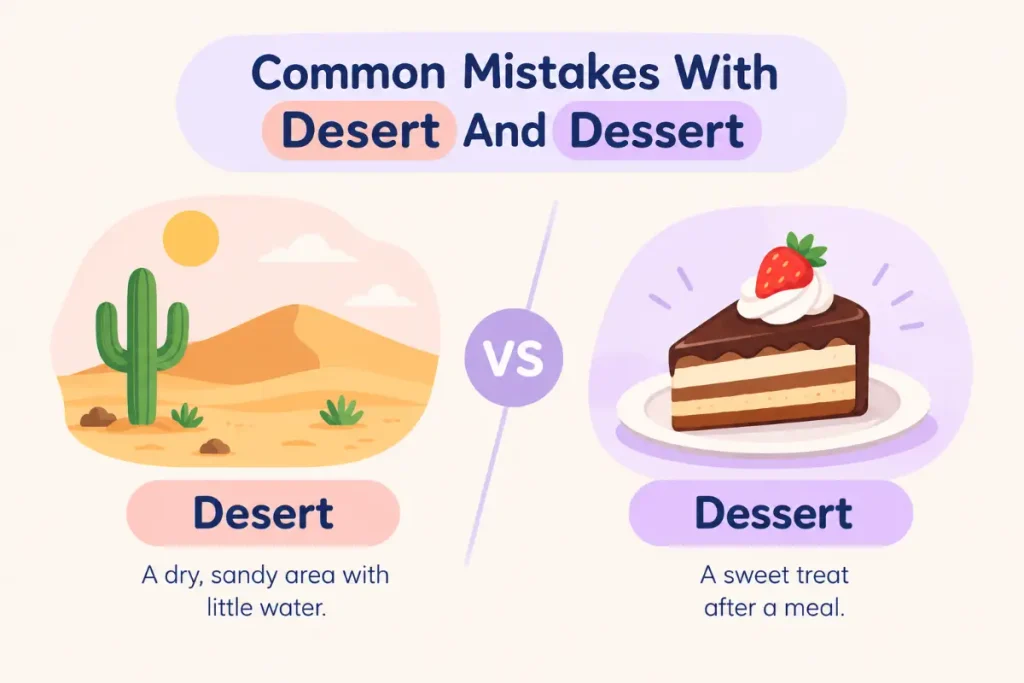
Desert and dessert are not the only words people mix up; another commonly confused pair is accept and except, which differ completely in meaning and usage.
Common Mistakes With Desert And Dessert
Most mistakes happen when writers remember the meaning but not the spelling. The extra s in dessert is particularly easy to forget.
Mistake One
Incorrect: We had cake for desert.
Correct: We had cake for dessert.
Cake is a sweet food served as the final course of a meal, so dessert is the correct spelling.
Mistake Two
Incorrect: We drove across the dessert.
Correct: We drove across the desert.
The sentence refers to a dry region of land, so the correct word is desert with one s.
Mistake Three
Incorrect: The soldier refused to dessert his post.
Correct: The soldier refused to desert his post.
Here, desert is a verb meaning to abandon. Dessert is a noun referring to sweet food and cannot be used in this sentence.
Mistake Four
Incorrect: What are we having for desert?
Correct: What are we having for dessert?
The phrase refers to food served after a meal, so dessert requires two s letters.
Mistake Five
Incorrect: The Sahara is a dessert.
Correct: The Sahara is a desert.
The Sahara is a dry geographical region. It has nothing to do with the sweet course of a meal, so desert is correct.
Grammar Rules For Desert And Dessert
The most important grammar distinction is that desert can be a noun or a verb, while dessert is normally used as a noun.
When desert means a dry region, it functions as a noun. You can use articles and adjectives before it.
- a desert
- the desert
- a vast desert
- the hot desert
- several deserts
When desert means to abandon, it functions as a verb.
- They deserted the town.
- He deserted his responsibilities.
- The soldiers deserted their posts.
Dessert functions as a noun.
- a dessert
- the dessert
- a delicious dessert
- several desserts
- chocolate dessert
This grammatical distinction can help you understand the sentence before you even think about spelling.
Desert Or Dessert In A Sentence
If you are unsure which word belongs in a sentence, look at the surrounding words and ask what the sentence is describing.
If the sentence is about land, climate, travel, wildlife, geography, or a dry environment, desert is probably the correct choice.
If the sentence is about cake, pie, ice cream, pudding, cookies, or food served after a meal, use dessert.
If the sentence means abandon, use desert as a verb.
Compare these sentences:
- The travelers crossed the desert.
- The travelers ordered dessert after dinner.
- The captain would not desert the crew.
The same spelling issue becomes much easier once you identify the meaning.
Formal And Casual Usage
Both desert and dessert are standard words in formal and casual American English. There is no difference in formality that determines which one you should choose.
The correct word depends entirely on meaning. A formal report about climate can use desert, while a casual text about dinner can use dessert. A historical or literary sentence can also use desert as a verb when discussing abandonment.
The spelling should remain the same across formal and informal contexts. What changes is the surrounding language, not the spelling of these words.
American English And Regional Usage
American English uses desert and dessert with the same basic meanings found in other major varieties of English. British, Canadian, and Australian English also distinguish the dry region from the sweet course using these spellings.
Pronunciation can vary somewhat by region and speaker, especially in vowel sounds and the pronunciation of the letter r. The core distinction between the words remains the same.
One important point is that desert as a noun and desert as a verb are pronounced differently in standard English. This distinction applies in American English as well as in other major varieties, although the exact vowel quality can vary.
Word Origin And Etymology
The two words have different historical origins despite their similar modern spelling.
The noun desert, meaning a dry region, comes through Old French from Latin desertum, referring to a deserted or uninhabited place. The connection with an uninhabited place makes sense because many deserts historically appeared sparsely populated because of their harsh conditions.
The verb desert, meaning to abandon, also comes through French and ultimately relates to the idea of leaving or abandoning something.
Dessert has a different history. It comes from French dessert, referring to the final course of a meal. The word is related to the idea of clearing the table after the main part of the meal has been served.
The similar modern spelling is therefore not evidence that the two words have the same meaning. Their histories developed along different paths.
Homophones And Near Homophones
People sometimes describe desert and dessert as homophones, but the answer depends on which pronunciation of desert is being discussed.
The noun desert, meaning dry land, is pronounced differently from dessert, so those two forms are not exact homophones in standard American English. The verb desert, meaning to abandon, has the same stress pattern as dessert, although the vowel sounds can still differ slightly.
For practical writing, the important point is that spelling cannot be chosen from appearance alone. You need to understand the meaning and pronunciation associated with the specific use.
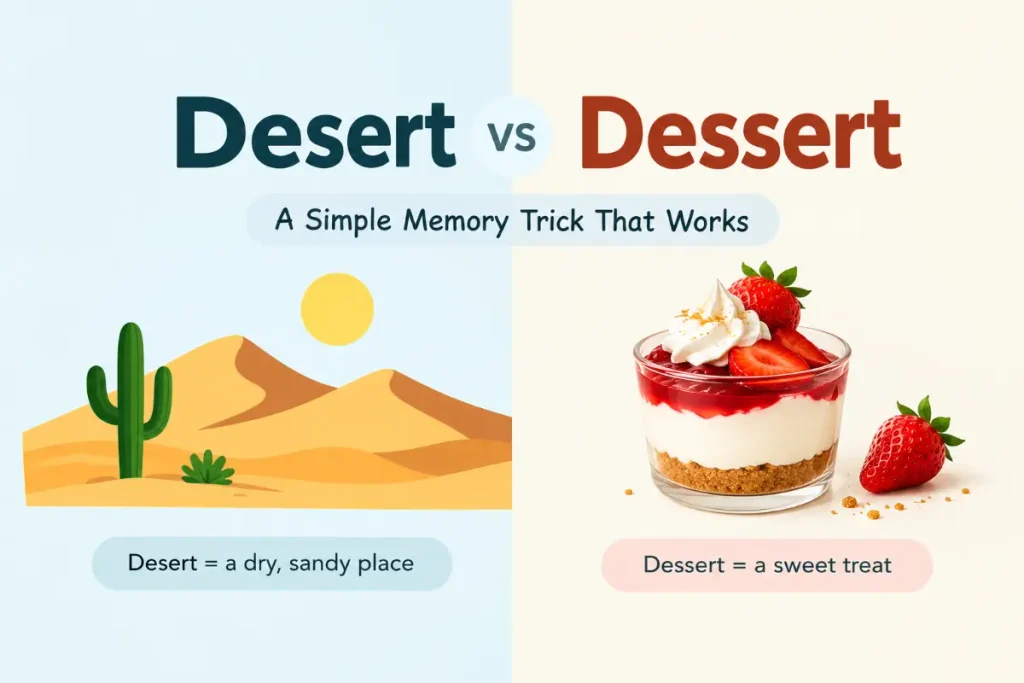
A Simple Memory Trick That Works
The easiest spelling trick is:
Dessert has two s letters because you want seconds.
The word dessert has an extra s, and the extra letter can remind you of wanting a second helping. This is one of the most useful memory devices for learners because it connects the spelling to a familiar experience.
For desert, remember the dry land. You do not need the extra s.
You can also use a three step check:
- Is it dry land? Use desert.
- Is it sweet food after a meal? Use dessert.
- Does it mean abandon? Use desert as a verb.
This simple test covers the main meanings without requiring you to memorize long definitions.
Similar Words People Confuse
English has many words that look or sound similar but have different meanings. Understanding desert and dessert can make you more alert to these distinctions.
Advice and advise are commonly confused because they differ by one letter and one sound. Advice is a noun, while advise is a verb.
Affect and effect can also cause problems because both are common in academic and professional writing. Their grammatical roles and meanings help determine which one belongs in a sentence.
Principal and principle are another familiar pair. A principal can be a person or something considered most important, while a principle is a rule, belief, or guiding idea.
The same basic strategy works with all of them. Instead of relying only on spelling or sound, identify the meaning and grammatical function first.
Expert Language Insight
One useful point that is often missed in basic explanations is that desert is not just one word with one meaning. The noun for dry land and the verb meaning to abandon have different pronunciations, even though they share the same spelling.
That means the sentence itself matters. If you read The hikers crossed the desert, the context clearly identifies a geographical noun. If you read He decided to desert his responsibilities, the word functions as a verb meaning abandon.
Dessert is much simpler because its common modern use refers to sweet food. The extra s is therefore the most practical spelling distinction to remember.
For writers, the best habit is to connect spelling with meaning instead of memorizing the letters in isolation. If you think dessert equals something sweet and possibly seconds, the two s letters become easier to remember. If you think desert equals dry land or abandon, the single s becomes easier to recognize.
If you’re working on precise everyday English, a useful usage distinction to learn alongside desert and dessert is the difference between advice and advise.
Frequently Asked Questions
What is the difference between desert and dessert
Desert can mean a dry region of land or, as a verb, to abandon someone or something. Dessert means a sweet food or course served after a meal. The spelling difference is one letter: dessert has two s letters, while desert has one.
Is desert or dessert correct for food
Dessert is correct when you mean sweet food served after a meal. For example, We had ice cream for dessert is correct. Desert with one s does not mean food. It usually refers to a dry geographical region or functions as a verb meaning to abandon.
How do you remember the spelling of dessert
A common memory trick is to remember that dessert has two s letters because you want seconds. The extra s can remind you of wanting another serving of something sweet. For desert, remember the dry landscape. This simple contrast works well for everyday writing.
Are desert and dessert pronounced the same
The noun desert, meaning a dry region, is pronounced differently from dessert. Desert has stress on the first syllable, while dessert has stress on the second. The verb desert, meaning to abandon, has second syllable stress and sounds much closer to dessert.
Why does desert have two pronunciations
Desert has two pronunciations because it represents two different words with different meanings and historical development. As a noun meaning a dry region, it has first syllable stress. As a verb meaning to abandon, it has second syllable stress. The spelling stayed the same even though the pronunciation and meaning differ.
Is the Sahara a desert or dessert
The Sahara is a desert because it is a vast dry region of land. Dessert refers to sweet food served after a meal, so it has no connection to the Sahara. The correct sentence is The Sahara is a desert.
Is dessert always sweet
In standard modern English, dessert normally refers to a sweet course or sweet food served after a meal. Common examples include cake, pie, ice cream, pudding, and cookies. Specific food traditions can vary, but the word itself is generally associated with a sweet final course.
What does desert mean as a verb
As a verb, desert means to leave or abandon someone, something, or a responsibility. For example, He refused to desert his family means he refused to abandon them. This use has a different pronunciation from the noun desert meaning a dry region.
Conclusion
The difference between desert vs dessert is easier to remember once you connect each spelling with its meaning. Desert with one s can refer to a dry region of land or mean to abandon someone or something. Dessert with two s letters refers to sweet food served after a meal.
For spelling, remember the simple trick that dessert has two s letters because you want seconds. For pronunciation, remember that the noun desert has first syllable stress, while dessert has second syllable stress. When you focus on meaning, grammar, and context, the extra s becomes much easier to remember.