Many people confuse drier vs dryer because the words sound the same but have different meanings. It’s a common question because both words are correct, they sound exactly the same, and they come from the adjective dry. The confusion starts when the same spelling pattern leads to two different meanings.
The short answer is simple. Drier is usually the comparative form of dry, while dryer most often refers to a machine or device that removes moisture. In some situations, dryer can also work as a comparative adjective, but modern style guides and dictionaries generally recommend drier for comparisons to avoid confusion.
Understanding the difference matters more than you might think. Choosing the right word makes your writing clearer and helps readers understand your meaning immediately. This is especially important in school assignments, professional writing, product descriptions, and everyday communication.
In this guide, you’ll learn what each word means, how native English speakers use them, why both spellings exist, and which one editors prefer in different situations. You’ll also find practical examples, grammar tips, pronunciation guidance, and answers to the questions people search for most.
Quick Definition
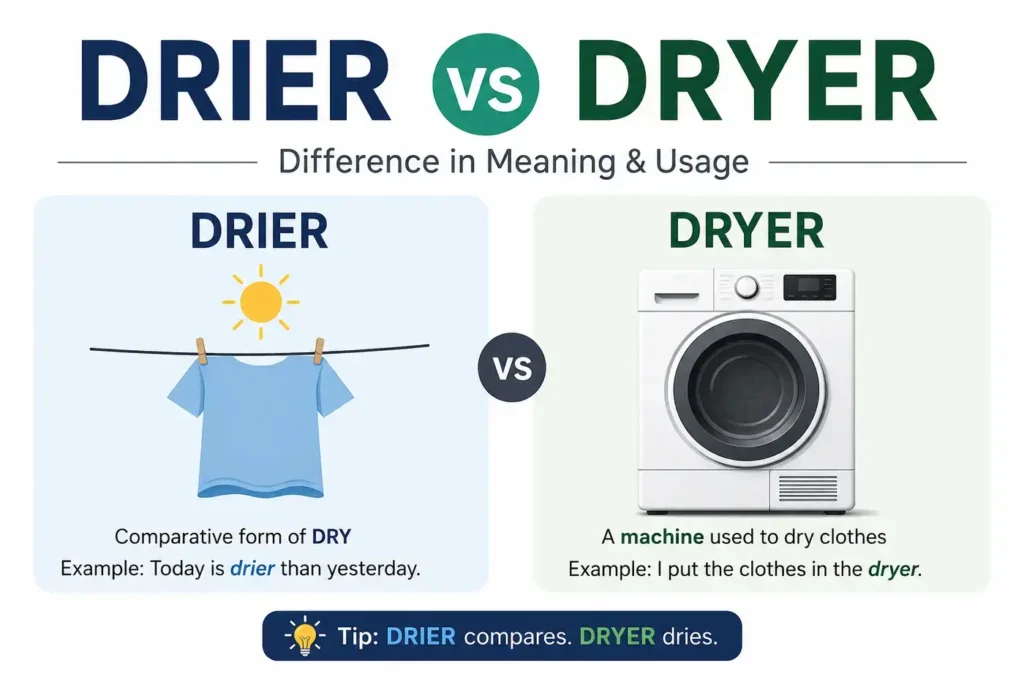
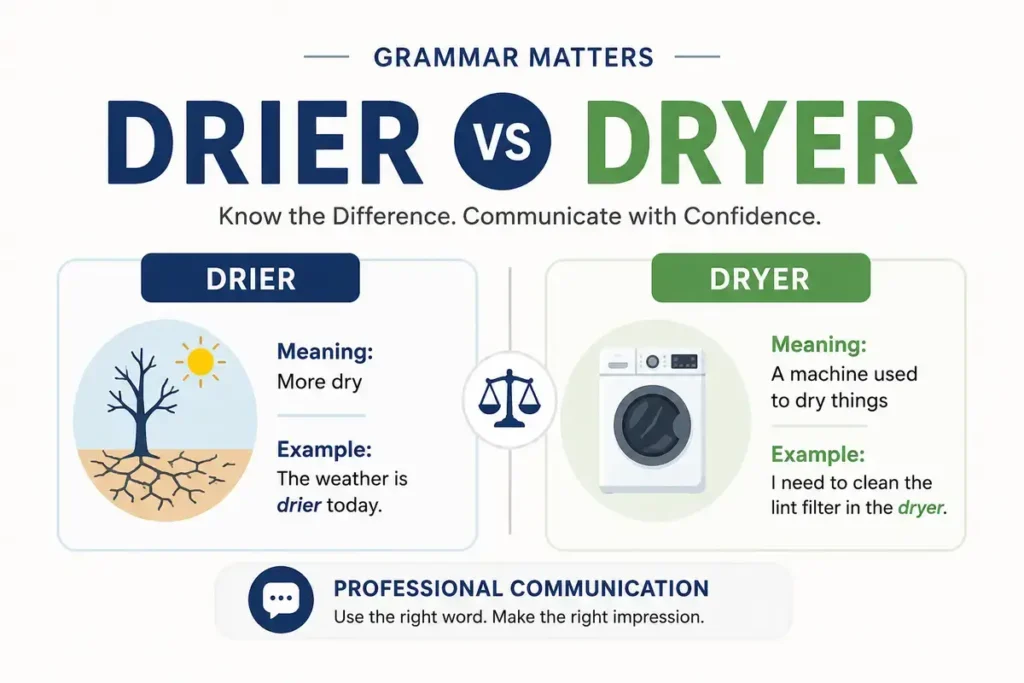
Drier is the comparative form of dry and means more dry or having less moisture. Dryer usually refers to a machine or device that dries something, such as a clothes dryer or hair dryer. Although dryer can occasionally appear as a comparative adjective, drier is the preferred spelling for most writing because it avoids confusion.
Quick Answer
If you only remember one rule, make it this one.
- Use drier when comparing moisture levels.
- Use dryer when talking about a machine or appliance.
- In modern writing, drier is the preferred comparative adjective.
- Dryer almost always refers to equipment that removes moisture.
For example:
- This towel feels drier than the other one.
- The clothes are in the dryer.
- Arizona has a drier climate than Florida.
- The hair dryer stopped working this morning.
Comparison Table
| Feature | Drier | Dryer |
|---|---|---|
| Part of speech | Comparative adjective. Sometimes noun in limited contexts. | Noun. Occasionally comparative adjective in older or less common usage. |
| Meaning | More dry or having less moisture. | A machine or device that removes moisture. |
| Origin | Comparative form of dry. | Developed as the noun form for drying devices. |
| Preferred use | Comparing moisture levels. | Referring to appliances and equipment. |
| Formality | Standard in all writing. | Standard for nouns. Less common as a comparative adjective. |
| Common contexts | Weather, climate, food, skin, soil, fabrics. | Laundry, hair care, laboratories, industrial equipment. |
| Usage frequency | Common in comparisons. | Extremely common as a noun. |
| Example | Today is drier than yesterday. | Put the towels in the dryer. |
Understanding Both Words
Although these words differ by only one letter, they don’t always serve the same purpose. Knowing how each one functions makes choosing the correct spelling much easier.
If you’re interested in avoiding similar spelling mix-ups, learning the difference between unphased and unfazed can help you write with greater confidence.
What Does Drier Mean
Drier is the comparative form of the adjective dry. It describes something with less moisture than something else.
You’ll usually see it when comparing two places, objects, materials, or conditions.
For example:
- The desert is drier than the rainforest.
- My hands feel drier during the winter.
- This paint becomes drier after a few hours.
- Cotton stays drier than wool in this situation.
- The air becomes drier as humidity drops.
The word answers a simple question.
Which thing has less moisture?
Because it compares one thing with another, drier functions as a comparative adjective.
What Does Dryer Mean
Dryer is most commonly a noun. It refers to something that dries another object by removing moisture.
The most familiar examples include household appliances.
- Clothes dryer.
- Hair dryer.
- Hand dryer.
- Food dryer.
- Industrial dryer.
Example sentences:
- The dryer finished its cycle.
- I bought a new hair dryer.
- The hotel installed automatic hand dryers.
- This laboratory uses a freeze dryer.
- Empty the lint filter after using the dryer.
Although some dictionaries acknowledge dryer as an alternative comparative spelling, that use is uncommon today because readers naturally associate dryer with an appliance.
Key Differences
The easiest way to remember these words is to focus on their purpose instead of their spelling.
Drier describes a condition. Dryer usually names an object.
Here’s a quick comparison.
| Drier | Dryer |
|---|---|
| Comparative adjective. | Usually a noun. |
| Means more dry. | Means a drying machine or device. |
| Describes moisture levels. | Names equipment that removes moisture. |
| Common in weather and climate. | Common in homes, businesses, and industries. |
| Preferred by most editors for comparisons. | Preferred for appliances and machines. |
A useful memory trick is to think about what the sentence is talking about.
If you’re describing something becoming less wet, choose drier.
If you’re talking about a machine that dries clothes, hair, or hands, choose dryer.
Which Word Is Correct
Both words are correct, but they aren’t usually interchangeable.
Choose drier when you’re making a comparison.
Examples include:
- The weather is drier this week.
- My skin feels drier after swimming.
- The western region is much drier than the coast.
- These crackers stay drier in an airtight container.
Choose dryer when referring to a device.
Examples include:
- The clothes are still in the dryer.
- My hair dryer overheated.
- The hand dryer stopped working.
- The repair technician fixed the dryer.
Many dictionaries list dryer as an acceptable comparative spelling, but experienced editors rarely recommend it outside very specific contexts. Using drier for comparisons removes any chance that readers might mistake it for an appliance.
Pronunciation Guide
One reason people confuse these words is that they sound exactly alike.
Drier
IPA pronunciation:
/ˈdraɪ.ər/
Syllable breakdown:
Dry • er
Dryer
IPA pronunciation:
/ˈdraɪ.ər/
Syllable breakdown:
Dry • er
The pronunciation doesn’t change because the spelling changes. Native speakers rely on the sentence itself to understand which word is intended.
For example:
- The air is becoming drier.
- The dryer needs a new heating element.
Even though both words are pronounced the same way, the surrounding words make the meaning clear.
Expert Language Insight
From an editor’s perspective, this isn’t really a spelling problem. It’s a usage problem.
Most professional writers choose drier whenever they’re comparing moisture levels because readers immediately recognize it as the comparative form of dry. Using dryer in the same situation can slow readers down since many people instinctively picture a household appliance.
You’ll notice this preference in newspapers, educational websites, style guides, weather reports, and professionally edited books. Phrases like drier weather, drier conditions, and drier climate appear far more often than their alternative forms because they’re clearer and leave little room for misunderstanding.
If your goal is clear, polished writing, treat drier as the comparative adjective and reserve dryer for machines and devices. It’s the simplest approach, and it’s the one most editors recommend.
Examples in Sentences
Seeing these words in context is the easiest way to understand the difference. Notice how drier compares moisture levels, while dryer refers to a machine or device.
Drier Examples
These examples use drier as the comparative form of dry.
- The air feels drier after the cold front moved through.
- This towel is much drier than the one hanging by the sink.
- Our summers are becoming drier every year.
- The soil looks drier after three weeks without rain.
- My skin gets drier during the winter months.
- Crackers stay drier in an airtight container.
- The western side of the state has a drier climate.
- The paint became drier overnight.
- These leaves are drier than the ones we collected yesterday.
- The cake turned drier because it stayed in the oven too long.
Dryer Examples
These examples use dryer as a noun.
- I forgot to take the clothes out of the dryer.
- The hair dryer stopped working this morning.
- Our new dryer uses less electricity than the old one.
- Clean the lint filter after every dryer cycle.
- The hotel restroom has an automatic hand dryer.
- The technician repaired the dryer in less than an hour.
- We bought a stackable washer and dryer.
- The food dryer preserves fruit without using chemicals.
- The laboratory installed a freeze dryer for research.
- The dryer made a strange noise before it shut off.
Common Mistakes
Even native English speakers occasionally mix these words up because they sound identical. The mistake usually happens when writers focus on pronunciation instead of meaning.
Here are the errors that appear most often.
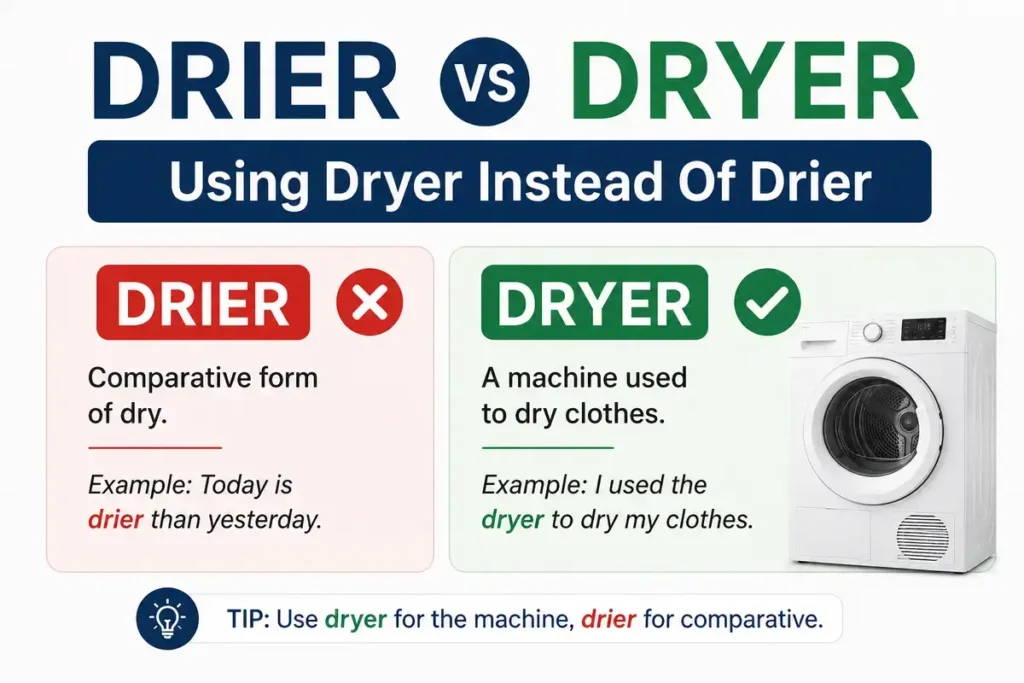
Using Dryer Instead Of Drier
Many people write sentences like this.
The weather is dryer today.
Although some dictionaries accept dryer as a comparative adjective, most editors prefer drier because it’s clearer and avoids confusion with an appliance.
A better version is:
The weather is drier today.
The same rule applies to phrases such as:
- Drier climate.
- Drier air.
- Drier skin.
- Drier soil.
- Drier conditions.
Using Drier For A Machine
This mistake is less common but still appears in everyday writing.
Incorrect:
Put the towels in the drier.
Correct:
Put the towels in the dryer.
When the word names a machine or appliance, dryer is always the correct spelling.
Forgetting The Context
The spelling depends on the role the word plays in the sentence.
Ask yourself one simple question.
Am I describing something with less moisture, or am I talking about a machine?
The answer usually tells you which spelling to choose.
Assuming One Word Is Always Wrong
Some writers believe only one spelling is correct.
That isn’t true.
Both words belong in standard English. They simply serve different purposes in modern writing.
Word Origin And History
The adjective dry has been part of English for well over a thousand years. It comes from Old English drȳge, which described something free from moisture.
This isn’t the only word that causes spelling confusion, understanding why “shiney” is a common mistake can help you spot and avoid another frequently misspelled term.
As English developed, the language formed comparative adjectives by adding er to many short words.
Examples include:
- Tall becomes taller.
- Small becomes smaller.
- Fast becomes faster.
- Dry becomes drier.
The noun dryer appeared later as technology evolved. Once machines were invented to remove moisture from clothing, hair, food, and other materials, English naturally adopted dryer as the name for those devices.
Because both words share the same root, their spellings look almost identical. Over time, editors began favoring drier for comparisons to help readers distinguish it from the appliance.
That preference remains common in modern dictionaries, educational materials, newspapers, and style guides.
Regional Usage of Drier vs Dryer
Unlike some spelling pairs, drier and dryer don’t change much from one English speaking country to another. The basic distinction stays remarkably consistent.
American English
American English generally uses drier as the comparative adjective and dryer for appliances.
Examples include:
- Drier weather.
- Drier skin.
- Clothes dryer.
- Hair dryer.
You’ll find this usage in schools, news publications, weather reports, and business writing across the United States.
British English
British English follows the same pattern.
Writers commonly use drier when comparing moisture levels and dryer for machines.
This also answers a popular question about dryer or drier UK. In British English, drier is the preferred comparative form, while dryer refers to an appliance.
Australian English
Australian English also favors drier in comparisons.
This is especially common in weather reporting because Australia frequently discusses rainfall, droughts, and changing climate conditions.
You’ll often read phrases like:
- Drier conditions.
- Drier regions.
- Drier summers.
Canadian English
Canadian English follows the same convention.
Although Canadian English sometimes blends American and British spelling preferences, the distinction between drier and dryer remains consistent.
Grammar Rules
Understanding the grammar behind these words makes them much easier to remember.
Parts Of Speech
The two words belong to different grammatical categories.
Drier is primarily a comparative adjective.
Dryer is primarily a noun.
That difference explains why they appear in different kinds of sentences.
Comparative Adjectives
English usually forms comparative adjectives by adding er to short adjectives.
Examples include:
- Bright becomes brighter.
- Cold becomes colder.
- Warm becomes warmer.
- Dry becomes drier.
This pattern explains why drier is considered the standard comparative form.
Nouns
A noun names a person, place, thing, or idea.
Examples of dryer include:
- Hair dryer.
- Clothes dryer.
- Hand dryer.
- Grain dryer.
- Food dryer.
In each example, the word names a physical object.
Dry Drier Driest
Another common search asks about dry drier driest.
These are simply the three degrees of comparison for the adjective dry.
- Positive form: Dry.
- Comparative form: Drier.
- Superlative form: Driest.
Examples:
- This towel is dry.
- That towel is drier.
- This is the driest towel of them all.
More Dry Or Drier
Another question people ask is which phrase sounds better.
Both more dry and drier are grammatically correct.
However, drier is far more natural in everyday English because short adjectives usually take the er ending instead of more.
Professional editors almost always choose drier unless there’s a specific stylistic reason not to.
Real Life Usage
These words appear in everyday situations far more often than many people realize.
Daily Conversation
You’ll hear comparisons such as:
- The air feels drier today.
- My lips are getting drier.
- Put the laundry in the dryer.
- I need a new hair dryer.
Academic Writing
Science and geography textbooks frequently discuss:
- Drier climates.
- Drier regions.
- Drier soil.
- Drier seasons.
Engineering and consumer product guides often refer to:
- Clothes dryers.
- Industrial dryers.
- Laboratory dryers.
Professional Communication
Meteorologists regularly describe:
- Drier weather.
- Drier air masses.
- Drier conditions.
Appliance manufacturers discuss:
- Energy efficient dryers.
- Electric dryers.
- Gas dryers.
The surrounding context makes the intended meaning obvious, even though both words sound exactly the same.
Related Words And Commonly Confused Terms
Once you understand the difference between these two words, you’ll notice several other word pairs that cause similar confusion. Most involve comparative adjectives, nouns, or spelling patterns that look alike but serve different purposes.
Here are some related terms that often appear in grammar discussions.
| Word or Phrase | Meaning |
|---|---|
| Dry | Free from moisture. |
| Drier | Comparative form of dry meaning more dry. |
| Driest | Superlative form meaning the most dry. |
| Dryer | A machine or device used for drying. |
| Drying | The process of removing moisture. |
| Moist | Slightly wet. |
| Damp | A little wet but not soaked. |
| Arid | Extremely dry, often used for climates. |
| Humid | Containing a high amount of moisture in the air. |
| Dehumidifier | A machine that removes moisture from the air. |
These words are closely connected, but each has its own role. Understanding the relationship between them makes your vocabulary stronger and helps you choose the right word more confidently.
You may also come across these common search queries.
Is Drier A Word
Yes. Drier is a real word and the standard comparative form of dry. Major dictionaries recognize it, and professional writers use it regularly when comparing moisture levels.
Dryer Or Drier Weather
When talking about weather, drier weather is the preferred choice because you’re comparing one weather condition with another.
Example:
- Forecasters expect drier weather later this week.
- The southern region usually has drier weather during the summer.
Drier Than Or Dryer Than
When making a comparison, drier than is the form most editors recommend.
Examples:
- Arizona is drier than Florida.
- This towel is drier than the other one.
- My hands feel drier than they did yesterday.
Although dryer than appears occasionally, it’s much less common in professionally edited writing because readers often associate dryer with an appliance.
Expert Language Insight
One of the easiest ways to write naturally is to think about the job the word is doing rather than the spelling.
If the word describes something with less moisture, you’re almost always looking for the comparative adjective. That’s why weather reports, travel guides, geography books, and health articles consistently use drier in phrases such as drier air, drier skin, and drier climate.
If the word names an object, the choice is just as straightforward. A dryer is something you can buy, repair, replace, or plug into an electrical outlet. Whether it’s a clothes dryer, hair dryer, hand dryer, or food dryer, the word refers to equipment rather than a description.
Professional editors also pay attention to clarity. Even though some dictionaries acknowledge dryer as an alternative comparative spelling, using drier for comparisons removes ambiguity and helps readers understand your meaning immediately. That’s one reason you’ll see it more often in newspapers, educational websites, textbooks, and professionally edited publications.
English includes plenty of usage debates, and knowing when to use “fliers” or “flyers” is another useful way to improve your writing accuracy.
Frequently Asked Questions About Drier vs Dryer
Is drier a real word?
Yes. Drier is the standard comparative form of dry. It means more dry or having less moisture than something else. You’ll commonly see it in weather reports, scientific writing, travel guides, and everyday conversation.
Is dryer always a machine?
In modern English, dryer is almost always a noun that refers to a machine or device used to remove moisture. Examples include a clothes dryer, hair dryer, hand dryer, and food dryer. Although some dictionaries list it as a comparative adjective, that use is uncommon today.
Which spelling should I use for weather?
Use drier when describing weather, climate, air, soil, or any other condition involving moisture.
For example:
- Drier weather.
- Drier conditions.
- Drier air.
- Drier climate.
These forms are widely accepted in both American and British English.
Is dryer than grammatically correct?
Some dictionaries recognize dryer than as an alternative comparative spelling. Even so, most editors and style guides recommend drier than because it clearly distinguishes the comparative adjective from the appliance.
What is the comparative form of dry?
The standard comparative form is drier, and the superlative form is driest.
Examples include:
- Dry.
- Drier.
- Driest.
This follows the normal pattern for many short English adjectives.
Do American and British English use different spellings?
No. Both American and British English generally follow the same distinction. Drier is preferred when comparing moisture levels, while dryer refers to a machine or appliance.
Why do people confuse these words?
The confusion comes from two simple facts. Both words share the same pronunciation, and they come from the same root word. Since they sound identical, many writers choose the spelling that looks familiar instead of thinking about the role the word plays in the sentence.
How can I remember the difference?
A simple memory trick is to connect dryer with household appliances. If you can plug it into a wall or use it to dry clothes or hair, it’s a dryer. If you’re describing something that has less moisture than something else, use drier.
Conclusion
The difference between these two words is much simpler than it first appears. Drier is the standard comparative form of dry, so it’s the right choice when comparing moisture levels. Dryer, on the other hand, is the noun most people use for a machine or device that removes moisture.
When you’re writing about weather, climate, skin, soil, food, or anything becoming less wet, drier is usually the clearest option. When you’re talking about laundry, hair care, or another drying appliance, dryer is the correct word.
If you’re ever unsure, ask yourself one question. Am I describing a condition or naming a machine? The answer will almost always point you to the correct spelling.
Once you understand that distinction, choosing between these words becomes second nature. You’ll write with more confidence, avoid a common mistake, and make your meaning clear from the very first sentence.