Choosing between farther vs further can be confusing because the two words are closely related and are often used in similar sentences. Both can describe moving or progressing beyond a point, and in everyday American English, many speakers use them interchangeably. Still, there is a useful distinction that can help you choose the most precise word in careful writing.
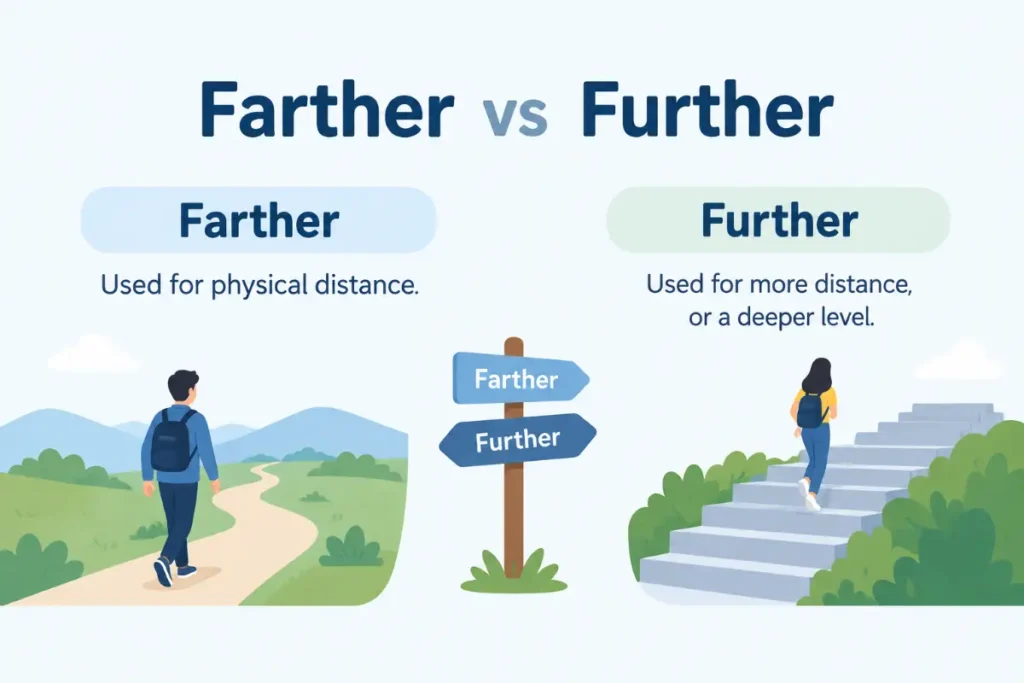
Traditionally, farther is associated with measurable physical distance, while further is more often used for figurative distance, additional progress, or something beyond what has already been mentioned. For example, you can say The store is farther down the road, but We need further information before making a decision.
Modern English is not completely rigid about this distinction. Further is widely used for both physical and figurative distance, while farther remains strongly associated with literal distance. This guide explains the difference, shows how Americans typically use both words, covers phrases involving time and progress, and gives practical examples so you can make the right choice naturally.
Quick Answer
Farther traditionally refers to greater physical distance, such as The airport is farther away. Further usually refers to additional progress, information, discussion, or figurative distance, as in We need further details. In modern American English, further can also describe physical distance, so the distinction is useful rather than absolute.
What Does Farther Mean
Farther is the comparative form traditionally used for physical distance. It describes something that is more distant from a particular point, person, place, or starting position.
For example, if one restaurant is two miles away and another is five miles away, you can say the second restaurant is farther away. The distance can be measured in miles, feet, kilometers, or another unit, but it does not have to include an exact measurement. The important point is that the meaning involves physical space.
Common examples include:
- The next gas station is farther down the highway.
- We walked farther than we planned.
- The school is farther from my house than the library.
- Can you move the chair farther away from the door?
- The beach is farther than I expected.
- She lives farther north than I do.
The word can also appear with phrases such as farther away, farther along, and farther down when those expressions describe movement or position in physical space.
Farther For Physical Distance
The easiest traditional rule is simple: use farther when you are talking about measurable or literal physical distance.
Imagine two runners on a track. If one runner has traveled 100 feet and another has traveled 200 feet, the second runner has gone farther. The comparison involves actual physical space, so farther fits naturally.
You do not always need to state a number. A sentence such as The mountains are farther than they look still describes physical distance even though the exact distance is unknown.
Other examples include:
- We drove farther than we expected.
- The trail continues farther into the forest.
- His house is farther from downtown.
- The boat traveled farther out to sea.
This is the clearest area where farther remains especially useful.
If you’re comparing the meaning or usage of one word with another, understanding the difference between than and then can help you avoid another common writing mistake.
What Does Further Mean
Further has a broader range of meanings. It can mean additional, more, to a greater degree, or to a more advanced point. It is especially common when the idea involves something abstract rather than a literal physical distance.
For example, We need further information means we need additional information. The committee discussed the issue further means the discussion continued or went into greater detail.
Further commonly appears with ideas such as:
- Information
- Discussion
- Research
- Investigation
- Development
- Progress
- Consideration
- Explanation
- Education
- Action
Consider these examples:
- We need further information before deciding.
- The issue requires further discussion.
- She wants to further her education.
- The company plans to further develop the product.
- The lawyer requested further details.
- The conversation went further than I expected.
The word can also describe physical distance in modern English. That broader use is one reason the distinction between farther and further is not an absolute grammar rule.
Further For Additional Meaning
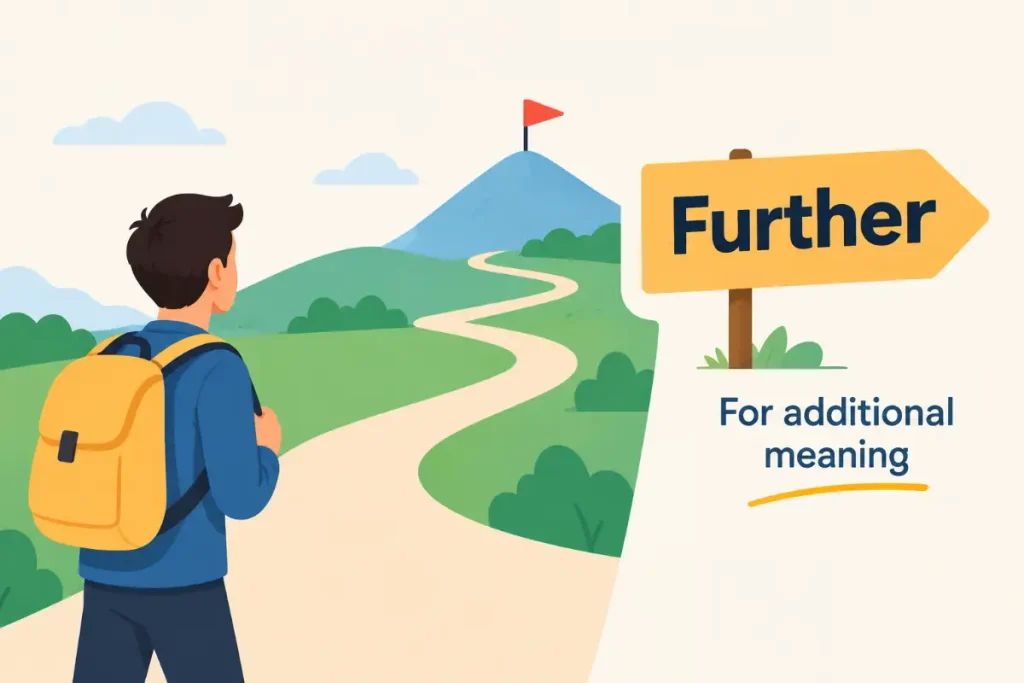
One of the most important uses of further is to mean additional or more. This use has nothing to do with physical distance.
For example, Please contact us if you need further assistance means additional assistance. You are not talking about moving farther through physical space.
The same pattern appears in many professional and academic contexts:
- Please provide further information.
- The matter requires further investigation.
- We need further evidence.
- The report needs further revision.
- The students received further instruction.
This is why further is much more common than farther in phrases involving abstract ideas.
Farther vs Further Comparison
The two words overlap, but their traditional meanings give you a useful way to distinguish them.
| Feature | Farther | Further |
|---|---|---|
| Main traditional meaning | Greater physical distance | Additional or more advanced |
| Physical distance | Common and precise | Also accepted in modern English |
| Figurative meaning | Less common | Very common |
| Additional meaning | Usually not used this way | Very common |
| Progress | Sometimes possible | Very common |
| Information | Not standard | Standard |
| Discussion | Not standard | Standard |
| Education | Not standard | Standard |
| American English | Common for physical distance | Very common for abstract and physical distance |
| Example | The store is farther away. | We need further information. |
The safest practical rule is to use farther for literal physical distance and further for additional or figurative meaning. This distinction gives your writing a clear and traditional pattern without suggesting that modern speakers never use further for physical distance.
The Main Difference Between Farther And Further
The central difference is the type of distance being described.
Farther traditionally answers a question about physical space. If you can imagine measuring the distance between two locations, objects, or positions, farther is often the natural choice.
Further traditionally moves away from physical distance and into the ideas of continuation, addition, advancement, or degree. You can go further into a discussion, further your education, or request further information.
Compare these pairs:
- The hotel is farther from the airport.
- We need further information about the hotel.
The first sentence describes physical distance. The second describes additional information.
Another pair makes the difference clearer:
- We walked farther along the trail.
- We discussed the problem further.
The first sentence involves physical movement. The second describes continued discussion.
How To Choose The Right Word
When you are unsure, first ask what kind of distance or progress the sentence describes.
Use Farther For Physical Distance
Choose farther when the sentence clearly involves movement or distance through physical space.
- The second exit is farther down the road.
- We drove farther than expected.
- The cabin is farther into the woods.
- How much farther do we have to walk?
A useful test is to imagine putting a ruler, map, measuring tape, or distance marker between the two points. If the comparison is clearly about physical space, farther is a strong choice.
Use Further For Additional Or Figurative Meaning
Choose further when the meaning is additional, continued, deeper, or more advanced.
- We need further research.
- The issue needs further attention.
- She wants to further her career.
- Let’s discuss this further.
- The investigation went further than expected.
Here, the idea of distance is figurative. You are moving deeper into a subject, not necessarily traveling through a physical location.
What If The Meaning Could Be Both
This is where modern usage becomes more flexible. Further is commonly used for physical distance, especially in ordinary speech and writing.
For example, How much further is the station? is widely used and understood. It does not create a serious grammatical problem simply because the distance is physical.
If you are writing carefully and want to maintain the traditional distinction, How much farther is the station? is the more specific choice for physical distance. In less formal contexts, further is also common.
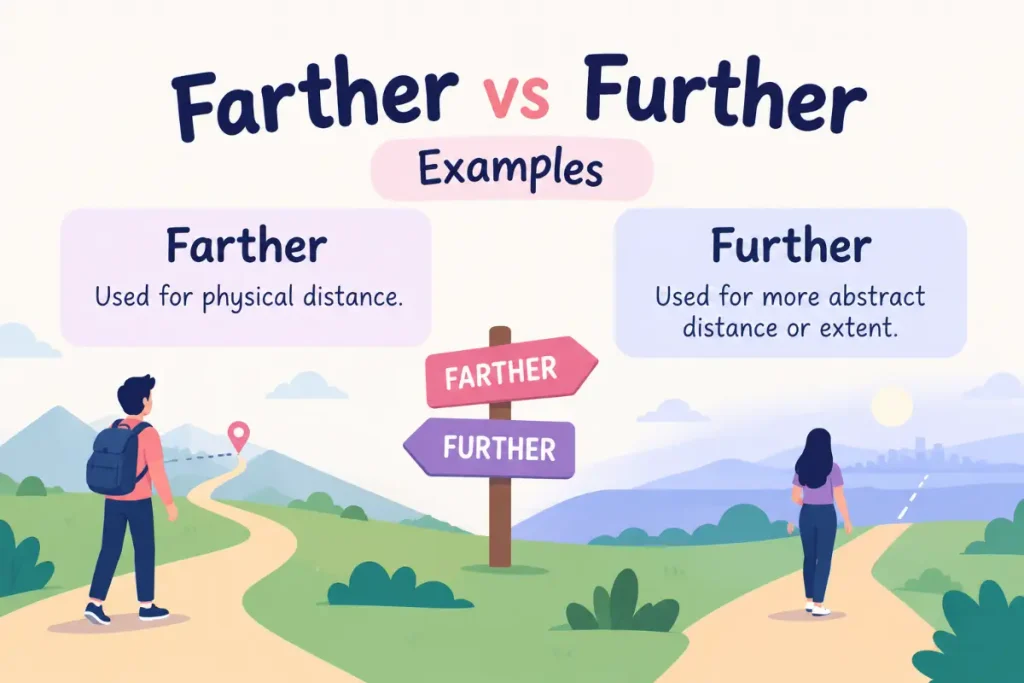
Farther And Further Examples
The best way to understand the distinction is to see the words used in different contexts.
Examples With Farther
These examples focus on literal physical distance.
- The pharmacy is farther down the street.
- We drove farther than we planned.
- The nearest exit is farther ahead.
- She moved farther away from the window.
- The hikers went farther into the park.
- The second apartment is farther from downtown.
- How much farther is the airport?
- The lake is farther than it appears on the map.
- The children ran farther than their parents expected.
- The town is farther north than we thought.
In each sentence, the word describes physical position, movement, or distance. Some examples do not give an exact measurement, but the meaning is still spatial.
Examples With Further
These examples use further for additional, figurative, or continued meaning.
- We need further information before deciding.
- The issue deserves further discussion.
- She wants to further her education.
- The company needs further evidence before acting.
- Please read further for more details.
- The conversation went further than expected.
- The research requires further analysis.
- We should consider the matter further.
- The project cannot move further without approval.
- The teacher provided further explanation.
These sentences describe continuation, addition, progress, or deeper consideration rather than a simple measurement of physical space.
Farther vs Further In A Sentence
Both words can appear naturally in sentences about movement and progress, but the intended meaning determines which one is more precise.
Consider The hikers walked farther into the forest. This describes literal movement through physical space. The traditional choice is farther.
Now consider The researchers took the study further. The researchers are not physically moving the study. They are developing or advancing it, so further is the natural choice.
Another useful comparison is:
The car traveled farther than the truck.
This compares physical distance.
The conversation went further than expected.
This describes the extent or development of a discussion.
The difference becomes easier to see when you stop treating the two words as competing spellings and instead ask what kind of distance the sentence expresses.
Just as farther vs further can depend on context, choosing between who and whom also requires paying attention to how the word functions in the sentence.
Farther And Further Along
The phrase farther along can describe literal position on a route or figurative progress.
For physical movement, farther along can refer to a location:
The gas station is farther along the highway.
Here, the meaning is physical. You are traveling farther along a road.
But further along is also common when talking about progress:
We are further along in the project than we expected.
The project is not a physical object moving down a road. The phrase describes progress toward completion.
This illustrates why context matters. Both forms can occur with along, but the meaning changes depending on what is being described.
Farther And Further In Time
The distinction becomes more interesting when the word describes time.
Traditional usage often favors further for figurative distance in time:
We cannot postpone the meeting any further.
Here, further means any longer or to a later point.
You can also say:
Further into the year, the weather became warmer.
The meaning concerns progression through time rather than physical distance.
Farther is generally less natural when time is the only kind of distance being discussed. If the idea is about postponement, continuation, or a later point in time, further is usually the better choice.
Examples include:
- We cannot wait any further.
- The project will be discussed further next month.
- Further into the semester, the assignments became more difficult.
- The issue may become clearer further down the line.
The last expression is figurative. No one is necessarily moving along a physical line.
Further From The Truth
The phrase further from the truth is a common example of figurative distance.
For example:
Nothing could be further from the truth.
This means that something is completely unlike or distant from the truth. The distance is conceptual, not physical, so further is the traditional and natural choice.
You may also see:
His explanation took us further from the truth.
Again, the sentence describes a growing difference between an explanation and reality.
This is a good example of why replacing further with farther can sound unnatural in figurative expressions. The word further has developed a strong role in describing abstract distance.
Farther Or Further In American English
In American English, the traditional distinction between the two words remains useful, but actual usage is flexible. Farther is strongly associated with physical distance, while further is used extensively for abstract meanings and is also accepted for physical distance.
For careful American writing, using farther for measurable physical distance and further for figurative or additional meaning is a clear and defensible style choice. It allows readers to see immediately what kind of distance you mean.
At the same time, it would be misleading to say that every use of further for physical distance is wrong. Sentences such as The restaurant is further down the road are common in American English and are widely understood.
The distinction is therefore best treated as a useful convention rather than an absolute rule.
Farther Vs Further In British English
British English also uses both words, and the traditional distinction is recognized there as well. However, actual usage can overlap, particularly when further describes physical distance.
American and British English share the same basic meanings for the two words. The main practical point is that neither variety requires writers to treat every physical use of further as an error.
For a US focused website, the clearest recommendation is to use farther when you specifically mean physical distance and further when you mean additional, continued, or figurative progress. This gives readers a useful distinction without overstating regional differences.
Grammar Rules For Farther And Further
Both farther and further can function as adverbs and adjectives.
As adverbs, they can describe the extent of an action:
- We walked farther.
- We discussed the issue further.
As adjectives, they can modify nouns:
- The farther destination required more planning.
- Further discussion may be necessary.
Further also has uses that go beyond simple comparison. It can mean additional, as in further information, and it can function as a verb meaning to promote or advance something.
For example:
The program aims to further scientific research.
In this sentence, further does not mean more distant. It means to advance or promote the research.
That verb use is one of the strongest reasons why further has a wider grammatical range than farther.
Further As A Verb
One less obvious use of further is as a verb. In this form, it means to advance, promote, or help something develop.
Common examples include:
- The program was created to further education.
- She took the course to further her career.
- The research could further our understanding of the disease.
- The organization works to further its mission.
This use has nothing to do with physical distance. It expresses advancement or development.
Because farther does not normally function this way, the distinction is easy in these sentences. If you are talking about helping an idea, career, goal, cause, or field advance, further is the appropriate word.
Common Mistakes
The most common mistake is treating farther and further as completely interchangeable in every context. Although they overlap, some uses strongly favor one word.
Using Farther For Additional Information
Incorrect or unnatural in standard usage: Please send farther information.
Better: Please send further information.
The information is additional, not physically more distant. Further is the established choice.
Using Further For Physical Distance In Careful Writing
Common in modern usage: How much further is the hotel?
Traditional and more precise: How much farther is the hotel?
The first sentence is widely accepted, especially in everyday speech. The second makes the physical distance distinction clearer.
Using Farther For Figurative Progress
Less natural: We need to discuss this farther.
More natural: We need to discuss this further.
The discussion is not moving through physical space. It is continuing or becoming more detailed, so further is the normal choice.
Confusing Farther With Father
Farther and father are different words, even though they can sound similar in some accents.
Farther refers to distance.
Father refers to a male parent.
For example:
- The store is farther away.
- My father lives nearby.
The extra r in farther is essential.
Pronunciation
In most American English, farther and further are pronounced differently.
Farther: /ˈfɑrðər/
A simple pronunciation guide is FAR thər.
Further: /ˈfɝðər/
A simple pronunciation guide is FUR thər.
The first syllable creates the main difference. Farther begins with the vowel sound associated with far, while further begins with the sound associated with fur in many American accents.
Because both words contain the th sound and end with a similar syllable, they can still sound somewhat alike in quick speech. Clear pronunciation is especially useful when explaining the distinction to language learners.
Word Origin And Etymology
The two words are closely related historically. Both developed from the broader English word far, which describes distance.
Farther developed as a comparative form connected with physical distance. Its relationship with far makes the traditional distance rule easy to remember.
Further also developed from the same general idea of moving farther or advancing beyond a point. Over time, its meaning expanded into abstract areas such as additional information, deeper discussion, advancement, and continuation.
This historical relationship helps explain why the two words overlap. They are not unrelated terms that happen to describe similar ideas. Their meanings developed from the same basic concept of distance and progression.
Formal And Casual Usage
Both words are standard English and can appear in formal, professional, academic, and casual writing.
In a formal report, further investigation is completely natural. In a business email, Please provide further details is standard. In everyday conversation, How much farther do we have to drive? is also natural.
The main consideration is meaning rather than formality. You do not need to avoid farther in professional writing or avoid further in conversation.
A useful editorial habit is to choose the word that makes the intended meaning easiest to understand. If you mean physical distance, farther provides a clear signal. If you mean additional information or continued discussion, further is usually unmistakable.
When explaining distinctions or adding examples, clearer use of i.e. and e.g. can make your writing more precise and easier to understand.
Expert Usage Tips
The traditional rule is helpful, but real English requires a little more flexibility. Treat farther as the more specific word for physical distance and further as the broader word that covers additional meaning, figurative distance, progress, and some physical distance.
If you are editing an important piece of American English writing, farther is a good choice when you can point to a literal distance between places or objects. Use further for expressions such as further information, further discussion, further research, further consideration, and further development.
Do not automatically change every physical use of further to farther. Modern English regularly uses further for physical distance, and many established expressions sound perfectly natural with it. Context and clarity matter more than applying the traditional rule mechanically.
Frequently Asked Questions
Is farther or further correct for distance?
Farther is the traditional choice for physical distance, especially when the distance can be measured or clearly imagined in space. For example, The store is farther away is a precise choice. However, further is also widely used for physical distance in modern American English, so its use is not automatically incorrect.
What is the difference between farther and further?
Farther traditionally refers to physical distance, while further commonly refers to additional information, continued progress, or figurative distance. For example, We walked farther describes physical movement, while We discussed the issue further describes continued discussion. Modern English also uses further for physical distance.
Is further always used for time?
Further is generally the natural choice when describing progression or extension in time. Expressions such as We cannot wait any further and Further into the year refer to time rather than physical space. Farther is strongly associated with physical distance, so it is usually less natural when time is the main idea.
Can further be used for physical distance?
Yes. Further can describe physical distance in modern English, especially in everyday speech and writing. For example, How much further is the gas station? is common and widely understood. If you want to follow the traditional distinction closely, How much farther is the gas station? is the more specific choice.
Is farther more correct than further?
Not generally. The two words have different traditional uses, but neither is universally more correct. Farther is more specific for physical distance, while further is preferred for additional information, continued discussion, and figurative progress. Further can also describe physical distance in contemporary English.
Is further formal or informal?
Further is a standard word that works in formal, professional, academic, and casual writing. Expressions such as further research, further information, and further discussion are especially common in formal contexts. The word itself is not informal. Its suitability depends on the meaning and sentence structure.
What does nothing could be further from the truth mean?
Nothing could be further from the truth means that a statement or idea is completely untrue or very different from reality. The distance is figurative rather than physical, which is why further is the natural word. The expression is common in both everyday and formal American English.
Can farther and further be used interchangeably?
Sometimes, especially when they describe physical distance. Further has a broader range of modern usage, so it can often replace farther in physical distance contexts. The reverse is not true. You would normally say further information, not farther information. The safest distinction is physical distance for farther and additional or figurative meaning for further.
Conclusion
The simplest way to remember farther vs further is to connect farther with physical distance and further with additional, continued, or figurative meaning. We drove farther describes movement through physical space, while We need further information refers to something additional.
That traditional distinction remains useful in American English, especially in careful writing. At the same time, modern usage allows further to describe physical distance too, so you should not treat every such use as an error. When precision matters, choose farther for literal physical distance and further for ideas such as discussion, research, progress, information, and time. This approach gives you a clear and natural rule without ignoring how English is actually used.