A metaphor describes one thing as if it were another, so an idea becomes clearer, stronger or easier to picture. When someone says “her words were a warm blanket,” nobody thinks words are made of wool. The comparison simply tells you how comforting those words felt.
This guide gathers metaphor examples by topic, from life, death and time to anger, fear and success. Every example comes with a plain-English meaning, so you can understand it, use it in an essay or poem, or borrow the idea to write your own. Each topic links to a full guide with many more examples.
What Is a Metaphor?
A metaphor is a figure of speech that says one thing is another thing to highlight a quality they share. It does not use “like” or “as,” and it is not meant literally.
- The city is a beehive. The city is busy, crowded and always buzzing with activity.
- My brother is a rock in hard times. He is steady, strong and dependable.
- The exam was a mountain. It felt huge and hard to climb.
The simple pattern is X is Y, where Y lends a quality or feeling to X. Sometimes the “is” is hidden. “He barked orders at the team” is also a metaphor, because it quietly compares him to a dog.
Why Do Writers and Speakers Use Metaphors?
Metaphors do real work in a sentence:
- They make abstract ideas concrete. It is hard to picture “grief,” but easy to picture a house with a missing room.
- They carry emotion. “She was boiling with anger” lands harder than “she was very angry.”
- They save words. One image can replace a paragraph of explanation.
- They make writing memorable. People forget lists of facts but remember a vivid picture.
Teachers ask students to find or write metaphors because they show whether you understand an idea. If you can compare it to something else, you have grasped it.
Quick Metaphor Examples
| Metaphor | What it means |
|---|---|
| The classroom was a zoo. | It was loud and out of control. |
| Her smile is sunshine. | Her smile brings warmth and cheer. |
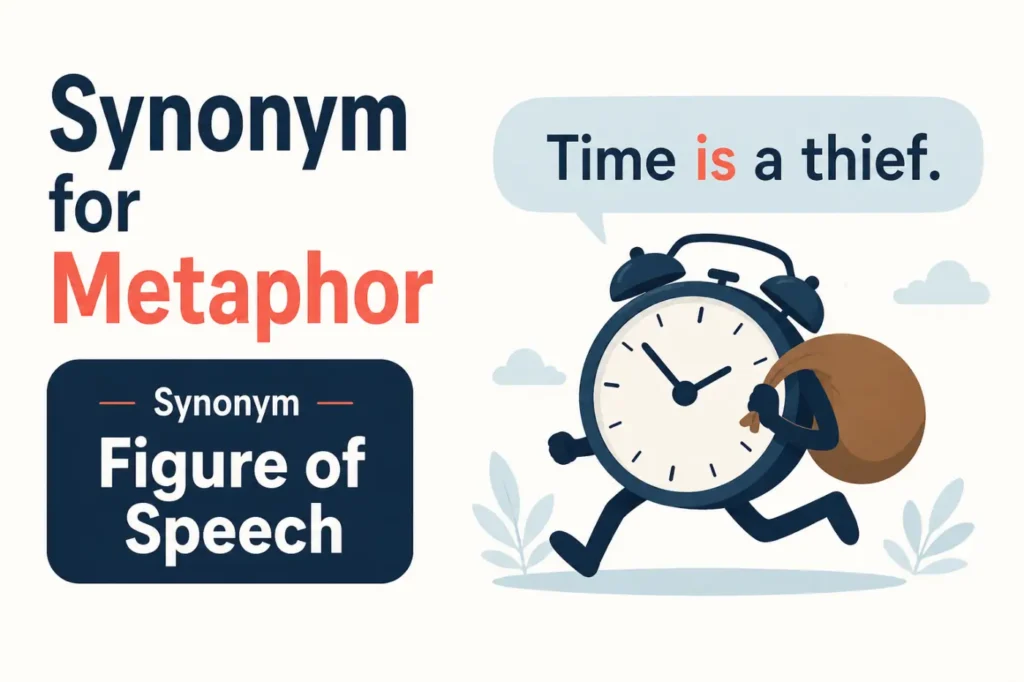
| Time is a thief. | Time quietly takes things from us. |
| He has a heart of stone. | He is cold and shows no feeling. |
| Words are weapons. | Words can hurt people. |
| The test was a walk in the park. | The test was easy. |
| My mind is a browser with too many tabs open. | My thoughts are crowded and hard to focus. |
| The company is a sinking ship. | The company is failing and people are leaving. |
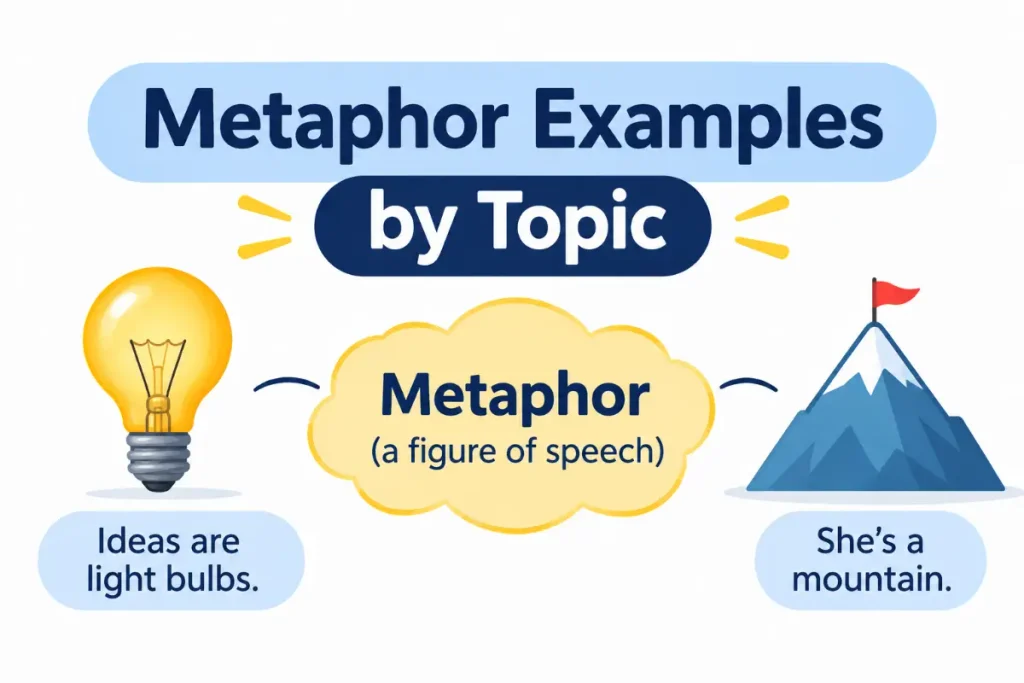
Metaphor Examples by Topic
Pick a topic below. Each section gives three examples with their meanings, then points you to a longer guide.
Big Life Themes
Life
Life is the classic subject for figurative language, and metaphors for life usually picture it as a road, a story or a ride.
- Life is a journey. There are turns, detours and a destination you keep adjusting.
- Life is a roller coaster. It has thrilling highs, scary drops and no way to get off mid-ride.
- Life is a book, and each day is a blank page. You write it as you go.
Death
Writers often turn to metaphors for death to soften a painful subject or to give it weight and meaning.
- Death is the final curtain. Life is a performance that comes to an end.
- She slipped into a long sleep. A gentle, peaceful way to describe dying.
- He crossed the river. Death as a journey to somewhere else.
Time
Time metaphors usually show time as something that moves, steals or flows.
- Time is a river. It carries us forward and never flows backward.
- Time is a thief. It takes moments and years without making a sound.
- The clock was a patient judge. Time quietly measures what we do with it.
Change
If you are writing about transitions, metaphors for change can capture both the gentle and the dramatic sides.
- Change is a doorway. It opens to something new, if you are willing to step through.
- Change is a storm that clears the air. It is uncomfortable but leaves things fresh.
- We are all rivers, always reshaping the land we pass. People keep evolving.
Memory
Memory metaphors often treat the mind as a storeroom, a photo album or a film that keeps playing.
- Memory is an attic full of boxes. Old moments are stored away, and some are dusty.
- Her memories were a photo album fading in the sun. Details blur as time passes.
- Remembering is editing a movie. Each replay changes the story a little.
Freedom
Open skies, wide roads and unlocked doors fill metaphors for freedom.
- Freedom is a bird with open wings. The ability to go wherever you wish.
- Freedom is an open road. There are no barriers, only choices.
- Education is the key to the cage. Knowledge unlocks a bigger life.
War
Writers use metaphors for war to show conflict as a storm, a monster or a wound.
- War is a storm that swallows everything. It destroys homes, lives and peace.
- War is a monster that feeds on youth. It consumes the young.
- War is a wound that takes generations to heal. Its effects last long after the fighting ends.
Relationships and Home
Love
Love metaphors often use warmth, growth and strength.
- Love is a garden. It needs care and attention to grow.
- He is my anchor. He keeps me steady in rough times.
- Their love was a slow-burning fire. Passion that builds and lasts.
Family
Family is often pictured through roots, shelter and belonging, as you will see in our list of family metaphors.
- Family is the roots of a tree. It holds you up and feeds you.
- Our home is a safe harbor. A place to rest after rough seas.
- My parents are my compass. They help me find my direction.
Friendship
Metaphors for friendship focus on support, trust and time.
- A good friend is a safety net. They catch you when you fall.
- Friendship is a bridge. It connects two people across their differences.
- Our friendship is a well-worn path. Familiar, comfortable and shaped by years of use.
Home
Home metaphors describe comfort, safety and belonging.
- Home is a warm fire at the end of a long road. A place of comfort after effort.
- Home is a lighthouse. It guides you back no matter how far you travel.
- Our kitchen was the heart of the house. The place where everyone gathered.
Loneliness
Metaphors for loneliness rely on empty spaces, silence and distance.
- Loneliness is an empty room with the lights off. Quiet, dark and without company.
- He was an island in a crowded sea. Surrounded by people but still isolated.
- Her phone was a silent bell. She waited for a message that never came.
Emotions
Happiness
Happiness metaphors lean on light, warmth and lightness.
- Happiness is sunshine on your face. It is warm and simple, and it lifts your mood.
- He was walking on air. He felt so happy that nothing weighed him down.
- Joy bubbled up inside her. A happy feeling that rose and could not be held back.
Sadness
Heavy coats, gray weather and dark rooms show up again and again in metaphors for sadness.
- Sadness is a heavy coat. It is hard to carry and hard to take off.
- A gray cloud followed her all day. A low mood that would not lift.
- His heart was an empty room. A sense of loss and quiet.
Grief
Grief metaphors deal with absence, waves and weight, because grief is the response to a specific loss.
- Grief is an ocean. The waves come and go, and some days they knock you down.
- Her loss was a house with a missing room. Daily life carries an empty space.
- He carried a backpack of stones. The weight of loss follows him everywhere.
Anger
Metaphors for anger usually use heat, pressure and explosions.
- Anger is a wildfire. It spreads quickly and burns whatever is in its path.
- He was a volcano ready to erupt. Long-held anger about to burst out.
- Her temper is a short fuse. She loses control very quickly.
Fear
Fear metaphors lean on darkness, cold and the feeling of being trapped.
- Fear is a cold hand on your shoulder. A sudden, chilling sense that something is wrong.
- The dark was a hungry mouth. It felt like the night could swallow you.
- He was a deer in the headlights. Frozen and unable to act.
Anxiety
Metaphors for anxiety describe racing thoughts, pressure and a mind that will not settle.
- Anxiety is a storm in the head. Thoughts crash around and are hard to calm.
- Her thoughts were a tangled knot. The more she pulled, the tighter it got.
- His mind was a browser with too many tabs open. Too many worries at once, and none finished.
Hope
Hope metaphors tend to use small lights, seeds and open doors.
- Hope is a lighthouse in the fog. It shows a way forward when you cannot see clearly.
- Hope is a seed under the snow. It waits quietly and will grow when the time is right.
- Hope is a small flame that refuses to go out. It stays alive even in dark times.
School, Work and Money
School
School metaphors show up in essays, speeches and student writing.
- School is a marathon, not a sprint. Success comes from steady effort over time.
- The cafeteria was a battlefield. Lunchtime was chaotic and competitive.
- A good teacher is a lighthouse. They guide students through confusing waters.
Work
Metaphors for work turn jobs and offices into machines, ladders and beehives.
- The office was a beehive. Everyone was busy, buzzing and working toward a shared goal.
- My job is a treadmill. I keep moving but never seem to get anywhere.
- My to-do list is a hydra. Every task I finish, two more appear.
Success
Success metaphors use climbs, peaks and ladders.
- Success is a mountain peak. The view is worth the long, hard climb.
- Success is a ladder with no top rung. There is always another level to reach.
- Success is a staircase built one step at a time. Progress comes from small, steady moves.
Failure
Metaphors for failure can show setbacks as detours, lessons and cracks you can repair.
- Failure is a teacher in disguise. It shows you what to do better next time.
- Failure is a detour, not a dead end. The path changes, but the journey continues.
- Failure is a cracked mirror. It shows exactly what needs fixing.
Money
Money metaphors treat it as a river, a tool or a chain.
- Money is a river that flows through your hands. It moves quickly if you do not plan.
- Money is a double-edged sword. It can help you or hurt you, depending on how it is used.
- Debt is a chain around the ankle. It slows every step you take.
Metaphor vs Simile: What Is the Difference?
Both figures of speech compare two things, but they do it in different ways.
| Metaphor | Simile | |
|---|---|---|
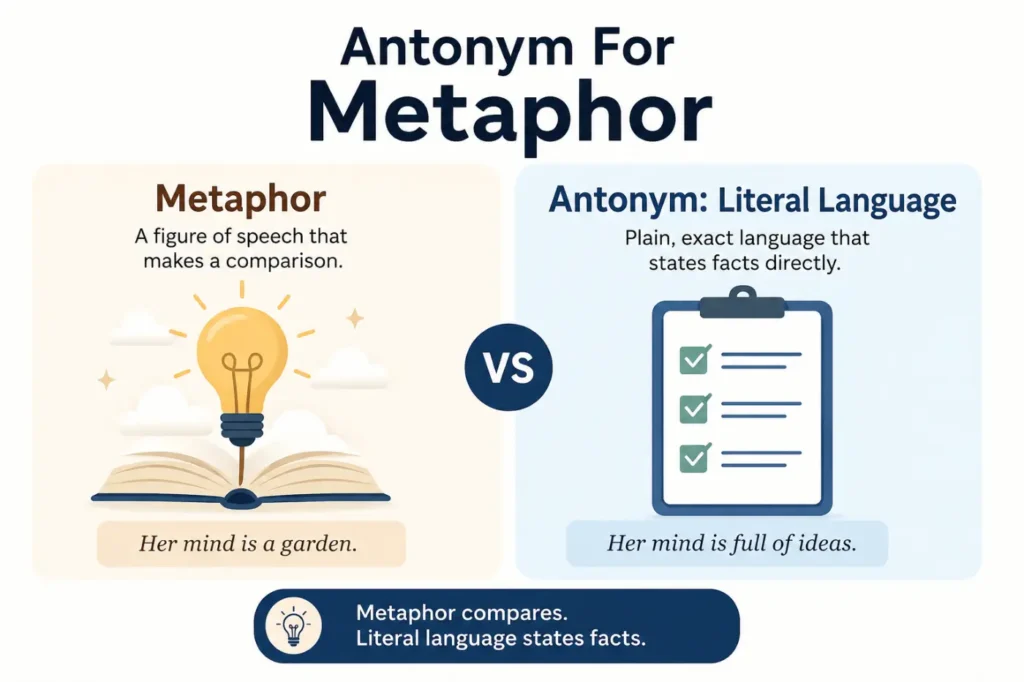
| How it compares | Says one thing is another | Says one thing is like or as another |
| Example | Her voice is honey. | Her voice is like honey. |
| Feel | Direct and strong | Softer and more explicit |
A quick test: if “like” or “as” makes the comparison, it is a simile. If it states the comparison outright, it is a metaphor. Many writers use both, with metaphors for the big, striking moments and similes for gentler description.
Common Types of Metaphors
- Standard metaphor: a direct comparison, such as “The world is a stage.”
- Implied metaphor: the comparison is suggested rather than stated. In “The senator hissed her reply,” she is compared to a snake without the word “snake” appearing.
- Extended metaphor: the comparison continues across several sentences or even a whole piece. A writer might describe a career as a mountain, then mention the climb, the thin air and the summit.
- Dead metaphor: a comparison used so often that we no longer notice it, like “the leg of a table” or “a river mouth.”
- Mixed metaphor: two comparisons that clash, such as “We’ll burn that bridge when we come to it.” Avoid these unless you are joking.
How to Write Your Own Metaphor
- Start with the feeling or idea. Decide what you want the reader to feel: fear, comfort, speed, weight.
- Choose something concrete. Pick an object, place or action people can picture, like a storm, a cage or a lighthouse.
- Connect the two. Use “is” or a strong verb. Try “Fear is a cold hand on my shoulder.”
- Check that it fits. The two things should share a real quality. If a reader has to work to see the link, simplify.
- Make it fresh. If you have heard it a hundred times, try a more specific image. “His anger was hot” becomes “His anger was a pot lid rattling on a boil.”
- Keep it short. One clear comparison beats three tangled ones.
Common Mistakes to Avoid
- Clichés. “Life is a rollercoaster” is clear but heard everywhere. Add a twist or use it as a starting point.
- Mixed images. Do not combine two unrelated comparisons in one sentence.
- Overdoing it. Too many metaphors in one paragraph make writing feel crowded.
- Unclear meaning. If the reader cannot tell what quality you mean, add a short phrase that makes it clear.
- Not explaining it. In essays, say what the metaphor shows. Do not just state it and move on.
Frequently Asked Questions
What is a metaphor in simple words?
A metaphor is a way of describing something by saying it is something else, to show what it is like. “The room was an oven” means the room was extremely hot.
What are some metaphors from everyday life?
People use them constantly: “my phone is my lifeline,” “the test was a breeze,” “she’s a night owl,” and “he is the black sheep of the family.”
Is “time is money” a metaphor?
Yes. It compares time to money to show that time is valuable and should not be wasted. For more examples, see our guide to metaphors about time.
Can a metaphor use “like” or “as”?
No. A comparison that uses “like” or “as” is a simile.
What is the difference between a metaphor and an idiom?
An idiom is a fixed phrase whose meaning is not literal, like “hit the roof.” A metaphor is a fresh comparison that you can create yourself. Many idioms started as metaphors and became common sayings.
What is the difference between a metaphor and personification?
A metaphor compares two different things. Personification gives human traits to something that is not human, such as “the wind whispered.” They can overlap, but they are not the same.
How many types of metaphors are there?
There are five common types: standard, implied, extended, dead and mixed. Teachers usually focus on the first three.
Why are metaphors important in writing?
They make ideas easier to picture, add emotion, and help readers remember what they read.
Browse All Metaphor Topics
Looking for something specific? Jump straight to the guide you need:
- Big life themes: life, death, time, change, memory, freedom, war
- Relationships and home: love, family, friendship, home, loneliness
- Emotions: happiness, sadness, grief, anger, fear, anxiety, hope
- School, work and money: school, work, success, failure, money
Conclusion
Metaphors turn ideas into pictures. A feeling you cannot quite name becomes a storm, a seed or a house with a missing room, and suddenly the reader understands. That is why metaphors appear in everything from school essays and speeches to poems, songs and everyday conversation.
To get the most from this guide, start with the topic closest to what you are writing, borrow the images that fit, and then twist them into something of your own. A fresh, specific comparison will always beat a familiar one. And remember the basics: keep each metaphor clear, use one main image at a time, and explain what it shows when you write for school.
Bookmark this page and come back whenever you need inspiration. We keep adding new topic guides, so there will always be more metaphors to explore.